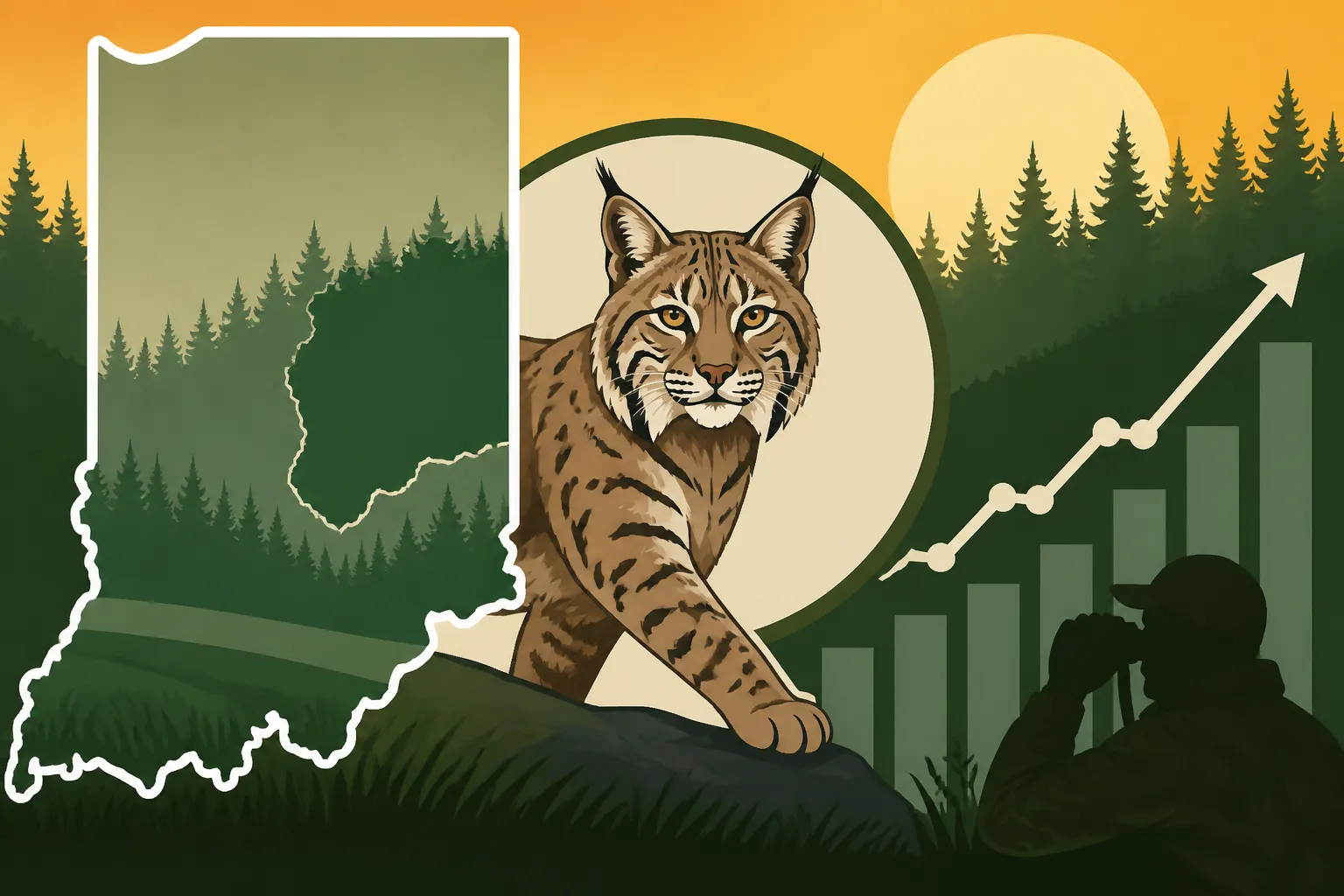
Indiana Bobcat Sighting Reports by Year
It can be incredibly frustrating to hear whispers and see blurry photos on social media about bobcats making a comeback in Indiana, yet feel like you never see solid information or understand just how many are out there. We’ve all been there, wondering if it's just a few isolated sightings or if these elusive felines are truly expanding their territory. This guide is here to shed some light on the impressive return of Indiana's bobcats, how sighting reports contribute to our understanding of their population, and what their increasing presence means for the Hoosier State's wildlife landscape.
Understanding Indiana's Bobcat Comeback
For many years, the bobcat was a creature of myth in Indiana, spoken about in hushed tones by older hunters who remembered a time when they might have seen one. Their story in our state is one of near disappearance and a truly remarkable return, a testament to conservation efforts and the adaptability of these beautiful animals. It’s no wonder people are seeing more of them now, as the population has undeniably bounced back from historical lows.
Historical Presence and Near Disappearance
If you grew up in Indiana anytime before the last few decades, the idea of seeing a bobcat probably felt like a wild dream. Historically, bobcats were a native species, roaming the diverse landscapes of Indiana long before European settlement. They were an integral part of our ecosystem, keeping small game populations in check. However, as human populations grew and agricultural land expanded, their natural habitats were fragmented and destroyed. Coupled with unregulated hunting and trapping pressures throughout the 19th and early 20th centuries, bobcat numbers plummeted. By the mid-20th century, many believed they were completely gone from the state, or at best, existed in only a few isolated, remote pockets. They were listed as an endangered species in Indiana, a stark reminder of how close we came to losing them entirely.
Factors Contributing to Their Return
The good news is, bobcats are tough, adaptable creatures, and their comeback is a true success story. One of the biggest factors has been the regrowth of forest habitat across Indiana, particularly in the southern hill country. As farms were abandoned in some less productive areas, timberlands reclaimed the landscape, providing the dense cover and abundant prey that bobcats need to thrive. Stricter wildlife management and protection laws, including their designation as an endangered species, played a crucial role by halting direct pressure on their dwindling numbers. Furthermore, their innate ability to travel and colonize new areas, sometimes covering significant distances, has allowed them to naturally expand their range from neighboring states where populations remained stronger. It's a slow process, but we've watched it unfold over the past several decades.
Challenges in Population Estimation
Even with their clear resurgence, getting a precise count of Indiana's bobcats isn't like counting deer in a field. These animals are incredibly secretive and elusive, master camouflage artists that prefer dense cover. They're also primarily nocturnal or crepuscular, meaning they're most active at dawn and dusk, which further limits direct observation. Because of this, wildlife biologists often rely on indirect methods to estimate their population, such as tracking surveys, genetic analysis of hair or scat, and the very sighting reports that you, the public, contribute. This makes every credible report, every trail camera photo, and every bit of evidence all the more valuable, helping the state piece together the puzzle of their distribution and abundance. It's a complex dance between hard science and citizen participation, all working towards a better understanding of this shy predator.
How Bobcat Sightings are Tracked in Indiana
If you've spent any time in the outdoors, you know how exciting it is to catch a glimpse of something truly wild and rare. For Indiana's bobcats, these sightings are more than just a cool story – they're vital data points that help wildlife professionals understand how this once-endangered species is recovering. While we don't track exact yearly numbers in a public-facing way, the methods of tracking and the trends they reveal are incredibly insightful.
Citizen Science and Incidental Reports
The vast majority of bobcat observations come from everyday folks just like you and me. These are often incidental reports: a fleeting glimpse while driving a backroad, an unexpected encounter while deer hunting, or even a track found in the snow. Hunters, hikers, trappers, and even folks just enjoying their backyard often provide the first clues that bobcats are present in a particular area. When you see something unusual, like a bobcat, reporting it to the Indiana Department of Natural Resources (DNR) is incredibly helpful. This kind of "citizen science" fills in gaps that formal surveys might miss, especially in remote or less-studied areas. Every time someone takes the time to accurately report what they saw, where they saw it, and when, it adds another layer to our understanding of the bobcat's expanding range. Think of it as hundreds, if not thousands, of extra eyes and ears out in the field, contributing to a collective knowledge base. It's truly a community effort to monitor our state's wildlife.
Trail Camera Contributions
If there's one piece of technology that has revolutionized bobcat monitoring, it's the trail camera. These silent sentinels, tucked away in the woods, capture candid moments of wildlife without human disturbance. Hunters, landowners, and wildlife enthusiasts set up trail cameras for deer, turkeys, or even just general wildlife observation, and increasingly, they're capturing crystal-clear images of bobcats. These photos provide undeniable proof of presence, often with timestamps and locations, offering invaluable data points. A series of photos from one location can even indicate a resident bobcat, rather than just a transient one. This is where tools like GoHunt come into play for mapping your camera locations, tracking your observations over time, and getting a better sense of habitat usage. It's fantastic for seeing what's really moving through your woods when you're not there. The sheer volume of bobcat images popping up on trail cameras today, compared to a decade or two ago, is one of the clearest indicators of their successful comeback.
Official Surveys and Data Collection
While citizen reports and trail cameras provide invaluable raw data, the Indiana DNR also conducts more formal, scientific surveys to monitor bobcat populations. These surveys can include things like track surveys conducted in suitable habitat, especially after a fresh snowfall, or the deployment of specialized remote cameras designed specifically to capture images of bobcats. Sometimes, hair snares are used to collect genetic material for DNA analysis, which can help determine individual bobcats, estimate population density, and understand genetic diversity. When a bobcat is unfortunately struck by a vehicle, these roadkill incidents also provide crucial samples for study. All of this information, from the casual sighting to the scientific data, is meticulously collected and analyzed. This ongoing data collection helps the DNR identify key bobcat habitats, track changes in their distribution, and inform management decisions. It’s a holistic approach that truly leverages every available piece of information to paint the most accurate picture possible of these elusive felines.
Interpreting the Increase in Reports
It’s exciting to hear that bobcat sightings are on the rise across Indiana. For anyone who cherishes our state’s natural heritage, this resurgence is a cause for celebration. But what does this uptick in reports really signify? Is it just more people seeing the same number of animals, or is it a true indicator of a thriving, expanding population? Understanding the nuances of these reports helps us appreciate the bobcat's ecological role and the success of conservation efforts.
More Bobcats or More Eyes?
When people hear about an increase in bobcat sightings, one of the first questions that often comes to mind is, "Are there actually more bobcats, or are we just better at finding them?" The truth is, it's likely a combination of both. There is strong evidence, supported by various scientific methods and anecdotal reports, that the bobcat population has indeed grown and expanded its range significantly since its near extirpation. However, it's also true that we have more "eyes" in the woods than ever before. The proliferation of trail cameras, better access to public lands for recreation, and simply a greater general interest in wildlife among the public all contribute to more opportunities for people to encounter and document these animals. Also, mapping tools like onX Layers for Indiana Land Status have made it easier for individuals to explore and identify prime habitats, indirectly increasing the chance of sightings. Even if the rate of individual bobcats being seen might be slightly inflated by more observers, the sheer volume and spread of these reports strongly suggest a robust and healthy population increase.
Implications for Other Wildlife
A healthy bobcat population is generally a good sign for the overall ecosystem. As apex predators (or near-apex, depending on the region), bobcats play a vital role in maintaining the balance of nature. Their primary diet consists of small game like rabbits and squirrels, but they will also prey on mice, voles, and even fawns. This predation helps to keep prey populations in check, preventing overgrazing or disease outbreaks that can occur when certain species become too numerous. For instance, a growing bobcat presence could potentially help manage burgeoning rabbit populations that might otherwise impact agricultural crops or forest regeneration. However, it's a delicate balance. A thriving bobcat population also means there's a strong prey base to support them, indicating a healthy habitat. Their presence is a good indicator of a robust and diverse ecosystem. You can learn more about how different species interact in Indiana Coyote Range and Density.
Conservation Success Story
Above all, the increasing bobcat sighting reports stand as a powerful testament to the success of wildlife conservation efforts in Indiana. From being listed as endangered to having a visibly growing and expanding population, the bobcat's journey is a story of hope and effective management. It demonstrates that with dedicated conservation programs, habitat restoration, and thoughtful regulation, species on the brink can indeed recover. This success is not just about the bobcat itself, but about the broader health of Indiana's natural landscapes. It means that the forests and wild spaces we cherish are becoming more vibrant and complete, supporting the full array of native species that belong there. This comeback is a collective victory for everyone who cares about wildlife and a future where our children can potentially spot one of these magnificent cats in the wild.
Where Bobcats are Most Frequently Reported in Indiana
If you're hoping to catch a glimpse of an Indiana bobcat, or perhaps capture one on your trail camera, understanding their preferred habitats and where they're most often reported is key. While their range is expanding, certain areas of the state remain hotspots for these elusive felines. It makes sense when you think about the kind of cover and prey they need to thrive.
Southern Indiana's Forested Hills
Without a doubt, the rugged, forested hills of southern Indiana remain the stronghold for bobcats. Areas like the Hoosier National Forest, Yellowwood State Forest, and Morgan-Monroe State Forest, along with vast tracts of private timberland, offer the dense, unbroken cover that bobcats crave. This region provides a complex mosaic of mature hardwoods, regenerating clear-cuts, and steep ravines, all of which offer excellent hunting grounds for small game and perfect hiding spots for these shy predators. The lower human population density in many of these counties also means less disturbance for bobcats. If you're scouting for deer in places like Brown County or Perry County, you're in prime bobcat country. You'll often find them utilizing thick brush along creek bottoms or navigating steep, timbered ridges. When you're using a mapping tool like GoHunt, focusing on areas with extensive forest cover and topographical relief in southern Indiana will greatly increase your chances of identifying potential bobcat habitat.
River Bottoms and Mixed Habitats
Beyond the deep woods, bobcats also show a strong preference for river bottoms and areas with mixed habitats. The Wabash River, White River, and various smaller river systems provide crucial corridors of dense vegetation, often bordered by agricultural fields. These areas offer a rich diversity of prey species, from waterfowl and small mammals in the riparian zones to rabbits and rodents in adjacent fields. The thick undergrowth, fallen trees, and rocky outcrops found in these bottomlands provide excellent den sites and ambush cover. Even in more agricultural northern Indiana, significant river corridors and associated wetlands can act as natural highways and refuges for bobcats. Look for areas where timber meets water, especially if there are thickets, brambles, or rock piles nearby – these are classic bobcat haunts. When you're Reading Aerial Photos for Southern Indiana Deer, keep an eye out for these transitional zones; they're often where the wildlife action is for many species, including bobcats.
Expanding Range Across the State
While southern Indiana remains their historical heartland, a truly exciting aspect of the bobcat's comeback is their expanding range. In recent decades, reports have become increasingly common in central Indiana, and even in parts of northern Indiana that were once considered far outside their typical distribution. This expansion speaks volumes about their adaptability and the overall health of our state's wild spaces. They're showing up in smaller woodlots, along fencerows, and even occasionally near suburban fringes, often utilizing creek systems and green corridors to move through developed landscapes. While these northern and central sightings might still be less frequent than in the south, their increasing presence indicates a healthy, growing population that is successfully colonizing new territories. This widespread return is a powerful indicator that Indiana's ecosystems are healing and becoming more robust. It truly shows that conservation efforts are paying off across the entire state, not just in isolated pockets.
Here's a quick look at the types of bobcat reports and what they tell us:
| Report Type | How It's Collected | Significance |
|---|---|---|
| Incidental Sightings | Personal observation (driving, hiking, hunting) | Confirms presence, indicates general distribution |
| Trail Camera Photos | Automated cameras in the woods | Provides photographic proof, location, time, and sometimes behavior |
| Roadkill | Bobcats struck by vehicles | Confirms presence, provides biological samples for study |
| Track Surveys | Professional tracking in suitable habitat | Indicates presence, movement patterns, habitat use |
| Genetic Samples | Hair snares, scat analysis | Estimates population density, genetic diversity, individual identification |
It's clear that the bobcat is no longer just a ghost in Indiana's wild places. Their increasing reports are a vibrant sign of a recovering ecosystem and a testament to the resilience of nature when given a chance.
Disclaimer
This article is for general informational purposes only and does not constitute professional advice. Laws, prices and regulations vary by location and change over time. Consult a qualified professional for guidance on your specific situation.