Grunt Calls in Mature Indiana Timber
Hunting mature Indiana timber can be a real challenge; the dense cover makes visibility tough, and deer seem to vanish into thin air. It’s frustrating when you know big bucks are using these areas, but they just aren't showing themselves. This guide is all about mastering the art of the grunt call specifically within these thick, mature woods, helping you entice those elusive whitetails into range.
Understanding Mature Indiana Timber Environments
Mature timber in Indiana isn't just a collection of big trees; it's a dynamic ecosystem with specific characteristics that influence deer behavior and, by extension, your calling strategy. Knowing what makes these areas tick is the first step toward effective communication with a whitetail.
Characteristics of Mature Timber
When we talk about mature timber in Indiana, especially in regions like the Hoosier National Forest or the larger state forests, we're often looking at tracts of hardwoods—oaks, hickories, maples, and poplars that have been standing for decades, if not longer. These areas present a unique set of challenges and opportunities. The canopy is usually dense, which can limit sunlight reaching the forest floor, impacting undergrowth. However, some mature timber will have pockets of thick briars, multiflora rose, or younger growth that has managed to thrive, creating bedding areas and browse.
Visibility is almost always limited. You might only be able to see 30 to 50 yards, sometimes even less, depending on the topography and specific understory. This means that deer can approach your position quickly and silently, often appearing out of nowhere. The sound dynamics are also different; in open fields, sound travels far, but in dense timber, it can be muffled, distorted, or swallowed entirely by the trees and terrain. Understanding how these factors play into a deer's senses is paramount. Additionally, the ground itself can be noisy, covered in leaf litter, twigs, and acorns, making quiet movement a skill in itself.
How Deer Use Mature Timber
Deer utilize mature timber for a variety of critical life functions, making these areas prime targets for hunters who understand their patterns. Bedding is a primary use. Bucks, especially mature ones, often seek out dense cover within the timber for bedding, particularly on thermal ridges or in thickets where they can detect approaching threats from multiple directions. These bedding areas are often nestled within sections of downed timber, regenerating clear-cuts, or natural thickets that provide concealment.
Mature timber also serves as vital travel corridors. Deer often follow the paths of least resistance, using subtle elevation changes, old logging roads, or natural funnels created by terrain features to move between feeding areas, bedding sites, and watering holes. A ridge-top saddle, for example, might be a highway for deer moving through extensive timber. If you're looking for where bucks bed, understanding these subtle topographical shifts and how they relate to the prevailing wind can be incredibly insightful. Many hunters use mapping software like GoHunt to pinpoint these features before ever stepping foot in the woods.
Food sources are another significant draw. Oak trees, in particular, provide a crucial food source in the form of acorns, especially during the fall. Deer will often congregate in areas with heavy mast production, turning a quiet piece of timber into a bustling cafeteria. Even in years Hunting After a Poor Acorn Year where mast crops might be poor, deer will still traverse mature timber looking for alternative browse, woody stems, or any available forage. This intimate knowledge of deer movement and habitat use within mature timber directly informs how and when you should deploy your grunt call.
The Role of Grunt Calls in Mature Timber
A grunt call is more than just a noisemaker; it’s a tool for communication, a way to speak the language of whitetails. But like any language, knowing when and how to use it is critical, especially in the unique acoustics of mature Indiana timber.
Why Grunt Calls Work (and Don't)
Grunt calls are designed to mimic the vocalizations of a whitetail buck, typically a tending grunt, a challenge grunt, or a social grunt. They work on several fundamental deer instincts. During the rut, a challenge grunt can tap into a buck's aggression, making him curious or even outright hostile towards a perceived rival in his territory. A tending grunt, on the other hand, can simulate a buck tending a doe, drawing in other bucks hoping to steal a breeding opportunity. Even outside the peak rut, a soft social grunt can pique a buck's curiosity, making him stop, turn, and investigate the source of the sound.
However, grunt calls aren't a magic bullet, especially in mature timber. One of the biggest limitations is sound travel. Dense foliage, hills, and hollows can dramatically absorb or redirect sound, meaning your grunts might not carry as far or as clearly as you intend. A buck might be close enough to hear you, but the sound could seem distant or indistinct, making him hesitant. Wind is also a major factor; calling directly into a strong wind is often a wasted effort as the sound dissipates quickly. Understanding Wind and Thermals on a Southern Indiana Ridge is crucial here.
Deer intelligence and pressure also play a role. Older, wiser bucks, especially those on public land that have heard countless calls, can become call-shy. They might hang up out of range, circle downwind, or simply ignore what they perceive as unnatural sounds. The effectiveness of a grunt call relies heavily on reading the deer's mood and the specific environmental conditions, not just blindly blowing into it.
Deciphering Deer Responses
When you make a grunt call, the silence that often follows can be nerve-wracking. But it's important to remember that deer communicate subtly. The response isn't always a buck crashing in. Often, it's a nuanced reaction that you need to be prepared to interpret.
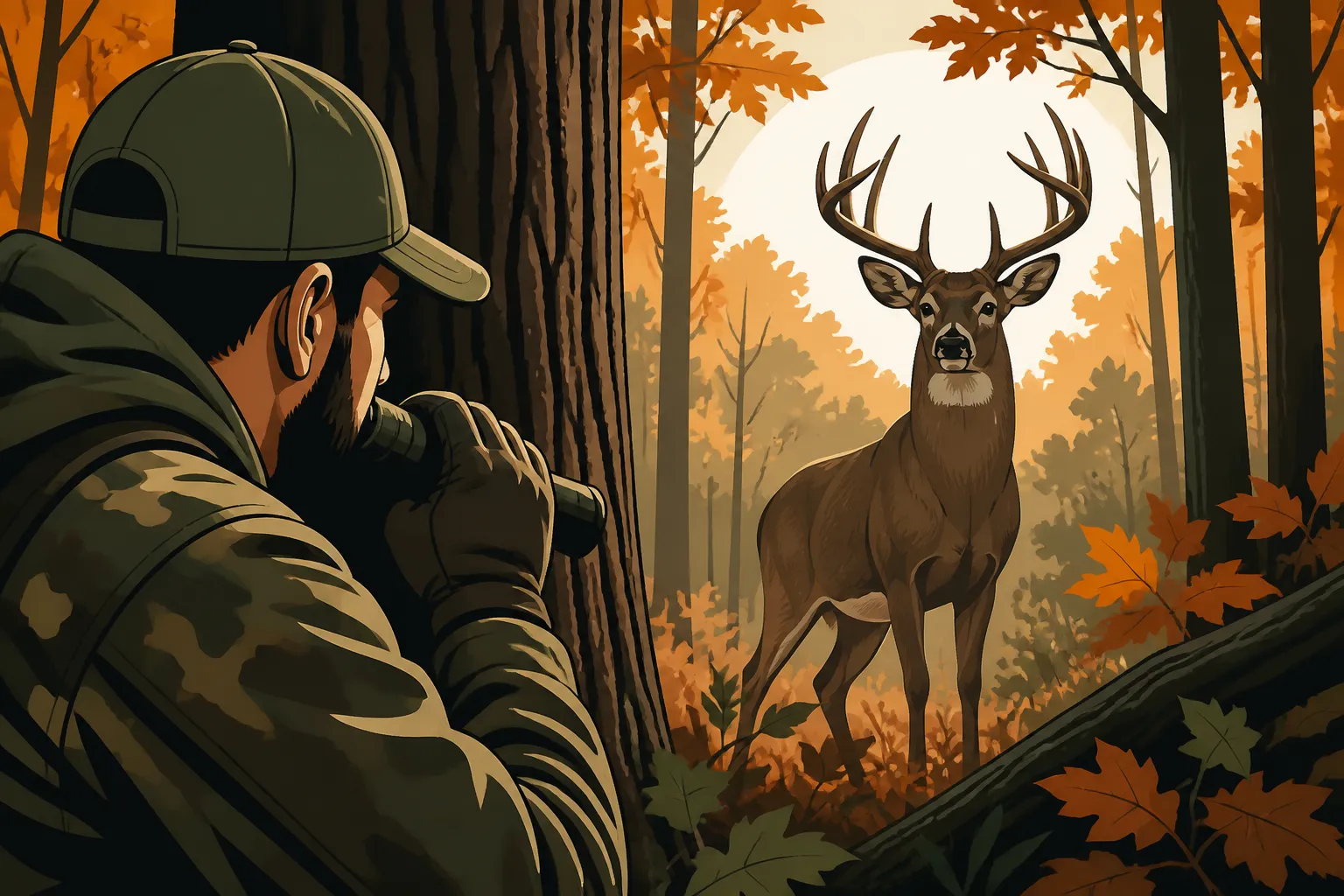
One common response, especially in thick timber, is a cautious approach. A buck might hear your call and slowly start to move in your direction, pausing frequently, scent checking the wind, and trying to pinpoint the source. You might catch glimpses of movement, a flick of an ear, or a flash of antler. This is where patience is key; resist the urge to call again too quickly. If he's approaching, let him come.
Sometimes, a buck will circle downwind. This is particularly common with mature, wary bucks. They want to get their nose into the wind to scent-check whatever is making the noise before committing to a direct approach. If you anticipate this, you can set up your stand or blind in a way that forces him to pass within shooting range before he gets directly downwind of you. This is where knowing how to scout using detailed topographical maps, perhaps from a platform like GoHunt, can make all the difference, helping you predict potential approach vectors.
Other times, a buck might vocalize back, letting out a grunt or a snort-wheeze in response. This is a clear indicator that he heard you and is either challenging you or curious. This is often the time to respond with another call, perhaps slightly softer, to keep the conversation going. And, of course, there's always the chance he'll simply ignore you. This could be because he didn't hear you, isn't in the mood, or is already tending a hot doe. Don't take it personally; just adjust your strategy or location. The key is to be observant, listening not just for grunts but for subtle footsteps, rustling leaves, or breaking twigs that indicate a deer's presence.
Effective Grunt Call Tactics for Indiana Timber
Using a grunt call in mature Indiana timber isn't just about making noise; it's about strategic communication. The goal is to draw a deer into a killable range, and that requires finesse, timing, and an understanding of the deer's mindset.
Call Sequence and Volume
The way you use your grunt call's volume and sequence can significantly impact your success in the dense timber. In areas with limited visibility, a common mistake is calling too loudly, hoping the sound will penetrate the thick cover. However, a loud, aggressive call in close quarters can often spook a deer that's already nearby, making them feel pressured or indicating an unnatural intensity.
Generally, starting with softer, more social grunts is a good strategy. Think of it as a casual conversation. A few soft grunts, followed by a minute or two of silence, allows any nearby deer to hear without being alarmed. If you don't get a response after 5-10 minutes, you can gradually increase the volume, moving to a series of short, medium-volume grunts, mimicking a buck casually moving through the woods.
When you do hear or see a deer, especially if it's acting curious but hesitant, you might introduce a challenge grunt or a tending grunt. A short, sharp challenge grunt can sometimes be just the push a hesitant buck needs to investigate. If you're targeting the rut, knowing Rattling and Grunting in Indiana can give you an edge, combining the visual of a fight with the sounds. However, always remember the density of the timber. You rarely need to blow a call with maximum force. Let the natural acoustics of the woods work with you, not against you. A good rule of thumb is to imagine how loud a real deer would be at the distance you expect your target buck to be.
Integrating Grunts with Other Strategies
A grunt call is most effective when it's part of a larger hunting strategy, not a standalone tactic. The dense cover of Indiana's mature timber often necessitates a multi-faceted approach.
First and foremost, scouting is indispensable. Before you even step foot in the woods, a thorough scouting session, perhaps aided by the detailed maps available on GoHunt, is invaluable. Identify natural funnels, pinch points, old logging roads, and ridge-top saddles where deer are likely to travel. These are prime locations for setting up, whether you're using a ground blind or a portable treestand. Knowing Treestand Setups in Hoosier National Forest or understanding how to read a ridge for deer can drastically improve your odds of success.
Wind direction is paramount. Deer will almost always try to approach downwind to scent-check you. Position yourself so that the wind carries your scent away from where you expect the deer to approach. This might mean setting up on the leeward side of a ridge or identifying areas where thermals consistently pull your scent upward in the mornings or downward in the evenings.
Consider combining your grunts with other vocalizations or even visual aids. During the peak of Hunting the Rut in Early November, subtle rattling sequences can be incredibly effective when paired with grunts, simulating a complete buck encounter. Even without a decoy, the combination of sound can be enough to draw a curious buck in, especially if you're set up in a thick area where he can't immediately pinpoint the source of the sound. Remember, the goal is to create a believable scenario that draws the deer out of its natural caution and into your shooting lane.
Situational Calling
The best grunt call sequence often depends on the specific time of year and the deer's current behavior. What works in early archery season might fall flat during the peak rut or the late season.
During the pre-rut (late September through October), bucks are beginning to feel the urge to breed but are not yet aggressively fighting. Soft, social grunts or tending grunts can pique their curiosity as they start to search for the first receptive does. This is a great time to be subtle and patient. Bucks might respond cautiously, circling to investigate without much urgency.
The peak rut (typically early to mid-November in Indiana) is when grunt calls truly shine. Challenge grunts, aggressive tending grunts, and even snort-wheezes can be highly effective. Bucks are less cautious, driven by hormones, and more willing to investigate or confront perceived rivals. This is when you can be a bit more assertive with your calling. If you see a buck cruising or hear one chasing a doe, a tending grunt can often pull him off the trail, believing another buck is about to steal his opportunity. During this frenetic time, knowing how to interpret Hunting the Rut in Early November behavior is key.
In the post-rut (late November into December), bucks are often worn out and focused on recovering body condition. Aggressive calling might be less effective. However, soft social grunts can still draw in curious bucks or those looking for the last remaining does. At this point, finding late-season food sources like persistent acorns or browse becomes more important than purely relying on vocalizations.
Finally, reacting to actual deer sightings requires quick thinking. If you see a buck out of range, or one that’s about to walk out of your shooting lane, a quick, sharp grunt can often stop him, giving you a chance for a shot. If he seems hesitant or is walking away, a single, softer grunt might just turn his head and make him pause, buying you precious seconds. It's about being responsive to the moment, not just adhering to a rigid calling script.
Common Mistakes and How to Avoid Them
Even with the best intentions, it's easy to make mistakes when using grunt calls in mature Indiana timber. Avoiding these pitfalls can significantly increase your chances of success.
Overcalling and Undercalling
One of the most frequent mistakes hunters make with grunt calls is either calling too much or not enough. There's a delicate balance to strike, and finding it often comes down to experience and reading the deer's behavior.
Overcalling is perhaps the more common sin. Many hunters, especially those new to calling, think that more noise equals more deer. However, in mature timber, constant or overly aggressive calling can make a buck suspicious. It's unnatural for a buck to grunt incessantly without a clear reason, like a hot doe or an ongoing fight. An overcalled scenario can sound fake or alarming, causing wary bucks to hang up or circle far downwind. Imagine sitting in a dense thicket and hearing constant grunts nearby without seeing anything. You'd be on high alert, right? Deer are no different. The key is patience. Call a few times, then wait. Give the deer 5-10 minutes to respond. If nothing happens, wait another 5, then call again, perhaps varying the intensity. Sometimes, silence is your most powerful tool, allowing the deer to process the sound and decide to investigate without feeling rushed or threatened.
On the flip side, undercalling can also be an issue. You might be too subtle, or not persistent enough, to get the attention of a buck that's just out of earshot or preoccupied. If you only grunt once every 20 minutes with a very soft call, a buck might never hear you, or might dismiss it as background noise. Especially in the noise-dampening environment of thick timber, you need to ensure your call carries effectively. This doesn't mean blowing the call as hard as you can, but rather using a sequence that offers enough presence to be heard without being alarming. If you've called softly for a while with no response, gradually increasing the volume or the number of grunts in a series can be beneficial. It's about slowly escalating the conversation until you get a reaction, then backing off and letting the deer make its move.
Ignoring Environmental Factors
The environment of mature Indiana timber plays an enormous role in how your grunt calls are perceived by deer. Failing to account for these factors can render your calling efforts useless.
Wind and thermals are arguably the most critical environmental elements. As discussed, deer rely heavily on their sense of smell. A buck approaching a grunt call will almost always try to circle downwind to scent-check the source. If your setup doesn't account for this, he'll smell you before you ever see him. Always try to position yourself so that the prevailing wind or thermal current carries your scent away from where you expect deer to approach. This might mean getting into a stand well before daylight to let thermals stabilize, or repositioning mid-day as the wind shifts. Understanding how Wind and Thermals on a Southern Indiana Ridge behave is not just helpful, it's essential for success.
Topography significantly affects sound propagation. In rolling hills and deep hollows common in southern Indiana, sound can be absorbed or deflected by ridges and valleys. A grunt call made on one side of a ridge might not be heard on the other side, or it might sound like it's coming from a completely different direction. Before calling, take a moment to consider the terrain. Where would sound naturally carry? Are there natural funnels or saddles that would channel sound? Using a tool like GoHunt or other mapping apps can help you visualize these topographical features and plan your calling strategy accordingly. This can also inform your scouting strategy, helping you to identify potential travel routes and ambush points that maximize your calling effectiveness.
Ambient noise is another factor. The rustling of leaves, the distant sound of traffic, or even the subtle crunch of your own footsteps can mask your calls. In noisy conditions, you might need to call slightly louder or more frequently to cut through the background. Conversely, on a still, quiet morning, even the softest grunt can carry a surprisingly long distance. Pay attention to the conditions on the ground. A good hunter is constantly observing and adapting to their surroundings, using their knowledge of the environment to make every grunt call count.
Conclusion
Mastering the grunt call in mature Indiana timber is truly an art, one that blends careful observation with strategic execution. It's about understanding the nuances of the environment, respecting the intelligence of the whitetail, and knowing when to speak their language, and more importantly, when to remain silent. It takes practice, patience, and a willingness to adapt, but when that mature buck steps out of the shadows, drawn in by your carefully crafted vocalizations, every moment of preparation will be worth it.
Disclaimer
Hunting is an activity that carries inherent risks. This guide provides information for educational purposes only. Always prioritize safety, understand and adhere to all local, state, and federal hunting regulations, and consider taking a certified hunter education course. The author and publisher are not responsible for any incidents or accidents that may occur.