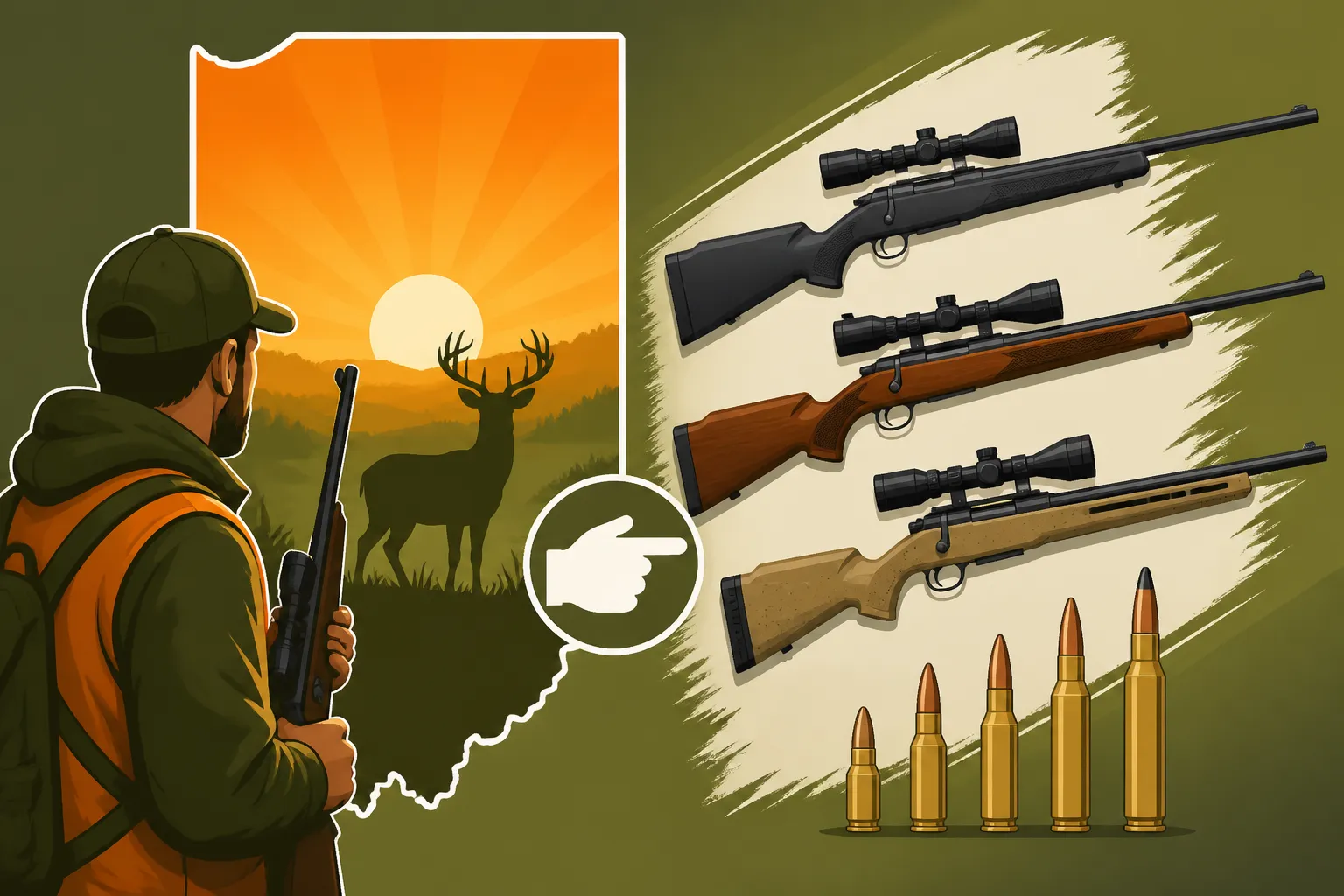
Choosing a Rifle Now That Cartridge Limits Are Gone
For years, Indiana deer hunters faced unique restrictions, navigating a landscape where only straight-wall cartridges were permitted for rifle hunting. This often meant sacrificing ballistic performance and range compared to hunters in other states, leading to understandable frustration and a narrower selection of firearms. But those days are behind us, and now a whole new world of rifle choices has opened up, which can be exciting but also a little overwhelming. This guide is here to cut through the confusion and help you select the ideal centerfire rifle for your Indiana deer hunting pursuits, covering everything from the updated regulations to finding the perfect caliber, action, and optics for any Hoosier terrain.
The Monumental Shift in Indiana's Rifle Regulations
Let's be honest, for a long time, the rifle hunting regulations in Indiana felt a bit… antiquated. While our neighbors enjoyed the versatility of modern centerfire cartridges, Hoosier hunters were limited to straight-wall options. This historical context is important to understand just how significant the recent changes truly are.
The Era of Straight-Wall Limitations
Back in the day, the primary reasoning behind Indiana's straight-wall cartridge rule was often cited as public safety, especially given our relatively high population density and patchwork of private land. The idea was that straight-wall cartridges, which typically operate at lower pressures and velocities, would have a shorter maximum range and thus pose less risk in populated areas. While the intention was good, it often meant that hunters were limited in their choice of firearms and cartridges. Many popular and effective deer hunting calibers like the .30-06 Springfield, .270 Winchester, and .308 Winchester were simply off-limits. This led to a boom in purpose-built straight-wall cartridges like the .450 Bushmaster and .350 Legend, which performed admirably, but still weren't quite the same as a full-power, necked-down rifle round. It was a compromise, and while many hunters made the most of it, there was always a longing for more options.
Understanding Senate Bill 280 and Its Impact
The landscape dramatically shifted with the passing of Senate Bill 280. This landmark legislation fundamentally changed the rules, effectively removing the straight-wall cartridge requirement for deer hunting statewide. For many, it was a long-awaited victory, finally bringing Indiana's rifle regulations into the 21st century and aligning them more closely with other states. No longer are hunters forced to choose between a limited selection; instead, the vast majority of common centerfire rifle cartridges are now legal for deer. This means more versatility, often better ballistics, and the ability to use firearms that many already owned or desired. If you're curious about the specifics, our detailed article on What Senate Bill 280 Changed for Rifle Hunters covers all the nitty-gritty details. The core takeaway is simple: if you've been dreaming of hunting Indiana deer with your trusty .308 or a modern 6.5 Creedmoor, those dreams are now a reality.
What the New Rules Mean for Cartridge Selection
So, what exactly does this mean when you're standing in front of a rifle rack or browsing online, trying to pick out your next deer gun? Essentially, your options have exploded. You're no longer restricted by case design; instead, the focus shifts to bullet diameter and energy. Indiana now largely requires a bullet diameter of at least .243 inches (6mm) and a case length no greater than 3 inches. This opens the door to virtually all popular deer cartridges.
It's important to remember that while the state no longer dictates the cartridge shape, you should still choose a cartridge suitable for the game you're pursuing – in this case, white-tailed deer. The new freedom means you can prioritize factors like recoil, effective range, bullet drop, and ammunition availability over the former straight-wall constraint. This also means you can finally dig out that old family heirloom .30-06 or invest in one of the newer, highly efficient cartridges like the 6.5 PRC without concern. Remember, it's always wise to confirm the latest regulations directly with the Indiana DNR, perhaps by checking their resources available through platforms like GoHunt, but the core message is clear: the straight-wall barrier is gone.
Deciphering the Best Calibers for Indiana Whitetails
With the shackles of straight-wall limitations removed, hunters now have a smorgasbord of calibers to consider. This new freedom can be both exciting and a bit daunting, so let's break down some of the most popular and effective choices for Indiana whitetails.
Embracing Traditional Centerfire Rifle Calibers
The removal of the straight-wall rule has opened up a world of time-tested and incredibly effective calibers. These are the cartridges that have been filling freezers and trophy rooms for generations across North America, and now they're perfectly legal in Indiana. When considering these options, think about the typical shot distances you anticipate and your comfort level with recoil.
- The .308 Winchester: This is an absolute workhorse. It's incredibly popular, meaning ammunition is widely available and often more affordable. It delivers plenty of punch for Indiana deer, has a relatively moderate recoil, and is incredibly accurate in a variety of rifle platforms. Whether you're making a close-range shot in thick timber or need to reach out across a longer field edge in northern Indiana, the .308 is a solid, reliable choice. It's often debated, but many consider it one of the Best Rifle Calibers for Indiana Whitetails due to its versatility.
- The .270 Winchester: Another classic, the .270 is known for its flat trajectory and excellent terminal performance on deer. It's a fantastic choice for those longer shots that might present themselves when hunting a big field or a powerline cut. Recoil is manageable for most shooters, and it's a proven deer stopper.
- The 6.5 Creedmoor: This relative newcomer has taken the shooting world by storm, and for good reason. It offers a very flat trajectory, exceptionally low recoil, and excellent accuracy. For hunters who appreciate precision and don't want to deal with heavy recoil, the 6.5 Creedmoor is an outstanding option. It's definitely one of the Best New Rifle Calibers for Indiana's Statewide Rule, especially if you're looking for a modern, efficient cartridge.
- The .30-06 Springfield: The venerable .30-06 is arguably the most versatile hunting cartridge ever developed. While it might have a bit more recoil than the .308 or 6.5 Creedmoor, it offers more power and can handle heavier bullets, making it suitable for any deer in Indiana and even larger game if you ever venture out of state. It's a fantastic all-around choice.
When looking at these calibers, remember that bullet construction is just as important as the caliber itself. Modern bullet designs ensure reliable expansion and energy transfer, regardless of whether you're using a .308 or a 6.5 Creedmoor.
The Enduring Value of Straight-Wall Cartridges
Just because you can use necked-down cartridges now doesn't mean you have to ditch your straight-wall rifle. In fact, many straight-wall cartridges remain incredibly effective and might even be preferred by some hunters, especially in certain scenarios. Our article on Straight-Wall Cartridges Still Worth Considering dives deeper into why these remain viable options.
- The .450 Bushmaster: This cartridge earned its stripes during the straight-wall era and continues to be a powerful, effective choice for deer. It delivers a tremendous amount of energy at reasonable ranges, making it ideal for shots in dense woods or heavy cover where longer shots are unlikely. Its heavy bullet offers great knock-down power, and for those who appreciate a larger hole, it's still a top contender.
- The .350 Legend: Designed specifically for states with straight-wall rules, the .350 Legend offers very low recoil, good accuracy, and sufficient power for deer out to 200 yards or so. It's an excellent option for youth hunters, those sensitive to recoil, or anyone looking for a lighter-recoiling alternative that's still very effective.
- The .444 Marlin and .45-70 Government: These classic lever-action cartridges are synonymous with powerful, close-range hunting. While perhaps not as common as the .450 Bushmaster or .350 Legend, they offer significant terminal performance and are a joy to hunt with for those who appreciate traditional firearms and brush-busting power.
Many hunters already own rifles chambered in these calibers and see no reason to switch. They are proven performers and will continue to be excellent tools for taking down Indiana whitetails. The choice really comes down to personal preference and what you feel most comfortable and effective with in the field.
Matching Caliber to Terrain and Hunting Style
The best caliber isn't just about what's legal or popular; it's about what makes the most sense for your specific hunting conditions and style. Indiana offers a wide variety of terrain, from the sprawling, hilly hardwood forests of the south to the flat, agricultural fields and woodlots of the north.
| Caliber | Typical Max Range (Deer) | Recoil Level | Common Bullet Weight (gr) | Best for Terrain | Pros | Cons |
|---|---|---|---|---|---|---|
| 6.5 Creedmoor | 400+ yards | Low | 120-147 | Open fields, longer shots, mixed terrain | Low recoil, high accuracy, flat trajectory | Less kinetic energy than .30 cal at closer range |
| .270 Win. | 400+ yards | Moderate | 130-150 | Open fields, longer shots, mixed terrain | Flat shooting, proven effectiveness, good energy | Slightly more recoil than 6.5 Creedmoor |
| .308 Win. | 300-400 yards | Moderate | 150-180 | All-around, thick timber, medium-range fields | Versatile, abundant ammo, excellent terminal performance | More bullet drop than flatter-shooting calibers at extreme range |
| .30-06 Spr. | 400+ yards | Medium-High | 150-200 | All-around, heavier game potential, diverse conditions | Powerful, versatile, handles heavier bullets | More recoil than .308 or 6.5 Creedmoor |
| .350 Legend | 200-250 yards | Low | 150-180 | Thick woods, youth hunters, shorter range fields | Very low recoil, good close-range power, still legal straight-wall | Limited long-range performance |
| .450 Bushmaster | 200 yards | High | 250-300 | Thick timber, brush, close-quarters | Massive knockdown power, heavy bullet, still legal straight-wall | Heavy recoil, very limited long-range capability |
If you primarily hunt the dense, rolling hills of the Hoosier National Forest, where shots rarely exceed 100-150 yards, a .308 Winchester or even a .350 Legend would be perfectly adequate and, in some cases, might be easier to maneuver through the brush. Our guide on Hunting Southern Indiana Hill Country emphasizes the importance of understanding the terrain for effective shot placement. In contrast, if you spend most of your time on the edges of large corn or soybean fields in northern Indiana, where a 250-yard shot isn't uncommon, then a flatter-shooting caliber like a 6.5 Creedmoor or .270 Winchester could be a significant advantage. Our insights into Hunting Northern Indiana Farmland Deer highlight the need for precision over distance in these open areas.
Consider your personal shooting comfort as well. If you're recoil-sensitive, a 6.5 Creedmoor or .350 Legend will be much more enjoyable to shoot and practice with, leading to better accuracy in the field. Ultimately, the best caliber is the one you can shoot accurately and confidently under hunting conditions.
Exploring Rifle Actions and Features
Beyond the caliber, the type of rifle action and its various features play a crucial role in how a rifle handles, performs, and feels in the field. Indiana's new rules remove restrictions on cartridge type, but not on action type, so you're free to choose what suits you best.
The Precision of Bolt-Action Rifles
For many hunters, the bolt-action rifle is the epitome of hunting firearms, and for good reason. They are renowned for their accuracy, reliability, and simple, robust design.
A bolt-action rifle operates by manually cycling a bolt to load a cartridge, extract a spent casing, and chamber a new round. This simple mechanism allows for very tight manufacturing tolerances, which translates directly into exceptional accuracy. If you're looking for precision, especially for those longer shots across a field or down a valley, a quality bolt-action is hard to beat. Brands like Ruger, Remington, Winchester, and Savage all offer excellent bolt-action options that are well-suited for Indiana hunting.
One of the biggest advantages of a bolt-action is its inherent reliability. With fewer moving parts than semi-automatics, there's less to go wrong in harsh weather or dirty conditions. They're generally lighter than semi-autos, which is a big plus if you're treking deep into the Hoosier National Forest with a pack for a Packs for a Hoosier Forest Day Hunt. While slower to cycle than a semi-auto, for deer hunting, where often only one shot is presented or needed, this isn't usually a significant disadvantage. Many bolt-actions also come with detachable magazines, making loading and unloading a breeze in the stand.
Speed and Tradition: Lever and Semi-Automatic Options
While bolt-actions dominate the precision market, other actions offer their own unique advantages and appeal, especially now that all cartridge types are allowed.
- Semi-Automatic Rifles: If rapid follow-up shots or simply the familiar feel of a modern sporting rifle is what you're after, semi-automatics are now fully viable. Platforms like the AR-10, chambered in calibers like .308 Winchester or 6.5 Creedmoor, offer low recoil, high magazine capacity (though Indiana still has a 10-round possession limit in the field), and the ability to mount a wide array of accessories. They can be heavier than traditional bolt-actions, which is a consideration for long walks, but their modularity and ease of shooting appeal to many. They're becoming increasingly popular for everything from Deer Drives on Indiana Public Land to stand hunting.
- Lever-Action Rifles: For those who appreciate tradition and a classic aesthetic, lever-actions are making a resurgence, particularly with the new rules. While some traditional lever guns were already legal with straight-wall cartridges, now you can also find them chambered in modern, necked-down calibers. A .30-30 Winchester lever gun, for example, is a fantastic choice for timber hunting – quick to shoulder, fast to cycle for a follow-up, and iconic. They are often lighter and shorter than bolt-actions, making them nimble in thick brush and easy to carry. The new rules might even spark renewed interest in older lever-action cartridges like the .30-30.
The choice between these actions really boils down to personal preference, hunting style, and what you feel most proficient with. All are capable of ethically taking deer in Indiana, it's just a matter of finding the one that fits you best.
Ergonomics, Weight, and Durability Considerations
Once you've narrowed down your caliber and action type, consider the finer details that will impact your comfort and performance in the field.
- Stock Materials: You'll typically find rifle stocks made from wood, synthetic polymers, or laminates. Wood stocks are beautiful and traditional but can be susceptible to warping with changes in humidity and temperature, potentially affecting accuracy. Synthetic stocks are generally lighter, more durable, and impervious to weather, making them an excellent choice for hunting in Indiana's often unpredictable conditions. Laminate stocks offer a compromise, providing stability and durability with an attractive appearance.
- Weight: If you primarily hunt from a fixed stand or blind, rifle weight might not be a huge concern. However, if you plan on still-hunting, scouting deep into public land, or covering a lot of ground in areas like Brown County, then a lighter rifle (under 7 pounds without optics) will make a noticeable difference by the end of the day. A heavier rifle might soak up recoil better, but a lighter one is a joy to carry.
- Ergonomics: How the rifle feels in your hands is paramount. The length of pull (distance from the trigger to the end of the stock), grip angle, and comb height should all fit your body comfortably. If possible, shoulder several different rifles at a local gun shop to see what feels natural. A rifle that fits you well will be easier to shoot accurately and more comfortable to carry throughout the day.
- Durability and Finish: Indiana hunting can involve rain, snow, mud, and brush. A durable finish like Cerakote or stainless steel will protect your rifle from the elements far better than a standard blued steel finish. Similarly, a rugged stock that can withstand bumps and scrapes is a wise investment for any serious hunter. Don't forget that if you're venturing out with a firearm in the late season, proper Layering for an Indiana Deer Stand is just as important as the rifle's finish in protecting yourself from the elements.
Essential Optics and Accessories for Your Rifle Setup
A rifle is only as good as its aiming system, and in the world of modern hunting, that almost always means a quality scope. But beyond the scope, several other accessories can significantly enhance your hunting success in Indiana.
Choosing the Right Scope for Indiana's Diverse Landscapes
Selecting the right rifle scope is paramount. It’s an investment that can make or break your shot, especially in the low-light conditions often encountered during legal hunting hours at dawn and dusk.
- Magnification Range: For most Indiana deer hunting, you don't need extremely high magnification. A variable power scope with a range like 3-9×40, 2-10×42, or 3.5-10×44 is often ideal. This provides enough low power for quick shots in dense timber while offering sufficient magnification for precise aiming across fields. Too much magnification can actually be a detriment in thick cover, making it hard to find a moving deer quickly. Our article on Rifle Scopes for Low-Light Timber goes into more depth on this.
- Objective Lens Size: The objective lens (the front lens) dictates how much light the scope gathers. A 40mm or 42mm objective is a great all-around choice, providing a bright image without making the scope overly bulky or requiring excessively high scope rings. Larger objectives (50mm+) can gather more light but add weight and bulk, which might be cumbersome in the woods.
- Glass Quality: This is where you don't want to skimp. High-quality glass provides a brighter, clearer, and sharper image, especially in twilight conditions. Look for scopes from reputable manufacturers like Leupold, Vortex, Nikon (though their hunting optics line has changed ownership), and Bushnell. Better glass means you can discern antlers from branches for those crucial extra minutes at the beginning and end of the day.
- Reticle Type: Most hunting scopes feature a duplex reticle, which is simple and fast. Some hunters prefer illuminated reticles for low-light situations, or those with ballistic drop compensators (BDC) or holdover points for estimating longer-range shots. For typical Indiana deer hunting ranges, a simple duplex is often all you need.
Remember, a good scope needs to be mounted correctly with quality rings. Don't cheap out on the rings; they are the crucial link between your rifle and your optic.
The Indispensable Role of Binoculars and Rangefinders
While the scope is for aiming, a quality pair of binoculars and a reliable rangefinder are your eyes and distance calculator in the field, making them truly indispensable tools for an Indiana deer hunter.
- Binoculars: A good pair of binoculars (8×42 or 10×42 are popular choices) is essential for glassing distant woodlines, checking field edges, or picking apart dense cover to identify deer. They reduce eye strain compared to constantly using your rifle scope, and they're safer to use for observation. Our guide on Binocular Choice for Indiana Whitetails offers a detailed breakdown of what to look for. Brands like Vortex, Leupold, and Maven offer excellent value and performance. You'll use your binoculars far more than your rifle scope during a hunt.
- Rangefinders: Knowing the exact distance to your target is critical for ethical shot placement, especially with a new rifle and potentially unfamiliar ballistics. A laser rangefinder takes out all the guesswork. Modern rangefinders are compact, easy to use, and give you an instant, accurate reading. This is particularly important if you’re hunting varied terrain where slopes can affect distance perception, or if you're taking advantage of the new rifle rules to attempt longer shots across clearings. For hunting in areas with lots of timber and shorter shot opportunities, a rangefinder that can perform well under 100 yards and cut through light brush is key, as discussed in Rangefinders in Thick Southern Indiana Cover.
These two tools, combined with a solid rifle and scope, form the core of a well-prepared hunter's kit, enabling you to scout effectively and make confident, ethical shots.
Practical Accessories for a Successful Hunt
Beyond the core rifle and optics, a few other accessories can make your time in the Indiana woods more comfortable, safer, and ultimately more successful.
- Rifle Sling: A good sling is a must-have, especially if you're doing any walking. It frees up your hands for climbing, carrying other gear, or simply resting your arms. Look for a sling that is comfortable, durable, and offers good grip on your shoulder.
- Cleaning Kit: Keeping your rifle clean and well-maintained is crucial for accuracy and reliability. A basic cleaning kit with a rod, bore brush, patches, and quality gun oil will ensure your rifle performs when you need it most.
- Ammunition Carrier: Whether it's a small pouch on your belt or loops on your sling, having a few extra rounds readily accessible is smart. You never know when you might need a follow-up shot or if you encounter another opportunity.
- Hearing Protection: Whether at the range or in the field, protecting your hearing is vital. Electronic hearing protection allows you to hear ambient sounds (like approaching deer) while suppressing the harmful blast of a gunshot.
- Soft Case/Hard Case: For transport to and from the hunting grounds, a protective case is essential. A soft case is fine for local travel, but a hard case is recommended for longer trips or if you're flying.
- Trail Cameras: While not directly attached to your rifle, trail cameras are invaluable for scouting. They help you understand deer movement patterns, identify potential stand locations, and confirm the presence of target animals. A lot of hunters, including those using platforms like GoHunt for their scouting data, find trail cameras indispensable for effective pre-season and in-season intelligence gathering.
These accessories, though seemingly minor, contribute significantly to a hunter's overall effectiveness and enjoyment of the experience.
Sighting In and Mastering Your New Rifle
Having the best rifle and scope combination means absolutely nothing if you haven't properly sighted it in and practiced extensively. This step is non-negotiable for ethical and successful hunting.
Zeroing for Optimal Performance Across Ranges
Sighting in your rifle, or "zeroing," means adjusting your scope so that the bullet hits precisely where your crosshairs are aimed at a specific distance. For deer hunting in Indiana, choosing the right zero distance is crucial.
- The 100-Yard Zero: For many, a 100-yard zero is a solid starting point. With most popular deer calibers, a bullet zeroed at 100 yards will typically hit slightly high at 50 yards and drop predictably beyond 100 yards. This gives you a known reference point.
- The "Maximum Point Blank Range" Zero: A more advanced approach, often discussed in our guide to Zeroing a Rifle for Mixed Distances, involves zeroing your rifle for its "maximum point blank range" (MPBR). This means choosing a zero distance that keeps your bullet within a target's vital zone (e.g., +/- 3 inches) without requiring any holdover or holdunder out to a certain distance. For a .308 Winchester or 6.2 Creedmoor, this might mean a 200-yard zero, allowing you to aim dead-on from 0 to about 250 yards without significant bullet drop compensation. This is incredibly practical for hunting, especially when a deer might appear quickly at an unknown range.
- Confirming Ballistics: Once you've chosen your zero, it's vital to know how your bullet performs at other distances. Use a ballistic calculator (many ammunition manufacturers provide them) or, even better, shoot at 50, 100, 150, 200, and 300 yards. Record your drops. This hands-on experience builds confidence and tells you exactly where your bullet will impact at various ranges under Indiana's conditions. This meticulous approach to understanding your rifle's capabilities is a hallmark of prepared hunters who leverage tools like GoHunt to plan their hunts.
Practicing for Real-World Hunting Scenarios
Sending lead downrange from a bench rest is one thing; making an ethical shot on a wary deer from a treestand in chilly weather is another. Practice needs to simulate hunting conditions as much as possible.
- Positional Shooting: Don't just shoot from a bench. Practice shooting from kneeling, sitting, and standing positions. If you hunt from a treestand, practice shooting from an elevated position. If you use a ground blind, practice shooting from inside it. Our guide on Sighting In a Centerfire Rifle for Indiana Woods really stresses the importance of varied practice. These real-world positions are far more challenging than a comfortable bench, and mastering them will make you a more versatile hunter.
- Shooting with Gear On: Practice in your hunting clothes, with your pack, and carrying your binoculars. These items can affect your cheek weld, sight picture, and overall comfort. Simulating hunting conditions as closely as possible will reveal any unforeseen issues before you're out in the field.
- Time Pressure: Hunting often involves quick decisions. Practice acquiring a target and making a shot under a slight time constraint. This helps to build muscle memory and reduces the chances of fumbling when a deer suddenly steps out. Start slow and gradually increase the speed.
- Breathing and Trigger Control: These are the foundations of accurate shooting. Focus on a consistent breathing cycle, pausing at the bottom of your exhale, and a smooth, surprise trigger break. These fundamentals are universal, regardless of the rifle or caliber, and mastering them is key to making ethical shots.
Ammunition Selection and Consistency
The ammunition you choose is just as critical as the rifle and scope. Consistency is key for accuracy and ethical performance.
- Bullet Construction: For deer, you want a bullet designed for controlled expansion. Look for terms like "bonded," "interlocked," or "partitioned." These bullets are designed to retain weight and penetrate deep, creating a devastating wound channel while still expanding to transfer maximum energy. Avoid varmint bullets, which often fragment too quickly on larger game.
- Grain Weight: Most deer calibers offer a range of bullet weights. For instance, a .308 might come with 150-grain, 165-grain, or 180-grain bullets. Heavier bullets generally offer better penetration, while lighter bullets often shoot flatter. Experiment to see which weight performs best in your rifle and offers the ballistic characteristics you desire for your hunting ranges.
- Batch Consistency: Once you find a load that your rifle shoots accurately, buy several boxes from the same production lot (if possible). Ammunition can vary slightly from batch to batch, and sticking with a consistent lot can help maintain accuracy.
- Practice with Hunting Ammo: Always practice with the exact same ammunition you intend to hunt with. Different bullet types, weights, and even brands can shoot to different points of impact, even if they're the same caliber. Don't show up on opening day with a rifle zeroed with cheap range ammo and expect your premium hunting rounds to hit the same spot.
By investing the time in proper zeroing, realistic practice, and consistent ammunition selection, you'll gain the confidence to make ethical, clean kills when the opportunity arises in the Indiana woods.
Disclaimer
The information provided in this article is for general guidance and informational purposes only. Hunting regulations can change frequently, and it is the hunter's responsibility to review and comply with all current Indiana Department of Natural Resources (DNR) rules and regulations. Always confirm specific dates, licensing requirements, and legal equipment with the official Indiana DNR resources before engaging in any hunting activities. Safety should always be your top priority.