Reading a Ridge for Hoosier Forest Deer
Hunting the vast, often intimidating ridges of Indiana's Hoosier National Forest can feel like searching for a needle in a haystack, especially when you're faced with endless timber and seemingly uniform terrain. It's a common frustration to walk miles only to find no deer sign, or worse, to set up in a spot that looks perfect on a map, only to realize deer are using an entirely different part of the ridge. This guide is all about equipping you with the knowledge to effectively read these complex ridge systems, understand how deer utilize them, and ultimately, put you in the right place at the right time for Hoosier Forest deer.
Understanding Ridge Anatomy and Deer Movement
Indiana's southern hill country, particularly the Hoosier National Forest, is a beautiful but challenging landscape defined by its network of steep ridges and deep hollows. For deer, these ridges aren't just high ground; they're travel corridors, bedding areas, and food sources, all rolled into one. Learning to break down a ridge into its key components and anticipate how deer will move through them is the first step to consistent success.
Key Ridge Features and Their Importance
Think of a ridge as a living, breathing thing with different parts serving different purposes for deer. Ignoring these nuances is often why hunters end up in low-traffic areas.
Ridge Tops and Crowns
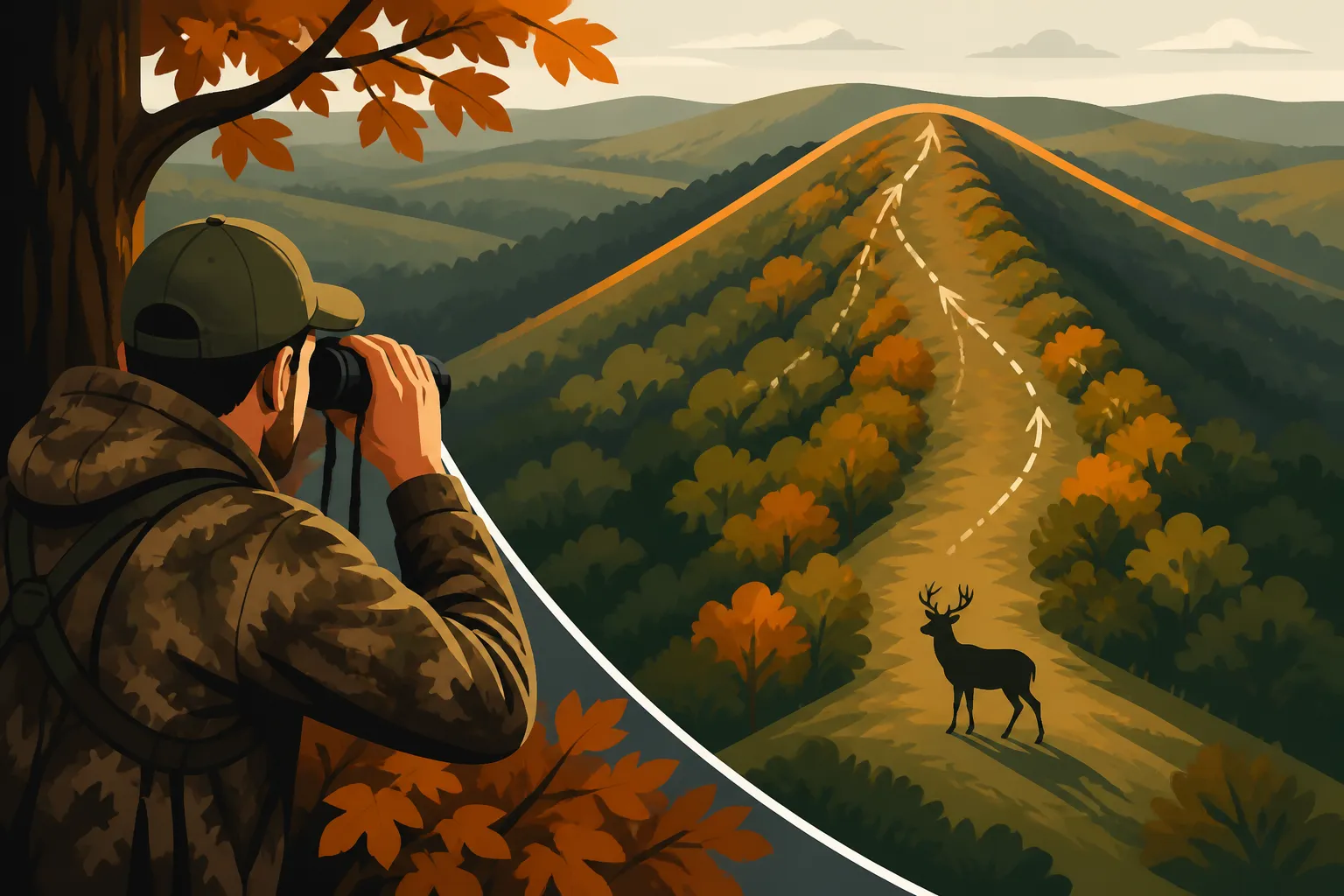
The very top, or crown, of a ridge can be surprisingly diverse. While some are broad and relatively flat, others are narrow and quickly drop off into steep slopes. Deer often use these highest points as primary travel routes, especially when moving between different drainages or larger blocks of timber. This is particularly true during the rut when bucks are cruising for does. A wide, flat ridge top might hold more bedding cover or scattered food sources like oaks, making deer linger. On the other hand, a narrow, defined ridge line acts more like a highway, pushing deer into a more predictable path. When you're Scouting Indiana Public Land Before Season, pay close attention to old logging roads or faint deer trails that run along these crowns – they're often superhighways for whitetails.
Fingers and Spurs
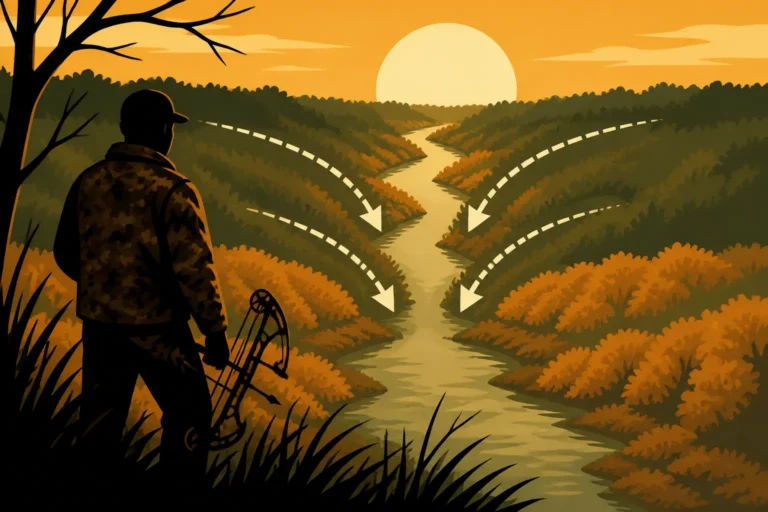
These are smaller, secondary ridges that branch off the main ridge line. Imagine the main ridge as a backbone, and the fingers are the ribs extending outwards. Deer absolutely love these features because they offer multiple advantages. They provide elevated travel routes into and out of hollows, allowing deer to move with a perceived sense of security. They also create natural funnels and pinch points. For instance, a deer traveling up a hollow might choose to pop over a finger ridge rather than walk all the way around, especially if there's good cover or a food source on the other side. These spurs are prime locations for ambush, as they concentrate deer movement.
Saddles and Low Spots
Saddles are depressions or low spots along a ridge line, essentially natural dips in the terrain. These are absolute magnets for deer movement. Why? Because they represent the path of least resistance for deer crossing from one side of a ridge to another. Instead of clambering over a high point, deer will naturally dip into a saddle to cross. These are critical funnels, often connecting bedding areas on one side of a ridge to feeding areas or water sources on the other. During the rut, bucks will often cruise these saddles, scent-checking for does. Observing the wind and thermals is crucial when hunting these spots, as deer will often use the wind to their advantage when crossing. Understanding Wind and Thermals on a Southern Indiana Ridge can be the difference between seeing a buck and blowing them out.
Benches and Terraces
These are flatter, shelf-like areas that interrupt an otherwise steep hillside. They can vary in size from just a few feet wide to several yards, and they're often formed by erosion or geological layers. Deer use benches extensively as secondary travel routes, especially when moving horizontally across a steep slope without having to climb all the way to the ridge top or descend into the hollow. They offer easier walking and often provide a slight elevation advantage for security. Benches are also fantastic bedding locations, particularly when combined with thick cover. Deer can bed on a bench with the wind at their back, watching their downwind approach.
How Deer Use Ridges for Travel, Bedding, and Feeding
Deer don't just wander aimlessly; their movement is highly strategic, driven by survival instincts related to food, cover, and reproduction. Ridges play a pivotal role in all three.
Travel Corridors
As mentioned, ridge tops, fingers, and saddles are primary travel routes. Deer will use the path of least resistance while maximizing their security. This often means staying just below the crest of a ridge, especially when moving during daylight, to remain out of sight from potential threats on the ridge top. They'll also use thick cover along these routes. Imagine a deer moving from a bedding area in a dense pine thicket on one side of a main ridge to an acorn flat in an adjacent hollow. They'll likely pick a finger ridge that leads down, or use a saddle to cross over, ensuring they stay concealed. Knowing these travel patterns is key to Still-Hunting Southern Indiana Ridges effectively.
Bedding Areas
Deer seek out bedding areas that offer maximum security and an advantage over potential predators. Ridges are ideal for this. A common bedding setup for a whitetail on a ridge is to bed on a bench or a point overlooking a hollow, with the prevailing wind coming from behind and above them. This allows them to smell anything approaching from upwind and see anything coming from downwind. Thick cover, such as cedar thickets, brushy clear-cuts, or even dense saplings, on a ridge top or along a steep side provides the visual obstruction they crave. Finding Where Hoosier National Forest Bucks Bed is a game-changer for hunting.
Feeding Zones
While deer will descend into hollows for certain food sources, ridges themselves can provide ample forage. Oak trees, particularly white oaks, are often found scattered along ridge tops and slopes, dropping acorns in the fall. Browsing opportunities, such as honeysuckle or greenbrier, can also be abundant on ridge sides, especially in areas with recent timber activity or natural openings. Deer will often bed higher on a ridge and then move to feed on the same ridge or adjacent slopes, especially during periods of low hunting pressure or favorable weather.
Scouting Ridges Like a Veteran
It's one thing to understand ridge anatomy on paper; it's another to interpret it in the field. Scouting is where you put your knowledge to the test, looking for the subtle clues deer leave behind.
Aerial Maps and Topographic Intel
Before you even set foot in the woods, the best scouting starts from the comfort of your home. Using online mapping tools is absolutely essential for breaking down complex terrain like the Hoosier National Forest.
Using Topographic Maps to Identify Key Features
Programs like GoHunt offer incredible detail, allowing you to zoom in and identify potential ridge tops, saddles, benches, and finger ridges without leaving your desk. Look for contour lines that "pinch" together, indicating a steep slope, or lines that bulge out, revealing a finger ridge or point. Contour lines that spread apart indicate a flatter area, like a bench or a wide ridge top. Pay special attention to areas where contour lines show a distinct dip – that's your saddle. These tools also allow you to see the elevation changes clearly, helping you visualize the lay of the land. I always recommend spending hours with these maps, marking potential hot spots, and creating a game plan before heading out. For a deeper dive into map reading, check out Reading Aerial Photos for Southern Indiana Deer.
Pinpointing Potential Funnels and Bottlenecks
Once you've identified the basic ridge features, start looking for how they connect to other landscape elements, forming funnels. A funnel could be a narrow section of a ridge between two steep drops, a saddle connecting two larger ridge systems, or a finger ridge that extends into a dense bedding area. Also, identify potential bottlenecks – points where deer movement is naturally constricted. This could be where a wide ridge top narrows abruptly, or where a bench ends at a rocky bluff, forcing deer to climb or descend. These are the places where deer traffic is highest and most predictable.
Boots-on-the-Ground Confirmation
No amount of map scouting can replace time spent in the actual woods. This is where you confirm your theories, find fresh sign, and learn the subtle nuances of a specific ridge.
Interpreting Deer Sign: Rubs, Scrapes, and Trails
When you're walking a ridge, you're looking for proof that deer are using it. Fresh rubs and scrapes are obviously high-priority finds, indicating recent buck activity. Rub lines, especially those running along the crest of a ridge or a bench, suggest a consistent travel corridor for bucks. Scrapes found in saddles or at the base of a finger ridge can be powerful indicators of a specific crossing point. Beyond the obvious, look for well-worn trails. These aren't always super-highways; sometimes it's just a faint path where deer have consistently walked. Check for tracks, especially in soft dirt or mud, to gauge freshness and direction of travel.
Locating Key Vegetation and Water Sources
Deer need food and water. While water might be scarce on the highest ridge tops, seeps or small springs can occur on mid-slopes or at the base of ridges, especially in draws. These can act as magnets for deer. Pay attention to the type of trees present. Are there mature oak stands dropping acorns? Are there patches of honeysuckle or greenbrier providing winter browse? Recent timber cuts or areas of dense regrowth can also provide excellent cover and browse, creating prime bedding and feeding habitats. Understanding the types of mast crops and browse available can inform your hunting strategy.
Hunting Ridges Effectively
Once you've done your homework, it's time to put a plan into action. Hunting ridges successfully means knowing when and where to set up, and how to use the terrain to your advantage.
Strategic Stand Placement
Choosing the right spot for your treestand or ground blind is paramount, especially on public land like the Hoosier National Forest where deer are often pressured.
Positioning for Wind and Thermals
This is arguably the most critical factor when hunting ridges. Deer rely heavily on their sense of smell. On ridges, wind and thermals can be tricky. In the mornings, as the sun rises, thermals typically rise, pulling scent uphill. In the evenings, as the air cools, thermals typically fall, pushing scent downhill. However, the actual wind direction (prevailing wind) can override or combine with these thermal currents. You generally want to set up so your scent is blowing away from where you expect deer to approach. If you're hunting a saddle, for example, you might set up on the downwind side, expecting deer to approach into the wind. This is where those detailed maps and careful observation of a specific ridge's micro-climate become invaluable. Always err on the side of caution with your wind direction; a slight shift can ruin a hunt. For the mobile hunter, a portable setup is key. Consider lightweight gear, as discussed in Portable Treestands Worth Packing In, especially when deep in the Hoosier National Forest.
Identifying Ambush Points in Funnels and Bedding Transitions
Once you've confirmed deer traffic and understood the wind, look for the exact spot where you can intercept deer. This is often an ambush point within a funnel (like a saddle or a narrow finger ridge) or along a transition line between bedding and feeding areas. If deer are bedding on a thick ridge top and moving down to a hollow to feed, you want to be positioned along that travel route, perhaps on a bench or a subtle dip, not directly in the bedding area or the primary feeding area. You want to intercept them between these points. Think about where deer feel safest moving and where they might pause or slow down. A lone oak tree dropping acorns in a subtle dip along a ridge top can be a perfect spot to hang a stand, catching deer moving through and stopping for a quick snack.
Tactical Approaches to Ridge Hunting
Beyond static stand hunting, there are active tactics that can prove highly effective on Hoosier Forest ridges.
Still-Hunting and Stalking Ridge Edges
For those who enjoy a more active approach, still-hunting or stalking along ridge edges can be incredibly productive, especially when the leaves are wet and quiet. Instead of sitting, you slowly and carefully move along a bench or just below the crest of a ridge, pausing frequently to glass ahead. This method works well in areas of diverse terrain, allowing you to use small dips and rises for concealment. Focus on moving into the wind or with a quartering wind, always thinking about where a deer might be bedded or traveling. The key is to move at a snail's pace, taking only a few steps before stopping and intensely scanning your surroundings, looking for horizontal lines, unnatural colors, or flicking ears that betray a deer's presence. Good optics, like those discussed in Binocular Choice for Indiana Whitetails, are crucial here.
Using Rattling and Grunting for Cruising Bucks
Ridges, especially during the rut, are prime locations for bucks to cruise. They're often traveling the main ridge lines and fingers, scent-checking for does. This makes them vulnerable to calling tactics like rattling and grunting. Set up in a concealed spot, perhaps in a saddle or on a point overlooking a wide area, and use a sequence of rattling and grunting calls. Give the calls time to work, often 15-20 minutes, as a buck might be a good distance away and needs time to respond and approach. Remember, calling works best when a buck is already actively searching. The natural funnels of ridges help carry the sound and guide a curious buck into your vicinity. While effective, understand that pressured public land bucks in areas like Hunting Brown County Ridgelines can be call-shy, so subtle tactics often yield better results than aggressive ones.
Practical Considerations for Hoosier Forest Hunters
Hunting the rugged terrain of the Hoosier National Forest requires more than just knowing deer sign; it demands preparedness and an understanding of the specific challenges of public land hunting.
Gear Essentials for Ridge Hunting
The right gear makes a huge difference in comfort, safety, and success, especially when you're covering significant ground on steep terrain.
Navigation Tools and Apps
A reliable GPS or a phone app like GoHunt is non-negotiable for hunting the Hoosier National Forest. These areas are vast, and it's incredibly easy to get turned around, especially when focused on tracking a deer or navigating through dense cover. These apps allow you to mark your stand locations, truck, and points of interest like fresh sign or water sources. They also show property lines, which is crucial for staying on public land. Always carry a backup, whether it's a traditional compass and paper map, or a fully charged power bank for your phone. Getting lost in the deep woods of southern Indiana is no joke. Don't forget to pack enough supplies in your Packs for a Hoosier Forest Day Hunt.
Lightweight and Durable Clothing
You'll be doing a lot of walking, often uphill and downhill, so layering is key. Start with a moisture-wicking base layer, add an insulating mid-layer, and top it with a quiet, durable outer layer that can withstand briars and thorns. Waterproof outer layers are also vital for unpredictable Indiana weather. Comfort and mobility are paramount. Also, remember Indiana's blaze orange requirements during firearms and muzzleloader seasons. Even during archery, many hunters opt for a blaze orange vest when walking in and out to increase visibility, especially on busy public land.
Respecting the Public Land Ethic
Hunting the Hoosier National Forest is a privilege, and it comes with responsibilities to other users and the resource itself.
Minimizing Impact and Practicing Leave No Trace
Pack out everything you pack in. Leave your hunting area cleaner than you found it. This includes empty water bottles, snack wrappers, and even spent bullet casings. Be mindful of scent, and avoid leaving trash that can attract non-target animals or detract from the wild experience for others. Adhering to the regulations regarding treestands and ground blinds is also crucial. Generally, on public land, stands must be removed at the end of the season, and often cannot damage trees. Check the specific regulations for the Hoosier National Forest or any other public land you intend to hunt.
Sharing the Woods and Being a Good Neighbor
The Hoosier National Forest is a multi-use area. You'll encounter hikers, mountain bikers, bird watchers, and other hunters. A friendly wave and a respectful attitude go a long way. If you scout a hot spot and find another hunter already there, move on. There's plenty of ground for everyone. Communication and courtesy ensure a positive experience for all. Remember, the challenge of Hunting Southern Indiana Hill Country often means you'll share space with others, so plan accordingly.
Ridge Hunting Checklist
To help you prepare for your next Hoosier Forest ridge hunt, here's a quick checklist of considerations:
| Category | Item to Consider | Importance (1-5) | Notes |
|---|---|---|---|
| Scouting | Aerial/Topographic Maps (e.g., GoHunt) | 5 | Essential for pre-hunt planning, identifying key features, and marking waypoints. |
| On-the-ground sign (rubs, scrapes, tracks, trails) | 4 | Confirms deer presence and preferred routes. Look for freshness. | |
| Vegetation & Food Sources | 3 | Identifies feeding areas (oaks, browse) and bedding cover. | |
| Strategy | Wind & Thermals Plan | 5 | Crucial for stand placement to avoid detection. Always consider shifting winds. |
| Funnels & Bottlenecks Identified | 4 | High-traffic areas for predictable deer movement. | |
| Bedding-to-Feeding Transitions | 4 | Intercept deer moving between cover and food. | |
| Gear | GPS/Mapping App (with downloaded maps) | 5 | Prevents getting lost. Mark stand sites, truck, sign. |
| Compass & Paper Map (backup) | 3 | Always have a non-electronic backup for navigation. | |
| Layered, Quiet Clothing | 4 | Comfort and stealth are key for long walks and sits. | |
| Quality Optics (Binoculars, Rangefinder) | 4 | Crucial for spotting deer in thick cover and judging distance. See Rangefinders in Thick Southern Indiana Cover. | |
| Treestand/Saddle (if applicable) | 3 | Lightweight, portable options are best for public land mobility. | |
| Blaze Orange/Pink (seasonal requirement/safety) | 4 | Essential for safety during gun seasons, recommended during archery when moving. | |
| Ethics | Pack-in/Pack-out mentality | 5 | Leave no trace. |
| Awareness of other users | 4 | Be respectful and prepared to adapt if an area is occupied. |
This comprehensive approach to reading and hunting ridges in the Hoosier National Forest will drastically increase your chances of success. It's a challenging but rewarding endeavor that teaches you a deep respect for the land and the animals that call it home.
Disclaimer
Hunting is an inherently dangerous activity. Always follow all local, state, and federal hunting regulations. Ensure you have the proper licenses and permits. Prioritize safety, including wearing blaze orange during applicable seasons, using a safety harness in treestands, and being aware of your surroundings. This information is for educational purposes and does not substitute professional safety instruction.