Rangefinders in Thick Southern Indiana Cover
We've all been there: nestled into a treestand on a steep southern Indiana ridge, a beautiful buck steps out, and your mind races. "Is that 30 yards? Maybe 40? What about that tree in the way?" The rolling, timber-choked hills of places like the Hoosier National Forest can make judging distance an absolute nightmare. This guide is all about cutting through that uncertainty, helping you understand how to choose and effectively use a rangefinder to make accurate shot placements in the dense, undulating landscape of Southern Indiana.
The Unique Challenge of Southern Indiana's Terrain
Hunting in Southern Indiana isn't like hunting the wide-open plains out west. Our woods are thick, our terrain is constantly changing, and what looks like a clear shot can quickly turn into a tangle of branches and elevation changes. This unique environment presents specific hurdles for distance estimation that flat ground or open fields simply don't.
Steep Hills and Deep Hollers
Anyone who has spent time chasing deer in the knobs and hollers of Southern Indiana knows how quickly the ground can drop out from under you or rise steeply ahead. You might be perched on a ridge, looking down into a creek bottom, or halfway up a slope, looking across to another. This constantly shifting vertical dimension makes traditional eye-balling of distances incredibly difficult. What might seem like a 30-yard shot horizontally could easily be a 45-yard equivalent shot with the angle thrown in. Many experienced archers and rifle hunters have made the mistake of underestimating or overestimating the effect of gravity on their projectile due to a steep angle, leading to a missed opportunity or, worse, a wounded animal. It's not just about the horizontal distance; it's about the true ballistic distance.
Imagine you're hunting a Brown County Ridgeline Public Access area. You've climbed a significant elevation to get to your stand, and now you're looking down into a deep ravine where a promising deer trail runs. A buck appears, quartering away. You think, "That's about 40 yards," but your arrow might hit high if your pin is set for a flat 40, because the steep angle makes the effective horizontal distance much shorter. This is where specialized rangefinder features come into play, which we'll discuss shortly.
Dense Timber and Brushy Undergrowth
Our Southern Indiana woods, especially public land areas, are notorious for their thick timber and heavy undergrowth. You're rarely going to find those perfectly manicured shooting lanes you see on hunting shows. Instead, you're navigating through mature hardwoods, dense saplings, thick briar patches, and fallen logs. This isn't just a challenge for silent movement; it's a huge obstacle for a rangefinder's laser beam.
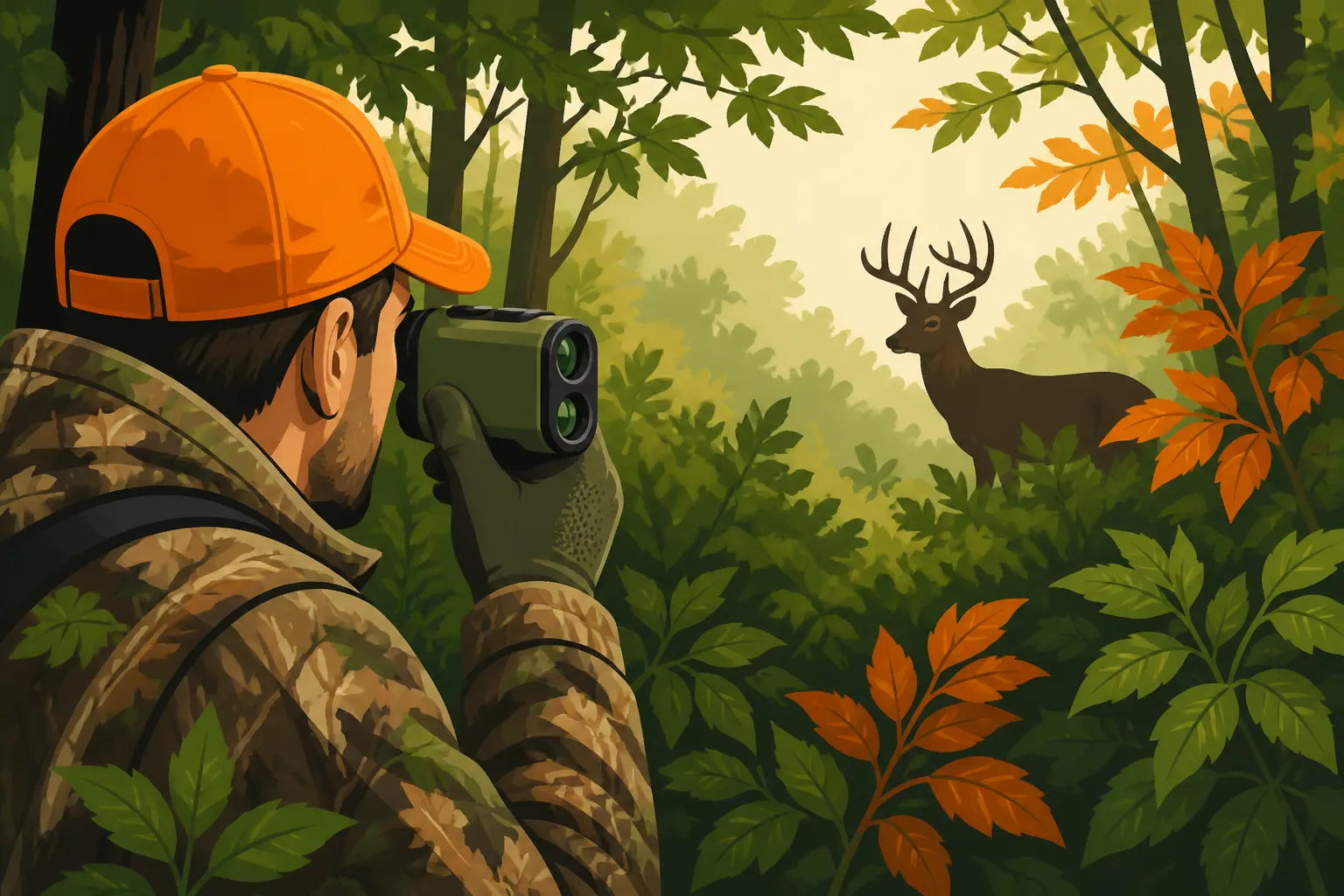
When you point a rangefinder at a deer standing behind a few small branches or a patch of thick brush, the laser often picks up the closer object – the branch or the brush – instead of your intended target. This "first priority" reading can lead to drastically incorrect distances. You might range a tree 10 yards in front of the deer instead of the deer itself, thinking you have a much closer shot than you actually do. This is a common frustration, especially when that trophy buck you've been chasing finally steps out for a split second. Trying to get a quick, accurate read through small gaps in the foliage is often a dance between patience and precision.
Why a Rangefinder Isn't Just for Open Country
There's a common misconception that rangefinders are only truly useful for long-range rifle hunting in wide-open spaces. While they certainly excel there, their value in the tight, close-quarters environment of Southern Indiana's thick cover is arguably even greater. Here, a few yards can make a monumental difference in shot placement.
Eliminating the Guesswork in Close Quarters
In archery, especially, every yard matters. The difference between 25 and 35 yards, or 30 and 40, can mean hitting the vitals or making a poor shot. When you're bowhunting in dense timber, deer often appear and disappear quickly. You might only have a split second to assess the distance and make the shot. Relying on guesswork, especially when your adrenaline is pumping, is a recipe for disaster.
A rangefinder takes the guesswork out of these crucial moments. Before the season, you can pre-range key landmarks around your stand or blind. You can hit that old oak to your left, the patch of cedars straight ahead, or the bend in the creek, and mentally note their distances. Then, when a deer steps into one of those pre-ranged zones, you already have a solid idea of the distance. If it's between those zones, a quick, accurate range will tell you exactly where to aim. This capability is invaluable in Southern Indiana, where shots are often up close and personal, but rarely perfectly clear. It gives you the confidence to execute your shot effectively, knowing you've eliminated one major variable.
Increasing Confidence and Reducing Ethical Risks
Every hunter carries a responsibility to make a clean, ethical kill. A big part of that is ensuring precise shot placement. In the thick woods of Southern Indiana, judging distance by eye is highly unreliable due to the visual distractions and lack of clear reference points. Without a rangefinder, you might feel compelled to pass on shots that you could make, simply because you're not confident in the distance. Or, worse, you might take a shot believing it's closer or further than it actually is, leading to a wounded animal and a difficult, if not impossible, tracking job in the dense undergrowth.
A rangefinder instills confidence. When you know, not guess, that a deer is at 32 yards, you can adjust your hold with certainty. This confidence translates to better shot execution, which directly leads to more ethical harvests. Think about Hunting Indiana River Bottom Funnels – deer are moving through dense cover, often obscured by trees and brush. A quick range can be the difference between a clean kill and a long, frustrating search through tangled vines and downed timber. It's about respecting the animal and ensuring you do everything in your power to make a responsible shot.
Key Features to Look for in a Southern Indiana Rangefinder
Not all rangefinders are created equal, especially when it comes to navigating the specific challenges of Southern Indiana's dense forests and rolling hills. Some features become absolutely critical, turning a simple distance-measuring tool into a true hunting advantage.
Angle Compensation Technology
This is perhaps the most important feature for hunting in the undulating terrain of Southern Indiana. As we discussed earlier, gravity affects your projectile differently on uphill and downhill shots. An arrow or bullet fired at a steep angle, even if the horizontal distance is the same, will hit higher than one fired on flat ground. Angle compensation (often called "true ballistic range," "horizontal distance," or "bow mode") calculates the effective horizontal distance to the target, telling you where to aim based on how gravity will actually affect your projectile.
For example, if a deer is standing 40 yards away horizontally, but 20 feet below you in a steep holler, a standard rangefinder might give you a line-of-sight distance of 45 yards. But your arrow will drop as if it were shot at a flat 30-35 yards. An angle-compensating rangefinder will read "45 yards" (line of sight) but then tell you the "compensated distance" is, say, 33 yards. That 12-yard difference is absolutely critical for accuracy, especially with archery equipment. Without this feature, you're constantly trying to mentally calculate these angles, which is not something you want to do with a buck in your sights. It's an absolute game-changer for anyone Still-Hunting Southern Indiana Ridges or set up in a treestand overlooking a steep drop.
First Priority vs. Last Priority Modes
Remember that frustration of ranging a branch instead of the deer? This is where a rangefinder with "last priority" or "through the brush" mode becomes invaluable. Most standard rangefinders operate on "first priority" mode, meaning they give you the distance to the first object they detect. This is fine in open country, but a nightmare in thick woods.
A "last priority" mode, however, tells the rangefinder's laser to ignore closer, less reflective objects like small branches, leaves, or blades of grass, and instead focus on the furthest, most prominent object in the beam's path – ideally, your deer. While no technology is perfect, this feature significantly increases your chances of getting an accurate reading on your target when there's minor brush or foliage between you. It's not magic, and it won't shoot through a solid tree, but for those frustrating instances of a few distracting twigs, it can make all the difference in getting a quick, clean read on a fleeting target.
Scan Mode and Speed
In the dynamic environment of Southern Indiana, deer rarely stand perfectly still for extended periods. They might be walking, browsing, or pausing for just a moment before moving on. This is where "scan mode" and the overall speed of the rangefinder come into play. Scan mode allows you to continuously sweep the landscape, getting real-time distance updates as you move the rangefinder. This is incredibly useful for:
- Ranging a moving target: You can follow a deer as it walks, getting updated distances.
- Scanning through brush: If you're trying to find an opening to range a deer behind thick cover, you can scan around, and the rangefinder will often pick up the target when the beam finds a clear path.
- Pre-ranging multiple points quickly: Before a deer even appears, you can quickly scan several potential shooting lanes or landmarks around your setup, committing distances to memory.
A rangefinder with a fast acquisition time means you press the button, and almost instantly, you have a reading. In those critical seconds when a deer presents itself, you don't want to be waiting for your rangefinder to process. A quick, responsive unit can be the difference between getting a shot and watching your opportunity walk away. Look for a model that boasts rapid ranging capabilities to capitalize on those fleeting chances.
How to Use Your Rangefinder Effectively in Thick Cover
Having the right tool is only half the battle; knowing how to wield it effectively is just as important. In the challenging environment of Southern Indiana's dense cover and varied topography, there are specific techniques that can maximize your rangefinder's performance and your confidence in the field.
Pre-Ranging Your Stand or Blind Area
One of the most valuable habits you can develop, especially when hunting from a fixed position like a treestand or ground blind, is to pre-range your surroundings. Do this as soon as you get into your setup, well before legal shooting light or when you're first setting up your stand. Take note of prominent features like specific trees, rocks, logs, or even changes in terrain.
Walk into a Treestand Setups in Hoosier National Forest location, and before you even pull your bow or rifle up, range that big oak 25 yards straight ahead, the clearing at 40 yards to your right, and the point where the trail crosses the little seep at 35 yards to your left. Jot these down on a small card or in your hunting app. This creates a "map" of known distances in your mind. When a deer steps out, you don't have to scramble for a range. If it's near one of your markers, you already know the distance. If it's between two, a quick range will confirm the exact number. This eliminates precious seconds of fumbling and allows you to focus on the shot when the moment of truth arrives. It's a proactive approach that significantly reduces stress in the heat of the moment.
Utilizing Scan Mode and Aiming for Clear Lanes
In dense cover, getting a precise reading on a deer can feel like threading a needle. This is where your rangefinder's scan mode really shines. Instead of trying to pinpoint the deer directly through a small gap, use the scan feature and slowly sweep the area around the deer. Often, the laser beam will find a momentary clear path to the animal, giving you an accurate reading.
Furthermore, always look for the clearest possible line of sight. If a deer is slightly obscured by a small branch, try to subtly shift your rangefinder a few inches to the left or right, or up or down, to find a clearer window. Sometimes, aiming at the deer's shoulder might give you a branch, but aiming slightly lower at its chest, or slightly higher at its back, might give you a clear shot to its body. With practice, you'll learn to "read" the cover and identify these micro-openings. Remember, your rangefinder needs to "see" the target just as much as your eye does. Tools like GoHunt sometimes offer satellite imagery that can help you scout potential shooting lanes from an aerial perspective, giving you a head start before you even step foot in the woods.
Understanding Display Types and Low-Light Performance
The type of display in your rangefinder can be a big deal in the dim, early morning or late evening light of Southern Indiana. Many rangefinders use a black LCD display. While perfectly fine in bright conditions, this can be nearly impossible to read in low light, especially under a thick canopy or on an overcast day.
This is where a rangefinder with a red LED or OLED display becomes a true asset. These displays illuminate the numbers, making them crystal clear even in the darkest legal hunting hours. While they might cost a bit more, the ability to get an accurate range when deer are most active – at dawn and dusk – is well worth the investment. After all, what good is a rangefinder if you can't read the numbers when you need them most? Before buying, it's always a good idea to check reviews or, if possible, test the display in simulated low-light conditions to ensure it meets your needs for those critical prime-time minutes in the timber.
Making the Most of Your Investment: Practice and Maintenance
A rangefinder is a significant investment for many hunters, and like any piece of critical gear, its value is only truly realized through consistent practice and diligent care. In the rugged environment of Southern Indiana, these aspects are particularly important to ensure your rangefinder performs when it matters most.
Practice, Practice, Practice
Simply owning a rangefinder isn't enough; you need to be proficient with it. This means more than just taking it out to the backyard once. Take it with you every time you hit the woods, even if you're just scouting or shed hunting. Practice ranging everything – trees, stumps, rocks, distant hills, and even your hunting buddies.
- Range different textures and colors: How does your rangefinder perform on dark bark versus light-colored leaves? What about wet surfaces versus dry?
- Practice through light brush: Intentionally try to range objects behind minor obstructions to see how your rangefinder's "last priority" mode performs.
- Practice quick draws: Simulate a deer appearing suddenly. How fast can you pull your rangefinder, get a reading, and put it away? In hunting situations, speed and efficiency are key.
- Practice angle compensation: Range objects at various uphill and downhill angles. Compare the line-of-sight distance with the compensated distance to truly understand the difference and how it affects your shot.
The more you practice, the more intuitive using your rangefinder will become, transforming it from a tool you "use" into an extension of your hunting process. You can even create a small shooting course in your backyard or a safe area on your property, ranging targets at known and unknown distances, and then confirming with your rangefinder. This familiarity will pay dividends when that moment of truth arrives in the field. Using mapping applications from GoHunt or similar platforms can help you visualize distances and terrain before you even step foot into an area, allowing for mental practice before physical practice.
Battery Life and Environmental Protection
The last thing you want on a cold December morning in the Indiana woods is a dead rangefinder battery. Modern rangefinders are generally very efficient, but extreme cold can significantly reduce battery life. Always start your hunting season with fresh, high-quality batteries. Consider carrying a spare set, especially during late-season hunts when temperatures drop.
Beyond batteries, protecting your rangefinder from the elements is crucial. Southern Indiana weather can be unpredictable, ranging from heavy downpours to misty mornings and even snow. Most quality rangefinders are at least water-resistant, but it's wise to keep it in a protective case or a pocket when not in immediate use. Dust, dirt, and mud can also compromise the optics. Regularly wipe down the lenses with a soft, clean cloth (the kind used for eyeglasses or camera lenses) to ensure clarity. A small, protective pouch or a dedicated compartment in your hunting pack, perhaps even in a specialized pack designed for Packs for a Hoosier Forest Day Hunt, can extend the life and reliability of your rangefinder. Treat it as the precision instrument it is, and it will serve you well for many seasons to come.
Table: Rangefinder Features for Southern Indiana Hunters
To help you make an informed decision, here's a quick comparison of rangefinder features especially relevant to our specific hunting conditions in Southern Indiana.
| Feature | Benefit in Southern Indiana Terrain | Ideal Setting | Less Critical Setting |
|---|---|---|---|
| Angle Compensation | Crucial for accurate shots on steep inclines/declines | Hilly, broken ground | Flat fields, open woods |
| Last Priority Mode | Essential for ranging through light brush/foliage | Thick timber, brushy areas | Wide-open fields, sparse woods |
| Scan Mode | Great for moving targets or quickly ranging multiple points | Dynamic hunting, scouting | Stationary, pre-ranged shots |
| Red/OLED Display | Excellent visibility in low light, dense canopy | Dawn/dusk, overcast days | Bright sunny days, open areas |
| Fast Acquisition Speed | Critical for quick shots on fleeting targets | Fast-paced hunting scenarios | Long-range, patient setups |
| Compact & Lightweight | Easier to carry and maneuver in thick woods | Mobile hunting, long walks | Fixed blind, minimal movement |
| Water Resistance | Protects against rain, snow, and humidity | All Indiana hunting conditions | Indoor shooting ranges |
The Final Shot: Confidence in Every Yard
Hunting in Southern Indiana offers some incredible experiences, but it also demands specific skills and the right gear to succeed ethically and consistently. A quality rangefinder, especially one equipped with angle compensation and a last priority mode, isn't a luxury – it's a vital tool for navigating our unique landscape. It takes the guesswork out of those critical moments, boosts your confidence, and helps ensure that when you squeeze the trigger or release an arrow, you're doing so with the utmost precision. So, take the time to choose wisely, practice diligently, and keep your rangefinder in top shape. It'll be an indispensable companion on many successful hunts in the Hoosier State.
Disclaimer
This article is for general informational purposes only and does not constitute professional advice. Laws, prices and regulations vary by location and change over time. Consult a qualified professional for guidance on your specific situation.