Hanging a Stand on a Southern Indiana Ridge
Hunting the steep, rolling hills of Southern Indiana presents a unique challenge for any deer hunter. The dense timber, deep hollows, and often unpredictable thermals can make locating and consistently connecting with whitetails a real head-scratcher. If you've ever struggled to find that perfect treestand spot, only to have deer bust you due to swirling winds or poor access, you know the frustration. This guide is all about demystifying the art of hanging a stand on a Southern Indiana ridge, helping you choose optimal locations, master the terrain, and get your setup right for more successful hunts.
Understanding Southern Indiana Ridge Topography and Deer Movement
Southern Indiana's landscape, particularly areas like the Hoosier National Forest or the rugged hills of Brown County, is a far cry from the flat farmland of the northern part of the state. Here, understanding the contours, saddles, and funnels is absolutely critical to placing your stand effectively. Deer in this kind of terrain move differently, and if you're not speaking their language, you'll be constantly outsmarted.
Reading the Land: Contours, Saddles, and Funnels
When you're looking at a topographical map, whether it's through a service like GoHunt or another mapping application, pay close attention to the contour lines. These lines are your key to understanding elevation changes and the steepness of the terrain. Tightly packed lines indicate a steep incline, while widely spaced lines suggest a gentler slope. Deer are creatures of efficiency; they'll often opt for the path of least resistance.
Saddles, for instance, are those dips or low spots along a ridge line. Think of them as natural highways for deer moving between two larger peaks or across drainages. They offer an easier travel route and often funnel deer movement through a confined area, making them prime spots for an ambush. Similarly, funnels – narrow strips of timber between open fields, or even subtle changes in elevation that pinch down deer movement – are invaluable. A deep ravine on one side of a ridge and a steep drop-off on the other can create a natural funnel along the spine of the ridge. You can learn a lot by simply spending time Reading a Ridge for Hoosier Forest Deer. These features concentrate deer traffic, giving you a better chance to intercept them.
Identifying Bedding and Feeding Areas
Deer movement is largely dictated by their core needs: food, water, and security cover for bedding. In southern Indiana's ridge country, these areas are often distinct but interconnected. Bedding areas are typically found on the leeward side of ridges, especially on sunny slopes where deer can catch warmth during colder months. They seek out thick cover—dense cedar thickets, brushy clear-cuts, or even just heavy blowdowns—that offers protection from the elements and predators, while also providing good visibility downwind. A buck might bed just below the crest of a ridge, allowing him to see and hear anything approaching from below, while his nose takes care of what's coming over the top.
Feeding areas, on the other hand, change throughout the season. Early season might see deer hitting soft mast like persimmons or native plums in creek bottoms, while the peak of fall often means acorns are king. Look for white oak and red oak flats on ridge tops and along slopes, identifiable by discarded caps or fresh tracks. Later in the season, deer might descend into hollows to browse on woody stems or seek out any remaining green browse. The trick is to identify the travel corridors connecting these bedding and feeding zones. A well-placed stand isn't in the bedding area or the feeding area, but rather along the discreet path deer use to move between them, often during low-light hours.
Strategic Treestand Placement Considerations
Hanging a treestand isn't just about finding a big tree. It's about a chess match with a deer's senses, primarily their nose and their eyes. Every decision, from the exact tree you choose to your entry and exit routes, has to consider these factors. Neglect any one, and your hunt is likely to be over before it even begins.
Wind and Thermals: Your Invisible Enemy and Ally
This is arguably the most critical factor in southern Indiana ridge hunting. The terrain here creates unpredictable air currents that can quickly betray your presence. Thermals are air movements driven by temperature changes. In the morning, as the sun warms the earth, air rises up the slopes. In the evening, as the air cools, it sinks down into the valleys. This means if you're set up on a ridge line in the morning, your scent will be carried up the hill. In the evening, it will fall down.
Wind, however, adds another layer of complexity. The prevailing wind can be deflected, swirled, and channeled by the ridges and hollows, often creating a completely different wind direction at ground level than what's indicated by weather reports. Always use a wind checker, like a puff of milkweed or scent-free powder, to constantly monitor local air currents. Many veteran hunters will tell you that you can't trust the wind to be consistent on a southern Indiana ridge for more than an hour or two. Planning your stand placement and hunt times around these expected thermal shifts is crucial. Don't be afraid to pull a stand and move it if the wind isn't right for that day, or have multiple stand options to cover different wind directions. For a deeper dive, check out Wind and Thermals on a Southern Indiana Ridge.
Entry and Exit Routes Without Spooking Deer
Even the best-placed stand is useless if you've spooked every deer in the area on your way in or out. Your entry and exit routes are just as important as the stand itself. You need to approach and depart from your stand unseen, unheard, and unscented. This often means taking the path of most resistance for you—creeping along a creek bed, utilizing a deep ditch, or walking directly into the wind as much as possible.
Identify natural terrain features that provide cover for your approach. Ridge lines that drop off sharply can offer a concealed path below the deer's line of sight. Logging roads, while sometimes noisy, can offer efficient, low-impact routes if used wisely, especially if the wind is in your favor. Avoid walking through known bedding areas or across open fields during prime deer movement times. For morning hunts, consider stands that allow you to approach from above the deer's bedding area, letting your scent fall away. For evening hunts, approaching from below and letting your scent rise might be a better option. Remember, silence is golden. Use quiet clothing and take slow, deliberate steps.
Choosing the Right Tree and Angle
Once you've identified a promising location based on deer sign, wind, and access, it's time to pick the specific tree. This isn't just about finding any old trunk. You need a tree that offers adequate cover, allows for clear shooting lanes, and provides a safe, stable platform for your stand. Look for mature, sturdy trees with enough trunk diameter to safely secure your stand. Oaks and hickories are common in southern Indiana and usually fit the bill.
Think about the canopy. Do you have enough overhead cover to break up your silhouette? Are there enough branches or smaller trees around you to provide natural camouflage? Also, consider your shooting lanes. You want clear shots into the primary areas where deer are expected to travel, but you also want to avoid over-trimming, which can make your setup look unnatural. Aim for multiple shooting lanes, covering different angles and distances. Positioning your stand slightly downwind of the anticipated deer travel route is often ideal, as it allows deer to pass naturally without winding you, while still offering a broadside shot opportunity. A good general rule is to hang your stand high enough (15-20 feet) to get above their primary line of sight and minimize your scent cone, but not so high that shooting becomes difficult or unsafe.
Types of Stands and Installation Techniques for Ridge Hunting
The ruggedness of Southern Indiana's ridges means portability and adaptability are key. You're not likely to drive an ATV right up to your stand location, so whatever you choose needs to be something you can comfortably pack in, set up, and often, pack out again.
Portable Hang-Ons and Climbing Sticks
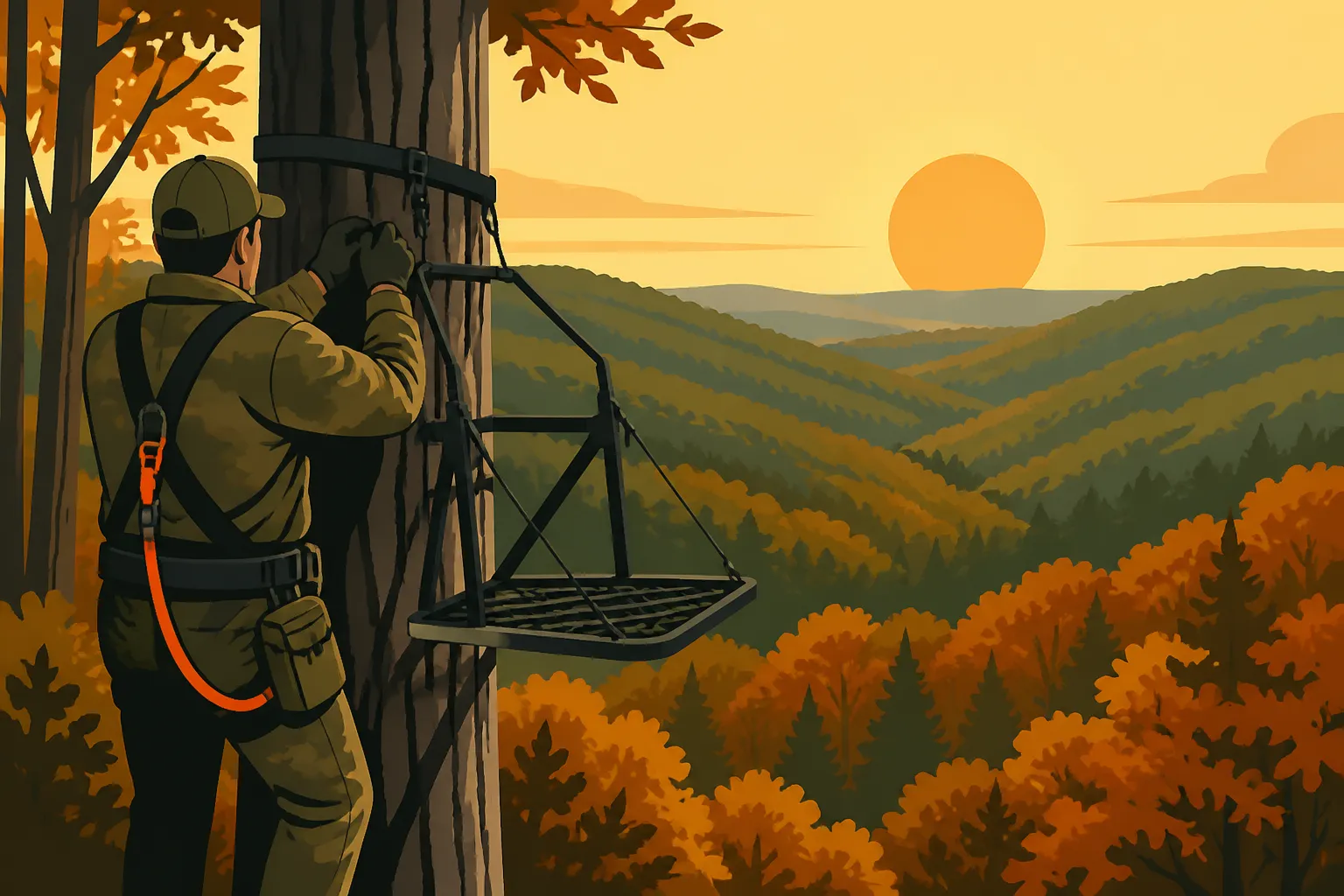
For the majority of ridge hunting scenarios, portable hang-on stands coupled with climbing sticks are the workhorses of the Indiana deer hunter. They offer incredible versatility because you can set them up in almost any sturdy tree, regardless of whether it's perfectly straight. This is a huge advantage in areas like the Hoosier National Forest, where ideal "climber trees" are often few and far between. Lightweight hang-ons made from aluminum are worth their weight in gold when you're hiking a mile or more up and down steep terrain. Brands like Lone Wolf, XOP, or Hawk make excellent, quiet options that are easy to pack in.
The climbing sticks are equally important. Sectional sticks or even rope-style ladders allow you to ascend crooked or limby trees where a traditional climbing stand would be impossible. When installing, always use a safety harness from the moment your feet leave the ground until you're back down. Practice setting up your system in your backyard before hitting the woods. For more on these setups, check out Portable Treestands Worth Packing In and Climbing Sticks for Indiana Hardwoods. Focus on silent setup and making sure your stand is rock-solid – any creaks or wobbles will instantly put deer on high alert.
Saddle Hunting for Ultimate Mobility
Saddle hunting has exploded in popularity, and for good reason: it offers unparalleled mobility and concealment, making it particularly well-suited for the challenging terrain of Southern Indiana ridges. Instead of standing or sitting on a platform, you're essentially harnessed to the tree, allowing you to rotate 360 degrees around the trunk for shots in any direction. This is a game-changer when deer come in unexpectedly or when you need to adjust your angle quickly.
The minimalist setup—a saddle, a few climbing sticks, and a small platform—is incredibly lightweight, allowing you to go deeper into public land and hunt areas other hunters can't or won't reach. It also makes for quick, quiet setups and tear-downs, which means you can be more opportunistic and respond to changing deer patterns or wind conditions. The ability to use the tree itself as cover, constantly shifting your position to remain hidden, gives you a significant edge. It takes some practice to get comfortable, but once you do, a saddle can be one of the most effective tools for Saddle Hunting in Indiana Hardwoods.
Ground Blinds on Southern Indiana Ridges
While treestands dominate ridge hunting, don't completely discount ground blinds. There are specific situations where a ground blind can be an excellent choice, especially if suitable trees are scarce or if you need to hunt a very specific, brushy pinch point. For instance, if you find a thick cedar patch on a ridge that deer are clearly using for bedding and crossing, and there isn't a good stand tree nearby, a well-placed and brushed-in ground blind might be your best bet.
The key to success with ground blinds on ridges is concealment. They need to be set up well in advance if possible, allowing deer to get used to their presence. If setting up on the day of the hunt, spend extra time brushing in your blind with local vegetation so it blends seamlessly into the environment. However, ground blinds do have limitations on steep terrain. Your visibility will be significantly reduced compared to an elevated stand, and your scent cone will be much closer to the ground, requiring even more meticulous attention to wind direction. Nonetheless, in thick cover or for targeting specific travel lanes, Using a Ground Blind on Indiana Public Land can still be a viable tactic.
Advanced Scouting and Seasonal Adjustments
Success in Southern Indiana hunting isn't a one-and-done deal. It requires continuous effort, both before the season and throughout it. Deer patterns shift with food sources, hunting pressure, and the progression of the rut. Being able to adapt and react is what separates consistently successful hunters from those who struggle.
Pre-Season Scouting with Maps and Boots on the Ground
Pre-season scouting is the bedrock of effective stand placement. Before you ever think about hanging a stand, you need to understand the lay of the land and where deer are spending their time. Start with digital mapping tools like GoHunt or other topographic map applications. These tools allow you to analyze aerial imagery and contour lines from the comfort of your home, identifying potential saddles, funnels, bedding areas, and food sources. Look for subtle changes in vegetation that might indicate a clear-cut or dense thicket, which often equates to bedding cover. This digital scouting saves valuable time and helps you prioritize areas to investigate on foot.
Once you have some target areas, it's time to hit the woods. Boots-on-the-ground scouting is irreplaceable. Look for hard sign: rub lines, scrape lines, fresh tracks, and worn trails. These tell you exactly where deer are traveling and what they're doing. Pay attention to water sources and mast crops. If it's an acorn year, focus on oak flats; if not, look for alternative food sources. Identify potential bedding areas like sunny, south-facing slopes with thick cover or deep coves where deer feel secure. Knowing Where Hoosier National Forest Bucks Bed before the season opens will put you miles ahead. The more time you spend in the woods without a weapon, observing and learning, the better your chances will be when season opens.
Adapting to Seasonal Deer Behavior
Deer behavior isn't static; it evolves throughout the hunting season, and your stand strategy needs to evolve with it.
- Early Season (September/October): Deer are often still on summer patterns, focused heavily on food and relatively predictable. They might be hitting soft mast, agricultural fields if available nearby, or consistent browse. Stand placement should be geared towards food source observation, especially in the evenings, and connecting travel routes between food and nearby bedding.
- The Rut (Late October/November): This is when deer activity peaks, but also when patterns become less predictable. Bucks are actively seeking does, often traveling significant distances and using main ridge lines and saddles more frequently. This is an excellent time to focus on natural funnels, pinch points, and observation stands in high-traffic areas. Consider how Hunting the Rut in Early November changes your tactics. Bucks will be cruising, checking doe bedding areas, and scent-checking every dip and rise.
- Late Season (December/January): After the rut, deer revert to a survival mode, focusing heavily on calorie-rich food sources and conserving energy. Remaining acorns, standing crops, or persistent green browse in sheltered areas become magnets. Bedding areas will often be on warm, south-facing slopes or in dense thermal cover. Your stand placement should shift to intercept deer moving from these bedding areas to late-season food sources, often during midday when the weather is coldest. For more on this, check out Late-Season Food Sources for Indiana Whitetails. The key is flexibility and being willing to move your stand as conditions and deer patterns change. A stand that was hot in October might be dead quiet in December, and vice versa.
By consistently scouting and adapting your stand placements, you'll be able to unlock the secrets of Hunting Brown County Ridgelines and similar challenging terrains, increasing your odds of success year after year.
Here's a quick comparison of common stand types for Southern Indiana:
| Stand Type | Mobility | Concealment (Typical) | Ease of Setup (Typical) | Best Use Case | Drawbacks |
|---|---|---|---|---|---|
| Hang-On Stand | High (especially with climbing sticks) | Good (natural tree cover) | Moderate (requires sticks) | Versatile, any sturdy tree, public land deep hunts | Heavier than saddle, less agile for shot angles |
| Climbing Stand | Moderate (tree dependent) | Good (natural tree cover) | Easy (on straight trees) | Specific straight, limbless trees, quicker setups | Limited to suitable trees, can be noisy, less flexible |
| Tree Saddle | Very High (ultra-light, quick to move) | Excellent (uses tree as cover) | Moderate (learning curve) | Steep, broken terrain, pressured public land, agile shots | Takes practice, not for everyone, no seat for long sits |
| Ground Blind | Low (once set up) | Very Good (when brushed in) | Easy (if pre-set) | Thick cover, lack of suitable trees, specific ambushes | Limited visibility, less scent control, harder on steep slopes |
Disclaimer
Hunting is an inherently dangerous activity. Always prioritize safety. Read and follow all manufacturer instructions for your treestand and safety harness. Always use a full-body harness when ascending, descending, and while in a treestand. Consult the Indiana Department of Natural Resources (DNR) for the latest hunting regulations and safety guidelines. Local conditions, regulations, and individual skill levels can vary, so always exercise good judgment and common sense.