How Wild Hogs Spread Across Indiana
The sudden appearance of wild hogs tearing up fields, rooting through timber, and destroying vital habitats is a gut punch for any Indiana landowner or hunter. It feels like an alien invasion, a problem that wasn't supposed to be our problem here in the Hoosier State. If you've wondered how these incredibly destructive animals ended up here, seemingly out of nowhere, you're not alone. This guide will meticulously break down the complex and often frustrating journey of how wild hogs have spread across Indiana, detailing their origins, the factors contributing to their rapid expansion, and the significant challenges they pose to our beloved state.
The Invasive Problem: Why Wild Hogs Are Such a Threat
Wild hogs, often referred to as feral swine, feral pigs, or simply "hogs" in the hunting community, are far more than just another game animal. They are an aggressively invasive species, capable of causing widespread ecological and agricultural devastation. Understanding why they are such a monumental problem is the first step in appreciating the urgency of their presence.
Unparalleled Ecological Damage
Imagine waking up to find a perfectly manicured lawn or a pristine forest floor looking like it's been rototilled by a heavy machine. That's the signature of wild hogs. Their constant rooting and wallowing activities destroy native plant communities, disrupt delicate soil structures, and can lead to severe erosion, especially in sensitive riparian areas. They'll decimate mast crops like acorns and pecans, directly competing with native wildlife such as white-tailed deer, wild turkeys, and squirrels for essential food sources. This isn't just about a few plants; it's about fundamentally altering entire ecosystems and reducing the carrying capacity for our native game animals.
Beyond vegetation, their presence directly impacts a wide array of wildlife. They are opportunistic omnivores, meaning they'll eat just about anything they can get their snouts on. This includes the nests and eggs of ground-nesting birds, fawns of white-tailed deer, and even small reptiles and amphibians. Their rooting also spreads invasive plant seeds and can contaminate water sources, making them an all-around ecological wrecking ball. The pressure they put on native species, already facing habitat loss and other challenges, is immense and often irreversible once a population becomes established.
Significant Agricultural and Economic Losses
For Indiana's farmers, wild hogs are nothing short of a nightmare. They can wipe out entire fields of corn, soybeans, and other crops in a single night, leading to staggering economic losses. Their rooting habit destroys root systems, while their sheer numbers can trample and consume vast quantities of marketable produce. Fences are no match for a determined sounder of hogs, and once they discover a food source, they will return again and again until it's gone.
The damage isn't limited to crops. Hogs can also transmit diseases to livestock, including swine brucellosis, pseudorabies, and even foot-and-mouth disease, though the latter hasn't been found in North American feral swine populations. These diseases pose a direct threat to Indiana's pork industry, potentially leading to costly quarantines, herd culls, and devastating financial hits for farmers. The sheer cost of damage and prevention measures—from reinforced fencing to specialized trapping equipment—adds another layer of burden to an already challenging agricultural landscape. It’s a constant battle, and one that requires vigilant monitoring, sometimes using tools like the GoHunt app to spot signs of their activity and plan effective mitigation strategies.
How They Arrived and Began Spreading
Understanding how wild hogs got to Indiana is crucial to grasping the difficulty of their control. Unlike a natural migration, their presence here is almost entirely human-driven, a complex mix of historical introductions and more recent, irresponsible actions.
Historical Roots and Early Introductions
The story of wild hogs in North America begins centuries ago with European explorers and settlers. Early Spanish explorers introduced domestic pigs to the southeastern United States as a food source. These animals, often left to forage freely, eventually escaped or were abandoned, adapting quickly to the wild and forming the foundation of many "feral" populations. Over generations, these animals interbred with wild boars (Eurasian wild hogs) intentionally introduced in the early 20th century, primarily for sport hunting, creating the hybrid "super pig" we often encounter today—larger, more aggressive, and incredibly resilient.
For a long time, Indiana was largely spared from these established populations, primarily due to its geographic location away from the initial introduction points in the Deep South. However, isolated pockets of escaped domestic pigs have always existed. Farmers throughout history have sometimes allowed pigs to free-range, and occasionally these animals would slip away, becoming feral. While these early escapes might have led to small, localized groups, they rarely established the widespread, destructive populations we see today. The true acceleration of the problem in Indiana is a more recent phenomenon.
The Rise of Illegally Transported Hogs
The primary driver behind the modern spread of wild hogs into new territories like Indiana is unequivocally human-mediated dispersal, specifically the illegal transportation and release of hogs for hunting purposes. This practice, often referred to as "trap-and-transfer," involves catching wild hogs in states where they are abundant and releasing them in new areas to establish hunting populations. This short-sighted and environmentally catastrophic practice treats these invasive animals as a recreational commodity rather than a destructive ecological threat.
The motivation behind these releases is often purely selfish: to create a new hunting opportunity. However, it completely disregards the enormous financial, ecological, and agricultural damage these animals inflict. It’s a frustrating reality for the Indiana DNR, which works tirelessly to educate the public and enforce laws against this activity. The consequences of even a small sounder being released can be devastating, as these animals quickly reproduce and establish themselves. This illegal activity is a constant battle for conservation agencies, who rely on public awareness and reporting to combat it effectively. You can learn more about the broader context of their presence in the state by reviewing Indiana's Feral Hog Regulations.
Reproductive Prowess and Rapid Population Growth
One of the most terrifying aspects of wild hogs is their almost unbelievable reproductive capacity. This biological advantage allows them to explode in numbers, making control efforts feel like an uphill battle.
Early Sexual Maturity and Multiple Litters
What makes wild hogs so difficult to control is their incredibly efficient reproductive cycle. Unlike many other large game animals, sows (females) can reach sexual maturity at an astonishingly young age—often as early as 6-8 months old, though 8-10 months is more common in the wild. This means that a sow born in the spring can potentially be breeding by late fall, or certainly by the following spring. This rapid maturation dramatically shortens the generation time, allowing populations to grow much faster than deer or bears.
Furthermore, wild hog sows are prolific breeders, capable of having multiple litters per year. While one litter per year is typical in stable environments, under ideal conditions with abundant food and mild weather, a sow can farrow two litters annually, sometimes even three. Each litter typically consists of 4-8 piglets, though litters of 10-12 are not uncommon. Imagine one sow, producing two litters of six piglets each in a single year, and then those female piglets are ready to reproduce less than a year later. The math quickly shows an exponential population surge, making even small initial populations quickly grow into widespread infestations.
High Survival Rates and Adaptability
Compounding their reproductive efficiency is the incredible hardiness and adaptability of wild hogs. Piglets, while vulnerable to predators, benefit from the protective nature of their sounder (a group of hogs). If a sow is healthy and the habitat provides adequate cover and food, a significant percentage of piglets will survive to adulthood. This high survival rate, combined with their rapid breeding, creates a perfect storm for population growth.
Wild hogs are also generalists when it comes to habitat and diet. They can thrive in a wide range of environments, from dense forests and swamps to open agricultural fields and suburban fringes. They're not picky eaters, consuming everything from acorns and roots to insects, carrion, and agricultural crops. This adaptability means they can exploit virtually any landscape they encounter in Indiana, finding shelter and sustenance where other species might struggle. Their intelligence, coupled with a keen sense of smell and nocturnal habits, makes them incredibly elusive and challenging to hunt or trap, especially as they learn to evade human pressure. Tools like the GoHunt app can sometimes help hunters identify remote, undisturbed pockets where hogs might be trying to establish themselves, but even then, their stealth is formidable.
Their Impact on Indiana's Ecosystem and Agriculture
The repercussions of wild hog presence are not just theoretical; they are tangible and devastating. From the subtle degradation of forest health to direct conflicts with human livelihoods, their footprint is undeniable.
Habitat Degradation and Water Quality Issues
The primary method of destruction for wild hogs is their constant rooting. They use their strong snouts to dig up soil, searching for roots, tubers, and invertebrates. While this might sound innocuous, the cumulative effect is catastrophic. They churn up vast areas of forest floor, destroying groundcover vegetation, disrupting natural regeneration of trees, and causing significant soil erosion. This is particularly problematic in sensitive habitats like wetlands and riparian zones along creeks and rivers, where their wallowing creates muddy pits and releases sediments and nutrients directly into the water, degrading water quality and impacting aquatic life.
Beyond physical destruction, wild hogs also spread invasive plant species. As they travel and root, they carry seeds on their bodies and in their feces, acting as vectors for undesirable plants that can outcompete native flora. Their presence can also lead to increased instances of diseases affecting native wildlife. Their impact touches every level of the ecosystem, from the smallest insect to the largest trees, altering natural processes and reducing biodiversity.
Predation on Native Wildlife and Crop Destruction
Wild hogs are not just vegetarians; they are opportunistic omnivores with a taste for protein. This means they will actively prey on ground-nesting bird eggs and chicks, including those of pheasants and wild turkeys. They are also known to depredate the fawns of white-tailed deer, a particularly disheartening reality for deer hunters. This direct predation adds another layer of pressure to native wildlife populations that are already contending with habitat loss and other human-related challenges.
The economic cost to Indiana's agriculture is immense. They invade cornfields, soybean fields, and wheat fields, often just before harvest, causing maximum damage. A sounder of hogs can flatten acres of crops in a single night, consuming what they can and trampling the rest. They target specialty crops like melons and vegetables, and even root up pastureland, making it unusable for livestock. Farmers in areas like southern Indiana, where Feral Swine Sightings in Southern Indiana are more common, bear the brunt of these damages, often facing significant financial losses that are difficult to mitigate. This constant threat forces farmers to invest in costly fencing or deterrence methods, further straining their resources.
Current Distribution and Monitoring Efforts
Knowing where wild hogs are currently located and how their populations are being tracked is crucial for effective management. The Indiana Department of Natural Resources (DNR) plays a vital role in this ongoing battle.
Understanding Indiana's Feral Swine "Hotspots"
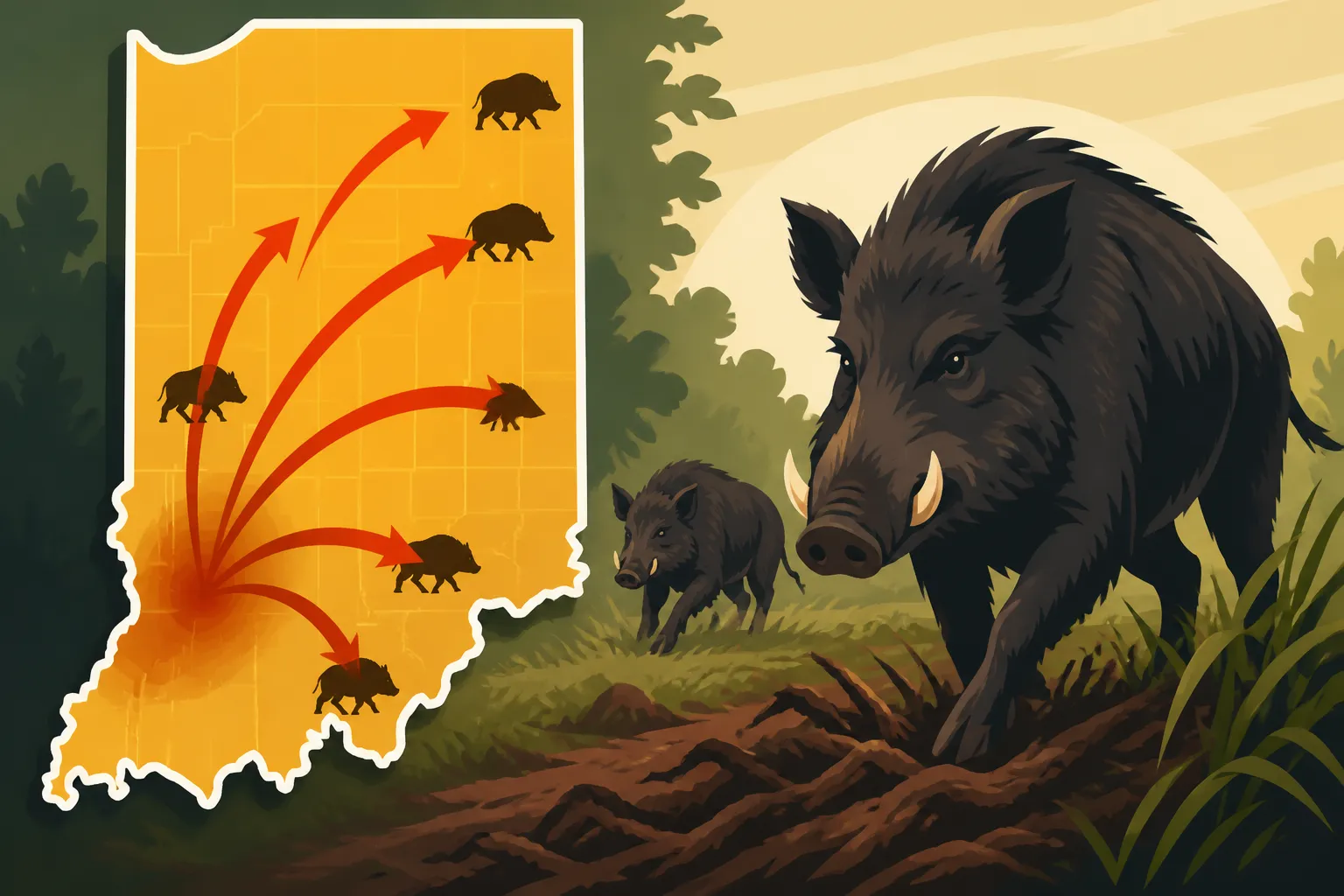
While wild hogs have been sighted in various parts of Indiana over the years, sustained populations tend to be concentrated in specific regions. Historically, southern Indiana, particularly the heavily wooded, rugged terrain near the Ohio River, has seen the most consistent presence. Counties like Perry, Crawford, and Spencer have had more frequent reports, often bordering Kentucky, which has more established hog populations. This type of habitat—dense forests, river bottoms, and agricultural interfaces—provides ideal conditions for hogs, offering cover, water, and ample food sources. You can gain insights into their movement patterns by understanding Indiana Feral Swine Genetics and Origin.
However, it's important to remember that sightings can and do occur in other parts of the state due to illegal releases or individual animals wandering. While pockets of feral swine can be found, the good news is that Indiana currently does not have the massive, widespread populations seen in some southern states. The goal of the Indiana DNR is to prevent such widespread establishment, acting quickly to eradicate any new sounders that appear. This proactive approach is critical, as a few animals can quickly become an unmanageable infestation if left unchecked.
The Role of the Indiana DNR in Surveillance and Response
The Indiana DNR takes the threat of feral swine incredibly seriously, recognizing them as a major ecological and agricultural threat rather than a game animal. Their approach is focused on eradication rather than management, aiming to eliminate populations before they can become entrenched. They work in conjunction with the U.S. Department of Agriculture (USDA) Wildlife Services to implement control measures.
A key component of the DNR's strategy is surveillance. They actively monitor reports from landowners and hunters, often deploying trail cameras and conducting ground surveys to confirm sightings and assess population size. Once a population is confirmed, a rapid response strategy is initiated. This typically involves trapping, which is considered the most effective method for eradicating entire sounders. Public cooperation is paramount, and the DNR encourages anyone who spots feral hogs to report them immediately. Detailed information on How Many Feral Hogs Indiana Has is regularly compiled through these rigorous monitoring efforts.
| Characteristic | Wild Hog (Feral Swine) | Typical Indiana Whitetail Deer |
|---|---|---|
| Reproductive Rate | Sexually mature at 6-10 months, 1-3 litters/year, 4-12 piglets/litter | Sexually mature at 1.5-2 years, 1 litter/year, 1-3 fawns/litter |
| Diet | Omnivorous (roots, crops, insects, eggs, fawns, carrion) | Herbivorous (browse, acorns, forbs, agricultural crops) |
| Habitat Adaptability | Extremely High (forests, swamps, urban fringes, farmland) | High (forests, agricultural edges, suburban) |
| Social Structure | Sounders (family groups) of varying sizes | Solitary or small groups (does & fawns, bachelor bucks) |
| Impact | Widespread rooting, crop destruction, disease vector, predation on wildlife | Browsing, occasional crop damage, minor disease transmission |
| Nocturnal Activity | Primarily nocturnal, especially under pressure | Crepuscular (dawn/dusk), some nocturnal activity |
| DNR Status | Invasive, actively eradicated | Game animal, managed for sustainable harvest |
Controlling the Spread: Trapping, Hunting, and Land Management
Given the severe threat posed by wild hogs, control efforts are multifaceted and require a concerted effort from landowners, hunters, and state agencies. The key is to be proactive and persistent.
Targeted Trapping as the Primary Eradication Method
When it comes to truly removing entire sounders of wild hogs, targeted trapping is hands down the most effective method. Unlike hunting, which often disperses hogs and makes them wary, trapping aims to capture every animal in a sounder at once. Modern traps are often large, corral-style enclosures with remotely triggered gates, allowing trappers to wait until an entire group has entered before closing the trap. This takes patience and skill, as hogs are intelligent and can quickly become trap-shy if done incorrectly.
The Indiana DNR and USDA Wildlife Services strongly advocate for and often conduct trapping operations. They often use bait, like fermented corn, to draw hogs into an area consistently over several days or weeks before setting the trap to spring. Once captured, the hogs are euthanized humanely. This method is critical because it removes breeding sows and younger hogs, significantly impacting the population's ability to rebound. For landowners who suspect they have hogs, contacting the DNR or USDA Wildlife Services is the crucial first step. You can also explore options for Trapping Indiana Feral Hogs yourself, but understanding the best practices for success and safety is important.
The Role of Hunting and Its Limitations
Hunting wild hogs in Indiana is legal year-round, without bag limits, and requires a valid hunting license. The Indiana DNR views wild hogs as an unprotected species, allowing hunters to take them on public or private land with permission. This continuous open season is a testament to the state's aggressive eradication policy. For hunters, it's an opportunity to contribute to conservation while enjoying a unique challenge. Night Hunting Hogs With Lights on Private Land is also a tactic employed to control their numbers, especially on agricultural lands where they often feed after dark.
While hunting can be a valuable tool for removing individual hogs and putting pressure on populations, it's generally not considered an effective eradication method on its own. Hogs are smart; intense hunting pressure can scatter sounders, making them more nocturnal, wary, and difficult to locate and trap. This is why agencies often prefer trapping to remove entire groups rather than relying solely on recreational hunting, which can inadvertently make the problem harder to solve. However, every hog removed by a hunter is one less animal destroying habitat and crops, so hunters are encouraged to participate in control efforts. For more details on the legal framework, consult Indiana Hog Hunting Permit Requirements.
Land Management and Prevention
Beyond direct removal, effective land management plays a critical role in preventing wild hog establishment and mitigating their impact. For landowners, this can mean implementing robust fencing around sensitive crops, managing food plots in a way that doesn't inadvertently attract hogs, and monitoring properties regularly for signs of rooting or trails. Using tools like GoHunt to analyze property boundaries, topo maps, and satellite imagery can help identify potential travel corridors or bedding areas that might be vulnerable to hog incursions.
Perhaps the most important prevention strategy is public education. Stopping the illegal transportation and release of wild hogs is paramount. Educating hunters and the general public about the severe consequences of moving these animals is a constant battle. The "If you see something, say something" mentality is vital. Reporting suspicious activity or confirmed hog sightings to the Indiana DNR helps agencies respond quickly before a small problem becomes an insurmountable one. Protecting Indiana from widespread feral swine infestation is a collective responsibility, requiring vigilance and cooperation from everyone who cares about our state's natural resources and agricultural heritage.
Disclaimer
Please note that hunting regulations, seasons, and licensing requirements can change. Always consult the most current Indiana Department of Natural Resources (DNR) regulations before engaging in any hunting activities. This content is for informational purposes only and does not constitute legal advice.