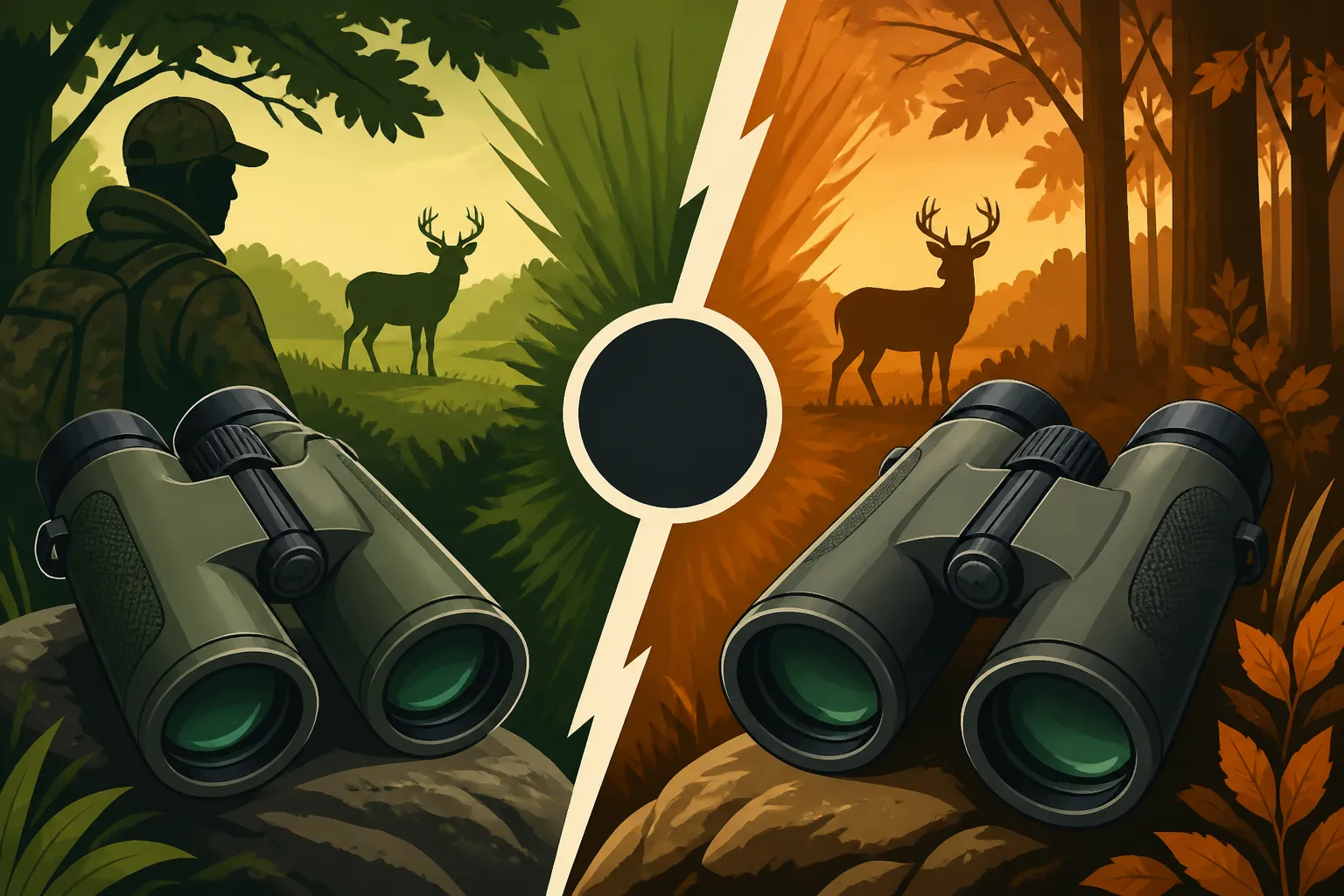
8×42 Versus 10×42 in the Woods
Choosing the right binoculars for hunting in Indiana's diverse landscapes can feel like a real head-scratcher. You're trying to decide if those crisp details at long range are worth sacrificing a wider view or a rock-steady image when a deer slips silently through the thick timber. This guide will walk you through the real-world differences between 8×42 and 10×42 binoculars, helping you understand which one best suits your hunting style in the Hoosier State's woods and fields.
Understanding Binocular Specifications for Indiana Woods
Before we dive into the nitty-gritty of how each binocular performs in the field, let's break down what those numbers—8×42 and 10×42—actually mean. It’s not just tech jargon; these figures directly impact your hunting experience, especially when you're glassing shadowy creek bottoms at dawn or scanning a distant ridge line right before dusk.
Magnification: What Do the Numbers Mean?
The first number, like the '8x' or '10x', indicates the magnification power of your binoculars. Simply put, an 8x binocular makes an object appear eight times closer than it would to your naked eye, while a 10x model makes it appear ten times closer. So, if a deer is 400 yards away, an 8x binocular would make it seem like it's 50 yards away (400/8), and a 10x would bring it in to feel like 40 yards (400/10).
This difference, while seemingly small on paper, can be quite noticeable in the field. Higher magnification, like 10x, can reveal finer details, allowing you to count antler points more clearly or discern subtle movements in distant cover. However, this increased power also amplifies any natural hand shake. Imagine holding a camera steady for a zoom shot; the more you zoom in, the harder it is to keep the image still. The same principle applies here. If your hands aren't rock-steady, that extra magnification can actually make the image less clear, turning subtle movements into blurry jitters. This is a common frustration, especially after a long walk to your stand or during those adrenaline-fueled moments when a buck finally appears.
Objective Lens Diameter: Why 42mm is a Sweet Spot
The second number, the '42' in both 8×42 and 10×42, refers to the diameter of the objective lenses (the large lenses at the front of the binoculars) in millimeters. This measurement is crucial because it dictates how much light your binoculars can gather. A larger objective lens can collect more light, which translates to a brighter, clearer image, particularly in low-light conditions.
For most hunting scenarios in Indiana, 42mm is widely considered a sweet spot. It provides an excellent balance between light-gathering capability and overall size and weight. You can certainly find binoculars with larger objective lenses (like 50mm or 56mm), which gather even more light, but they tend to be significantly heavier and bulkier, making them less practical for carrying all day through the Hoosier National Forest Hunting or hiking into a remote area. Conversely, smaller objective lenses (like 32mm or 25mm) are lighter and more compact, but they sacrifice a noticeable amount of brightness, especially during those critical twilight hours when deer are most active. That 42mm hits that ideal middle ground, ensuring you get enough light for dawn and dusk observations without feeling like you're hauling bricks around your neck.
The Case for 8×42 Binoculars in Indiana Timber
When you're slipping through the dense hardwoods of Southern Indiana or navigating the thick brush along a fencerow in the northern parts of the state, an 8×42 binocular often shines. It’s the workhorse for many hunters who prioritize a stable, wide view, especially when shots are likely to be up close and personal.
Wider Field of View and Stability
One of the most significant advantages of 8×42 binoculars is their wider field of view (FOV). This means you see a broader area through the lenses at any given moment. In the tight confines of Indiana's timber, where deer can materialize out of nowhere and disappear just as quickly, a wider FOV is invaluable. Instead of painstakingly panning to find that flick of an ear or twitch of a tail, you can scan a larger section of woods more efficiently. This makes it easier to track a moving deer, pick up on subtle signs like a feeding grouse, or simply take in more of your surroundings without constantly moving your head.
Beyond the wider view, 8x magnification offers superior image stability. As we mentioned earlier, higher magnification amplifies hand shake. With an 8x binocular, the image remains much steadier, even if you’re a bit winded from climbing a ridge or shivering from the cold. This stability is critical for quick target acquisition when a buck suddenly steps out at 60 yards. You can raise your binoculars, lock onto the animal, and assess it without the image bouncing all over the place. For moments when every second counts, or for long periods of glassing from a Treestand Setups in Hoosier National Forest, that stable 8x view reduces eye strain and fatigue, making you a more effective hunter.
Brighter Image in Low Light
The ability to perform in low light is paramount for deer and turkey hunters in Indiana. Game animals are most active during dawn and dusk, times when the forest can be incredibly dim, especially under a heavy canopy. Here, the 8×42 binoculars often have a subtle but distinct advantage. This comes down to something called the "exit pupil."
The exit pupil is the size of the light beam that exits the binocular and enters your eye. You calculate it by dividing the objective lens diameter by the magnification (42mm / 8x = 5.25mm for an 8×42; 42mm / 10x = 4.2mm for a 10×42). A larger exit pupil means more light is delivered to your eye, resulting in a perceived brighter image, especially as your pupils naturally dilate in low light. While both 8×42 and 10×42 are excellent in low light due to their 42mm objective lenses, the slightly larger exit pupil of the 8×42 can make a noticeable difference in the deepest shadows of a ravine or that last sliver of shooting light in a dense thicket. It allows you to pick out the fainter details, detect movement in gloomier conditions, and sometimes, extend your effective glassing time just enough to make a crucial observation.
The Advantages of 10×42 Binoculars for Indiana Hunters
While the 8×42 excels in dense cover, the 10×42 finds its stride when you need to reach out and touch something with your eyes. For hunters who frequently encounter more open terrain or need to scrutinize distant game, the extra magnification can be a game-changer.
Increased Detail at Longer Distances
The primary reason to choose a 10×42 binocular is, of course, the increased magnification. That extra 2x power can reveal details that an 8x might just blur into general shape. Imagine you're sitting on the edge of a large Hunting a Standing Soybean Field or glassing across a vast clear-cut on public land. With a 10×42, you can often discern if that faint brown patch under a distant tree is a bedded deer or just a stump, or if the rack on that buck at 300 yards has the points you're looking for.
This additional reach is especially valuable when hunting species like turkeys in a wide-open field or trying to identify movement on a far-off hillside. It allows you to stay put and analyze situations from a greater distance, minimizing your disturbance of the environment. While the narrower field of view and increased hand shake can be drawbacks, the trade-off is often worth it for hunters who prioritize getting the clearest, most magnified view possible when distances stretch out. You can effectively "scout" an area from afar, saving valuable time and energy, and often spotting game before they ever know you're there.
When the Extra Reach Matters
There are many specific scenarios in Indiana hunting where the additional reach of a 10×42 can truly make a difference. Consider hunting a large agricultural property in Northern Indiana, where deer might feed 500 yards away in a cut cornfield, or cross a far-off fencerow that you can only see from your ridge-top stand. A 10x binocular allows you to study their patterns, identify specific animals, and even spot other hunters from a safe distance.
Perhaps you're trying to locate a gobbler on a distant ridge during Spring Turkey Hunting in Indiana. With a 10×42, you might pick out the faint movement of a strutting tom or a hen feeding in the undergrowth that would be missed with less magnification. When Scouting Indiana Public Land Before Season, you might use your 10x binoculars to scan distant timber for rubs or scrapes without having to physically walk to every suspicious-looking patch of woods. Even for smaller game, trying to identify a squirrel nest high in a distant hickory grove can be made easier. For hunters who leverage mapping tools like GoHunt or other digital scouting resources, a 10x binocular complements the aerial views by providing detailed ground-level verification of distant features marked on the map. It helps confirm those suspected deer trails, distant thickets, or potential bedding areas without putting boots on the ground right away.
Making Your Choice: Factors to Consider
Deciding between 8×42 and 10×42 isn't about one being inherently "better" than the other. It's about which tool is better for you and your specific hunting style in the places you'll be hunting in Indiana. It’s a personal choice that balances multiple factors.
Your Hunting Style and Terrain
Think critically about how and where you typically hunt. Are you primarily still-hunting through dense, brushy creek bottoms and timber tracts, where quick, close-range observations are the norm? If so, the wider field of view and superior stability of an 8×42 will likely serve you better. It allows you to scan effectively, reduce eye strain, and quickly acquire a target in tight cover without the image jumping around. This is especially true if you hunt Reading a Ridge for Hoosier Forest Deer where the terrain is broken and views are often obstructed.
Conversely, if you spend a lot of time in a fixed position, perhaps in a treestand overlooking a large open field, a food plot, or a vast river bottom, then the added magnification of a 10×42 will give you an edge. It’s ideal for picking apart distant cover, identifying game at long ranges, or discerning subtle details like antler size on a buck across a field. If your hunts often involve Hunting Northern Indiana Farmland Deer where long sightlines are common, that extra reach will be incredibly beneficial. Hunters who regularly use a rangefinder and take longer shots might also prefer the 10x to better gauge distances and assess game more thoroughly.
| Feature / Consideration | 8×42 Binoculars | 10×42 Binoculars |
|---|---|---|
| Magnification | 8x (Objects appear 8x closer) | 10x (Objects appear 10x closer) |
| Field of View | Wider (Easier to scan large areas in dense cover) | Narrower (More focused, harder to scan quickly) |
| Image Stability | Excellent (Less hand shake, easier to hold steady for long periods or quick target acquisition) | Good (More susceptible to hand shake, requires steadier hold) |
| Brightness (Low Light) | Slightly brighter perceived image (Larger exit pupil) | Slightly less bright perceived image (Smaller exit pupil) |
| Detail at Distance | Good for most typical hunting ranges | Excellent for picking out fine details at extended ranges |
| Ideal Terrain | Dense timber, thick brush, close-quarters hunting, tracking moving game | Open fields, long ridgelines, food plots, clear-cuts, long-distance observation |
| Eye Strain | Generally less, especially with extended use or unstable positions | Can be more noticeable with extended use or if hands aren't steady |
| Typical Use Case | Still-hunting deep woods, stalking, quick assessments, fast-moving game | Stand hunting over open areas, long-range scouting, identifying distant antlers, turkey hunting fields |
Budget, Quality, and Ergonomics
It's also important to remember that not all 8x42s or 10x42s are created equal. The quality of the optics, coatings, and construction can significantly impact performance, often more so than the slight difference in magnification. A high-quality 8×42 binocular with excellent glass and coatings might offer a brighter, crisper image than a lower-end 10×42, even with the latter's higher magnification. Better optics can mitigate some of the drawbacks; for example, a premium 10x binocular might have such clear glass that its low-light performance rivals a cheaper 8x.
Beyond the optics, consider the ergonomics. How do they feel in your hands? Is the focus wheel smooth and easy to operate with gloves on? What about the weight? If a pair of binoculars feels uncomfortable or too heavy, you'll be less likely to carry them, defeating the purpose. Many hunters find that reviewing user feedback on platforms like GoHunt, or trying different models in person at a sporting goods store, is incredibly helpful for assessing quality and ergonomics. Look for binoculars that feel robust, have good eye relief (the distance your eye can be from the eyepiece and still see the full field of view), and are sealed to protect against Indiana's often wet and humid weather. Ultimately, investing in the best quality you can afford, regardless of the magnification, will always pay dividends in the field.
Disclaimer
This article is for general informational purposes only and does not constitute professional advice. Laws, prices and regulations vary by location and change over time. Consult a qualified professional for guidance on your specific situation.