Zeroing at 100 Yards for Woods Hunting
Many hunters fall into the trap of obsessing over extreme long-range ballistics, picturing those cinematic 400-yard shots. But let's be realistic: in the dense timber and rolling hills of Indiana, most deer encounters happen at surprisingly close distances, often leaving you with precious few seconds to make a confident shot. This guide will cut through the confusion and explain exactly why zeroing your rifle at 100 yards is not just sufficient, but often the absolute best strategy for deer hunting in the Hoosier State, ensuring you're perfectly prepared for the reality of those quick, close encounters.
The Undeniable Reality of Indiana Woods Hunting Distances
Hunting in Indiana isn't typically about wide-open spaces where you can dial in for hundreds of yards. It's about navigating thick woods, rolling terrain, and tight cover where deer appear and disappear in an instant. Understanding this fundamental truth is the first step to setting up your rifle for success.
Why 100 Yards Covers Most Real-World Scenarios
Think about your last few deer encounters in Indiana. Were they across vast agricultural fields stretching for a quarter-mile, or were they in a brushy creek bottom, a timbered funnel, or along a fencerow where visibility was limited to 50, 70, maybe 100 yards at best? For most of us, it's the latter. The typical shot distance in the thick hardwood forests of southern Indiana, or even the woodlots and creek lines of northern Indiana farmland, rarely extends beyond 125 yards.
Deer move through lanes in the timber, behind brush, or over rises that obscure them. You might catch a glimpse of a deer at 200 yards, but often by the time you can identify it and get a clear, ethical shot, it's closed the distance, or you've moved to get closer. Over-complicating your ballistic setup for a shot you're unlikely to take can actually hinder your performance on the shots you will take. The frustration of needing to make a lightning-fast decision on a deer that suddenly materializes at 60 yards, only to second-guess your holdover because you're zeroed at 200 yards, is something many hunters face. A 100-yard zero simplifies this, providing a confident aim point where it matters most.
The "Point-Blank Range" Advantage for Common Calibers
When we talk about "point-blank range," we're not talking about hitting the exact same spot from zero yards to 200 yards. What we mean is the effective range where your bullet's trajectory remains within a vital zone (typically considered a 4 to 6-inch diameter circle) without needing significant holdover or holdunder adjustments. For most popular deer hunting calibers – think your .270s, .30-06s, .308s, 6.5 Creedmoors, or even some of the newer straight-wall options – a 100-yard zero provides an incredibly flat trajectory well past that 100-yard mark.
With a 100-yard zero, your bullet will typically rise a couple of inches above your line of sight somewhere around 50 yards, then fall back to zero at 100 yards, and then drop a few more inches out to 150 or even 200 yards. For a deer's vital zone, this means if you aim dead-on at 100 yards, you're going to hit the vitals without thinking about it at 25, 75, 125, or even 150 yards for many cartridges. This provides immense confidence and reduces the mental load in a high-pressure situation. You can focus entirely on shot placement and trigger control, not on ballistic math. It's especially useful when Hunting Southern Indiana Hill Country where shot angles can also play a role, or Hunting Northern Indiana Farmland Deer where woodlots might offer a longer shot, but still within this practical range.
Here's a simplified look at how some common hunting cartridge types generally perform with a 100-yard zero:
| Cartridge Type (Example) | Point of Impact @ 50 Yards (Approx.) | Point of Impact @ 100 Yards | Point of Impact @ 150 Yards (Approx.) | Typical "Point-Blank" Range (Approximate) |
|---|---|---|---|---|
| Fast, Flat-Shooting (e.g., .270, 6.5 CM) | 1-2 inches high | Dead on | 1-3 inches low | Out to 200-225 yards (within 4-inch vitals) |
| Moderate Velocity (e.g., .308, .30-06) | 1-2 inches high | Dead on | 3-5 inches low | Out to 175-200 yards (within 4-inch vitals) |
| Lever-Action (e.g., .30-30, .35 Rem) | Dead on to 1 inch high | Dead on | 5-8 inches low | Out to 150-175 yards (within 4-inch vitals) |
| Straight-Wall (e.g., .450 Bushmaster, .350 Legend) | Dead on to 1 inch high | Dead on | 4-7 inches low | Out to 150-175 yards (within 4-inch vitals) |
Note: These are general relationships. Your specific rifle, ammunition, and environmental factors will influence actual trajectory. Always confirm with your own testing.
Step-by-Step: Achieving a Rock-Solid 100-Yard Zero
Getting your rifle properly zeroed is more than just hitting the target; it's about building trust in your equipment. A precise 100-yard zero ensures that you know exactly where your bullet is going to hit in the most common hunting scenarios you'll face in Indiana.
Pre-Range Inspection and Essential Gear
Before you even think about heading to the shooting range, take some time to inspect your rifle. A loose scope mount or dirty bore can throw off your zero significantly. Begin by checking all your scope mount screws – the ones holding the rings to the base and the rings to the scope itself. Give them a good, firm check with a proper torque wrench if you have one, or at least a snug twist with a screwdriver. You'd be amazed how many "unexplained misses" are simply due to a scope shifting under recoil. Next, ensure your rifle's bore is clean. Fouling can impact accuracy, especially with a fresh zero.
Crucially, choose the ammunition you plan to hunt with and stick with it. Different bullet weights and brands, even within the same caliber, will often impact in different places. Consistency is key. You'll also need a sturdy shooting rest – a good bipod, sandbags, or a lead sled will make the zeroing process much easier and more precise. Don't forget a spotting scope or good binoculars to see your impacts, and, of course, proper eye and ear protection. If you're looking for public ranges or want to scout out potential shooting lanes on public land before heading out, using a mapping tool like GoHunt can be incredibly helpful for planning your trips and getting familiar with the area. It can also assist in confirming land ownership if you plan to shoot on private property. For more on preparing your firearm, check out Rifle Setups for Indiana Deer Hunting.
The Practical Process on the Range
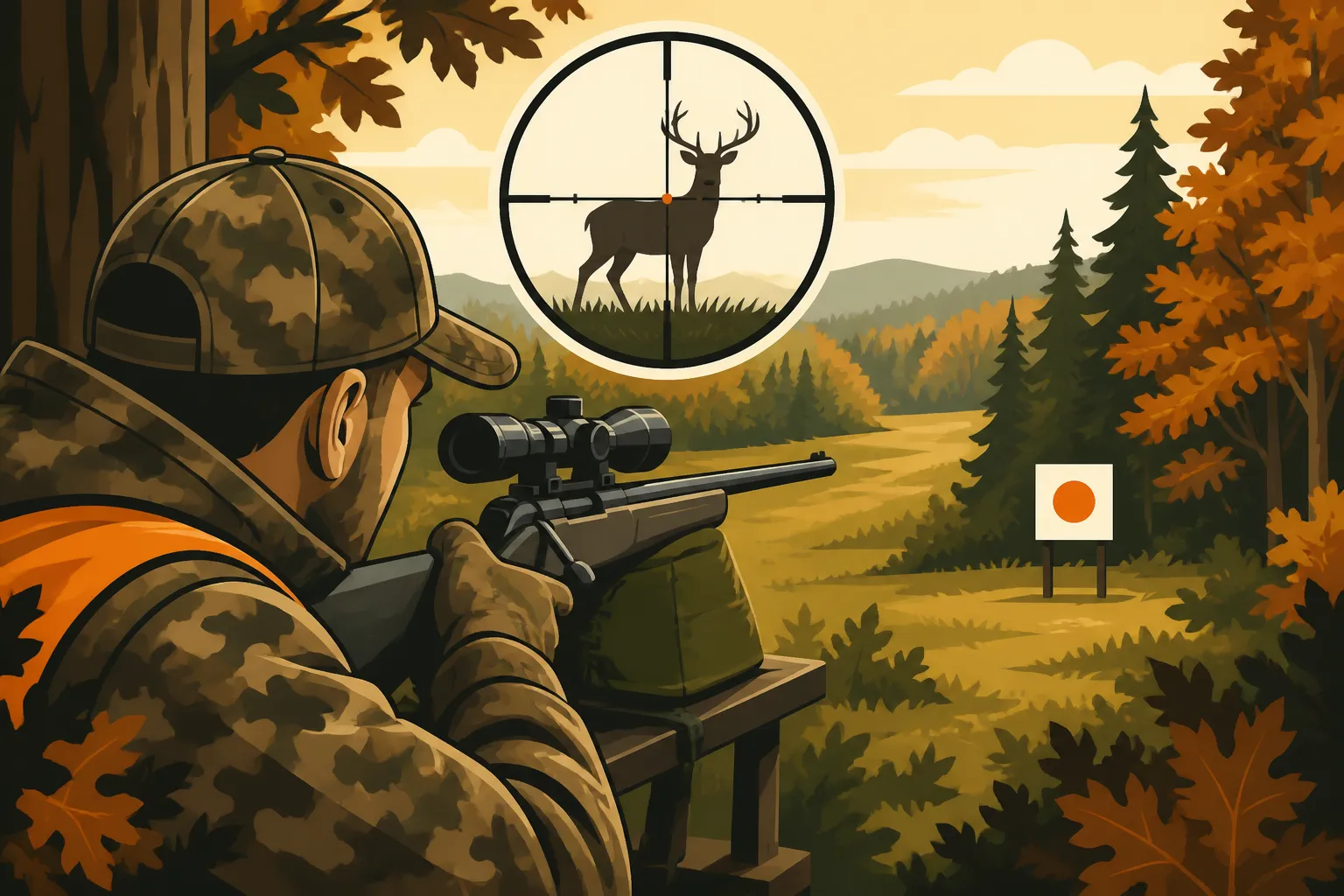
Once you're at the range, there's a methodical process to zeroing. If you have the option, starting with a boresight can save you a lot of ammunition and frustration. A boresighter, whether a laser type or a collimator, helps align your scope with your bore before you even fire a shot, usually getting you "on paper" at close range. If you don't have one, no worries, you can still get zeroed effectively.
Begin by shooting at a closer distance, like 25 yards. This ensures you'll hit the target somewhere. Fire a three-shot group, aiming dead center. This group will tell you where your rifle is actually shooting. Once you see your group, adjust your scope's windage and elevation turrets. Most scopes have clicks that represent a certain amount of movement (e.g., 1/4 MOA per click, meaning 1/4 inch at 100 yards, or 1/16 inch at 25 yards). Adjust your scope so that the next group will move toward your aim point. Repeat this process until you're consistently grouping shots dead center at 25 yards.
Now, move your target out to 100 yards. This is where your true zero will be established. Again, fire a precise three-shot group, aiming at the bullseye. Observe where your group hits relative to your aim point. Use your scope's adjustments to "walk" the group to the center. For example, if your group is 2 inches low and 1 inch left at 100 yards, and your scope is 1/4 MOA per click, you'd adjust up 8 clicks (2 inches / 0.25 inches per click = 8 clicks) and right 4 clicks (1 inch / 0.25 inches per click = 4 clicks). Fire another group to confirm. Repeat until your groups are consistently centered at 100 yards. Don't chase individual shots; always make adjustments based on the average center of a tight group. This consistent approach ensures you're ready for any shot within Practical Range in Indiana Timber.
Understanding Your Rifle's Trajectory for Shots Beyond 100 Yards
While a 100-yard zero is ideal for the vast majority of Indiana woods hunting, it's also important to understand how your bullet will behave if a longer shot opportunity does present itself. Knowing your rifle's capabilities and limitations will only enhance your confidence.
Knowing Your Ballistics: Drop and Drift
Even with a 100-yard zero, gravity is an undeniable force. Your bullet will begin to drop relative to your line of sight immediately after leaving the barrel, only intersecting your line of sight at your zero distance (100 yards in this case). Beyond 100 yards, that drop becomes more pronounced. For instance, many common deer calibers, zeroed at 100 yards, might drop 4-6 inches at 200 yards. While this might sound like a lot, it's still often within the upper or lower half of a deer's vital zone if you aim dead center. However, it's crucial to know your specific rifle and ammunition's ballistic curve. Generic charts are a good starting point, but they don't account for your barrel length, specific ammo velocity, or local atmospheric conditions.
Wind also plays a role, even at closer ranges, though its effect on a 100-yard shot is usually negligible for deer hunting. At 200 yards, a moderate crosswind can push your bullet several inches off course. While a 100-yard zero primarily addresses vertical trajectory (drop), understanding wind drift is also part of being a complete marksman. In the dense woods of Indiana, wind can be notoriously tricky, swirling and changing direction with the topography. Utilizing a mapping tool like GoHunt can help you analyze terrain and anticipate potential wind currents based on features like valleys, ridges, and clearings, which is also useful when you're Scouting Indiana Public Land Before Season or trying to understand Wind and Thermals on a Southern Indiana Ridge.
When and How to Compensate for Longer Shots (The Exception, Not the Rule)
Let's be clear: truly long shots (200+ yards) are the exception, not the rule, in Indiana. But they can happen, particularly if you're hunting along large field edges, power line cuts, or open areas within public lands like the Hoosier National Forest. For these less frequent scenarios, your 100-yard zero still serves as an excellent foundation, but you'll need to know how to apply a little holdover.
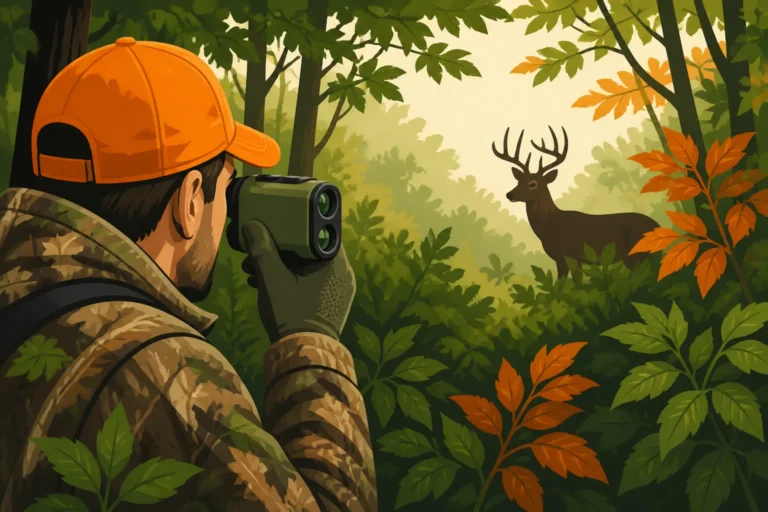
Instead of adjusting your scope turrets in the field (which is often impractical and time-consuming when a deer is in front of you), most hunters use what's called "holdover." This means simply aiming slightly higher on the target. If you know your bullet drops 5 inches at 200 yards with a 100-yard zero, you'd aim roughly 5 inches high on the deer's shoulder. This requires practice and knowing your dope. A quality laser rangefinder is absolutely indispensable for these situations. It instantly tells you the exact distance, allowing you to apply the correct holdover based on your rifle's known ballistics. For more on rangefinding in our state's varied cover, check out Rangefinders in Thick Southern Indiana Cover.
Remember, the goal isn't to become a long-range precision shooter for Indiana deer. The goal is to be profoundly confident in the ranges you will typically encounter, and to have a simple, effective strategy for the rare longer shot. A 100-yard zero strikes this balance perfectly, simplifying the majority of your hunting experiences while giving you the tools to adapt for the rest.
Maintaining Accuracy and Field Confidence
Getting your rifle zeroed at 100 yards is a critical first step, but maintaining that accuracy and building confidence in the field requires ongoing effort. A zero isn't a "set it and forget it" kind of deal.
Practice Makes Perfect: Realistic Field Drills
Hitting a tight group from a bench rest at 100 yards is one thing; making a clean shot at a deer that steps out unexpectedly at 70 yards while you're kneeling, with your heart pounding, is another. To truly build field confidence, you need to practice shooting from realistic hunting positions. Set up targets at various distances (25, 50, 75, 100 yards) and practice shooting off-hand, kneeling, sitting, or using a tree as a rest. Simulate quick, unexpected shots where you have only a few seconds to react.
These drills help you understand your rifle's balance, how quickly you can acquire a target, and how stable you are in different stances. The more you practice, the more muscle memory you build, which translates into calmer, more accurate shots when it counts. Don't be afraid to incorporate movement into your practice, too. Walk for a bit, then stop and quickly acquire a target, simulating still-hunting. This kind of dynamic practice is invaluable for Indiana's varied terrain. Consider incorporating these drills after reading up on different Best Rifle Calibers for Indiana Whitetails to ensure you're familiar with your chosen setup.
Regular Checks and What to Inspect
Your rifle's zero can shift for various reasons: a bump or drop, extreme temperature changes, or even just the natural settling of components over time. It's a wise practice to periodically check your zero, ideally before each hunting season or after any significant travel or rough handling of your rifle. A simple three-shot group at 100 yards will confirm if your zero is still holding true.
Pay attention to your scope mounts and rings. They can sometimes work loose under recoil or from vibrations during transport. A loose mounting screw can cause frustrating and unexplained shifts in your point of impact. Also, consider the environment. If you zero your rifle in 70-degree weather and then hunt in freezing January conditions, you might see a slight shift in impact due to changes in powder burn rates or barrel harmonics. These shifts are usually minor for deer hunting ranges but are worth being aware of. A good Rifle Scopes for Low-Light Timber setup should also maintain its zero robustly through these conditions.
Ultimately, your 100-yard zero for Indiana woods hunting is a foundation of confidence. It's about simplifying your shooting solutions in a complex environment. With regular practice and periodic checks, you'll be ready and confident when that Hoosier whitetail steps into your shooting lane, no matter if you're in a stand using a Cold-Weather Sitting Strategy in Indiana or sneaking through a Hunting a Funnel Between Two Woodlots.
Disclaimer
This article is for general informational purposes only and does not constitute professional advice. Laws, prices and regulations vary by location and change over time. Consult a qualified professional for guidance on your specific situation.