Best Shotgun Gauge for Indiana Pheasant
It's a common dilemma when you're gearing up for pheasant season in Indiana: which shotgun gauge is truly the "best"? You want something that's effective, comfortable to carry, and gives you confidence when a rooster busts out of a fencerow at warp speed. This guide will walk you through the various shotgun gauges, their real-world applications in Indiana's diverse pheasant habitats, and help you decide what will put more birds in your game vest.
Understanding the Core Gauges for Pheasant Hunting
When it comes to pheasant hunting, a few shotgun gauges consistently rise to the top of discussions. Each has its loyalists and its critics, but understanding their fundamental characteristics is key to making an informed choice for your Indiana hunts. We're talking about the 12-gauge, the 20-gauge, the 28-gauge, and even the often-underestimated .410 bore. It's not just about the size of the hole in the barrel, but about the payload, pattern density, and overall shootability for flushing birds.
The Venerable 12-Gauge
The 12-gauge shotgun is, without a doubt, the most popular choice for upland bird hunting across the country, and Indiana is no exception. Its popularity stems from its incredible versatility. You can throw a huge payload of shot with a 12-gauge, which means you get a dense pattern and greater forgiveness for slight aiming errors, especially on fast-moving birds. This larger payload also translates to more pellets downrange, which can be a real advantage when you’re trying to connect with a tough old rooster pheasant.
For Indiana hunters, the 12-gauge offers options from lighter 2 ¾-inch loads all the way up to heavy 3-inch magnum shells. While you likely won't need a 3-inch magnum for pheasants, the ability to choose from a vast array of shot sizes and loads means you can truly dial in your pattern for different hunting conditions. If you're hunting expansive open fields where shots might be a bit longer, or if you're hunting with a strong pointing dog and want to ensure a clean kill on a bird holding tight, the 12-gauge provides that extra confidence. However, that versatility often comes with increased recoil, which some shooters find challenging over a long day of walking, and the guns themselves tend to be heavier, making those miles through cover feel even longer.
The Nimble 20-Gauge
Often hailed as the "gentleman's gauge" or the perfect compromise, the 20-gauge has steadily grown in popularity for pheasant hunting. It offers a significant reduction in recoil compared to the 12-gauge, making it much more comfortable to shoot for an entire day, especially if you're putting in serious miles in the field. The guns themselves are typically lighter and more slender, leading to quicker swings and easier handling, which can be a huge advantage when a pheasant explodes from underfoot and you need to get on target fast.
While the 20-gauge does throw a lighter payload than a 12-gauge, modern ammunition technology has made it incredibly effective for pheasants. With the right shot size and choke, a 20-gauge can put a dense, lethal pattern on a bird out to respectable ranges. Many experienced pheasant hunters find that the lighter weight and reduced recoil allow them to shoot more accurately and remain more comfortable, ultimately leading to more consistent performance in the field. It’s a fantastic choice for younger hunters or those who are recoil-sensitive, proving that you don't need the biggest gun to be effective. For those looking for a balanced upland gun that's a joy to carry all day, the 20-gauge is hard to beat. 20 Gauge Doubles for Fencerow Cover explores this gauge's strengths in a common Indiana habitat.
The Elegant 28-Gauge
The 28-gauge is often considered a specialized or "boutique" gauge, but it has a dedicated following among upland hunters, particularly for species like quail and grouse. For pheasants, it's a bit more of a niche choice, but don't underestimate its capabilities. The 28-gauge delivers an incredibly efficient and consistent shot pattern with very mild recoil, making it a dream to shoot. The guns built for the 28-gauge are usually lightweight and elegant, designed for fast handling and a responsive feel in the field.
The key with a 28-gauge for pheasants is knowing its limitations and shooting it well. It typically throws a ¾-ounce payload of shot, which is considerably less than a 12 or 20. This means your pattern is smaller and less forgiving, requiring a more precise shot. If you're a skilled shooter who can consistently connect with flushing birds and keep shots within 30-35 yards, the 28-gauge can be an absolute pleasure. It's often chosen by experienced hunters who appreciate the challenge and the minimal recoil. However, for most hunters, especially those new to pheasant hunting or who anticipate longer shots over dogs that range wide, it might be a bit underpowered for ensuring clean kills on tough pheasants.
The Underestimated .410 Bore
The .410 bore is often thought of as a beginner's gun or solely for small game like squirrels, but it can be surprisingly effective on pheasants in the hands of a truly expert shooter. It boasts the lightest recoil and lightest guns of all the gauges discussed, making it extremely easy to carry and quick to shoulder. However, the .410 throws a very small payload – typically ½ ounce or 11/16 ounce in 3-inch shells – resulting in a very sparse pattern.
Successfully hunting pheasants with a .410 demands exceptional shooting skills, a tight choke, and a commitment to only taking close-range shots. There's almost no room for error, and if you're not putting the core of that pattern exactly on the bird, you're likely to wound rather than cleanly kill. While the idea of dropping a rooster with a .410 certainly earns bragging rights, for ethical hunting and consistent success, it's generally not recommended for the average pheasant hunter. It's truly a specialist's tool for those who crave the ultimate challenge and are willing to pass on all but the closest, most ideal shots.
Matching Your Gauge to Indiana's Pheasant Habitats
Indiana's landscape offers a variety of pheasant hunting scenarios, from vast stretches of corn and soybean fields to dense CRP (Conservation Reserve Program) grasslands and brushy fencerows. The "best" shotgun gauge isn't just about raw power; it's about what fits the terrain and how those wily Indiana pheasants typically behave in it. Understanding these dynamics will help you choose a gauge that gives you the best chance of success. When scouting for these diverse areas, an application like GoHunt can be invaluable for identifying potential pheasant cover from aerial views.
Open Fields and CRP Grasslands
When you're slogging through chest-high CRP grass or walking the edges of cut cornfields, shots can vary wildly. Sometimes a bird will hold tight, busting out practically at your feet. Other times, a pressured rooster might flush 40 or 50 yards out, especially on public lands where they've seen some action. This is where the versatility of the 12-gauge really shines. Its ability to throw a heavy, dense pattern means you're prepared for those longer shots that can sometimes be the only opportunity you get. You can also dial down to lighter loads for closer work without sacrificing pattern density entirely.
However, the 20-gauge is also an excellent choice here. Modern 20-gauge loads with advanced wads and shot technology can deliver effective patterns out to 35-40 yards, which covers the vast majority of pheasant shots. The lighter gun makes walking those big fields much less fatiguing. If you're hunting with a strong dog that gives you solid points and allows you to close the distance, a 20-gauge is often more than enough. Many hunters find that the reduced recoil of the 20-gauge allows for faster follow-up shots if you miss the first, or if a second bird flushes unexpectedly. For hunters who prioritize comfort and maneuverability without sacrificing too much reach, the 20-gauge is a strong contender for these open areas. Pheasant Hunting Indiana Grassland offers more insights into hunting these environments.
Thick Fencerows and Brushy Cover
Indiana is crisscrossed with fencerows, small woodlots, and brushy creek bottoms – prime real estate for pheasants, especially later in the season when temperatures drop. Birds love to dive into this thick stuff for cover and thermal protection. In these environments, flushes are almost always sudden and at close range. A bird might explode just five to fifteen yards in front of you, giving you mere seconds to react. Here, quick handling and an open pattern are often more important than long-range capability.
For these close-quarters encounters, a 20-gauge truly excels. Its lighter weight and smaller frame allow for faster mounting and swinging through dense brush. A 12-gauge can certainly work, but a heavier gun might feel cumbersome as you navigate tangled cover, and the stronger recoil might be less forgiving on those lightning-fast, close-in shots. Even a 28-gauge could be a viable, albeit challenging, option for a skilled shooter in these tight spots, where precise, close shots are the norm. The key is a gun that comes to the shoulder naturally and quickly. A more open choke, like improved cylinder or modified, is usually preferred to allow the pattern to open up quickly at short distances. Pheasant Hunting a Fencerow Edge goes into greater detail on these specific tactics.
Managed Public Lands and Stocked Birds
Indiana has several Fish and Wildlife Areas (FWAs) that offer pheasant hunting, some even with stocked birds. These areas can see significant hunting pressure, and birds might flush wild or run before holding for dogs. In such scenarios, having a bit more firepower can be beneficial. The sheer volume of pellets a 12-gauge can deliver helps penetrate thicker plumage and provides a margin of error that can be crucial when birds are moving fast or presenting challenging angles.
However, the "best" gauge still comes down to personal preference and shooting skill. A confident 20-gauge shooter can certainly be just as effective as a 12-gauge shooter on stocked birds. The most important factor on pressured public land is often patience and good dog work, allowing you to get close enough for an ethical shot regardless of your gauge. When planning your trips to these specific public access points, utilizing a tool like GoHunt can assist in understanding terrain features and potential access points, though always check specific FWA rules and regulations directly with the DNR.
Beyond Gauge: Chokes, Shot Size, and Comfort
Choosing the right gauge is a fantastic starting point, but it's only one piece of the pheasant hunting puzzle. To truly optimize your setup for Indiana birds, you need to think about choke constriction, shot size, and how comfortably you can shoot your chosen firearm throughout a long day in the field. These elements can significantly impact your success and enjoyment.
Choke Choice for Pheasants
A shotgun's choke dictates how tightly the shot pattern holds together after leaving the barrel. For pheasant hunting, where shots can range from close-quarters flushes to longer opportunities, having the right choke is paramount.
- Improved Cylinder (IC): This is a great all-around choke, especially for hunting with dogs that hold birds close, or in thicker cover like fencerows where shots are typically under 30 yards. It allows the pattern to spread fairly quickly, offering a larger target area and more forgiveness. Many hunters start with an IC choke.
- Modified (MOD): If you anticipate slightly longer shots, or if you're hunting more open fields without a dog, a Modified choke is an excellent choice. It keeps the pattern tighter than an IC, extending your effective range out to around 40 yards. This is arguably the most versatile choke for pheasants, offering a good balance of spread and density.
- Full (FULL): A Full choke delivers the tightest pattern, ideal for very long shots (40+ yards) or for hunters who want maximum pellet density at range. However, at closer distances, a Full choke can result in a "blown" pattern, meaning the shot is so concentrated it creates a hole in the bird, potentially ruining meat or causing a miss if the pattern core isn't perfectly centered. It's generally less forgiving for rapid, close flushes.
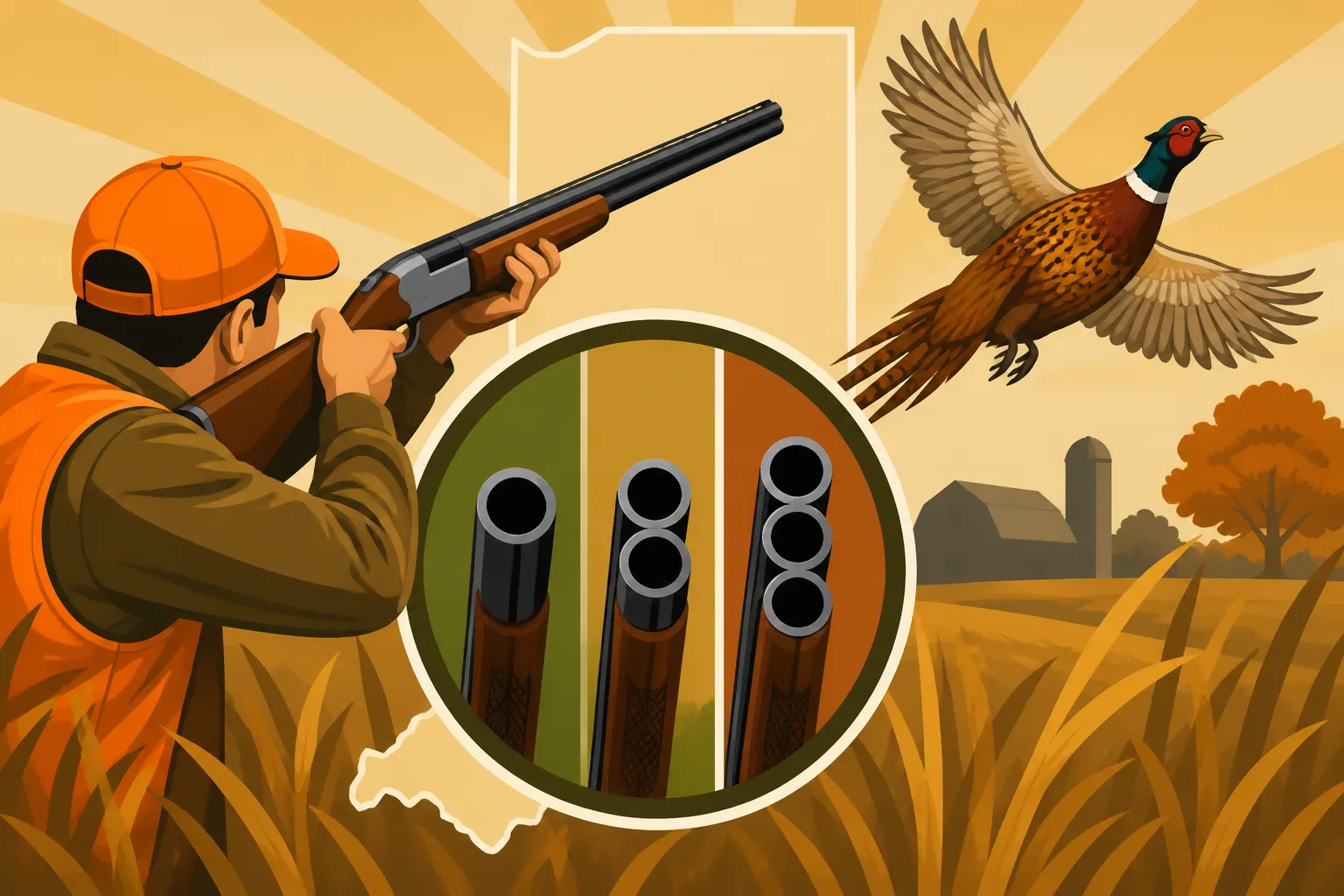
Many over/under or side-by-side shotguns allow you to have different chokes in each barrel (e.g., IC in the first barrel, MOD in the second). For pump-action or semi-automatic shotguns, interchangeable choke tubes make it easy to adapt to conditions. Choke Choice for Fast Flushes dives deeper into selecting the right constriction.
Shot Size for Indiana Pheasants
Selecting the right shot size is crucial for ethical and effective pheasant hunting. You need enough pellet energy to penetrate the bird's dense feathers and tough body, but also enough pellets in the pattern for a high probability of hitting vital organs.
The most common and effective shot sizes for pheasants are No. 4, 5, and 6 lead shot.
- No. 6 shot is excellent for closer range birds (under 30-35 yards) and in areas where you might also encounter quail or rabbits. It provides a dense pattern, increasing the chances of multiple pellet hits. Shot Size for Pheasant and Rabbit often cross-references with this size.
- No. 5 shot is a fantastic all-around choice. It offers a good balance of pellet count and individual pellet energy, making it effective for a wide range of pheasant hunting situations, from medium-range flushes to slightly longer shots. It's a great choice if you only want to carry one type of shell.
- No. 4 shot carries the most energy per pellet and is best for longer shots (35+ yards) or for those tough, late-season roosters with heavy plumage. It provides fewer pellets per shell than 5s or 6s, so a denser pattern is even more critical.
For environmentally sensitive areas, or if you simply prefer, non-toxic alternatives like bismuth or tungsten-matrix are available. These often perform similarly to lead shot of the next size up (e.g., No. 5 bismuth might perform like No. 4 lead). Always check local regulations, especially on public lands, as some may require non-toxic shot.
Comfort and Ergonomics
This often-overlooked factor is arguably as important as gauge and choke. If your shotgun doesn't fit you well, or if it's too heavy and produces too much recoil for your comfort, you won't shoot it effectively, and you certainly won't enjoy your time in the field.
- Gun Fit: A shotgun that "fits" you comes to your shoulder naturally, aligns your eye with the rib, and points instinctively. If a gun is too long, too short, or has an incorrect comb height, you'll be fighting it with every shot. This leads to missed birds and frustration. Consider getting your shotgun fit checked by a professional if you're serious about your shooting.
- Recoil: As discussed, 12-gauge shotguns generally have more recoil than 20-gauges, which have more than 28-gauges, and so on. Excessive recoil can lead to flinching, poor shooting habits, and general discomfort. If you're sensitive to recoil, or if you're putting in heavy mileage, choosing a lighter-recoiling gauge or a gas-operated semi-automatic (which absorbs recoil more effectively) can make a huge difference.
- Weight: Carrying a heavy shotgun for several miles through fields and fencerows is a workout. A lighter gun is a joy to carry all day, reducing fatigue and allowing you to remain fresh and focused when a bird flushes. Many upland-specific shotguns, especially 20-gauges and 28-gauges, are designed with weight savings in mind. Barrel Length for Walking Thick Cover discusses how gun configuration also plays a role in overall maneuverability and weight distribution. When using tools like GoHunt to plan your extensive walking routes, remember that every ounce matters on a long day.
Ultimately, the best shotgun gauge for Indiana pheasant hunting is the one you shoot most confidently and comfortably. While the 12-gauge offers maximum versatility and the 20-gauge provides a fantastic balance of power and comfort, personal skill and preference will always trump any arbitrary "best" designation.
Here's a quick comparison of the common gauges for pheasant hunting:
| Gauge | Common Payload (oz.) | Typical Effective Range | Recoil Level | Typical Gun Weight | Best For |
|---|---|---|---|---|---|
| 12-Gauge | 1 to 1 1/4 | Up to 45 yards | Medium to Heavy | Medium to Heavy | All-around versatility, longer shots, open fields, heavy cover, less precise shooters |
| 20-Gauge | 3/4 to 1 | Up to 40 yards | Light to Medium | Light to Medium | Balanced performance, comfort, quicker handling, good for walking hunters, moderate ranges |
| 28-Gauge | 3/4 | Up to 35 yards | Very Light | Light | Experienced, precise shooters, close-range work, those prioritizing low recoil and elegance |
| .410 Bore | 1/2 to 11/16 | Up to 25 yards | Very Light | Very Light | Expert shooters, very close-range shots only, ultimate challenge, minimal meat damage |
This article is for general informational purposes only and does not constitute professional advice. Laws, prices and regulations vary by location and change over time. Consult a qualified professional for guidance on your specific situation.