Marsh Boats and Push Poles
Navigating Indiana's vast marshlands for waterfowl can feel like an impossible puzzle. The shallow, mucky waters, dense cattail stands, and hidden obstacles often make reaching prime hunting spots a back-breaking struggle with traditional boats or even just wading. This guide will walk you through the world of marsh boats and push poles, showing you how these specialized tools can transform your access and success in the state's most challenging wetland environments.
Why Traditional Methods Fall Short in Indiana Marshes
When you picture waterfowl hunting, you might imagine a classic john boat or an aluminum V-hull making its way across open water. While those vessels certainly have their place, they often become more of a liability than an asset in the unique, often unforgiving conditions of Indiana's marshes. The challenges posed by these environments demand a different approach, one that recognizes the limitations of conventional gear and embraces specialized solutions.
The Frustration of Wading Through Thick Cover
There's nothing quite like the feeling of sinking into thigh-deep muck with every step, your waders threatening to pull off as you try to navigate through a dense thicket of cattails. Many Indiana duck hunters know this struggle firsthand, especially in areas like the Kankakee, where the water might only be knee-deep but the bottom is a soft, energy-sapping quagmire. You're trying to haul a dozen decoys, your shotgun, and a blind bag, and every yard feels like a mile. Not only is it physically exhausting, but the noise you create crashing through the vegetation spooks birds long before you get close. Imagine trying to get into a hot spot that's just a few hundred yards off the main ditch, but the only way in is through a half-mile of tangled emergent vegetation. By the time you arrive, drenched in sweat and breathing heavily, any chance of a stealthy setup is gone.
This isn't just about discomfort; it directly impacts your hunting success. The sheer effort required to wade into these areas means you're often limited to spots near easy access, which usually means more hunting pressure. If you can't get into those untouched pockets of habitat, you're missing out on birds that haven't been called at or shot at all season. Plus, the dangers of stepping into hidden holes, tripping over submerged logs, or getting tangled in roots are very real. A sudden fall in cold water can quickly turn a challenging hunt into a dangerous situation, especially when you're far from any solid ground. Waterfowl Hunting the Kankakee Marshes delves deeper into the specific challenges of these prime areas.
Navigating Shallow Water and Dense Vegetation
Standard outboard motors, with their lower units and props, are simply not designed for the extremely shallow, often weed-choked waters common in Indiana's marshes. A few inches of water over a soft bottom or a patch of thick lily pads is enough to foul a prop, shear a pin, or bog down entirely. You're left pulling up the motor, trimming it, and trying to paddle or pole through, essentially turning your powered boat into an oversized canoe. This isn't just inefficient; it can damage your equipment, leading to costly repairs and lost hunting time. Think about trying to motor through a foot of water that's full of coontail or milfoil – your prop will become a weed-gathering machine, slowing you to a crawl and creating a noticeable wake that screams "hunter!" to every duck in the area.
Even kayaks or canoes, while generally more suitable for shallow water than larger motorboats, have their own limitations. They often lack the stability required for shooting or setting large decoy spreads, and their capacity for gear is usually quite restricted. Trying to haul a dozen full-body goose decoys, a layout blind, a shotgun, ammunition, and a dog in a single kayak is an exercise in futility. Plus, the low profile that makes them stealthy can also make them vulnerable to tipping, especially when you're moving around to set decoys or retrieve a downed bird. These craft are fantastic for certain situations, but when you need to transport a significant amount of gear and maintain stability, they can fall short. This is where dedicated marsh boats and the skill of using a push pole really shine, allowing you to effectively reach the most secluded and productive areas. Hunting the Kankakee River Marshes discusses the unique characteristics of these environments.
The Marsh Boat Advantage: Design and Features
Marsh boats aren't just smaller versions of traditional boats; they are purpose-built machines designed to conquer the very obstacles that stymie other vessels. Their unique characteristics allow hunters to access prime waterfowl habitat previously thought unreachable, turning frustration into efficient and effective hunting. They represent a significant leap forward in design for wetland navigation, offering specific benefits that make them invaluable tools for the dedicated Indiana waterfowler.
Low-Profile Design for Stealth and Stability
One of the most defining features of a marsh boat is its low-profile design. These boats are engineered to sit incredibly shallow in the water, often drawing only a few inches even when loaded with gear and hunters. This minimal draft is crucial for gliding over submerged vegetation, mudflats, and barely-there water channels that would stop a conventional boat dead in its tracks. Imagine slipping silently through a cattail marsh, the boat riding just above the muck, allowing you to approach a flock of feeding ducks without being seen. This stealth factor is paramount in waterfowl hunting, where wary birds can spot an approaching threat from a long distance.
Beyond the shallow draft, the hull shape itself is usually very wide and flat-bottomed, which translates to exceptional stability. This stability is critical for safety and functionality in a hunting scenario. You need to be able to stand up to pole, to swing on a flying bird, or to retrieve a decoy without feeling like you're going to tip over. This broad stance helps distribute weight evenly, making the boat feel solid even in choppy conditions or when you're shifting positions. When you're setting out a large spread of decoys, loading a hunting dog, or tending to gear, that steadfast platform is absolutely invaluable. Brands like GoHunt often highlight these practical design elements, understanding that a hunter's success relies on stable, stealthy access.
Material and Construction: Durability for Rough Environments
Marsh boats are built to take a beating. They are designed for environments where stumps, rocks, submerged logs, and sharp reeds are not just possibilities but guarantees. This demands robust construction and materials that can withstand constant abuse without puncturing or developing leaks. While traditional aluminum boats might be prone to denting or tearing in these conditions, marsh boats often utilize thicker gauge aluminum, tough composite materials, or rotationally molded polyethylene. These materials offer superior resistance to impact and abrasion, ensuring your investment holds up season after season.
The construction methods also focus on durability. Welded seams, reinforced keels, and heavy-duty transoms are common, all contributing to a boat that can be dragged, pushed, and bumped without failing. A robust hull means you're less likely to be stranded deep in the marsh with a damaged boat, which is a significant safety consideration. This ruggedness extends to every component, from the oar locks to the transom, ensuring that the boat can perform reliably under the most challenging circumstances. For hunters who venture into truly wild and untouched areas, this kind of dependable build quality isn't a luxury; it's a necessity. It means less worry about your equipment and more focus on the hunt. Waterfowl Gear for Kankakee Marshes explores other essential equipment for such demanding hunts.
Storage and Customization: Carrying Capacity for the Hunt
Unlike a minimalist kayak, marsh boats are designed with the hunter's substantial gear load in mind. They offer ample interior space to carry everything from dozens of decoys and multiple shotgun cases to blind materials, coolers, and even a hunting dog or two. Many models feature integrated storage compartments, dry boxes, and tie-down points to keep gear organized, secure, and protected from the elements. This capacity is vital when you're planning an all-day hunt and need to be self-sufficient, especially in remote locations.
Beyond basic storage, marsh boats are often highly customizable to enhance the hunting experience. Many designs incorporate features for quick blind attachment, allowing you to transform the boat into a concealed hunting platform within minutes. Some even have built-in mounts for shallow-water anchor poles or trolling motors, further increasing their versatility. The ability to integrate things like dog ladders, gun racks, or even small heaters means you can tailor the boat to your specific hunting style and local conditions. This thoughtful design ensures that your marsh boat isn't just a means of transport but an integral part of your hunting setup, making everything from decoy deployment to bird retrieval more efficient. Layout Blinds and Marsh Boats discusses how these integrated systems truly benefit the hunter.
Mastering the Push Pole: Technique and Selection
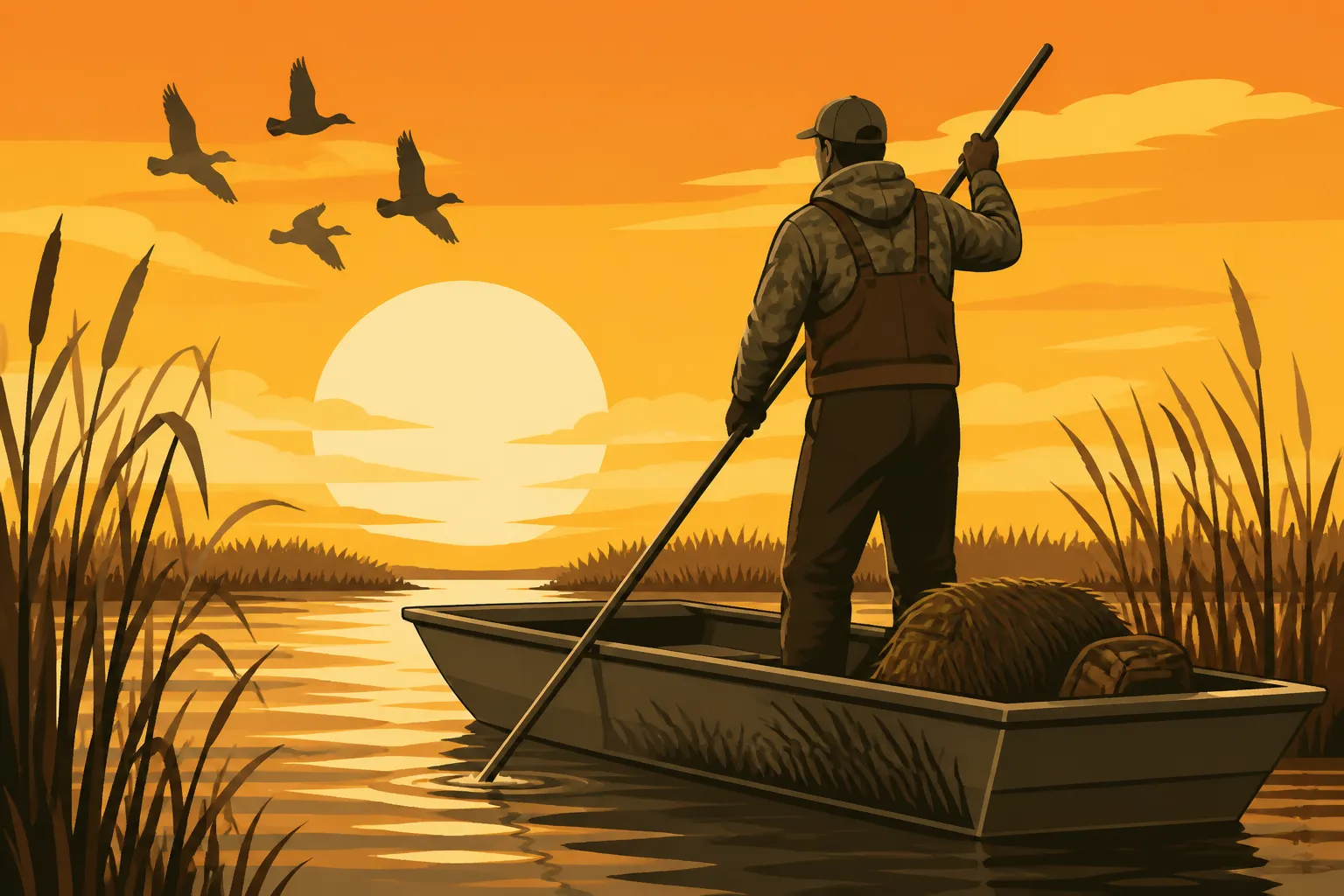
The push pole is the silent, efficient engine of the marsh boat. It's an ancient tool, refined over centuries, that allows precise control and propulsion in environments where mechanical means fail. Learning to wield it effectively is a skill that takes practice, but once mastered, it opens up a world of inaccessible hunting spots and provides an unmatched sense of connection to the water.
The Art of Poling: Proper Grip, Rhythm, and Steering in Different Marsh Conditions
Poling a marsh boat effectively is an art form, not just brute force. It requires a nuanced understanding of leverage, balance, and the terrain beneath the water. The basic technique involves placing the end of the pole firmly on the bottom, usually near the bow, and pushing the boat forward while walking your hands down the pole towards the stern. As the pole reaches the end of its useful push, you lift it from the water, move it back to the bow, and repeat. This creates a smooth, controlled glide that is both silent and efficient. The key is to find a rhythm – a steady push, retrieve, and reset – that minimizes splashing and maximizes forward momentum.
Steering is accomplished by subtle pushes or drags on one side of the boat, or by using the pole as a rudder at the stern. In dense vegetation, you might need to use the pole to part reeds or push off from stubborn clumps, requiring a different kind of finesse. A strong, steady push is needed in thick mud, while a lighter touch works in softer, shallower areas. Practicing in different conditions will build muscle memory and confidence. It's about feeling the bottom, understanding the resistance of the water and vegetation, and becoming an extension of the boat itself. GoHunt often features tips and techniques from experienced marsh hunters, emphasizing that skill and preparation with tools like the push pole are as important as the gear itself. Hunting Kankakee River Marsh Waterfowl further illustrates how crucial this technique is in diverse marsh settings.
Choosing the Right Pole: Materials, Length, and Tip Designs
Selecting the right push pole is just as important as selecting the right boat. The ideal pole should be strong, lightweight, and durable enough to withstand constant use in abrasive environments. Common materials include fiberglass, aluminum, and composite blends. Fiberglass poles offer a good balance of strength and flexibility, often preferred for their ability to absorb shock without feeling brittle. Aluminum poles are very rigid and strong but can be heavier and might transmit more vibration. Composite poles, often a blend of fiberglass and carbon fiber, provide the best of both worlds: strength, light weight, and a good feel.
Length is another critical factor. A good rule of thumb is that the pole should be roughly twice the depth of the water you expect to navigate, plus a little extra for leverage. For typical Indiana marshes, poles ranging from 10 to 16 feet are common. A pole that’s too short won’t give you enough leverage, while one that’s too long can be unwieldy. Finally, consider the tip design. A "duck foot" or "paddle foot" tip spreads out the pushing force, preventing the pole from sinking too deep into soft mud and providing more surface area for steering. A pointed or shovel-shaped tip might be better for breaking through ice or tangled roots, but it will sink deeper in soft bottoms. Many hunters prefer interchangeable tips, allowing them to adapt to varied conditions.
| Push Pole Material | Key Benefits | Considerations | Best For |
|---|---|---|---|
| Fiberglass | Good strength-to-weight, flexible | Can be heavier than carbon fiber, good value | General marsh hunting, varied bottoms |
| Aluminum | Very rigid, durable, often more affordable | Can be heavy, can get cold in winter, less flex | Harder bottoms, breaking ice |
| Composite (Carbon Fiber/Blend) | Excellent strength, very lightweight, stiff | Typically more expensive, can be brittle if thin | Long traverses, soft mud, performance hunting |
Safety and Best Practices: Avoiding Snags, Buddy System, Awareness of Surroundings
Safety should always be paramount when using a marsh boat and push pole. The unique environments you'll be accessing often come with inherent risks. Always be aware of your surroundings, especially submerged obstacles like stumps, logs, or even old fence posts that can snag your pole or boat. Getting a pole stuck in the muck can cause a sudden stop or even throw you off balance, so always maintain a firm grip and be ready to release the pole if it gets truly stuck. When pushing, keep your eyes scanning ahead, looking for changes in water depth or potential hazards.
It's always a good idea to hunt with a buddy, especially when venturing into remote marsh areas. A buddy system means you have assistance if you get stuck, injured, or encounter unexpected difficulties. Having two people to pole can also be much more efficient for longer distances or when hauling heavy loads. Always inform someone of your hunting plans, including your expected route and return time. Dress in appropriate layers, as Waders for Cattail Marsh Hunting emphasizes, and carry essential safety gear such as a whistle, a fully charged communication device (in a waterproof bag), a small first-aid kit, and enough water and emergency rations. The quiet nature of poling means you might be further from assistance than you realize, so preparation is key.
Integrating Marsh Boats and Push Poles into Your Hunt
A marsh boat and push pole aren't just tools for getting from point A to point B; they are integral components of a successful marsh hunting strategy. Their advantages extend beyond mere transport, influencing everything from scouting to decoy deployment and even game retrieval. When properly integrated, they enhance efficiency, stealth, and overall hunting satisfaction.
Scouting and Planning Your Route
Effective marsh hunting starts long before you launch your boat. With a marsh boat and push pole, your scouting efforts become even more critical, as you're looking for specific travel lanes, hidden pockets of open water, and subtle changes in vegetation that indicate prime feeding or loafing areas. Using aerial maps, whether online or through apps, to identify potential routes and deeper channels is an absolute must. Look for breaks in cattail fields, slight elevation changes that might indicate firmer bottoms, or areas where different types of vegetation converge. Tools like GoHunt's mapping features can be invaluable here, allowing you to mark waypoints for obstacles, productive spots, and your planned entry and exit points.
Before the season, a recon mission with your marsh boat and pole can solidify your plans. Spend a day slowly poling through target areas, mapping out the actual depths, noting any hidden snags, and confirming the navigability of your chosen routes. This firsthand knowledge is irreplaceable and will save you immense time and effort on hunt day. Understanding wind direction and how it might affect your approach and your decoy spread is also part of this planning. A well-scouted route means less fumbling in the dark on an early morning hunt and a more confident, stealthy approach to your setup. Scouting Indiana Public Land Before Season stresses the importance of this groundwork.
Decoy Deployment and Blind Setup
One of the most significant advantages of a marsh boat is the ease it brings to decoy deployment. Instead of wading through icy water, dragging a sled full of decoys, you can load your spread directly into the boat. This allows you to motor or pole silently to your desired location, often a shallow flat or a small opening, and then systematically deploy your decoys from the stable platform of the boat. This is particularly useful for larger spreads or when using bulky full-body decoys, which can be cumbersome to carry by hand. You can place decoys precisely, arranging them in natural-looking patterns that mimic feeding or resting birds, without disturbing the water or the surrounding habitat.
Furthermore, many marsh boats are designed to double as a blind. Their low profile can be easily concealed with natural vegetation, camouflage netting, or specialized pop-up blinds that attach directly to the boat. This allows you to set up quickly and effectively, creating a hidden shooting position that blends seamlessly into the environment. You can position your boat-blind strategically, perhaps tucked into a cattail edge or nestled among some flooded timber, maximizing your concealment from incoming birds. The boat itself provides a dry, stable platform for waiting out the hunt, keeping you more comfortable and focused. Decoy Spreads for Kankakee Divers offers further insight into optimizing your setup.
Retrieval and Extraction
After a successful hunt, the marsh boat and push pole continue to prove their worth during bird retrieval and gear extraction. Instead of a long, cold wade to pick up downed birds or gather decoys, you can simply pole out to them, scoop them up, and bring them back to the boat. This minimizes your time in the water, especially on frigid late-season days, and ensures that no bird is lost in dense cover. The ability to quickly and efficiently retrieve downed game is not only ethical but also helps to prevent spoilage and waste.
When it's time to pack up, the process is equally streamlined. Decoys are easily loaded back into the spacious boat, and any other gear, from extra layers to dog blind, finds its place. The push pole then allows you to silently and effortlessly glide back to your launch point, often through paths that would be impossible for other vessels. This ease of extraction, even when loaded down with birds and gear, makes the entire hunting experience more enjoyable and less physically demanding. It allows you to spend more time hunting and less time struggling, which is exactly what a good piece of gear should do. Hunting the Late-Season January Lull often requires such efficient retrieval methods due to challenging conditions.
Disclaimer
This article is for general informational purposes only and does not constitute professional advice. Laws, prices and regulations vary by location and change over time. Consult a qualified professional for guidance on your specific situation.