Trapping Indiana Feral Hogs
Feral hogs are an absolute menace in Indiana, tearing up farmland, destroying native habitats, and even posing a significant threat to our cherished native wildlife. If you've been battling these destructive invaders, you know the frustration firsthand – the rooted-up fields, the damaged property, and the seemingly endless cycle of their population growth. This guide is all about giving you the practical tools and in-depth knowledge to effectively trap Indiana feral hogs, turning that deep-seated frustration into successful eradication.
Understanding the Feral Hog Threat in Indiana
Before we even talk about setting a single trap, it's crucial to grasp just what kind of problem we're dealing with here in the Hoosier State. These aren't just a nuisance; they're an ecological and agricultural disaster in the making.
The Destructive Impact on Land and Wildlife
The damage caused by feral hogs is often astounding, and it's easy to see if you've ever had them on your property. Their constant rooting behavior, where they plow through the soil with their snouts in search of food, devastates crops like corn and soybeans. Farmers across southern Indiana, particularly in counties like Perry and Crawford, have reported extensive losses, turning promising fields into pockmarked landscapes overnight. Beyond crops, they tear up pastures, damage delicate ecosystems, and even undermine infrastructure like roads, levees, and fences, leading to costly repairs and endless headaches for landowners.
But it’s not just about the land. The ecological havoc these pigs wreak is equally, if not more, alarming. Feral hogs are opportunistic omnivores, meaning they'll eat just about anything. This includes the fawns of our native white-tailed deer, the eggs and poults of ground-nesting birds like wild turkeys and quail, and even rare amphibians and reptiles. They directly compete with native wildlife for crucial food sources like acorns and other mast, putting additional pressure on species that are already struggling. It’s a cascading effect that disrupts the entire food web and can lead to significant declines in local wildlife populations. Furthermore, these animals are known carriers of various diseases, some of which can be transmitted to livestock and even humans. While thankfully not yet prevalent, the threat of diseases like chronic wasting disease (CWD) transmission (though less direct, they can disturb CWD-infected soil environments) or others like pseudorabies and brucellosis looms large, making careful handling and disposal even more critical. Understanding the broader context of wildlife health is key, and the Indiana Department of Natural Resources (DNR) maintains vigilant Indiana Wildlife Disease Monitoring efforts.
Why They're So Hard to Control
If you've ever tried to deal with feral hogs, you quickly realize they're not like other nuisance animals. Their biology and behavior make them incredibly resilient and challenging to manage. One of the primary reasons is their astonishing reproductive rate. A sow can start breeding as young as six months old, produce two litters a year, and have an average of four to eight piglets per litter. Do the math, and you quickly see how a small sounder can explode into a massive problem in just a few years. This exponential growth outpaces most eradication efforts if they're not incredibly effective and sustained.
Beyond their prolific breeding, feral hogs are notoriously intelligent and wary. They learn quickly from negative experiences, meaning if you try a trapping method that only catches a few individuals, the survivors become "trap-shy" or "trap-educated." These educated hogs become incredibly difficult to catch, often avoiding traps even when baited heavily. Their keen sense of smell, excellent hearing, and surprisingly good eyesight for their size also contribute to their evasiveness, making a stealthy approach essential.
Their nocturnal habits and preference for dense cover further complicate matters. While you might see signs of them during the day, much of their activity—feeding, traveling, and breeding—happens under the cloak of darkness. They utilize thick briar patches, deep timber, and dense river bottoms for bedding and escape routes. This means finding and targeting them requires extensive scouting and often calls for patience and specialized techniques, as discussed in "How Wild Hogs Spread Across Indiana". Their wide-ranging movements mean that even if you clear them out of one area, new hogs can quickly move in from adjacent properties, making local control efforts feel like a losing battle without coordinated, widespread management.
Essential Principles of Feral Hog Trapping
Successfully trapping feral hogs isn't about luck; it's about a systematic, patient approach grounded in understanding their behavior. Cutting corners will almost always lead to failure and, worse, educated hogs.
Scout Thoroughly and Identify Activity Hubs
Before you even think about setting up a trap, the most critical first step is intensive scouting. You need to know where the hogs are, how many there are, and what their patterns are. Look for obvious signs like freshly rooted-up ground, which will often appear as overturned soil, sometimes for hundreds of yards. Wallows—muddy depressions where hogs cool off and rub off parasites—are another clear indicator. Also, keep an eye out for rub marks on trees, especially low to the ground, and of course, tracks and scat. Pay close attention to travel corridors they use to move between bedding areas and food sources. Tools like the Scouting With the Indiana DNR App or commercial mapping platforms like GoHunt can be invaluable here. Using GoHunt's satellite imagery and public/private land layers can help you pinpoint potential travel routes, water sources, and areas of thick cover that might serve as bedding sites, especially when looking at Reading Aerial Photos for Southern Indiana Deer or identifying specific Feral Swine Sightings in Southern Indiana.
Once you've identified potential areas of activity, deploy trail cameras. These are your absolute best friends in this fight. Place them along suspected travel lanes, near rooting sites, or by water sources. The cameras will give you vital intel without pressuring the hogs. You'll learn the size of the sounder (how many hogs are in the group), their typical movement times (are they strictly nocturnal?), and the specific trails they favor. This data is critical for proper trap placement and timing. Remember, hogs are often most active during dawn, dusk, and nighttime hours, so cameras with good low-light performance are a must. They're excellent for general wildlife observation, as detailed in Trail Cameras for Deer Reduction Zone Scouting, but for hogs, they provide a blueprint of their daily lives.
Focus your scouting efforts on areas where food, water, and cover converge. This could be the edge of a standing cornfield, a dense timber block adjacent to a creek bottom, or a briar thicket near an oak flat during acorn drop. Hogs love these transition zones. By consistently monitoring these areas, you can pinpoint the exact locations where a sounder feels comfortable and spends the most time, significantly increasing your chances of a successful trap. Don't forget to look for signs like "snout rings" around the edges of water sources, indicating where they've been drinking.
The Importance of Whole-Sounder Trapping
This might be the single most crucial concept in effective feral hog management: you must aim to capture the entire sounder, not just a few individuals. Trying to catch one or two hogs at a time is often counterproductive and will likely make your problem worse in the long run. When you remove only a portion of a sounder, the remaining hogs quickly learn to associate that location or trap design with danger. They become trap-shy, scattering and becoming even more difficult to catch. This fragmentation can lead to smaller, more wary groups that are nearly impossible to lure back into a trap.
Think of it like this: if you hunt deer, and you take a few deer from a field, the remaining deer might still come back. Hogs are different. Their social structure means they move and feed as a unit, and if that unit is disrupted by a perceived threat, they become incredibly suspicious. They are survivors, and their intelligence allows them to adapt rapidly. This is why patience and precision are paramount in trapping.
The goal is to condition the entire sounder to freely enter and exit the trap for an extended period, making them feel completely safe within its confines. Only once all individuals, from the largest boars to the smallest piglets, are confidently entering the trap should you initiate the capture. This patient pre-baiting phase, often lasting days or even weeks, is what truly sets successful trapping apart from haphazard attempts. It ensures that when the trap is finally triggered, you maximize your take, effectively eliminating the problem sounder rather than just displacing and educating them.
Choosing the Right Trap System
The type of trap you deploy is just as important as where you put it or what you bait it with. Choosing the wrong one can mean wasted time, effort, and educated hogs.
Different Trap Designs and Their Applications
There are two primary categories of feral hog traps: box traps and corral traps. Each has its place, but for most Indiana situations, one clearly reigns supreme.
Box traps are typically smaller, rectangular traps, often made of hog panel or cattle panel, designed to catch one to three hogs at a time. They usually have a guillotine-style or swing-style door triggered by a trip wire or root stick inside the trap. Their main advantages are portability and lower cost. If you have a very small, isolated property with only one or two confirmed hogs, a box trap might seem appealing. However, their limitations quickly become apparent. They are almost incapable of catching an entire sounder. More often than not, they catch one hog, and the rest of the sounder, witnessing the capture and ensuing commotion, scatter and become trap-shy. This is exactly what we want to avoid. Therefore, while seemingly convenient, box traps are generally not recommended for effective long-term hog control in Indiana, as they contribute more to educating hogs than eradicating them.
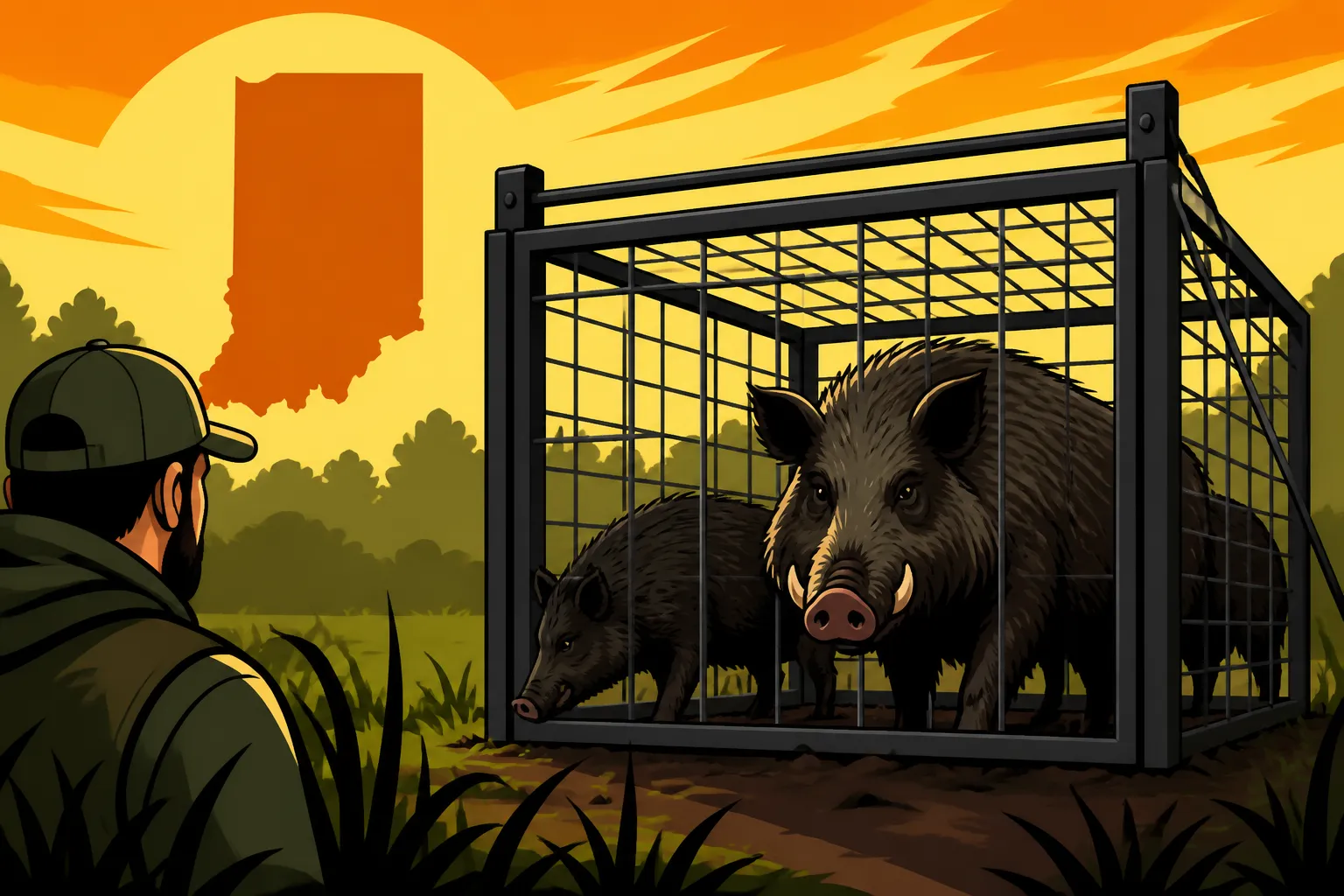
Corral traps, on the other hand, are the workhorses of effective feral hog management. These are large, circular or square pens, typically 15-30 feet in diameter, constructed from heavy-duty hog panels or cattle panels. They are designed to hold an entire sounder, often 10-20 hogs or more, at once. Corral traps typically feature a single, large door that can be triggered remotely or manually. Their size is their biggest asset; it allows multiple hogs to enter and feed comfortably, reducing their wariness. Once the entire sounder has been identified within the trap via trail camera, the door can be closed, capturing all of them. While more expensive and requiring more effort to set up initially, the efficiency and effectiveness of a corral trap far outweigh the drawbacks of box traps. For serious hog control, this is the system you want to invest in.
Here's a quick comparison of the two main trap types:
| Feature | Box Trap | Corral Trap |
|---|---|---|
| Size | Small (typically 4×8 ft or 5×10 ft) | Large (15-30 ft diameter) |
| Capacity | 1-3 hogs | Entire sounder (10-30+ hogs) |
| Cost | Lower initial investment | Higher initial investment |
| Portability | Relatively easy to move | More effort to move and set up |
| Effectiveness | Low, often educates remaining hogs | High, designed for whole-sounder capture |
| Trigger | Trip wire, root stick, pressure plate | Remote drop gate, manual trip |
| Best Use | Very rare, for highly isolated individuals | Most effective for sounder eradication |
Remote Triggering Systems and Why They're Game Changers
In the world of modern feral hog trapping, remote triggering systems have revolutionized the game. Gone are the days of having to physically be present to set a trap, hoping the hogs are all inside when you pull the rope. These systems, often integrated with cellular cameras, allow you to monitor your trap site from anywhere and trigger the trap door with a simple text message or app command on your phone.
The primary advantage of a remote trigger is its ability to facilitate true whole-sounder capture. With a traditional trip wire, you're relying on a hog to hit the trigger at just the right moment. This often results in only a few hogs being caught, while others escape as the door drops, becoming wary and making future trapping efforts nearly impossible. With a remote system, you can watch your cellular trail camera feed (many modern trail cameras, like those from Moultrie or Browning, offer cellular connectivity) and observe the hogs entering and exiting the trap in real-time. You patiently wait until every last hog in the sounder is comfortably inside the corral, feeding. Only then, once you've confirmed visually that all targets are present, do you remotely trigger the door.
This method drastically increases your success rate and ensures that the maximum number of hogs are removed from the landscape. It also minimizes human presence at the trap site, which is crucial for not alarming the highly intelligent hogs. Imagine not having to drive to a remote location every day, just to find no hogs in the trap. Instead, you can check your phone from your home or office. While the initial investment for a quality remote system (including the cellular camera, trigger mechanism, and a cellular plan) is higher, the efficiency and effectiveness it brings to feral hog eradication make it an invaluable tool for any serious trapping effort. Battery life and cell signal strength are important considerations when selecting a system, so be sure to test these in your desired trap location.
Effective Baiting Strategies
Bait is the lure, the irresistible invitation that draws hogs into your trap. But it's not enough to just throw some corn out there; how you bait is just as crucial as what you bait with.
Preferred Bait Types and Fermentation
When it comes to baiting feral hogs, one item stands head and shoulders above the rest: corn. It's relatively inexpensive, widely available, and hogs absolutely love it. However, regular dry corn is only the starting point. The real magic happens when you "sour" or ferment that corn. Fermentation enhances the corn's natural odors, creating a pungent, irresistible aroma that can carry on the wind for long distances, drawing hogs in from further away.
To sour corn, simply place dry corn in a five-gallon bucket or larger container, cover it with water, and add a packet of inexpensive baking yeast. Stir it up, cover it loosely (to allow gases to escape), and let it sit for several days to a week, especially in warmer weather. The corn will ferment, creating a strong, almost alcoholic scent that hogs find intoxicating. Other alternative baits include discarded fruits and vegetables, commercial hog attractants (often with molasses or cherry scents), or even stale pastries. However, nothing beats soured corn for its cost-effectiveness and proven drawing power. Remember, the stronger the smell, the better, as their sense of smell is their primary tool for finding food.
When you begin baiting, always start by scattering a generous amount of bait outside the trap structure. You want the hogs to find and feast on the bait without any perception of danger from the trap itself. Once they are consistently cleaning up the bait outside the trap, you gradually move the bait inside, eventually placing the majority of it towards the back of the trap, far from the entrance. This conditions them to enter the trap freely and confidently, seeing it as a safe and reliable food source.
Pre-Baiting and Conditioned Feeding
This is where many well-intentioned trappers fail: they set a trap, bait it, and expect instant results. With feral hogs, that's almost never the case. The critical phase of pre-baiting is all about building trust and conditioning the entire sounder to freely enter and exit the trap enclosure without any fear. This takes time and immense patience.
The process typically involves setting up your corral trap, securing the door in an open position so it cannot accidentally trigger, and then heavily baiting the area around and inside the trap. You want the hogs to discover this new food source and gorge themselves on it for several consecutive nights. Use your trail cameras to monitor their activity. You're looking for consistent patterns: are they coming every night? Is the entire sounder entering the trap? Are they acting relaxed and confident inside the trap?
This pre-baiting period can last anywhere from a few days to a few weeks, depending on the hogs' wariness and the pressure they've experienced. You must resist the urge to set the trap early. If you close the door prematurely and only catch a few, the remaining hogs will likely become trap-shy, and you'll have a much harder time catching them later. The goal is to make the trap a completely normal, safe, and desirable feeding spot for every hog in the sounder. Only once you have confirmation (via your trail cameras) that the entire sounder is routinely entering the trap, staying for extended periods, and showing no signs of nervousness, are you ready to engage your trigger. This patient, methodical approach is the backbone of successful whole-sounder trapping and is far more effective than trying to rush the process.
Deployment and Monitoring Techniques
You've got the right trap and the perfect bait, but if you don't deploy it strategically and monitor it consistently, all that effort could be for naught.
Strategic Trap Placement
Where you place your trap is almost as important as the trap itself. This is where your thorough scouting efforts truly pay off. Look for natural travel funnels, areas where hogs are naturally channeled, such as along creek bottoms, fence lines, or timber edges between bedding and feeding areas. Often, the edge of a standing crop field that backs up to a dense woodlot or a briar thicket is a prime location. Hogs prefer to travel under cover or along its edge, giving them a sense of security. Identifying areas where there are Finding Sign in Big Hoosier Forest Timber or along natural funnels where deer would move, as outlined in Hunting a Funnel Between Two Woodlots, can translate well for hog activity.
Consider the layout of the land using mapping apps like GoHunt, which can highlight topography, water sources, and vegetation types. Placing a trap on a slight rise can sometimes help with visibility if you're using a camera, but ensure it doesn't stand out too much. You want the trap to blend into the environment as much as possible. Use natural vegetation to camouflage the trap panels, breaking up its outline. While you need access for baiting and checking, try to minimize your impact around the trap. Park your vehicle some distance away and walk in, avoiding leaving strong human scent trails directly to the trap entrance. Always be mindful of the wind direction; hogs have an incredible sense of smell, so approach from downwind whenever possible.
Ultimately, the best trap placement is where your trail cameras consistently show hog activity. If you're getting photos of hogs rooting and traveling in a specific spot, that's your starting point. Don't be afraid to move the trap if, after a period of pre-baiting, the hogs aren't responding. Sometimes, a slight adjustment of 50 or 100 yards can make all the difference.
Consistent Monitoring and Adjustment
Once your trap is deployed and pre-baiting has begun, consistent monitoring is absolutely critical. This isn't a "set it and forget it" operation. Ideally, you should be checking your trail cameras daily, whether physically retrieving cards or, preferably, using a cellular camera system that sends images directly to your phone. This constant feedback loop allows you to understand the hogs' behavior in relation to your trap. Are they approaching it but not entering? Are only certain individuals entering? Are they showing up at specific times?
Based on your monitoring, you'll need to make adjustments. If the hogs are wary, try adding more cover to the trap or moving it slightly. If they're not interested in the bait, try souring it more or switching to something else. Perhaps they're only showing up at 3 AM; this intel helps you plan when to be ready to trigger your trap if you're not using a remote system. Patience is key here, but so is adaptability. A trap that's being ignored is a trap that's not working, and you need to be willing to change your strategy.
The monitoring phase also provides crucial information about the size and composition of the sounder. You need to ensure all individuals, including the wary older boars and the youngest piglets, are entering the trap regularly. If you only see a portion of the sounder, continue pre-baiting. Hogs are smart, and they're constantly testing their environment. This cat-and-mouse game requires you to be just as persistent and observant as they are. This is where a detailed mapping application like GoHunt can again be useful, not just for initial scouting but for logging observations, noting hog movements, and planning your approach routes for checking or triggering the trap.
Dealing with Captured Hogs and Legalities
Capturing feral hogs is only half the battle. Knowing how to handle them ethically and legally is just as important for effective management and responsible hunting.
Humane Euthanasia and Carcass Disposal
Once you've successfully trapped a sounder, the next step is humane euthanasia. This is not a task to be taken lightly. The goal is to dispatch the animals quickly and without unnecessary suffering. A well-placed shot to the head, typically from a firearm, is the most common and effective method. Always prioritize safety for yourself and others, and ensure you have a clear, safe backstop. Do not attempt to tranquilize or capture hogs alive for relocation; it is illegal and counterproductive to eradication efforts. These animals are a destructive invasive species, and humane dispatch is a necessary part of their control.
After euthanasia, proper carcass disposal is crucial. You cannot simply leave them in the trap or drag them into the woods. Feral hogs can carry diseases like pseudorabies or swine brucellosis, which pose risks to domestic livestock and, in some cases, humans. The Indiana DNR recommends burying carcasses deeply enough (at least 3 feet) to prevent scavenging by other animals, or, if available, taking them to a rendering facility. Check with your local county health department or DNR office for specific guidelines in your area. For more information on dealing with such situations, you might consult resources like Indiana Feral Hog Regulations. Remember, never release any captured hog, as this only perpetuates the problem and is against the law.
Regulations and Reporting Requirements
It's vital to be aware of Indiana's specific regulations regarding feral hogs. The good news for landowners is that Indiana classifies feral hogs as an unprotected, invasive species. This means that on private land, you can take feral hogs year-round, day or night, with no bag limits and without needing a hunting license. This makes methods like Night Hunting Hogs With Lights on Private Land a viable option for direct control. However, this freedom to act does not extend to public lands. On public lands, hunting feral hogs is typically prohibited, and any trapping or removal efforts must be coordinated directly with the land management agency (e.g., DNR, National Forest Service). Always confirm the rules for any public property before engaging in hog removal activities. For comprehensive details, refer to Indiana's Year-Round Hog Rule on Private Land.
Furthermore, while there's no mandatory reporting for every hog taken, the Indiana DNR and USDA Wildlife Services strongly encourage reporting sightings and captures. This data is incredibly valuable for tracking hog populations, understanding their spread, and coordinating broader control efforts across the state. You can often report sightings through the DNR's website or by contacting your local wildlife biologist. Providing accurate information helps wildlife managers better allocate resources and target problem areas effectively. Remember, moving live feral hogs is strictly illegal, as is releasing them into new areas. The goal is eradication, not relocation. Your efforts, combined with those of other landowners and agencies, contribute to a healthier Indiana ecosystem for native wildlife and agricultural interests alike.
Disclaimer
The information provided in this guide is for general informational purposes only and does not constitute legal advice. Hunting regulations and guidelines can change. It is your responsibility to consult the most current Indiana Department of Natural Resources regulations and all applicable local, state, and federal laws before engaging in any hunting or trapping activities. Always prioritize safety and ethical practices.