Vehicle Rules on Indiana Public Land
It can be incredibly frustrating to haul all your gear to a prime hunting spot on Indiana public land, only to find you can't get your vehicle where you need it, or worse, you've accidentally broken a rule. Navigating the maze of regulations for cars, trucks, ATVs, and other motorized conveyances on state and federal lands can be a real headache. This guide is here to untangle those rules, making sure your access plan is solid and you stay on the right side of the law, letting you focus on the hunt, not the hassle.
Understanding the General Philosophy of Vehicle Access
Let's be real, public land in Indiana isn't a free-for-all when it comes to vehicles. The core philosophy behind most vehicle regulations on state and federal hunting grounds boils down to two main things: protecting the natural habitat and ensuring public safety. While it might feel restrictive at times, these rules are in place to prevent erosion, minimize disturbance to wildlife, and keep everyone, from hikers to horseback riders to other hunters, safe. It's a balancing act, and sometimes it means we have to walk a little farther than we'd like.
Imagine rolling up to your favorite tract of woods in the Hoosier National Forest, ready to scout. You see a perfect two-track leading deeper into a secluded area, and your first thought is, "Can I just drive my truck back there?" The answer is often "no," or at least, "it's complicated." Most established roads are open, but once you start eyeing those smaller trails, it's critical to know the specific land designation and its rules. What might be a passable trail for your rig on private land can be a significant violation on public ground. Always assume restricted access until you can confirm otherwise.
Another crucial aspect is the type of hunting experience the land managers want to promote. Many areas are designated to provide a more primitive, foot-traffic-only experience, pushing hunters deeper into the woods away from vehicle noise and pollution. This is particularly true for many interior sections of our State Forests and even some larger Fish and Wildlife Areas. It means strapping on a good pack and being ready to earn your spots. Understanding this overarching philosophy helps hunters appreciate why these rules are in place, even if they occasionally present a logistical challenge.
Specific Rules for Different Vehicle Types
The rules aren't one-size-fits-all; they depend heavily on the type of vehicle you're operating and the specific public land unit you're on. A two-wheel-drive sedan is going to have different limitations than a powerful side-by-side. Knowing these distinctions is key to avoiding fines and ensuring your trip goes smoothly.
Cars and Trucks on Designated Roads
For most public land in Indiana, standard street-legal cars and trucks are restricted to designated, improved roads. This means paved roads, gravel roads, and sometimes well-maintained dirt roads. The moment a road becomes a "trail" or "unimproved," your standard vehicle usually isn't permitted.
Think about driving through a State Forest like Yellowwood or Morgan-Monroe. You'll find plenty of gravel roads that wind through the timber, allowing you access to various parking areas or trailheads. These are generally fair game. However, you'll also see gated logging roads or narrow paths that clearly aren't meant for passenger cars. Driving past a gate, even if it looks open, or taking your truck off a clearly marked road, is a surefire way to get a ticket and potentially cause significant environmental damage. These rules are particularly strict in areas like Hoosier National Forest Hunting, where miles of backcountry roads exist, but only a fraction are open to public vehicle traffic. Always look for signage; if there's no sign explicitly permitting vehicular access, assume it's prohibited. It's not uncommon to find a gravel road suddenly turn into a foot-traffic-only trail, marked by barriers or clear signage.
All-Terrain Vehicles ATVs and Utility Task Vehicles UTVs
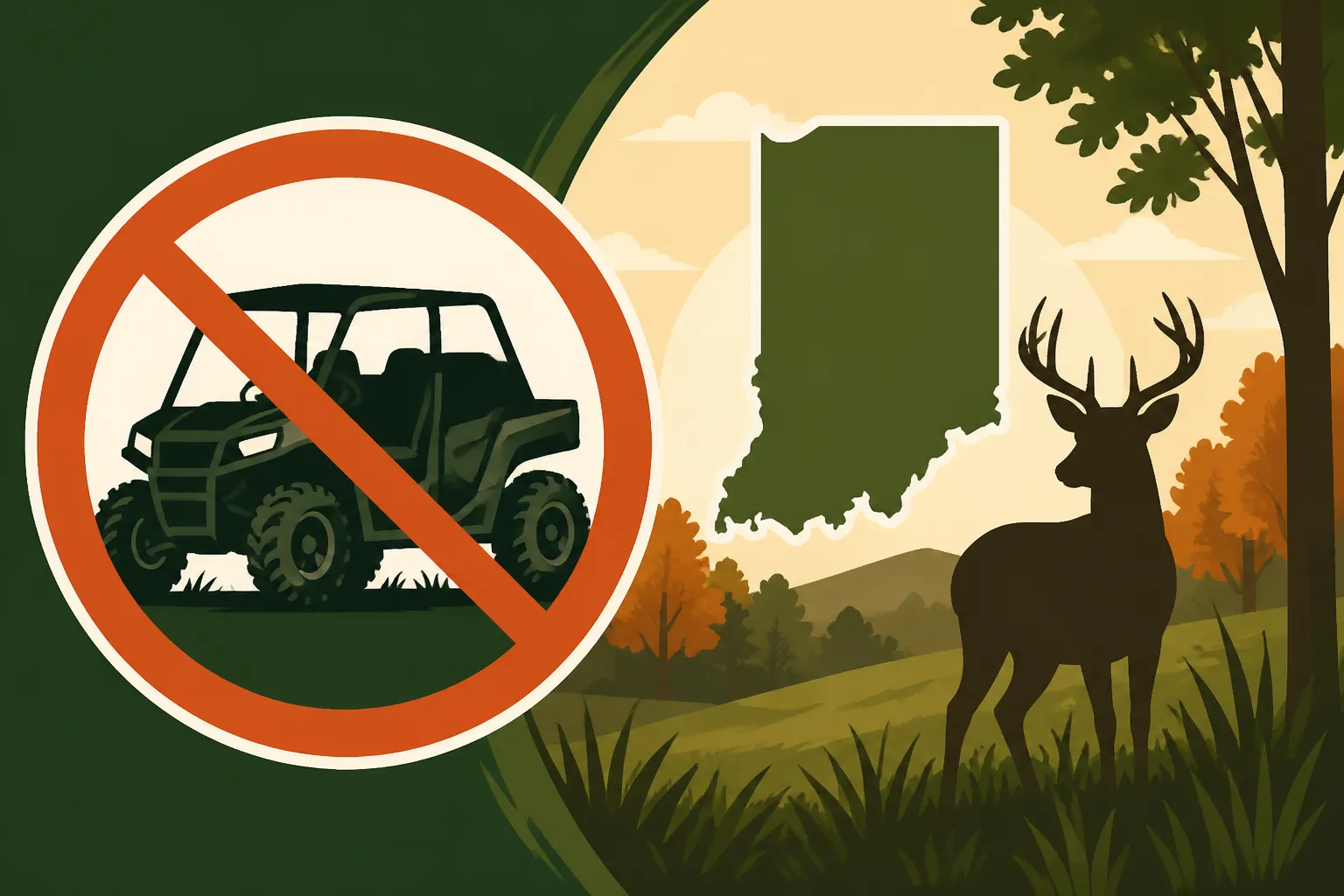
This is where things can get a bit more nuanced and where many hunters run into trouble. Generally speaking, ATVs and UTVs are highly restricted on most Indiana public hunting lands. While they are wonderful tools for accessing private land, their use on state and federal properties is often confined to very specific, designated trails or circumstances.
For instance, at many Indiana Fish and Wildlife Areas (FWAs), the use of ATVs and UTVs is strictly forbidden for hunting access, with very limited exceptions for special needs permits or specific work details. You might see FWA staff using them, but that doesn't mean you can. In the Hoosier National Forest, there are designated off-road vehicle (ORV) trails, but these are typically for recreational riding and are not generally for hunting access or retrieving game. ATV Rules on Indiana Forest Roads are very clear on this; you can't just drive your quad into the woods to set up a stand or haul out a deer. The intent is to keep these areas quiet and wild for hunting purposes. If you use an app like onX Hunt, you can often see marked ORV trails, but you'll need to double-check with the specific land manager (DNR, US Forest Service) if these trails can be used for hunting access or game retrieval. These designated trails are also usually separate from hiking trails or horse trails, further segmenting user groups to minimize conflicts and preserve specific experiences.
Bicycles and Electric Bicycles
Bicycles fall into a gray area, often treated differently than motorized vehicles but still subject to specific trail rules. On many multi-use trails within State Forests or some FWAs, traditional bicycles are permitted. However, if a trail is designated "foot-traffic only," that includes bicycles.
Electric bicycles (e-bikes) are a newer challenge for land managers. Depending on the land managing agency and the class of e-bike, they might be treated like a traditional bicycle or a motorized vehicle. On most Indiana public hunting grounds, particularly in the deeper woods, the intent is for foot-powered access. If an e-bike uses a throttle or provides significant assistance without pedaling, it's generally going to be viewed as a motorized vehicle and restricted accordingly. Always check the specific property regulations. When you're Scouting Indiana Public Land Before Season, it's smart to clarify these rules beforehand, especially if you plan to cover a lot of ground quickly on two wheels.
Comparing Vehicle Access on Indiana Public Lands
Here's a quick overview of general vehicle access expectations on common types of Indiana public hunting land. Remember, always check specific property regulations as there can be local variations.
| Vehicle Type | Indiana State Forests | Indiana Fish & Wildlife Areas (FWAs) | Hoosier National Forest |
|---|---|---|---|
| Cars/Trucks (Street Legal) | Designated gravel/paved roads, parking areas. | Designated roads, parking areas, some field access roads. | Designated paved/gravel roads, parking areas. |
| ATVs/UTVs | Generally prohibited for hunting access, limited ORV trails for recreation in specific areas only. | Generally prohibited for hunting access, limited exceptions for disability permits or specific management needs. | Generally prohibited for hunting access, designated ORV trails for recreation in specific areas only. |
| Bicycles (Non-electric) | Permitted on multi-use trails, designated roads. Prohibited on foot-traffic-only trails. | Permitted on designated trails/roads, check property maps. | Permitted on multi-use trails, designated roads. Prohibited on foot-traffic-only trails. |
| Electric Bicycles (E-bikes) | Often treated as motorized; check specific property rules. Generally restricted outside designated bike trails. | Often treated as motorized; check specific property rules. Generally restricted. | Often treated as motorized; check specific property rules. Generally restricted. |
| Horseback | Designated horse trails only. | Restricted to designated trails/areas, check property maps. | Designated horse trails only. |
Special Situations and Exceptions
While the general rules paint a broad picture, there are always exceptions and specific scenarios that warrant a closer look. Understanding these can prevent misunderstanding or allow for legitimate access where it might otherwise seem forbidden.
Accessible Hunting and Disability Permits
Indiana, like many states, recognizes the need to provide accessible hunting opportunities for individuals with disabilities. For hunters with mobility impairments, special permits can sometimes be obtained from the Indiana Department of Natural Resources (DNR) to allow limited vehicle access, often ATVs or UTVs, into areas normally restricted to foot traffic.
These permits are not a blanket allowance to drive anywhere. They are typically granted for specific individuals, often for specific properties or sections of properties, and come with strict conditions regarding where and when the vehicle can be operated. If you or someone you hunt with requires such accommodation, it's crucial to contact the DNR well in advance of the season to understand the application process and specific requirements. These permits are designed to level the playing field, not to create a separate class of unrestricted access. Hunters often appreciate seeing an individual with a disability accessing an area, understanding that the proper channels were followed.
Managed Hunts and Draw Hunts
Certain managed hunts or draw hunts on properties like some State Parks (which often restrict hunting normally) or specific FWAs might have unique vehicle rules. These hunts are highly controlled, and the property managers will clearly outline any specific vehicle allowances or restrictions during the application or orientation process.
For instance, a deer reduction zone hunt in an urban area might have very different logistics than a typical forest hunt, including designated parking far from the hunting zone, or even temporary permissions to access certain fields for game retrieval. Always pay extremely close attention to the rules provided for that specific hunt as they can supersede general property regulations. These events are often designed to manage wildlife populations efficiently, and vehicle access might be part of that strategy. You might be asked to park in a specific field, and only allowed to drive a truck to retrieve a downed animal during specific hours.
Game Retrieval Considerations
This is a common point of contention and confusion for hunters. You've just harvested a deer deep in the woods, and now you're facing a mile-long drag. Can you bring your ATV in to retrieve it? On most Indiana public land – no. Generally, vehicles are not permitted off designated roads, even for game retrieval.
This means you need to have a plan for how you'll get your game out. This might involve a deer cart, a quality game bag and a good pack for boning out the animal, or recruiting some strong friends to help with a long drag. While it’s tempting to risk a quick drive to make retrieval easier, the potential fine and habitat damage simply aren't worth it. Some properties might have specific, very limited provisions for game retrieval by vehicle, but these are rare and always explicitly stated. If you are using digital mapping tools like onX Hunt or GoHunt, you can mark potential retrieval routes and distance to plan for extraction well before you ever pull the trigger. Knowing your exit strategy is as important as your entry strategy, especially if you're hunting challenging terrain in southern Indiana, where dragging a deer uphill for a mile can feel like an Olympic event.
Consequences of Violating Vehicle Rules
Ignoring vehicle rules on Indiana public land isn't just a minor infraction; it can lead to significant penalties, financial costs, and even the loss of hunting privileges. Understanding these consequences might make you think twice before taking a shortcut.
Fines and Citations
The most immediate consequence of violating vehicle rules is a citation and a fine. These aren't usually cheap. Driving a motorized vehicle on a closed trail, operating an unregistered ATV where prohibited, or going off-road can result in fines that easily run into hundreds of dollars.
Beyond the initial fine, there can be additional court costs and administrative fees. A single moment of convenience or a lapse in judgment could turn into a hefty bill. Enforcement officers regularly patrol public lands, especially during hunting seasons, and they are well-versed in spotting unauthorized vehicle tracks or listening for engine noise in prohibited areas. They take these rules seriously because habitat protection and public safety are paramount. It’s not about ruining your day, it’s about preserving these precious resources for everyone.
Environmental Damage and Restoration Costs
Beyond the personal financial impact, driving off-road or on closed trails causes environmental damage. Vehicles can compact soil, destroy vegetation, create erosion channels, and disturb wildlife. When you break these rules, you're not just breaking a law; you're harming the very resource you're trying to enjoy.
In some cases, if significant damage occurs, you could be held liable for the cost of restoration. Imagine creating deep ruts on a muddy trail that requires heavy equipment to repair. These costs can be astronomical and far exceed any simple fine. Property managers spend considerable resources maintaining trails and roads; unauthorized vehicle use undermines these efforts and often falls back on taxpayer dollars to fix. It's not just about what you can get away with, it's about being a responsible steward of the land. When you utilize resources like Using the Indiana OnX and DNR Map Tools, you are often seeing the work of these managers, and disrespecting their efforts leads to greater restrictions for everyone.
Loss of Hunting Privileges
For serious or repeat offenses, violating vehicle rules could lead to the suspension or revocation of your hunting privileges. This means losing the ability to participate in an activity you love, sometimes for several years. This is a severe consequence that can stem from seemingly minor vehicle infractions if they are egregious enough or part of a pattern of disregard for regulations.
A hunting license is a privilege, not a right, and that privilege comes with the responsibility to follow the rules designed to manage wildlife and protect habitats. It’s a harsh reality, but consistent rule-breaking on public lands can eventually lead to being permanently excluded from them. Remember, DNR officers are not just enforcing game laws; they are also enforcing property rules. If you're constantly pushing the limits, you risk losing access altogether, which is a far greater loss than any single hunt. It’s much wiser to plan your trips, understand the rules for each Indiana State Forest Hunting or FWA you visit, and err on the side of caution. If you are struggling to understand a particular rule, call the property office ahead of time. They are there to help, not just to enforce.
Best Practices for Vehicle Use on Public Land
So, how do you make sure you're doing it right? A few simple best practices can help you stay compliant, respectful of the land, and safe during your public land hunting adventures.
Always Check Property-Specific Regulations
This is the golden rule. While general rules apply, every public land property in Indiana—whether it's a State Forest, an FWA, or a section of the Hoosier National Forest—has its own specific set of regulations, maps, and often, current conditions to consider. What's allowed at Glendale FWA might be strictly prohibited at Atterbury FWA.
Before you ever leave your driveway, pull up the property's website or call the property office. Look for maps that clearly delineate open roads, parking areas, and restricted zones. Many properties have brochures available online or at kiosks on site. Don't rely on assumptions or what you "heard from a friend." Regulations change, and it's your responsibility to know the current rules. Apps like onX Hunt are fantastic for showing property boundaries, but always cross-reference with official DNR or Forest Service maps for vehicle-specific rules, as map layers for these might not always reflect the most granular detail.
Utilize Mapping Apps and GPS
Modern technology is your best friend when navigating public land. Apps like onX Hunt and GoHunt allow you to download maps to your phone, showing property boundaries, designated trails, and sometimes even marked gates or parking areas. These tools can be invaluable for helping you stick to open roads and identify legitimate parking.
Before you go, spend time with these apps, marking potential parking spots, entry points, and routes. This is especially helpful when you're exploring new areas or complex terrain. Even if you lose cell service, downloaded maps will still work via your phone's GPS. This prevents accidental trespass and ensures you're accessing the property where it's legally permitted for vehicles. Knowing exactly where you are in relation to a designated road or parking area can make all the difference, especially when you are trying to Find Ground That Sees Fewer Hunters by accessing remote corners.
Plan Your Access and Retrieval Carefully
Since vehicle access into the deep woods is largely restricted, you need to think ahead about how you'll get yourself and your game out. This means packing appropriately and understanding your physical limits.
If you plan to hike several miles in, ensure you have a comfortable pack capable of carrying your gear and potentially boned-out meat. Consider bringing a lightweight deer cart for easier retrieval if the terrain allows for it. Hunting with a partner or group can also make game retrieval significantly easier. Always scope out potential retrieval routes beforehand, looking for the easiest path back to a legal vehicle access point. Sometimes the path you walked in isn't the best path for dragging a deer out. For example, if you are hunting a river bottom funnel, plan your drag route to avoid crossing deep water if possible. Even if you're not planning to stay overnight, understanding Camping Rules on Indiana State Forest Land can sometimes give you a better sense of allowed vehicle access points for specific areas that also cater to campers.
Respect Gates and Signage
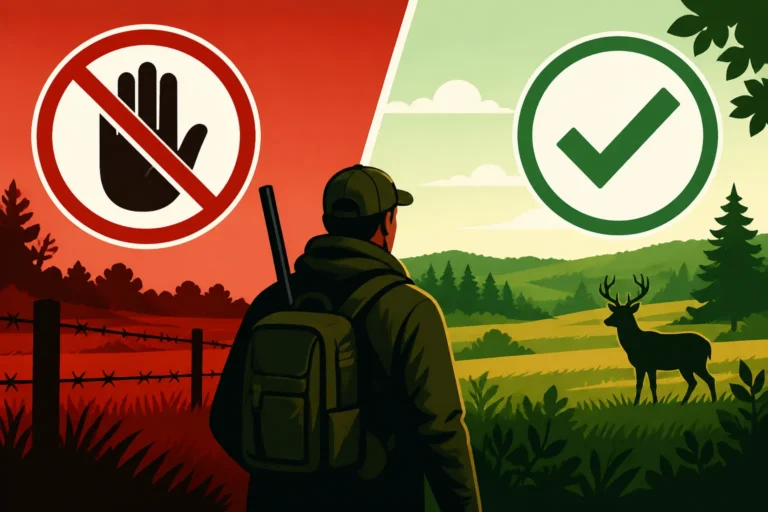
This seems obvious, but it's surprising how often people ignore it. Gates are there for a reason, even if they appear open or unlocked. "Road closed" signs mean exactly that. If a sign explicitly prohibits motorized vehicles, don't drive past it.
These markers are the direct communication from land managers about where you can and cannot go. Disregarding them not only puts you at risk of a citation but also shows a disrespect for the hard work that goes into managing these lands for everyone's benefit. If you’re ever in doubt, park your vehicle legally and proceed on foot. It’s always better to walk a little farther than to risk a fine or damage to the habitat. It’s a simple rule, but following it helps maintain access for all of us in the long run.
Disclaimer
This article is for general informational purposes only and does not constitute professional advice. Laws, prices and regulations vary by location and change over time. Consult a qualified professional for guidance on your specific situation.