Upland Guns for Fencerow Cover
Navigating Indiana's fencerows for upland game can feel like a labyrinth, with sudden flushes and fleeting shot opportunities leaving you questioning if you have the right tool in your hands. It's a frustrating dance between thick cover and explosive action, but choosing the proper upland gun can dramatically improve your success and enjoyment. This guide will walk you through the specifics of selecting the best firearm for tackling these challenging, yet incredibly rewarding, fencerow habitats across the Hoosier state.
The Unique Challenge of Indiana's Fencerow Cover
Hunting Indiana's fencerows offers a thrill unlike almost any other type of small game pursuit. These linear strips of habitat, often bordering agricultural fields or separating woodlots, are magnets for game. But their very nature presents unique challenges that demand specific gear choices. Understanding these nuances is the first step to becoming a more effective upland hunter in Indiana.
What Makes Fencerows So Productive for Upland Game?
Indiana's fencerows are ecological goldmines, providing a crucial blend of food, cover, and travel corridors for various small game species. Imagine a long, overgrown hedge row stretching for hundreds of yards, filled with multiflora rose, wild plum, sumac, and brushy saplings. This tangle offers incredible protection from predators like coyotes and hawks, as well as harsh winter winds and snow. Birds and rabbits can burrow deep into the brush to escape danger. Furthermore, these fencerows often accumulate dropped grain from nearby fields, provide natural berries and seeds, and host a vibrant insect population, creating a consistent food source throughout the seasons. They act as natural highways, allowing game to move between larger woodlots, crop fields, and water sources without exposing themselves to wide-open spaces. This constant flow of wildlife means that while the hunting can be tough, the potential for encounters is consistently high.
Think about a crisp autumn morning after a light frost. Pheasants might be loafing in the thick brambles, warming themselves as the sun rises, while rabbits nibble on tender shoots at the edge. Squirrels are constantly on the move, caching nuts they’ve gathered from bordering oak or hickory trees. These linear habitats concentrate game in a way that large, open fields or dense forests sometimes don't, making them incredibly attractive to hunters willing to put in the work. You might find a single fencerow holding several species, offering a mixed bag opportunity that keeps you on your toes.
The Quick-Shot Nature of Fencerow Hunting
Hunting fencerows is rarely about long, drawn-out stalks or careful aiming. It's almost always about sudden, explosive action that demands quick reflexes and a fast-handling firearm. Picture yourself pushing through a particularly dense section of multiflora rose, your heart thumping, when suddenly a pheasant explodes skyward just ten yards in front of you. Or a rabbit bolts from underfoot, zig-zagging wildly into the next thicket. These are not opportunities for deliberate, precise shots. You need a gun that comes to the shoulder quickly, swings smoothly through tight spaces, and points naturally.
The visibility in fencerows can be incredibly limited. Often, you're shooting through gaps in branches, over dense brush, or at birds that are only airborne for a few precious seconds before disappearing over the nearest tree line. The game is usually moving at top speed, and your shot window is incredibly narrow. This is where the balance and natural pointing ability of your shotgun become paramount. A slow-handling gun, or one that's too heavy and cumbersome to maneuver through briars, will often mean missed opportunities and an empty game vest. It's a place where instinctual shooting truly shines.
Common Upland Game Species in Indiana's Fencerows
Indiana's fencerows are bustling with a variety of small game, each offering its own unique hunting challenge. Knowing what you're likely to encounter helps in choosing the right shotgun and ammunition.
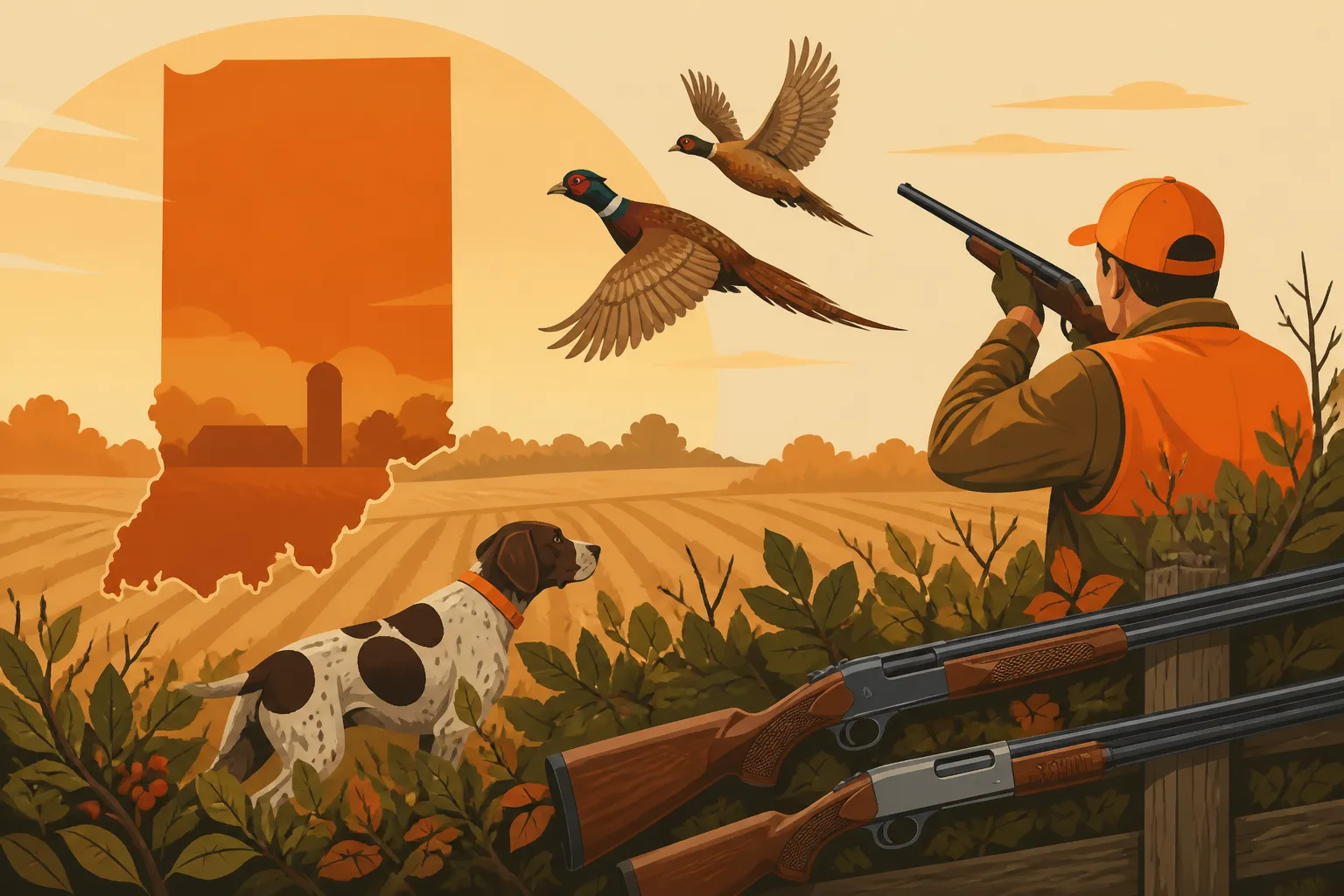
Pheasants are perhaps the most iconic fencerow quarry. While their numbers vary across the state, particularly where large tracts of native grassland habitat are scarce, they can often be found holding tight in dense fencerow cover, especially those bordering corn or soybean fields. They prefer to run rather than fly, making a quick flush often the only shot opportunity when they finally decide to take to the air. Finding areas that hold wild pheasants can be a real treat, but many hunters also enjoy the challenge of hunting stocked birds on public lands. For more about this, check out Pheasant Hunting Indiana Grassland.
Rabbits, primarily cottontails, are absolutely king of the fencerows. These little dynamos thrive in the thorny, brushy tangles that make up most fencerows. They provide fast-paced action, whether you're still-hunting slowly or working with a pack of beagles. When a rabbit bursts from cover, it's often a darting, unpredictable target that requires a quick swing. Hunting rabbits in fencerows is a classic Indiana pastime, and you can learn more about it in Rabbit Hunting Indiana Fencerows.
Squirrels, both fox and gray, also frequent fencerows, especially if those fencerows contain mature mast-producing trees like oaks, hickories, or walnuts. While often associated with deep woods hunting, fencerows provide excellent travel routes and feeding opportunities. A quick shot at a squirrel scampering along a fence line or darting up a tree is a common scenario. Their presence adds another layer of opportunity for the dedicated small game hunter. Sometimes you'll find squirrels using the fencerow to get from one woodlot to another. If you're targeting them specifically, it's worth reading up on Squirrel Hunting Indiana Bottomland Hardwoods.
Less common, but still present in some areas, are bobwhite quail. While their populations have declined significantly over the decades due to habitat loss, where suitable cover and food exist, particularly in southern Indiana, you might still encounter a covey. A quail covey flush is an exhilarating explosion of birds, demanding rapid, multiple shots. Fencerows can provide crucial cover for quail, especially when they connect larger blocks of quality habitat. The possibility of encountering any of these species is what makes upland hunting in Indiana's fencerows so exciting and dynamic.
Choosing the Right Shotgun Type for Close Quarters
When you're pushing through dense Indiana fencerow cover, the type of shotgun you carry makes a huge difference. Each action type — over/under, side-by-side, pump-action, and semi-automatic — has its own distinct advantages and disadvantages when it comes to speed, balance, and reliability in tight spaces. Your choice often comes down to personal preference, budget, and the specific demands of your hunting style.
Over/Under and Side-by-Side Shotguns: Tradition Meets Speed
There's something inherently classic and elegant about swinging a double-barreled shotgun, whether it's an over/under or a side-by-side, through an Indiana fencerow. These guns are often lauded for their balance, quick handling, and the ability to offer two immediate shots with different chokes, which can be a huge advantage when a bird flushes close but there’s a follow-up shot opportunity at a slightly longer range. Their short overall length, especially with shorter barrels, makes them highly maneuverable in thick brush, reducing the chance of snagging on thorns or branches. Many upland hunters swear by their doubles for their responsiveness and natural pointing characteristics.
The main benefit of a double gun is the instantaneous second shot. Unlike a pump or semi-auto where you have to cycle the action, a double gun has two barrels ready to fire. This is particularly useful for those fast-flying pheasants or a covey of quail where multiple targets present themselves rapidly. While they might carry a higher price tag than many pump-actions, their robust construction and timeless design often mean they're an investment that lasts a lifetime. The break-action also makes them inherently safe for crossing fences or navigating tricky terrain, as you can easily open the action and visibly ensure the gun is unloaded.
Side-by-sides, with their wider profile, can feel a bit different in the hands compared to over/unders. Some hunters find the side-by-side's balance more natural for quick, intuitive pointing, especially in thick cover. Others prefer the stacked barrels of an over/under for its more rifle-like sight plane. Both styles share the advantage of being compact and quick to shoulder. They are generally very reliable, with fewer moving parts than a semi-automatic, reducing the chances of a malfunction in dusty or wet field conditions. For many, a double gun is more than just a tool; it's a piece of hunting heritage that adds to the enjoyment of the pursuit.
Pump-Action Shotguns: Reliable and Rugged
The pump-action shotgun is an absolute workhorse, and for many Indiana hunters, it's their go-to choice for virtually any hunting scenario, including upland game in fencerows. Pumps are renowned for their reliability, ruggedness, and relatively affordable price point. They can take a beating, get dirty, and still cycle shells, which is a huge plus when you're pushing through briars, mud, and whatever else an Indiana fencerow throws at you. The manual cycling of the action might be slightly slower than a semi-auto, but for many, the rhythmic "shuck-shuck" is part of the charm and discipline of pump-gunning.
One of the biggest advantages of a pump-action is its versatility. Most models can easily swap barrels, allowing you to quickly change between a short, open-choked barrel for fencerow hunting and a longer, tighter-choked barrel for waterfowl or turkey. This means you can own one reliable firearm that serves multiple purposes. They are also incredibly easy to maintain and clean, which is important after a muddy or wet day in the field. The solid construction and simple mechanism mean fewer things can go wrong.
While some might argue that the pump action introduces a slight delay between shots compared to a double gun or semi-auto, for many, the sheer dependability and robust nature of a pump-action like a Remington 870 or Mossberg 500 makes it the perfect choice for tough fencerow hunting. You learn to make that first shot count, but you still have two more on tap if needed. They are often less sensitive to different ammunition loads, reliably cycling everything from light target loads to heavy magnum upland shells, adding to their practical appeal for hunters who use a variety of ammunition.
Semi-Automatic Shotguns: Soft Recoil, Fast Follow-Ups
Semi-automatic shotguns offer a compelling blend of features that make them excellent choices for upland hunting in Indiana's fencerows, especially for those who prioritize rapid follow-up shots and reduced felt recoil. Unlike a pump-action, a semi-auto uses the energy from the fired shell to automatically cycle the next round into the chamber, giving you incredibly fast second and third shots. This can be a game-changer when multiple birds flush simultaneously, or a quick-running rabbit offers a second chance.
Another significant advantage of semi-automatic shotguns is their ability to significantly reduce felt recoil. The gas-operated systems common in many semi-autos absorb some of the recoil energy, making them much more comfortable to shoot, especially during a high-volume day of upland hunting or for hunters sensitive to recoil. This comfort can lead to greater confidence and better shooting, as you're not anticipating a harsh kick. Models from manufacturers like Beretta, Browning, and Winchester are popular choices among upland enthusiasts for their smooth operation and often excellent balance.
While semi-autos generally have more moving parts than pumps or double guns, requiring a bit more attention to cleaning to ensure flawless operation, modern designs are remarkably reliable. They offer a great combination of speed, comfort, and the ability to hold several rounds, making them highly effective for the unpredictable nature of fencerow hunting. If you value a smooth shooting experience and the ability to get multiple shots off quickly without having to manually cycle the action, a semi-automatic shotgun is definitely worth considering for your Indiana upland adventures.
Gauges, Chokes, and Ammunition: Dialing in Your Pattern
Once you've settled on a shotgun action type, the next critical step for effective fencerow hunting in Indiana is selecting the right gauge, choke, and ammunition. These three factors work together to determine your shot pattern, which is absolutely crucial for success on fast-flushing upland game in dense cover. A poor combination here can lead to frustrating misses or even lost game.
Selecting the Ideal Gauge for Indiana Uplands
Choosing the right gauge is a fundamental decision for any shotgun hunter. For Indiana upland hunting in fencerows, several gauges are popular, each with its own fan base and distinct advantages.
The 12 gauge is, without a doubt, the most popular and versatile shotgun gauge available. It offers the widest array of ammunition choices, from light target loads to heavy magnum upland shells. Its generous payload of shot means a denser pattern, which can be an advantage on tough pheasants or when shooting through brush. However, a 12 gauge can also be heavier and have more recoil than smaller gauges, which might be a consideration if you're walking many miles through thick fencerows all day. For many, its power and flexibility make it the undisputed king of upland fields.
The 20 gauge is often considered the perfect "sweet spot" for upland hunting. It's lighter to carry, has significantly less recoil than a 12 gauge, and with modern ammunition, it still delivers plenty of knockdown power for pheasant, rabbit, and squirrel at typical fencerow distances. A 20 gauge gun usually means a lighter, faster-swinging firearm, which is a huge advantage for quick shots in dense cover. For many, the reduced weight and recoil translate to less fatigue and more accurate shooting throughout a long hunting day. This is an excellent choice for those who want a capable upland gun without the heft of a 12 gauge.
The 28 gauge is a delightful and increasingly popular choice, particularly for experienced upland hunters. While it carries a lighter shot payload than the 12 or 20, its patterns are often incredibly consistent and dense. The guns themselves are typically very light and exceptionally quick to handle, making them a joy to carry and swing, especially for species like quail or rabbit. Recoil is minimal, making it a favorite for those seeking a genteel hunting experience. However, its effective range is shorter, and shot selection is less varied. For pure fencerow fun, especially on birds or rabbits that flush close, the 28 gauge is a fantastic, if slightly specialized, option.
The table below offers a quick comparison of these popular gauges for Indiana upland hunting:
| Gauge | Typical Weight Range (lbs) | Felt Recoil (Relative) | Shot Payload (ounces) | Ideal for Fencerow Hunting | Primary Advantage |
|---|---|---|---|---|---|
| 12 | 7-8.5 | Moderate to Heavy | 1 to 1 1/4 | Very good | Versatility, dense patterns |
| 20 | 6-7.5 | Light to Moderate | 3/4 to 1 | Excellent | Balance of power, weight, and recoil |
| 28 | 5-6.5 | Very Light | 5/8 to 3/4 | Excellent (close range) | Maneuverability, low recoil |
Open Chokes Are Your Best Friend in Dense Cover
In the world of fencerow hunting, where shots are typically close and fast, your choke selection is paramount. A choke is a constriction at the muzzle end of a shotgun barrel that controls the spread of the shot pattern. For dense cover, you generally want a wider, more open pattern to increase your chances of hitting a fast-moving, close-range target.
Cylinder choke (or unchoked) provides the widest, most open pattern. At close range, say 10-20 yards, it's incredibly forgiving, spreading shot rapidly to cover a larger area. While it loses density quickly at longer ranges, for those explosive, in-your-face flushes from briar thickets, it's often exactly what you need. You might only get a glimpse of a pheasant or rabbit before it disappears, and a wide pattern can mean the difference between a hit and a miss.
Improved Cylinder is slightly tighter than cylinder but still considered an "open" choke. It offers a good balance, providing a wider pattern for close shots but retaining enough density to be effective out to 25-30 yards. Many experienced upland hunters will use an improved cylinder in their first barrel for close flushes and perhaps a modified choke in their second barrel (on a double gun) for a bird that gets out a bit further. For general fencerow hunting, an Improved Cylinder is often the perfect all-around choice. It’s effective for both pheasants breaking from cover and rabbits scurrying through the undergrowth.
Using tighter chokes like Modified, Improved Modified, or Full in fencerows is generally not recommended. A tight pattern at very close range can actually result in "pattern blowing," where the shot charge is too concentrated and creates a hole in the target or misses it entirely. It's also less forgiving for slight aiming errors. Remember, fencerows are about quick, instinctive shots, not precision long-range efforts. You want a broad spread to maximize your chances when a bird flushes just feet away. For more on this, check out Choke Choice for Fast Flushes.
Ammunition Selection: Shot Size and Composition
Once your gauge and choke are sorted, choosing the right ammunition is the final piece of the patterning puzzle. For Indiana upland game in fencerows, you'll generally be looking at smaller shot sizes.
For pheasants and larger rabbits, #5 or #6 lead shot is typically the go-to. The larger pellets carry more energy, which is important for penetrating feathers and bone. A #5 shot offers good penetration and range for pheasants, while #6 provides a denser pattern, often preferred for rabbits or pheasants that might be flushed a bit closer. The goal is to deliver enough energy to cleanly dispatch the animal without over-penetrating or ruining too much meat.
For smaller game like quail or squirrels, or for rabbits at very close range, #7.5 lead shot can be highly effective. These smaller pellets create a very dense pattern, increasing the likelihood of hitting a small, fast-moving target. While they don't carry as much energy as #5 or #6, at typical fencerow distances, they are perfectly adequate for these species. If you're running a mixed bag hunt, a compromise like #6 shot in a 20 gauge with an Improved Cylinder choke often works well for a variety of Indiana's small game. You can learn more about specific shot sizes in Shot Size for Pheasant and Rabbit.
It's crucial to also consider shot composition, especially if you're hunting on public land. Many Indiana Fish and Wildlife Areas (FWAs) and some other public properties require the use of non-toxic shot for upland game, particularly pheasants. Always check the specific regulations for the area you plan to hunt. Common non-toxic options include steel, bismuth, or tungsten-matrix loads. While non-toxic loads can be more expensive and sometimes require different choke considerations (steel shot should generally not be shot through full or even modified chokes in older guns), they are essential for preserving wetlands and other sensitive habitats. For private land, lead shot is generally permissible, but always be aware of your surroundings and any local ordinances.
Finally, always pattern your shotgun with your chosen ammunition and choke combination. What works well on paper at 20-30 yards will give you confidence when that bird explodes from the fencerow. You'll understand the spread and density of your pattern, ensuring you're ready for the field.
Practical Considerations for Maneuvering Fencerows
Hunting Indiana's fencerows isn't just about shooting; it's about navigating challenging terrain, covering ground, and staying comfortable and efficient throughout the day. The practical aspects of your gear and approach can make or break a hunting trip.
Weight and Balance: A Day of Walking Makes a Difference
Imagine slogging through a mile-long fencerow, thick with briars and unseen holes, carrying a heavy, unbalanced shotgun. By the end of it, your arms ache, your shoulders are sore, and your swings are sluggish. This is why the weight and balance of your upland gun are incredibly important for fencerow hunting. You're likely to be walking significantly more than you're shooting, and a lightweight, well-balanced firearm reduces fatigue and improves your ability to make those critical, quick shots.
A gun that feels "lively" in your hands, one that comes to the shoulder smoothly and naturally points where you look, is a huge asset. This often means opting for a shorter barrel length (26 inches is very popular for upland, some even go to 24 inches for extreme maneuverability) and a lighter gauge like a 20 or 28 gauge, as discussed earlier. Even within the same gauge, different models can vary wildly in weight and how that weight is distributed. Spend time shouldering various guns at your local sporting goods store. Close your eyes, bring the gun up, and see where it naturally points. Does it feel front-heavy, or does it balance nicely between your hands? This personal fit is crucial for instinctive shooting in tight cover. Don't underestimate how much a few ounces saved on your gun can impact your endurance and reaction time over a full day of busting brush.
Durability and Weather Resistance
Indiana weather can be notoriously unpredictable, especially during upland seasons. A crisp, sunny morning can quickly turn into a drizzly, muddy afternoon, or a sudden cold front can bring sleet and snow. Your upland gun needs to be able to stand up to these conditions and the rough-and-tumble nature of fencerow hunting. You'll be pushing through thick brush, crawling under fences, and potentially even stumbling in muddy conditions. A delicate, highly polished gun might look beautiful, but it could quickly show wear and tear in this environment.
Look for shotguns with durable finishes that resist rust and scratches. Synthetic stocks are often a practical choice over fine wood, as they are impervious to moisture and less prone to dinging. A matte or subdued finish is also preferable to a highly reflective one, as it reduces glare and is less likely to spook wary game. Reliability in adverse conditions is key; you don't want your action to freeze up or jam because of mud, water, or debris. Simple, robust designs, like those found in quality pump-action shotguns, are often excellent choices for their ability to function flawlessly even when they're not pristine. After all, a gun that doesn't fire when a pheasant flushes is just expensive walking stick. This also applies to other gear you carry, such as tough Brush Pants for Indiana Fencerows.
Leveraging Technology for Better Fencerow Scouting
While the gun itself is paramount, modern technology can significantly enhance your fencerow hunting strategy. Before you even step foot in the field, tools like mapping apps can be invaluable. This is where a resource like GoHunt really shines. Using detailed aerial imagery, you can identify promising fencerows, pinpoint potential bottlenecks, locate dense cover patches, and even visualize access points before you ever leave home. This pre-scouting saves you precious time and effort in the field, allowing you to focus your energy on the most productive areas.
Imagine scanning satellite photos on GoHunt and spotting a long fencerow that connects a standing cornfield to a small woodlot, with a creek running alongside part of it. This tells you immediately that it's a prime travel corridor with food, water, and cover – a perfect spot for pheasants and rabbits. You can mark these waypoints, measure distances, and plan your approach routes to optimize your hunt. This kind of detailed planning can also help you understand how deer might use these areas, especially if you plan to do some off-season scouting for shed antlers. Knowing the lay of the land digitally helps you to be much more efficient once you're out there. These apps also often show property lines, which is crucial for staying on public land or ensuring you have proper permission on private parcels. For more on navigating public lands, check out Scouting Indiana Public Land Before Season.
Field Etiquette and Safety in Fencerow Environments
Hunting in Indiana's fencerows often means being in close proximity to other hunters, dogs, and potentially private property. Practicing good field etiquette and unwavering safety is not just about following the rules; it's about being a responsible hunter and ensuring a positive experience for everyone.
Blaze Orange and Clear Communication
Safety in numbers is a key aspect of upland hunting, especially when pushing dense fencerows with partners and bird dogs. This is where blaze orange (or blaze pink, which is also legal in Indiana) becomes absolutely non-negotiable. Indiana law requires hunters to wear a certain amount of blaze orange during specific seasons, especially firearms deer season, but it's always a good idea when upland hunting, regardless of the season, to ensure you're visible to others. A bright orange vest and hat aren't just for legal compliance; they are critical for preventing accidents. Always consult How Much Blaze Orange Indiana Requires to be sure you're properly equipped.
Beyond visibility, clear and constant communication with your hunting partners is vital. Let everyone know where you're moving, when you're crossing an obstacle, and if you're approaching a dense patch of cover where game might flush. Hand signals, whistles, and verbal calls should be established before the hunt begins. If you're hunting with dogs, make sure they are well-trained and respond to commands, preventing them from running out of range or into dangerous situations. Never swing your gun outside of your safe zone of fire, especially if you have partners or dogs working ahead or to the side. Always identify your target clearly and ensure nothing is beyond it that you don't intend to shoot.
Respecting Property Boundaries and Landowners
Indiana's fencerows often run along the edges of private agricultural fields or smaller woodlots, making it incredibly easy to inadvertently trespass if you're not paying attention. Respecting property boundaries is not just a legal requirement but a cornerstone of ethical hunting. Always know exactly where you are, whether using a handheld GPS, a mapping app like GoHunt, or simply by observing physical markers like fence lines and posted signs. If there's any doubt, err on the side of caution and avoid the area.
If you plan to hunt private land, securing explicit permission from the landowner is absolutely essential. Many prime fencerows are on private property, and building a good relationship with a landowner can open up incredible hunting opportunities. When asking for permission, be polite, respectful, and offer to share some of your harvest. Always leave gates as you found them, don't litter, and avoid damaging crops or fences. A landowner's trust is a precious thing, and a single disrespectful hunter can ruin access for everyone. For tips on how to approach landowners, read Asking an Indiana Farmer for Permission. Remember, retrieving downed game from private land without permission is still trespassing, so always be mindful of where your bird or rabbit might fall. You can find more specific rules in Indiana Trespass and Permission Law.
Handling Obstacles Safely
Fencerows, by their very nature, are full of obstacles. You'll encounter barbed wire fences, fallen trees, overgrown ditches, and thorny thickets. Navigating these safely requires forethought and careful gun handling. When crossing a fence, always open the action of your shotgun and place it safely on the other side before climbing over. Alternatively, if hunting with a partner, one person can hold both unloaded guns while the other crosses, then swap. Never climb over or under a fence with a loaded firearm.
Be mindful of your footing. The ground in fencerows can be uneven, muddy, or obscured by heavy brush, increasing the risk of a fall. A slip could result in an accidental discharge if you're not handling your gun properly. Pay attention to where your muzzle is pointing at all times, keeping it in a safe direction, typically pointed upward or downward away from yourself and others. Thorns and briars can snag on your clothing and equipment, so wear appropriate gear like sturdy canvas or brush pants. Being deliberate and careful in your movements will help prevent accidents and ensure you have an enjoyable and safe day afield.
Maintaining Your Upland Gun for Longevity
Your upland gun is an investment, a tool that performs under demanding conditions. Just like any fine instrument, it requires proper care and maintenance to ensure its longevity, reliability, and continued performance. Neglecting your shotgun after a hunt, especially a wet or muddy one in Indiana's fencerows, can lead to rust, malfunctions, and premature wear.
Post-Hunt Cleaning and Storage
After a long day in the fencerows, it's tempting to just lean your shotgun in the corner and call it quits. Resist that urge! A thorough cleaning is essential. Start by always making sure the gun is completely unloaded and verify it multiple times. Then, disassemble the gun according to the manufacturer's instructions. Pay close attention to the bore, removing all powder residue, lead fouling (if using lead shot), or plastic wad buildup. A good quality bore cleaner and a brass brush are your friends here. After cleaning, run dry patches through until they come out clean, then apply a light coat of rust preventative oil.
The action and receiver also need attention. Wipe down all external surfaces, removing mud, dirt, and moisture. Use a soft brush or compressed air to dislodge any debris from the action, especially in semi-automatics where gas ports can get clogged. Lightly oil all moving parts. For wooden stocks, wipe them down with a soft cloth and consider applying a wood conditioner if they’ve been exposed to a lot of moisture. For synthetic stocks, a simple wipe-down is usually sufficient. Store your cleaned and oiled gun in a breathable gun sock or case in a dry, temperature-controlled environment. Avoid storing it in padded cases for long periods, as these can trap moisture and actually promote rust.
Regular Inspection and Minor Maintenance
Beyond the post-hunt routine, regular inspection and minor maintenance throughout the season are crucial. Before each hunt, give your shotgun a quick once-over. Check for any loose screws, especially those holding the stock to the receiver or the forend in place. Tighten them gently if needed, but avoid over-tightening. Inspect the barrel for any obstructions, even a small twig or mud can cause serious issues if fired through. Look at your chokes to ensure they are properly seated and haven't loosened during previous shooting.
Keep a small kit of essential cleaning supplies, a multi-tool, and a bottle of oil in your hunting pack or vehicle. This allows for quick field fixes or wipe-downs during a multi-day hunt. If you notice any unusual wear, persistent malfunctions, or excessive rust that you can't address with your regular cleaning, don't hesitate to take your gun to a qualified gunsmith. They can diagnose and repair issues before they become major problems, ensuring your upland gun remains safe, reliable, and ready for countless more seasons of chasing pheasants and rabbits through Indiana's fencerows. Proper care ensures that your chosen firearm will be a trusted companion for years to come, reflecting your dedication to the sport.
Disclaimer
This article is for general informational purposes only and does not constitute professional advice. Laws, prices and regulations vary by location and change over time. Consult a qualified professional for guidance on your specific situation.