Illuminated Reticles for Dark Timber
Many Indiana hunters have faced that frustrating moment when legal shooting light is technically available, but the timber is so thick and dark that your black crosshairs simply disappear against a deer's dark hide. It's an issue that can make the difference between a clean shot and a missed opportunity, or worse, an unethical one. This guide will dive deep into how illuminated reticles can be a game-changer for navigating those low-light challenges in our Hoosier woods.
The Challenge of Low-Light Hunting in Indiana's Timber
Indiana's woods, while beautiful, can be incredibly dense, especially in the thickets and hollows where deer love to hide. This natural cover, combined with atmospheric conditions, often makes aiming a shot a real struggle, even when you technically have enough light.
Why Indiana's Woods Get So Dark
Think about those deep river bottoms along the Wabash, or the heavily canopied slopes of the Hoosier National Forest. The hardwoods grow tall and thick, creating a natural ceiling that filters out an incredible amount of light. Even on a bright, sunny day, stepping into a mature timber stand can feel like entering a dimly lit room. Then you add in the crucial hunting times: early morning just after legal light, and late evening right before it closes. These periods are inherently low-light, and when combined with dense overhead cover, it gets dark fast.
Rainy, overcast, or foggy days only exacerbate the issue. We've all been out there when a thick gray sky hangs low, turning midday into something resembling dusk. In these conditions, those whitetails blend seamlessly into the shadows, and a traditional black reticle can vanish into the background, leaving you guessing. It's not just about seeing the deer; it's about seeing your aiming point clearly on the deer.
The Frustration of Losing Your Reticle
There’s a unique kind of panic that sets in when a buck steps out in a shaded creek bottom, perfectly broadside, but your reticle is completely gone. You know he’s there, you can see his outline, but you can’t make out those crucial crosshairs against his dark coat or the even darker timber behind him. It's a situation many of us have faced, leading to agonizing decisions. Do you risk a shot you're not 100% confident in, or do you let a prime opportunity walk away?
This isn't just about missing a deer; it's about ethical hunting. We owe it to the animal to make the cleanest, most humane shot possible. If you can't clearly see your aiming point, your chances of a precise shot diminish significantly. This frustration can turn a peaceful hunt into a nerve-wracking experience, especially when you've put in the time scouting Finding Sign in Big Hoosier Forest Timber or sitting through a long, cold day in the stand. No hunter wants to spook a deer because they fiddled too long trying to find their reticle, or worse, make a poor shot.
Understanding Illuminated Reticles
So, what's the solution to this vanishing reticle problem? For many, it's the illuminated reticle, a feature that has become increasingly popular for good reason. It offers a distinct advantage in those challenging low-light conditions we frequently encounter in Indiana.
How Illuminated Reticles Work
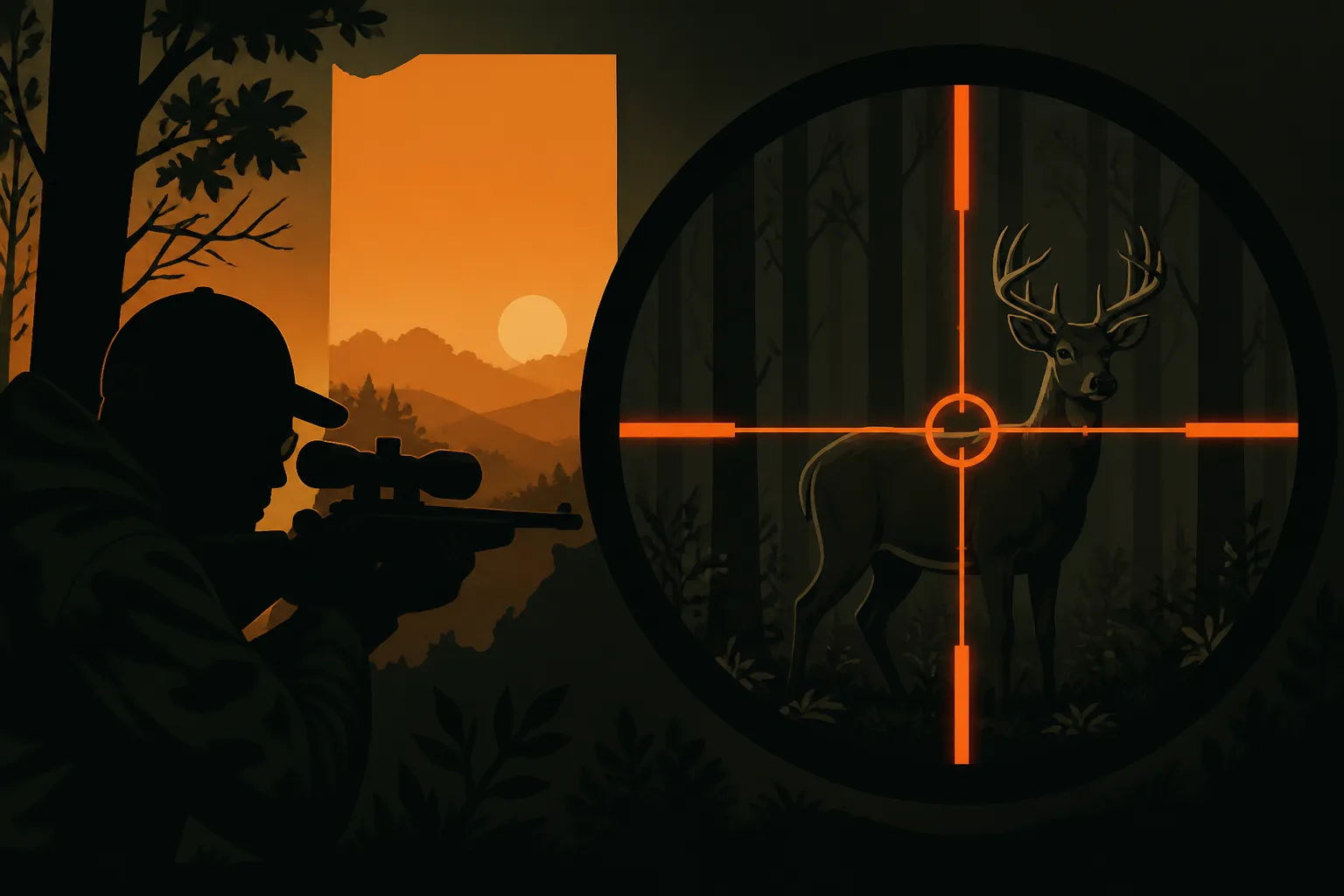
At its core, an illuminated reticle is a set of crosshairs or a aiming dot within your scope that can be lit up by a small internal light source, typically an LED. Unlike traditional wire reticles, which are simply etched into the glass or made from fine wire, illuminated reticles often feature a special etching that allows light to pass through and highlight the reticle pattern.
Here’s the basic breakdown: a tiny battery powers an LED light. This light is then directed to illuminate a portion of the reticle, whether it’s just the center dot, the entire crosshair, or a specific aiming point. You usually control this illumination with a dial or buttons on the scope's eyepiece or side parallax knob. Different scopes offer different colors, with red and green being the most common. Red is generally favored because it's less disruptive to your natural night vision, while green can be very visible during certain twilight conditions. The light isn't projected onto the target; it's contained within the scope, making your aiming point clearly visible to you.
Types of Illumination and Brightness Settings
Not all illuminated reticles are created equal. You’ll find a wide spectrum of illumination styles and brightness adjustments. Some scopes offer a simple on/off button for a single brightness level, while others provide a sophisticated range of settings, from extremely dim, almost imperceptible glows suitable for true darkness, to daylight-bright options that can be seen even against a snow-covered field in full sun.
The ability to precisely adjust brightness is critical. Imagine sitting in a ground blind at dawn: you might need a very subtle, almost ghostly red dot to keep from "flaring out" your vision. Later, if a deer steps into a deep, dark shadow at last light, you might crank it up a notch or two. Too bright, and the reticle can bloom, obscuring your target; too dim, and it's still hard to see. High-quality scopes often feature "off" positions between each brightness setting, preventing you from having to cycle through all intensities to turn it off, which saves battery life. When you're considering different optics, doing some research on platforms like GoHunt can help you compare these features and find scopes with the fine adjustments you need for varied Indiana conditions.
First Focal Plane (FFP) vs. Second Focal Plane (SFP) with Illumination
This is where things can get a little technical but are important for illuminated reticles, especially when thinking about hunting distances in Indiana.
- Second Focal Plane (SFP) Reticles: In an SFP scope, the reticle stays the same size regardless of the magnification setting. If you increase the magnification, the target appears larger, but your reticle remains constant. For illuminated reticles, this means your illuminated dot or crosshair will always appear the same size, which can be beneficial for consistent aiming, especially at lower magnifications in dense timber. However, if your illuminated reticle has ranging marks or holdovers, these will only be accurate at a specific magnification setting, usually the highest. Most hunting scopes, particularly those with a more traditional design, are SFP.
- First Focal Plane (FFP) Reticles: With an FFP scope, the reticle grows and shrinks proportionally with the magnification. As you dial up the power, the reticle gets larger; as you dial it down, it shrinks. For illuminated reticles, this means the illuminated dot or crosshair will also change size. The main advantage here is that any ranging or holdover marks on the reticle remain accurate at all magnification settings. However, at very low magnifications, the reticle might become extremely fine and difficult to see, even with illumination, while at very high magnifications, it might appear quite thick. For the typical Indiana timber hunter taking shots under 200 yards, the consistent reticle size of an SFP can often be simpler and more intuitive, particularly if the illumination is just a central dot for quick acquisition.
Here's a quick comparison of how FFP and SFP illuminated reticles behave:
| Feature | Second Focal Plane (SFP) Illuminated Reticle | First Focal Plane (FFP) Illuminated Reticle |
|---|---|---|
| Reticle Size | Stays constant regardless of magnification | Changes size proportionally with magnification |
| Illumination Size | Appears the same size at all magnifications | Grows/shrinks with magnification |
| Ranging/Holdovers | Only accurate at specific magnification (usually highest) | Accurate at all magnification settings |
| Visibility at Low Power | Consistent, easy to see | Can become very fine and hard to discern |
| Visibility at High Power | Consistent, can feel thin compared to target | Can become thick and potentially obscure target |
| Typical Use in Indiana | Most common for timber hunting, simpler aiming | More common for long-range precision, less so in thick timber |
Practical Benefits and Considerations for Indiana Hunters
Understanding the mechanics is one thing, but how does an illuminated reticle truly benefit you when you're out there chasing a November buck in the Hunting the Indiana Rut in Early November or sitting a December stand during Cold-Weather Sitting Strategy in Indiana?
Enhancing Target Acquisition in Gloomy Conditions
This is the bread and butter of the illuminated reticle. Imagine you're hunting a ridge line in Brown County, and a thick fog rolls in just before dark. A nice buck steps out of a cedar thicket at 70 yards. With a traditional black reticle, he might just blend in, the crosshairs disappearing against his shoulder. But with a subtle red dot glowing brightly against his dark hide, you can place that shot with confidence.
These conditions are common in Indiana. Whether it’s the shaded side of a hill in the Hoosier National Forest, a deep ditch in northern Indiana farmland, or the thick cover around a Hunting a Funnel Between Two Woodlots, deer are experts at disappearing into the dim light. An illuminated reticle dramatically cuts down the time it takes to acquire a clear aiming point. This quick acquisition is vital, as deer rarely offer long shot opportunities. It allows for faster, more confident target engagement, which translates to a more ethical and successful hunt. The glowing reticle provides a distinct contrast against the target, regardless of how dark or camouflaged the background might be.
Battery Life and Reliability in the Field
While illuminated reticles offer a clear advantage, they do come with a reliance on batteries, which means you need to be mindful of battery life and have a backup plan. Most modern scopes use common coin-style batteries that are relatively inexpensive and easy to find. However, cold weather, which is often a factor during Indiana’s late archery and firearms seasons, can drain batteries faster.
It’s crucial to turn off the illumination when not in use. Many scopes automatically shut off after a period of inactivity, but it’s still good practice to manually switch it off. Always carry spare batteries in your pack, especially on multi-day hunts or during very cold weather. Before each hunt, do a quick check to ensure your reticle lights up. There’s nothing worse than needing it most and finding the battery dead. Brands like Leupold, Vortex, and Nikon often integrate power-saving features, but vigilance on your part is key. For long walks into your stand, like when you're using one of your Packs Built for a Hoosier Forest Day Hunt, having a few spare batteries tucked away won't add much weight but will save you a lot of grief.
Cost Versus Benefit for the Average Hunter
Let's be real, adding features to any hunting gear often means adding to the price tag. Illuminated reticle scopes generally sit at a slightly higher price point than their non-illuminated counterparts. You'll find entry-level options that are quite affordable, while premium scopes can demand a significant investment.
Is it worth the extra cost for the average Indiana hunter? For many, the answer is a resounding yes. Consider the peace of mind and the ethical advantage. The ability to make a clean shot in marginal light conditions is invaluable. It reduces the risk of wounding an animal and losing it, which is something no hunter wants. If you primarily hunt in open fields or only during bright daylight hours, an illuminated reticle might not be a top priority. However, if your hunting grounds involve dense timber, early morning/late evening stands, or you frequently hunt in overcast weather, the investment pays dividends in confidence and capability. Tools like GoHunt can be invaluable for comparing the features and price points of various scopes, helping you determine where the sweet spot is for your budget and hunting style.
Choosing and Using Your Illuminated Reticle Scope
So, you’re convinced an illuminated reticle is for you. Now, how do you pick the right one and make sure you’re getting the most out of it in the Indiana woods?
Key Features to Look For
When shopping for an illuminated reticle scope, don't just grab the first one you see. Consider these crucial features:
- Brightness Range and Adjustments: As discussed, a wide range of brightness settings is paramount. Look for scopes that offer very dim settings for true low light and bright enough settings for those overcast, gloomy days. Fine, incremental adjustments are better than big jumps in brightness.
- Reticle Design: Do you prefer a simple illuminated dot, a crosshair, or a more complex reticle with holdovers? For timber hunting, a clean, uncluttered reticle with a visible illuminated dot is often ideal for quick target acquisition. Avoid overly busy reticles that can obscure your target in low light.
- Durability and Weatherproofing: Indiana weather is unpredictable. Your scope needs to be robust, waterproof, and fog proof. Look for nitrogen-purged or argon-purged scopes to prevent internal fogging. A durable housing will stand up to the bumps and scrapes of trekking through thick brush.
- Battery Type and Availability: Opt for scopes that use commonly available batteries, so you’re not scrambling to find an obscure power source when you need it most.
- Low-Light Performance (Beyond Illumination): Remember that illumination supplements the scope's overall low-light performance. A scope with high-quality glass and good light transmission will gather more ambient light, making the image brighter before you even turn on the reticle. Read reviews and look for discussions on Low-Light Performance in a Scope.
- Ergonomics: Can you easily reach and operate the illumination dial or buttons while mounted in your stand, perhaps even with gloves on during a cold morning?
Practice Makes Perfect
Having an illuminated reticle is fantastic, but it's not a magic bullet. You need to practice with it under various conditions to truly understand its capabilities and limitations.
- Varying Light Conditions: Take your rifle to the range and practice during dawn and dusk. Experiment with different brightness settings against various backdrops. Get a feel for how the reticle appears against dark targets, bright skies, and everything in between.
- Quick Acquisition Drills: Practice shouldering your rifle and quickly finding the illuminated reticle on a target. In the real world, deer don't stand still for long. The goal is to make the illuminated reticle an extension of your natural aiming process.
- Zeroing and Familiarity: Just like any other scope, you need to zero your rifle properly. Spend time at the range, ensuring your setup is accurate. Get comfortable with how the illuminated reticle functions at different magnifications if it's an FFP scope. We have a great guide on Sighting In a Centerfire Rifle for Indiana Woods that can help you with the basics before adding the illumination factor. Understanding your gear completely before you head out is paramount.
Maintaining Your Illuminated Scope
A little care goes a long way in ensuring your illuminated reticle scope serves you well season after season.
- Battery Management: Always replace batteries annually, or more frequently if you use the illumination often. Remove batteries during long-term storage to prevent leakage, which can damage the internal electronics.
- Cleaning: Keep the lenses clean using appropriate lens cleaning solutions and cloths. Avoid harsh chemicals or abrasive materials. A dirty lens will drastically reduce light transmission, negating the benefit of good glass and illumination. For tips on post-hunt care, check out Cleaning a Rifle After a Wet Sit.
- Proper Storage: Store your scope in a safe, dry place, ideally in a padded case, to protect it from impacts and moisture.
An illuminated reticle can truly change your hunting experience in Indiana's dark timber, giving you that extra edge of confidence and ethical precision when it matters most.
Disclaimer
This article is for general informational purposes only and does not constitute professional advice. Laws, prices and regulations vary by location and change over time. Consult a qualified professional for guidance on your specific situation.