Hunting a Clear-Cut Regrowth Edge
Navigating Indiana's diverse deer habitats often means facing dense, unpredictable terrain, and few places present a bigger challenge, or opportunity, than a clear-cut regrowth edge. Hunters frequently feel frustrated when deer seem to vanish into an impenetrable tangle, making it tough to establish consistent patterns. This comprehensive guide will walk you through the nuances of hunting these dynamic clear-cut areas, offering proven strategies to turn what often feels like a puzzle into a successful hunting ground.
Understanding Clear-Cuts and Their Appeal to Deer
Clear-cuts, for all their initial starkness, are a vital part of forest ecology and, more importantly for us hunters, a magnet for whitetails. They might look like a messy, chaotic landscape to the untrained eye, but beneath the surface lies a rich tapestry of new growth that provides deer with everything they need: food, cover, and security.
The Life Cycle of a Clear-Cut
When a timber company comes through and fells a section of forest, it creates a void. But nature abhors a vacuum, and almost immediately, new life begins to spring forth. In the first year or two, you'll see a flush of grasses, forbs, and brambles like blackberry and raspberry. This herbaceous growth is incredibly nutritious and palatable for deer, acting like a giant buffet. As years pass, pioneering tree species like sassafras, wild cherry, and various hardwoods start to take root and grow rapidly. Within five to ten years, this area becomes a dense thicket of saplings, often chest-high or taller, creating an almost impenetrable fortress. This middle stage is prime bedding cover. Finally, as the trees mature, the understory thins again, and the clear-cut transitions back into more open timber, though often with a different species composition than before the cut. Understanding these stages is critical because deer use them differently.
During the initial years, when the ground is awash with tender greens, deer will actively browse. You'll find them feeding heavily in these areas, especially during early archery season. As the clear-cut matures into a dense, almost claustrophobic thicket of young trees and brush, it transforms into ideal bedding cover. Bucks will often seek out the densest parts of these areas for security, particularly mature bucks that prefer solitude. Does with fawns also find safety here. The "edge" of this regrowth, where it transitions into more mature timber, or even another clear-cut of a different age, becomes a superhighway for deer movement, acting as both a travel corridor and a transition zone for feeding and bedding.
Why Deer Gravitate Towards Early Successional Habitat
Deer are creatures of edge. They thrive where different habitat types meet, and a clear-cut provides an abundance of these crucial edges. Think about it: an old-growth forest offers high canopy and shade, but often a sparse understory, meaning less food. A clear-cut, on the other hand, bombards the forest floor with sunlight, igniting a boom of vegetation. This makes clear-cuts incredibly attractive for several reasons.
Firstly, food availability is vastly increased. The sheer volume and variety of browse in a young clear-cut are hard to beat. From the tender shoots of young saplings to the berries and leaves of various shrubs, it's a deer grocery store. Secondly, the dense regrowth offers unparalleled security cover. A deer can disappear into a five-year-old clear-cut and be practically invisible, even at close range. This thick cover provides refuge from predators and hunters alike, making them feel safe to bed down during daylight hours. Thirdly, the varied topography and numerous escape routes within the jumbled growth mean deer can evade threats with ease. When hunting these areas, you'll notice how deer seem to melt away into the underbrush, using every bit of cover to their advantage. This combination of abundant food and impenetrable cover makes clear-cut regrowth edges irresistible to Indiana whitetails throughout the season.
Scouting and Locating Key Areas in Regrowth Edges
Finding success in clear-cuts isn't about aimlessly wandering; it's about smart, focused scouting. These areas can be frustratingly thick, but with the right approach and a bit of technological help, you can pinpoint exactly where the deer are.
Reading the Landscape: Identifying Deer Sign
Scouting a clear-cut regrowth edge requires a keen eye and a patient approach. Unlike open timber where sign can be spread out, in a clear-cut, deer sign is often concentrated in specific travel lanes or bedding pockets. Start by identifying the transition points. Where does the clear-cut meet a mature timber stand? Where does it border a creek bottom or a food plot? These are your primary zones of interest. Look for heavy trails leading in and out of the thick cover. These trails will often be well-worn, especially closer to feeding areas, and might even feature tracks, droppings, and occasional rubs or scrapes. Pay close attention to trails that parallel the edge of the clear-cut, as these are often preferred travel routes for deer moving between bedding and feeding areas without exposing themselves too much. If you're looking for where the big bucks might be hanging out, focus on areas within the thickest part of the regrowth that offer a slight rise or a more open pocket. Bucks often like to bed with their back to the wind, facing downwind into an open area, using the dense cover behind them for security. You might find more substantial rubs or larger beds here. Don't be afraid to get in there and poke around, but do so carefully to avoid leaving too much human scent or disturbing the area before the season. For more in-depth scouting techniques, check out this guide on Finding Sign in Big Hoosier Forest Timber.
Using Technology for Effective Pre-Season Scouting
In today's hunting world, technology can be a game-changer, especially when tackling complex landscapes like clear-cuts. Online mapping platforms are your best friend here. Services like GoHunt offer invaluable aerial imagery that can reveal the age and density of clear-cuts without ever stepping foot in the woods. You can easily spot the boundaries between different stages of regrowth, identify mature timber pockets, and even see faint deer trails or natural funnels that might be invisible from the ground. Look for darker green areas indicating older, denser regrowth, and lighter patches for younger, more open sections.
I personally use a mapping app to overlay property lines (crucial for public land and avoiding trespass), topography, and even historical satellite images to see how a clear-cut has evolved over the years. This allows me to virtually scout potential bedding areas, identify travel corridors, and mark potential stand locations before I ever hit the woods. This is especially helpful when planning an approach to a specific area. Furthermore, you can mark potential entry and exit routes that keep you concealed and utilize the wind. Some platforms also offer data layers for public land boundaries and even recent timber harvests, which can save you a ton of time. This kind of advanced planning, as covered in topics like Reading Aerial Photos for Southern Indiana Deer, helps minimize disturbance during actual physical scouting trips and ensures you focus your efforts on the most promising spots.
Effective Hunting Strategies for Regrowth Edges
Once you've done your homework and identified promising clear-cut regrowth edges, it's time to put a plan into action. Hunting these areas demands adaptability and a solid understanding of deer movement patterns within dense cover.
Stand Placement and Wind Considerations
Picking the right spot for your stand is paramount, and in a clear-cut, it's even more critical because deer can materialize out of nowhere. Your best bet is usually on the edge of the thickest regrowth, where it transitions into more open timber, a field, or a different habitat type. Look for bottlenecks or funnels along these edges – a narrow strip of timber between two clear-cuts, a ridge point overlooking a bottom, or a slight dip in the terrain that deer naturally follow. These spots force deer movement into predictable patterns.
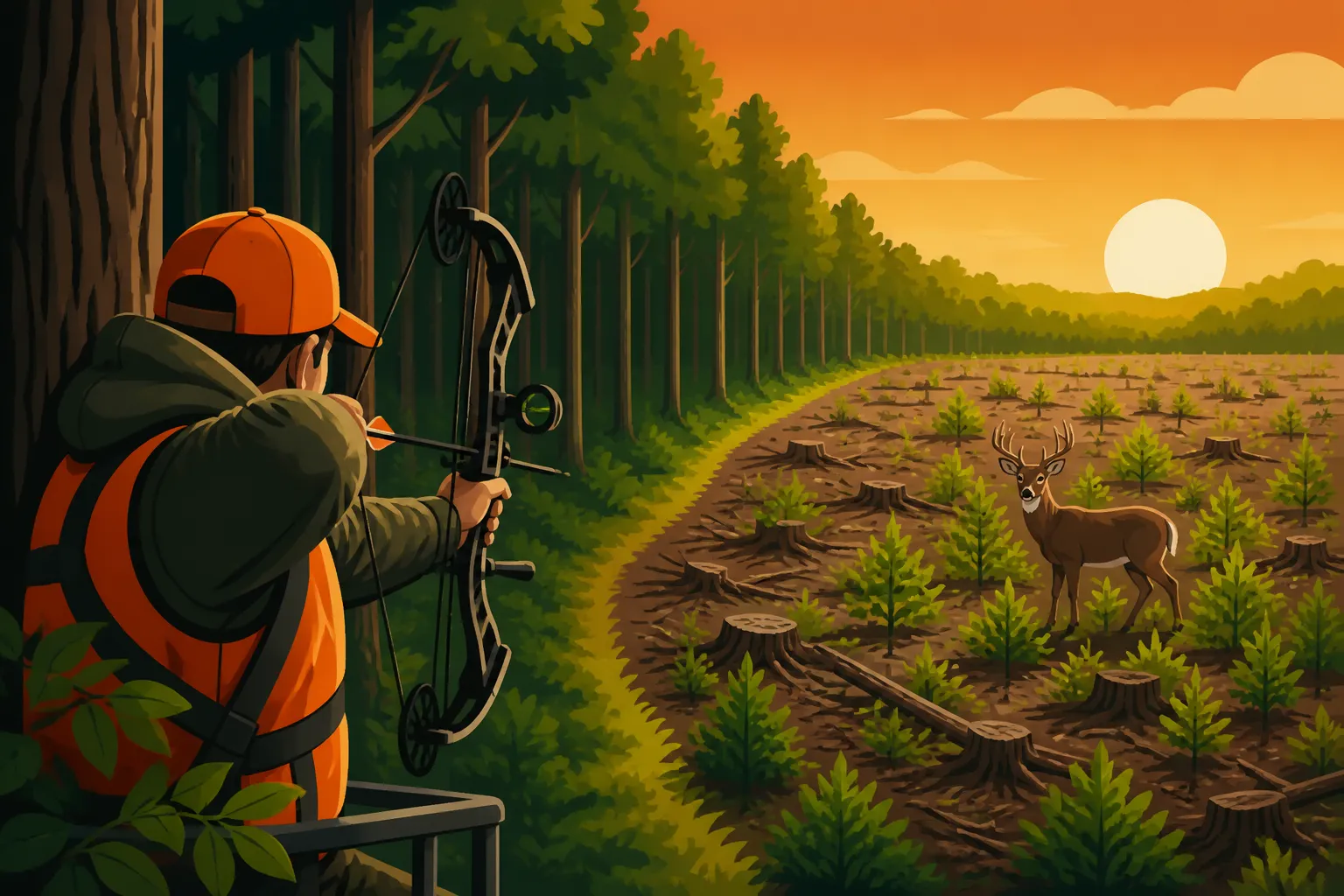
When hanging your stand, especially if you're targeting those mature bucks that love the security of the thick stuff, consider placing it just inside the mature timber, looking into the clear-cut. This gives you a better vantage point without being right in the middle of the chaos. Aim to place your stand where you can cover multiple trails that lead into or out of the thicket. For more detailed advice on elevation and tree choice, consider checking out articles like Treestand Setups in Hoosier National Forest.
Wind is your absolute master in clear-cut hunting. Deer will use their incredible sense of smell to detect danger, and in dense cover, they often feel even more secure, making them less prone to spook if the wind is right. Always set up so your scent is blowing away from where you expect deer to approach or bed. If you have a clear-cut that's primarily a bedding area, try to position yourself on the downwind side, ideally with a crosswind component, so you can catch deer as they leave to feed or move to a different bedding location. This is where those mapping apps and pre-season scouting come in handy – you can identify multiple potential stand sites for different wind directions, maximizing your hunting opportunities.
Still-Hunting and Drives in Thick Cover
While sitting on a stand can be effective, sometimes the best way to hunt a clear-cut is to get in there and move with the deer. Still-hunting, or slowly creeping through the woods, can be incredibly productive, particularly in these noisy, thick environments. The key is to move exceptionally slowly, taking one or two steps, then pausing for several minutes to scan, listen, and glass every patch of cover. Deer often rely on their ears in these areas, and the crunch of leaves can give you away. Move into the wind or with a slight crosswind, paying close attention to any breaks in the cover or small, natural openings where a deer might be browsing or bedded.
Focus on the transition zones and the slightly more open sections within the clear-cut. Look for horizontal lines (a deer's back) amidst the vertical tangle of saplings. It's often difficult to see more than 30-40 yards, so your shots will be close and fast. This requires a different kind of focus than sitting in a stand. If still-hunting isn't cutting it, or if you're hunting with a group, organized deer drives can be highly effective in pushing deer out of these dense clear-cuts towards waiting standers. Just be sure to coordinate carefully for safety. Strategies like those detailed in Still-Hunting Southern Indiana Ridges can be adapted for the unique challenges of clear-cuts.
Timing Your Hunt: When to Hit the Edge
The timing of your hunt around a clear-cut regrowth edge can greatly influence your success. Early season, when the new growth is lush and green, deer will be actively browsing in these areas. Think September and October for Indiana's archery season. Deer will spend more daylight hours feeding in clear-cuts, especially during cooler mornings or evenings. This is a great time to focus on edges bordering agricultural fields or mature timber that offers good staging cover.
As the season progresses and the rut approaches in early November, clear-cuts become crucial travel corridors and bedding areas for bucks looking for does. Bucks will cruise the edges of these thickets, checking for scent and sparring with smaller rivals. This is an excellent time to sit a stand that overlooks a known travel lane or a narrow funnel within the clear-cut. Later in the season, when temperatures drop and other food sources dry up, clear-cuts can still offer valuable browse and thermal cover. Deer might be less active during the day, but they'll still utilize these thickets for bedding and protection from harsh weather. Consider hunting mid-day during late season, as deer might shift their activity when temperatures are warmest, or as they leave bedding to hit a nearby late-season food source for Indiana whitetails.
Gear and Safety Considerations for Clear-Cut Hunting
Hunting clear-cuts isn't like hunting open woods. The dense nature of the habitat means you need specific gear and a heightened sense of safety. Being prepared can make the difference between a frustrating day and a successful one.
Essential Gear for Navigating Dense Regrowth
When you're pushing through chest-high brush and tangled saplings, your gear needs to be tough and functional. Lightweight, durable clothing is key. Think brush pants or chaps to protect your legs from thorns and briars, and a rugged jacket that won't snag or tear easily. Good quality, waterproof boots with ankle support are a must, as clear-cuts can be uneven, muddy, and full of hidden obstacles. I highly recommend a sturdy pair of LaCrosse Alpha Burly Pro boots for comfort and durability in these conditions.
A quality pack is also essential for carrying your gear, water, and any game you might take. A compact, streamlined pack that won't get caught on every branch, similar to those recommended in Packs Built for a Hoosier Forest Day Hunt, is ideal. Don't forget a sharp knife for field dressing, and a small saw or pruners can be invaluable for clearing shooting lanes or paths to your stand. A GPS unit or a reliable mapping app on your phone (download offline maps!) is non-negotiable, as it's incredibly easy to get disoriented in the maze of a clear-cut. Finally, for rifle hunters, consider a compact rifle with a shorter barrel, as longer barrels can be cumbersome in dense cover. A fast-handling shotgun with slugs or a crossbow is also excellent choices for the close-quarters shots often presented in a clear-cut.
Safety First in Challenging Terrain
Clear-cuts present unique safety challenges that every hunter needs to be aware of. First and foremost, visibility can be extremely limited. When still-hunting or moving through a clear-cut, it's often hard to see more than a few yards, which significantly increases the risk of an accidental shooting. This makes wearing blaze orange, even during archery season where it might not be strictly required statewide, a critical safety measure. Always comply with Indiana's Blaze Orange Requirements. If you're hunting with a group, establish clear communication protocols and stick to designated roles (drivers, standers). Never shoot at sounds or movement without positively identifying your target and knowing what's beyond it.
Beyond firearm safety, the terrain itself can be hazardous. Uneven ground, fallen logs, hidden stumps, and tangled vines can lead to trips and falls, especially when carrying gear or dragging a deer. Watch your footing carefully. Be mindful of dead snags or widowmakers that might fall unexpectedly, especially on windy days. Always carry a basic first-aid kit and let someone know your hunting plans, including your general location and expected return time. Hunting a clear-cut can be incredibly rewarding, but prioritizing safety ensures you return home to tell the tale.
| Regrowth Stage | Age (Approx.) | Primary Deer Use | Hunting Strategy Focus |
|---|---|---|---|
| Herbaceous Growth | 1-3 years | Primary Feeding, Some Cover | Early Season Stand hunting on edges, still-hunting feeding lanes |
| Dense Sapling Thicket | 4-10 years | Primary Bedding, Travel Corridors | Mid-Late Season Stand hunting on edges, strategic drives, still-hunting interior trails |
| Maturing Forest | 10+ years | Transition Zones, Secondary Cover | Stand hunting funnels and transition points, scouting for new growth |
Disclaimer
The information provided in this guide is for informational purposes only and does not constitute legal advice. Hunting regulations and conditions can change. Always consult the most current Indiana Department of Natural Resources (DNR) regulations and local ordinances before engaging in any hunting activities. Ensure you have the proper licenses, permits, and landowner permission. Prioritize safety and ethical hunting practices at all times.