Blood Trailing After Dark in Indiana
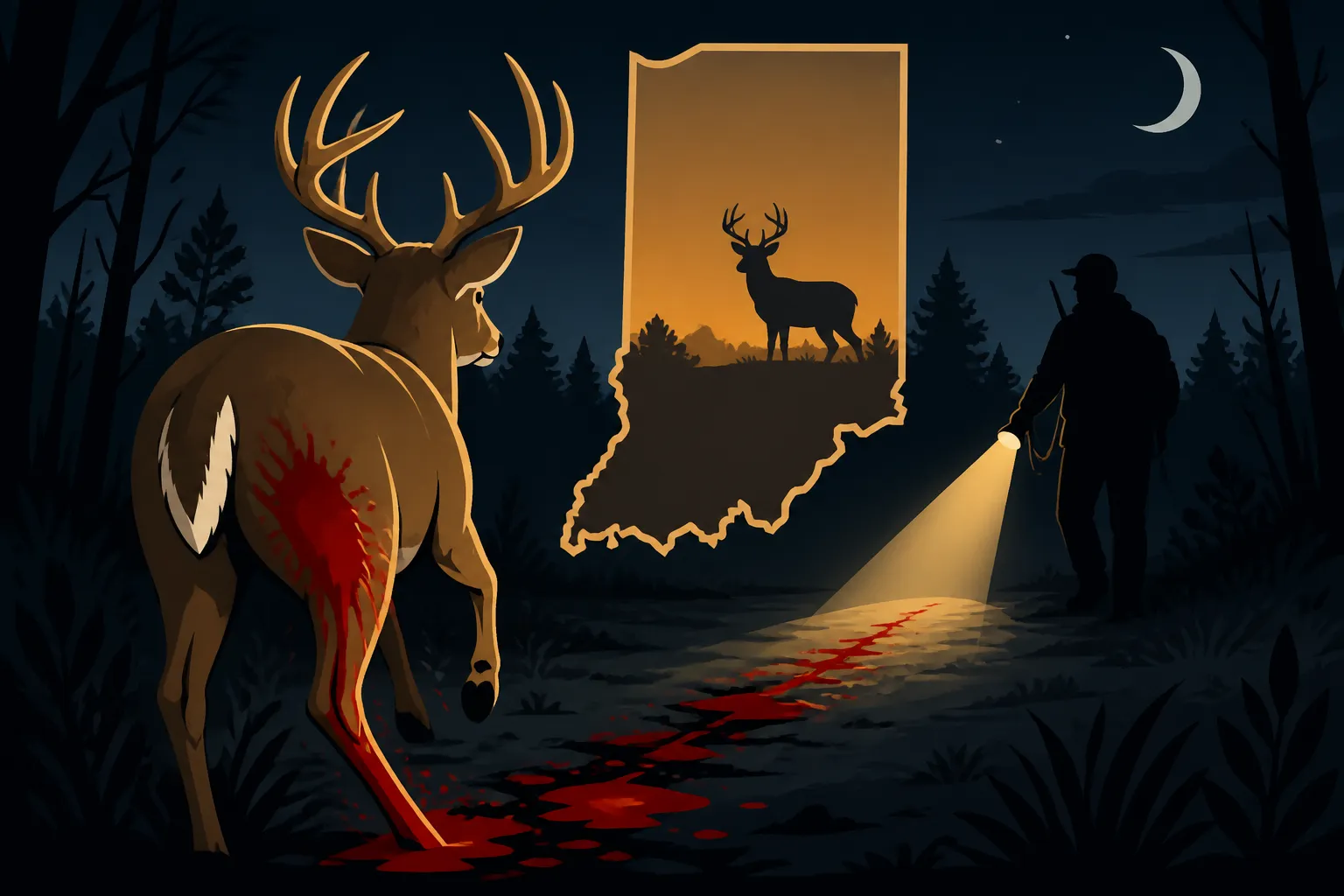
You shot a deer in the last minutes of light, saw it crash off through the timber, and now it’s full dark in the Indiana woods. Your heart is pounding, and you have questions. Can you use a flashlight? Can you bring a dog? What if the trail crosses the fence? This guide covers the rules and the practical steps for blood trailing after dark.
What Indiana Law Says About Recovering a Deer After Dark
Know this part before you take a single step on the trail. The Indiana rules on recovering a deer at night are short, and they stay the same every time they come up in this article.
Lights on the Trail
Indiana law says a light may not be used to take a deer, or to help another person take one. It also says you may not cast the rays of a spotlight or other artificial light from a vehicle while you have a firearm, bow or crossbow with you, if an animal could be killed that way. That applies even if no animal is shot, injured or chased.
Using a light only to follow a blood trail and find your deer is not among those prohibitions. Finishing the deer with the help of a light would be. So a headlamp or flashlight on foot is a tracking tool, not a shooting tool. If you walk up on a deer that is still alive, the light cannot be part of killing it.
That rule shapes the practical advice later in this guide. It is a big reason careful trackers back out from a deer that might still be alive and come back at daylight.
Tracking Dogs Must Stay on a Leash
Indiana allows dogs to track or trail a wounded deer only while the dog is on a leash. Every tracking dog on an Indiana blood trail must stay on a lead, whether it’s a seasoned tracker or your Labrador.
The leash matters for more than the rules. A leashed dog moves at a pace you can keep up with in the dark. It is far less likely to push a wounded deer into the next county, and you can see exactly where the scent line turns.
Thermal, Infrared and Night Vision Devices
The rules on using thermal, infrared or night vision devices to find a deer have been under review. Before you use one on a recovery, confirm the current rule with the Indiana DNR. Your local Conservation Officer is the best person to call. Do it before the season, not at 9 p.m. with a deer down somewhere in the dark.
When the Trail Crosses Onto Private Land
This one causes more stress than anything else. The Indiana DNR says you may not go onto someone’s property to track or retrieve a deer unless you have the landowner’s permission, and written permission is preferred. If you can’t reach the landowner, the DNR suggests contacting your local Conservation Officer for help through Central Dispatch at 812-837-9536.
Save that number in your phone today. For more on that conversation with neighbors, see Retrieving Game From Private Land in Indiana and Do You Need Written Permission in Indiana?.
Checking In the Deer
Once you recover the deer, it must be checked in through the CheckIN Game system within 48 hours. A late-night recovery doesn’t change that window. Registering an Indiana Deer Online walks through the process, and Indiana Deer Reporting Requirements covers the wider picture.
Reading the Shot Before You Take a Step
Most blown recoveries go wrong in the first ten minutes, not the last hundred yards. The urge to climb down and start looking right away is strong. It’s also the most common way a recoverable deer turns into a lost one.
Sounds, Reactions and the Arrow
Close your eyes for a second and replay the shot. Did the deer mule-kick, hunch up, or bolt with its tail tucked? Did you hear a crash, or did the running fade into silence? A high kick and a sprint often mean a heart or lung hit. A hunched, slow walk away often points to a gut hit.
If you’re bowhunting, the arrow tells a story too. Bright pink, frothy blood with bubbles usually means lungs. Dark red suggests liver. Green or brown material with a sour smell means the stomach or intestines. Hair on the ground helps too. Long, coarse, hollow hair comes from the body, and white belly hair hints at a low hit. Broadhead design changes how much blood hits the ground, which is covered in Broadheads for Timber Shots.
Write down or record a voice memo of what you saw: the time, where the deer was standing, which way it ran, and the last place you saw it. You’ll forget details faster than you think once the adrenaline wears off.
How Long to Wait Before Tracking
Waiting feels terrible, but it is how you recover deer. A wounded deer that isn’t pushed will often bed down close by and die there. A deer that’s jumped from its bed by a tracker with a bright light can run a long way on adrenaline and leave little blood behind.
| Likely Hit | Blood and Sign | Common Wait Before Tracking | Night Tracking Approach |
|---|---|---|---|
| Double lung or heart | Bright, frothy blood, often heavy | 30 minutes to an hour | Usually fine to track carefully at night |
| Single lung or high shoulder | Moderate blood that may thin out | Several hours | Track slowly, back out if blood stops |
| Liver | Dark red blood, steady at first | Several hours or longer | Often better to wait until morning |
| Gut or paunch | Thin blood, stomach matter, odor | Many hours, often overnight | Back out and resume at first light |
| Muscle or leg | Blood that starts strong and fades | Varies, sometimes hours | Consider a leashed tracking dog |
On a cold November night, a long wait costs you very little meat. On a warm early-season evening, the tradeoff is harder. Even then, pushing a gut-shot deer in the dark usually costs more than it saves.
Working a Blood Trail in the Dark Step by Step
You’ve waited, you’ve thought it through, and the sign looks good. Here is how to work the trail without making it worse.
Choosing and Using Your Light
A strong white headlamp lets you keep both hands free, and a handheld flashlight held low helps blood stand out on leaves and grass. Many trackers carry both. A light held at waist height and angled across the ground often shows blood drops better than a headlamp shining straight down. Lanterns spread light wide, and some hunters swear by them on leaf litter.
Bring spare batteries. A light that fades an hour into a trail is a real problem in the Hoosier National Forest, where every hollow looks the same after dark. Headlamps for Walking Out After Dark covers brightness and battery life in more detail.
Remember the Indiana rule here. The light is for following the trail and finding the deer. It cannot be used to help take the deer.
A Step-by-Step Night Tracking Routine
- Go to the exact spot where the deer stood when you shot. Find first blood, hair or the arrow before you follow anything.
- Mark the starting point with a piece of flagging tape, toilet paper or a reflective tack.
- Drop a pin on your phone at the shot location. Mapping apps like GoHunt let you save waypoints and mark your track, which helps when you need to find your way back.
- Follow the blood one drop at a time. Mark the last sign every few yards so you can look back and see the direction the trail is heading.
- Walk to the side of the trail, not on it, so you don’t smear or bury sign.
- Stop and look ahead often. Shine your light forward as well as down, because a dead deer’s eyes and white belly can show up yards ahead.
- Watch for beds. A small pool of blood with a flattened spot in the leaves means the deer lay down, and it may still be nearby.
- If you jump the deer, or the blood suddenly gets thin and the deer seems to be walking normally, stop. Mark the spot and back out quietly.
- If the trail heads toward a fence line, stop at the boundary. Do not cross onto private land without the landowner’s permission. Call the landowner or Central Dispatch at 812-837-9536.
Bring a partner if you can. One person stays on the last blood while the other searches ahead. Two lights also show more of the ground, which helps in thick cover.
When the Blood Runs Out
Every tracker hits the moment when the drops just stop. Don’t panic and start walking in random directions. Go back to the last marked blood and search in a slow, widening circle. Check the undersides of leaves, stems at knee height, and logs the deer may have stepped over.
Wounded deer often head downhill, toward water, or into the thickest cover around. In southern Indiana that may mean a creek in the bottom of a hollow. In northern farm country it may mean a cattail ditch or a thick fencerow. Think about where you’d go if you were hurt and wanted to hide.
If you’ve searched carefully and still have nothing, mark your last sign on the ground and in your app, and come back at first light. GoHunt’s saved waypoints, or any good offline map app, will take you straight back to that spot in the morning. Daylight shows blood you’d never find with a headlamp. GPS Units Versus Phone Apps compares the options for keeping your bearings in big timber.
Indiana Terrain That Makes Night Tracking Harder
Indiana isn’t one landscape, and the ground you hunt changes how a night trail plays out.
Southern Ridges and Hollows
In Brown, Monroe, Lawrence and Perry counties, steep ridges and deep hollows turn a short trail into a real workout. Wounded deer often run downhill, and blood on a steep, leaf-covered slope can slide or get covered by leaves you kick loose. Move slowly and keep a hand free to catch yourself.
Navigation is the bigger worry. Hollows look alike in the dark, cell signal comes and goes, and it’s easy to get turned around. Download maps before you go in. A mapping app such as GoHunt with offline maps saved to your phone can show you which ridge you’re on, which is worth a lot at 10 p.m. Tell someone at home where you’re hunting before you leave the truck.
River Bottoms and Farm Country
Along the Wabash, the White River and their feeder creeks, wounded deer often head for water. Blood trails end at the water’s edge, and a deer may cross and die on the far bank. Thick brush, standing water and mud all hide sign. Recovering a Deer From a River Bottom goes deeper on these spots, and Tracking a Deer in Fresh Indiana Snow covers the easier nights when snow on the ground shows you every drop.
In northern Indiana farmland, the biggest problem is property lines. Small woodlots, fencerows and crop fields often belong to different owners, and a deer can cross two boundaries in a hundred yards. This is where the private land rule matters most. Use GoHunt or another app with land ownership layers to see where the property line is, but remember that a map line is not permission. You still need the landowner’s okay, written if possible, before you step over the fence. If you can’t find the owner, call your local Conservation Officer through Central Dispatch.
Standing corn adds another challenge. A deer in the corn can be lying a few rows away and you’d never see it. Go slowly, check between rows carefully, and don’t be shy about waiting for morning.
Finding the Deer and Finishing the Night
When your light finally picks up that white belly, take a breath. Walk up from behind, out of reach of the legs, and watch for breathing. Look at the eyes. A dead deer’s eyes stay open and glassy.
If the deer is still alive, stop and think before you do anything. Indiana law does not allow finishing a deer with the aid of a light. Many hunters in this spot back away quietly, mark the location, and come back at daylight. If you’re not sure what to do, call your local Conservation Officer for guidance on your situation.
Once the deer is confirmed dead, tag it, take a moment, and then get to work. Field dress it promptly, especially on a mild night. Field Dressing a Deer in Cold Weather has a full walkthrough. Then make sure you check it in through CheckIN Game within 48 hours.
A few things to keep in your pack for every evening hunt:
- A bright headlamp and a backup handheld light with spare batteries
- Flagging tape or reflective markers
- A phone with offline maps and Central Dispatch at 812-837-9536 saved in contacts
- A leash, if you might bring a tracking dog
- A knife, gloves and a drag rope
- Written landowner permission for any neighboring property you’ve arranged access to
Blood trailing after dark tests your patience more than your skill. Wait longer than feels right, follow every drop, mark everything, stop at fences, and keep your light on the ground. Do those things and you’ll recover more deer.
Disclaimer
This article is for general informational purposes only and does not constitute professional advice. Laws, prices and regulations vary by location and change over time. Consult a qualified professional for guidance on your specific situation.