How Indiana Quail Numbers Fell Since the 1960s
It's a bittersweet truth for many of us who remember the "good old days" of hunting in Indiana: the whirring explosion of a covey of bobwhite quail was once a common sound across our fields and fencerows. Today, that sound is increasingly rare, and the frustration of walking seemingly perfect cover only to find it empty is a feeling far too many hunters know well. This guide is going to dig deep into the reasons why Indiana's quail population, once so robust, has seen such a drastic decline since the 1960s, and what that means for the future of this iconic game bird in the Hoosier State.
The Golden Age of Quail and Its Fading Echo
If you talk to any old-timer who hunted Indiana in the mid-20th century, they'll often tell tales of seemingly endless quail. Coinciding with a certain era of agricultural practices and land use, bobwhite quail thrived in a landscape that, ironically, was heavily altered by human hands. It wasn't pristine wilderness, but a patchwork that provided exactly what these birds needed. That era, however, began to fade, taking the quail numbers with it.
A Landscape Transformed: From Patchwork to Monoculture
The post-World War II agricultural boom brought with it a revolution in farming. My grandpa used to talk about how small family farms dotted the landscape, each a mosaic of row crops, pastures, hayfields, and small woodlots. Critically, these farms were often divided by dense fencerows, brushy draws, and weedy field edges. These "edge habitats" were gold for quail. They offered cover from predators, diverse food sources like weed seeds and insects, and safe nesting sites.
As farming became more industrialized, the emphasis shifted to larger fields and maximizing acreage. Fencerows were ripped out to make way for bigger equipment. Small, irregular fields were consolidated into vast expanses of single crops, primarily corn and soybeans. The land became a monoculture, highly efficient for food production, but devastatingly uniform for wildlife like quail. Imagine trying to hide in a billiard table when you’re a small bird – that’s what it became for them. The nuanced landscape that once provided a rich tapestry of life was streamlined for efficiency, and the bobwhite simply couldn't adapt to such a radical, widespread change.
The Unseen Predators and Their Role
It's easy to point fingers at habitat loss, and that's absolutely the biggest piece of the puzzle. But when quail populations are already stressed and fragmented due to lack of cover, the role of natural predators becomes amplified. Hawks, owls, raccoons, opossums, skunks, foxes, and coyotes are all part of the natural ecosystem, and they all prey on quail or their nests.
In a healthy habitat with abundant, dense cover, quail have places to hide, escape, and nest successfully. They can withstand a certain level of predation. However, when those safe havens disappear, quail become incredibly vulnerable. A hawk can spot a quail running across an open field with ease, and a raccoon can quickly find a nest along a sparse field edge. Furthermore, some predator populations, like coyotes and raccoons, have seen increases in recent decades, sometimes thriving even in altered landscapes. This isn't to say predators caused the decline, but rather that the lack of protective habitat made quail far more susceptible to their natural enemies, effectively lowering their survival rate from generation to generation.
Habitat: The Undeniable Loss of Home
If you ask any wildlife biologist or experienced quail hunter, they'll tell you that habitat is king. For bobwhite quail, "habitat" isn't just any patch of woods or field; it's a specific blend of diverse, low-growing cover that provides food, nesting sites, and protection all year round. The loss of this particular kind of habitat is the single greatest factor in their decline.
The Vanishing Edge Habitat
The term "edge habitat" might sound like scientific jargon, but it's incredibly important for small game. It refers to the transitional zones where two different types of habitat meet – for example, where a crop field meets a brushy fencerow, or where a woodlot borders a grassland. These edges are incredibly productive because they offer the best of both worlds. Quail can feed in the crop field or open grassland, then quickly dart into the dense fencerow or brush for immediate escape cover. They'll nest in the taller grasses or weeds along these edges, and find thermal protection from winter winds in thickets.
Modern agriculture, suburban sprawl, and even changing forestry practices have systematically eliminated these vital transition zones. Imagine driving through rural Indiana now: you often see vast fields that end abruptly at a ditch or a road, or a neatly mowed lawn right up to the forest line. The messy, brushy, diverse "middle ground" that quail rely on simply isn't there anymore. Without that complex tapestry of cover, quail can't fulfill their basic needs for survival, much less thrive and expand their numbers. This loss of intricate cover is a primary reason why you might struggle to even find a bird, let alone a covey, even in seemingly "good" areas. When you're scouting for a place to hunt other small game, perhaps looking for Rabbit Hunting Indiana Fencerows, you'll notice how sparse those fencerows have become, and that directly impacts quail too.
The Impact of Changing Farming Practices
Beyond just removing fencerows, a host of interconnected changes in farming practices have directly contributed to the decline of bobwhite quail. These aren't intentional anti-quail actions, but rather the natural progression of modern agriculture focused on efficiency and yield.
Table: Historical vs. Modern Farming Practices and Quail Impact
| Feature/Practice | Historical Farming (Pre-1960s) | Modern Farming (Post-1960s) | Quail Impact |
|---|---|---|---|
| Field Size | Smaller, irregular fields | Larger, consolidated fields | Less edge habitat, more exposure. |
| Fencerows | Dense, brushy, unkempt | Removed or kept clean-cut | Loss of travel corridors, escape cover, nesting sites. |
| Tillage | Often spring plowing, some no-till winter cover | Extensive fall plowing, less winter cover | Removes residual food and cover for winter survival. |
| Crop Diversity | Small grains (wheat, oats), hay, row crops | Predominantly corn and soybeans | Reduced diverse food sources (weed seeds, insects) and nesting cover. |
| Pesticides/Herbicides | Limited use | Widespread use | Reduces insect populations (crucial for chicks) and weed seeds (winter food). |
| Equipment | Smaller, less efficient | Larger, more efficient | Facilitates large field sizes and fencerow removal. |
Take fall plowing, for instance. Historically, many fields might have been left with stubble through the winter, or planted with small grains. This provided residual cover and a scattering of waste grain and weed seeds – crucial sustenance for quail during the lean winter months. Now, it's common to see fields plowed clean in the fall, leaving bare earth exposed. While efficient for the next season's planting, it leaves quail with absolutely nothing to eat or hide in during the harshest time of year.
Similarly, the widespread use of herbicides to control weeds has eliminated a vital food source. Quail chicks rely heavily on insects for protein in their early weeks, and adult quail consume a huge variety of weed seeds, particularly in fall and winter. When herbicides wipe out these "weeds" (which are actually beneficial plants for wildlife) and their associated insect populations, it starves the quail. The landscape became cleaner, but also sterile for bobwhite survival. If you want to understand more about how our game birds are impacted, reading about Pheasant Hunting Indiana Grassland will give you similar insights into habitat needs.
The Cumulative Effect: A Perfect Storm for Quail
The decline of Indiana's bobwhite quail isn't due to a single catastrophic event, but rather a slow, relentless erosion of their habitat combined with other environmental stressors. It's a classic example of a "perfect storm" that made it incredibly difficult for the birds to reproduce and survive.
Disease, Weather, and Population Cycles
When a wildlife population is robust, with plenty of individuals spread across healthy habitat, it can generally withstand localized outbreaks of disease or periods of harsh weather. Think of it like a healthy immune system. However, when a population is already struggling – with fewer birds, fragmented habitat, and lower overall health – even minor stressors can have disproportionately devastating effects.
For quail, severe winter weather, especially prolonged ice storms or deep, crusted snow, can be lethal. Without dense thermal cover provided by thickets and brush piles, quail simply freeze or starve. They can't access food buried under ice or snow, and they expend too much energy trying to stay warm. A healthy population might bounce back, but a depleted one, unable to find sufficient food or cover, often sees local extinctions. Disease outbreaks, while not as widely documented for quail as for deer, can also hit small, isolated populations hard, especially if they are already weakened by nutritional deficiencies from poor habitat. These factors, combined with natural population cycles, push the numbers lower and lower when the underlying habitat isn't there to provide a buffer.
What the Numbers Tell Us
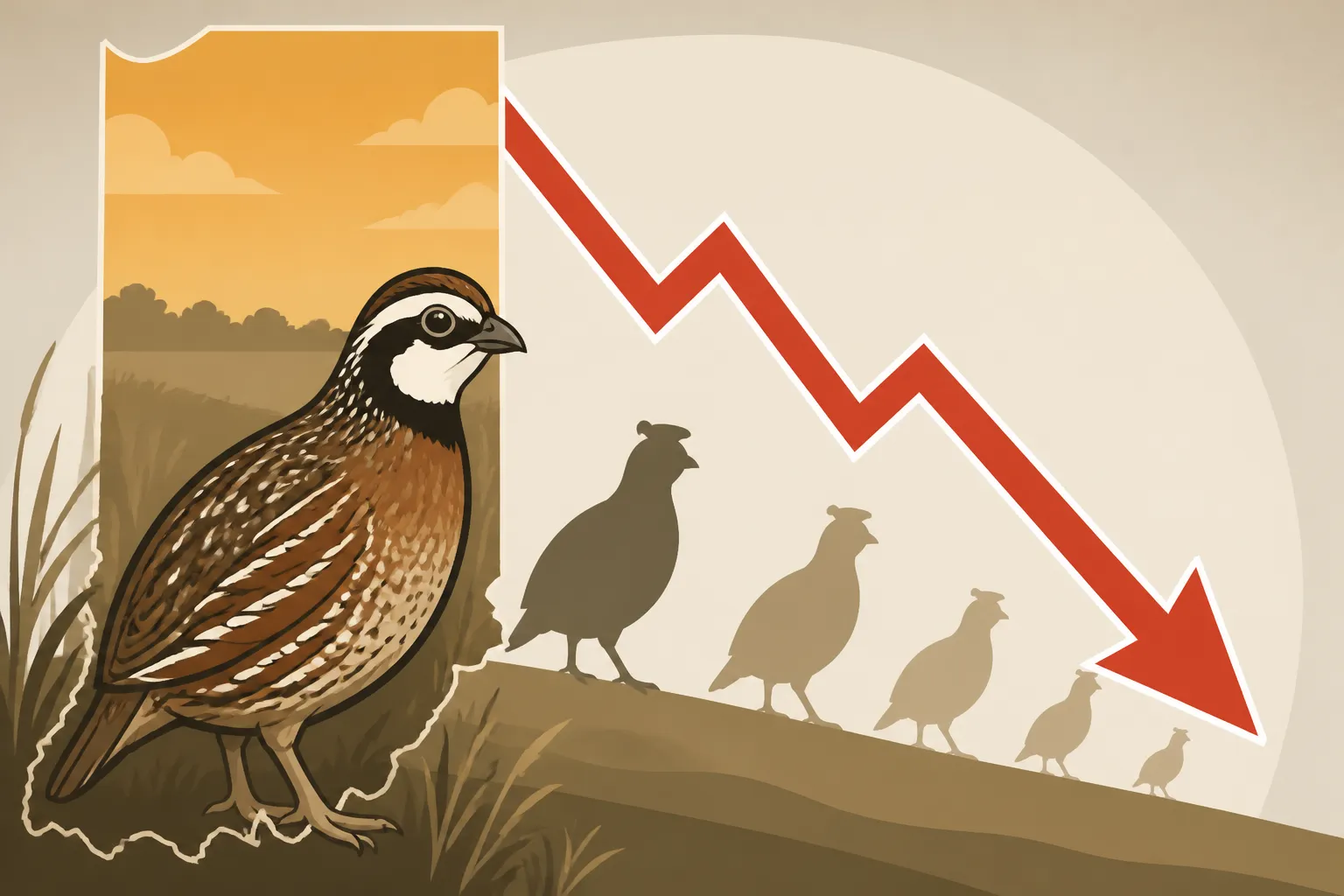
While I can't give you exact figures from specific years, decades of observation and surveys by wildlife agencies consistently show a steep decline in bobwhite quail numbers across Indiana since the 1960s. These are not just anecdotal observations from hunters; they are reflected in scientific data, hunting success rates, and generalized population estimates.
Early surveys, often conducted by listening for the distinctive "bob-white!" call, or through roadside counts, would reveal relatively high densities of birds in many counties. Fast forward to today, and those same surveys show drastically reduced numbers, or often no birds at all, in many of those historical strongholds. The harvest data over the decades also paints a stark picture: fewer birds are being taken by hunters because fewer birds exist. This decline is not unique to Indiana; it's a regional issue across much of the bobwhite's northern range, closely tied to the massive changes in agricultural landscapes that occurred across the Midwest. If you're wondering about specific areas, you might look into Best Indiana Counties for Wild Quail to see where remnant populations might still be found.
Hope on the Horizon: Restoration Efforts and What Hunters Can Do
While the picture for Indiana's bobwhite quail can seem bleak, it's not without hope. Dedicated conservationists, landowners, and state agencies are working tirelessly to reverse these trends, and hunters play a critical role in these efforts.
Conservation Programs Making a Difference
Recognizing the dire situation, various conservation programs have been established over the years to encourage habitat restoration on private lands, which make up the vast majority of Indiana's landscape. Programs like the Conservation Reserve Program (CRP) or Environmental Quality Incentives Program (EQIP), offered through the USDA, provide incentives for landowners to take marginal crop ground out of production and establish wildlife habitat, including native grasses, wildflowers, and shrubs that benefit quail.
Here in Indiana, the DNR also has its own initiatives aimed at small game restoration. Many Fish and Wildlife Areas (FWAs) and State Forests are actively managing sections of land with quail in mind, planting native warm-season grasses, performing prescribed burns to promote new growth, and creating brushy escape cover. These projects are vital pockets of hope, demonstrating what can be achieved when land is managed specifically for quail and other small game. You can learn more about these efforts by looking into Habitat Work on Indiana Wildlife Areas. These efforts are long-term investments, but they are crucial for providing the foundational habitat these birds desperately need.
How Individual Actions Can Help
As hunters and conservationists, we can feel powerless in the face of such large-scale challenges, but our individual actions, when combined, can make a real difference.
First and foremost, support conservation organizations that are actively engaged in habitat work. Groups like Quail Forever or similar local chapters are on the ground, working with landowners to implement habitat projects. Your membership dollars or volunteer time directly contribute to creating more places for quail to thrive.
Secondly, if you're a landowner, even of a small tract, consider implementing quail-friendly practices. Planting native warm-season grasses, allowing fencerows to grow thick, creating brush piles, or planting food plots with a mix of grains and beneficial weeds can provide invaluable micro-habitat. Even just letting a field edge get a little "messy" can be a huge step.
For hunters without their own land, advocating for strong conservation policies and supporting the Indiana DNR's wildlife initiatives is crucial. When you're out scouting, use mapping tools like GoHunt or the Scouting With the Indiana DNR App to identify areas with potential habitat, even on public land. Look for those often-overlooked edges, thickets, and diverse cover types. While the primary purpose of GoHunt might be for bigger game, its detailed mapping layers can help you pinpoint areas that look like they could hold quail, guiding your efforts for other small game like rabbit and squirrel too. Understanding your Indiana Small Game Season Rules and participating legally and ethically is also key to being part of the solution. Every hunter who contributes to habitat improvement or supports conservation efforts is helping ensure that future generations might once again hear the cheerful "bob-white!" call in Indiana's fields.
Disclaimer
This article is for general informational purposes only and does not constitute professional advice. Laws, prices and regulations vary by location and change over time. Consult a qualified professional for guidance on your specific situation.