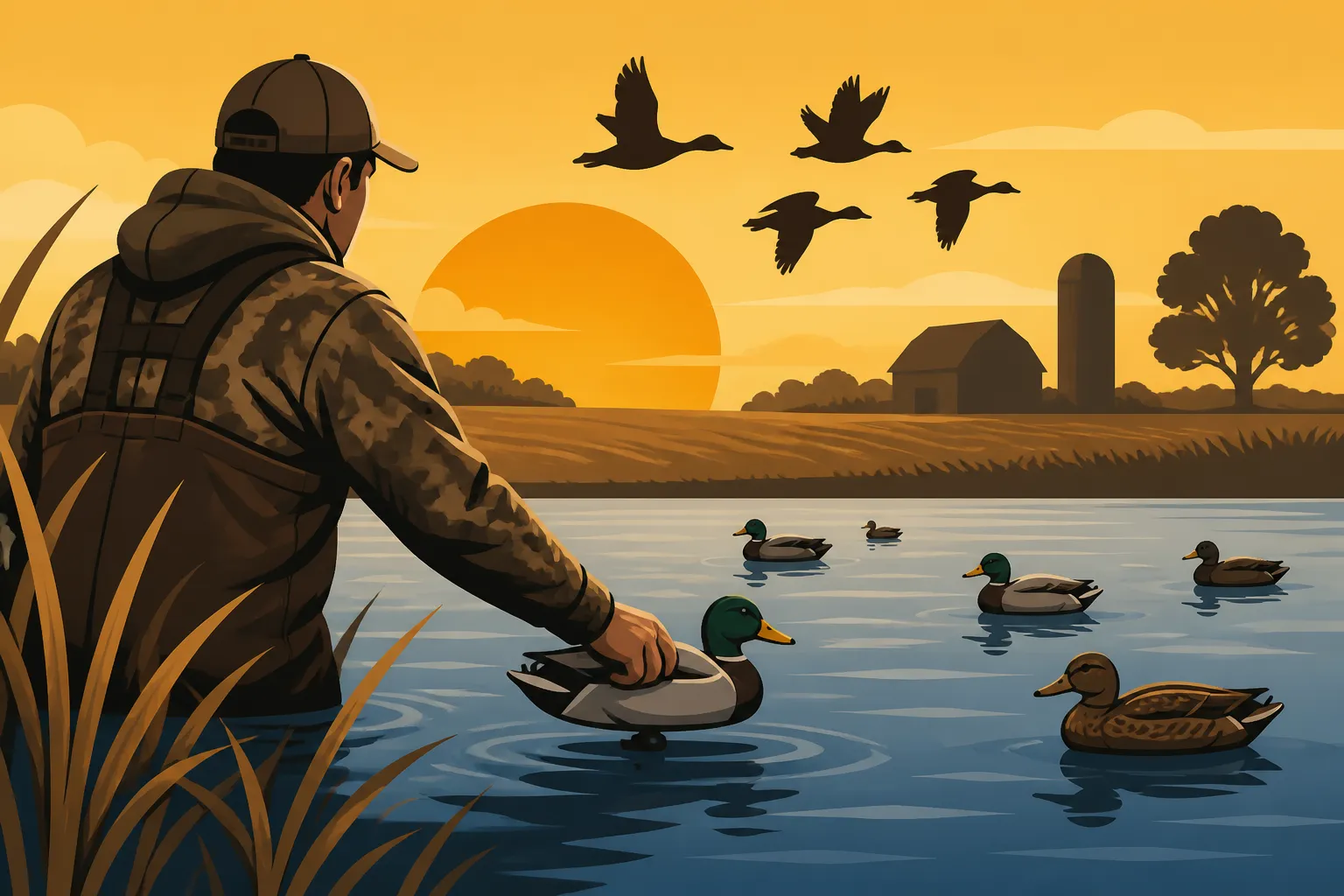
Setting Decoys on a Farm Pond
There's nothing quite like the unique challenge and reward of hunting waterfowl on a small Indiana farm pond. Many of us, myself included, have spent countless mornings huddled in meager cover, watching ducks circle, only to flare at the last second because our spread looked… well, unnatural. It’s frustrating when you've done all the work to get permission and wake up before dawn, only to have a flock of mallards completely ignore your setup. This guide aims to clear up the mystery of effective decoy placement on these smaller, often overlooked, bodies of water, giving you the insights needed to draw in those wary birds consistently.
Understanding Farm Pond Dynamics for Waterfowl
Hunting farm ponds isn't like setting up on the expansive Kankakee Marshes or a sprawling lake. These smaller waters have their own quirks, and understanding them is crucial before you even think about tossing out your first decoy. We're talking about intimate setups where every detail matters.
Reading the Water and Shoreline
Farm ponds in Indiana are typically shallower, often surrounded by agricultural fields or mixed woodlands, and can vary greatly in size, from a quarter-acre puddle to several acres. Unlike big rivers or vast lakes, these ponds often have distinct features: a dam, a muddy bank, perhaps some cattails or brush along one edge, and sometimes even a few downed trees extending into the water. These features aren't just scenery; they're vital clues. Ducks and geese use these ponds for a few key reasons: they're often overlooked by other hunters, providing a sense of safety; they can be excellent feeding grounds, especially if near harvested corn or soybean fields; and they offer accessible roosting spots.
When you scout, pay close attention to the wind-sheltered corners, any patches of open water amidst thicker vegetation, and where birds are naturally loafing or feeding. Are they hugging the far bank? Are they dabbling in a shallow, grassy inlet? An app like GoHunt can be invaluable here, letting you mark these precise locations, observe terrain features, and even track wind direction over time for optimal planning. The presence of natural food sources like smartweed or buttonbush can also be a huge draw. If you're seeing ducks consistently favoring a particular spot on the pond, that’s your starting point for decoy placement. Remember, the goal is to make your spread look like exactly what those real ducks are already doing.
The Role of Wind and Sunlight
If there's one golden rule in waterfowl hunting, it's that ducks and geese almost always land and take off into the wind. This isn't just a preference; it's a matter of aerodynamics, giving them lift and control. On a farm pond, understanding this is paramount. Your decoy spread needs to be positioned so that the "landing zone" – the open water where you want the birds to commit – is directly facing into the prevailing wind. This forces incoming birds to cup their wings and set down right in front of you.
Consider a crisp fall morning in central Indiana. If the wind is blowing from the north, you'll want your decoys to be set up so the ducks will approach from the north and land south of your main spread, putting them in prime shooting range. Conversely, if the sun is rising in the east, you ideally want it at your back or at least to the side. Hunting with the sun directly in your face can make it impossible to see incoming birds clearly, and worse, it can silhouette your position, making you easily detectable. If you can position your blind with the sun at your back, you'll be practically invisible, and the sun will illuminate the ducks, making identification and shooting much easier. Sometimes, however, you're stuck with what you've got. In those cases, use natural shadows, deeper cover, or even a strategically placed ground blind to mitigate the sun's glare and your visibility.
Crafting Your Decoy Spread for Farm Ponds
Now that you understand the lay of the land and the influence of Mother Nature, let's talk about actually getting those plastic birds in the water. This isn't just about throwing them out; it's about telling a story that makes real ducks and geese feel safe and enticed.
Species-Specific Spreads
Indiana farm ponds often host a mix of waterfowl. You'll commonly find mallards, wood ducks, and various diving ducks, as well as Canada geese. Your decoy spread should reflect the species you're targeting or the birds that are most prevalent in the area. For a mixed bag, a general approach is to have a majority of mallard decoys, as they are the most common and often act as "confidence" decoys for other species. If you know wood ducks are frequenting the pond, adding a few wood duck decoys close to the shore, perhaps near some wooded cover, can be incredibly effective, as they often prefer the timbered edges.
For Canada geese, a separate cluster of full-body goose decoys placed on the bank or in shallow water near the edge of a field can be a game-changer. Geese are often wary of water-only spreads and feel more secure if they see their kind loafing on dry land or in very shallow water. A common ratio might be 70% mallards, 10-15% other dabblers (like pintails or widgeon if present), and 15-20% wood ducks if timber is nearby. For goose hunting, you might run an all-goose spread, or a mixed spread with geese dominating the shoreline and ducks in the water. Remember, realism is key, so avoid setting out too many decoys if it looks unnatural for the pond's size. A small pond with fifty decoys can look intimidating, not inviting.
The "Landing Zone" Strategy
This is the bread and butter of decoy placement. The landing zone is that sweet spot, the open water pocket where you want the birds to commit and set their wings. Your entire spread should be designed to funnel incoming birds into this area, which ideally is within 20-30 yards of your blind.
Common spread patterns for farm ponds include:
- The J-hook or U-shape: This is a classic for a reason. You place the majority of your decoys forming a "J" or "U" shape, with the open part of the hook or "mouth" of the U facing directly into the wind, towards where the ducks will approach. The birds will naturally fly into this open pocket, thinking it's a safe place to land among their comrades. Your blind should be at the "bend" of the J or the "back" of the U.
- The Cluster: Sometimes, especially on very small ponds, a tight cluster of decoys with a small opening in the middle is all you need. This mimics a group of ducks feeding or resting together, and the small opening provides an obvious place for new arrivals to join.
- The Funnel: If you have a narrow pond or a natural pinch point, you can use your decoys to create a funnel effect, leading birds right towards your shooting lane.
Always consider the wind. If the wind is coming from your left, your landing zone should be to your right (from the perspective of the incoming birds). They will drift left as they set down, putting them right in front of your blind. Motion decoys, like a simple Jerk Rig, can add incredible realism to your landing zone, making it appear as if ducks are actively feeding and splashing, a major confidence booster for circling birds. On some ponds, a well-placed spinning wing decoy, like those from Mojo Outdoors, can be highly effective at long range, but be aware that overly aggressive motion can also flare wary, late-season birds.
For instance, imagine a small rectangular pond next to a freshly cut cornfield. The wind is from the north. You've set up your blind along the south bank, nestled into a patch of brush. You'd position a large "U" of mallard decoys with the open end facing north, creating a clear landing strip. If you have some Canada goose decoys, scatter them on the grassy bank near your blind, making it look like they're grazing or resting, adding another layer of realism and confidence to your setup. For an extremely small pond, even just half a dozen decoys tightly clustered but with a clear gap for landing can be enough.
| Decoy Spread Type | Ideal Pond Size | Species Targeted | Wind Orientation | Benefits | Drawbacks |
|---|---|---|---|---|---|
| J-Hook / U-Shape | Medium to Large | Mixed Ducks, Geese | Open end faces into wind | Creates clear landing zone, natural funnel | Requires more decoys, space |
| Cluster with Gap | Small to Medium | Mixed Ducks | Gap into wind, near blind | Compact, effective with fewer decoys | Less natural for large groups |
| Shoreline Geese | Any Size | Geese, Mixed | On bank, near water | Adds confidence for geese, realism | Can be less effective for ducks |
| Runway (Linear) | Long, Narrow | Ducks, Divers | Downwind end for landing | Utilizes pond shape, simple | Less inviting for tight turns |
Hiding Your Presence and Executing the Hunt
The best decoy spread in the world is useless if the ducks see you first. Waterfowl have incredible eyesight, and they're constantly looking for anything out of place. On a farm pond, often surrounded by open fields, concealment is paramount.
Choosing and Constructing a Blind
Many Indiana farm ponds don't come with pre-built, elaborate blinds. That means you'll need to use your creativity and the natural surroundings. Look for thick fencerows, standing corn or soybeans (if the farmer allows access after harvest), brush piles, or even a cluster of dense trees. Your goal is to become part of the landscape.
- Natural Cover: If there's a good line of multi-flora rose or a patch of cattails, work with it. Cut local vegetation – corn stalks, soybean stubble, tree branches – and weave it into your position to break up your outline. Just be sure not to damage the farmer's crops or property excessively.
- Portable Blinds: A small, low-profile ground blind or a panel blind can be invaluable. These are easy to transport and quick to set up. Brands like Final Approach or Avery make excellent compact blinds that you can brush in quickly. Lay them out, then completely cover them with natural material from the immediate vicinity. Don't leave any gaps for the sky to show through, and make sure your head and face are covered when ducks are working.
- Elevation: On a small pond, especially if the banks are low, your profile can stick out like a sore thumb. Consider digging in a shallow pit blind if conditions allow and you have permission, or ensure your blind is low enough that when you're seated, you're below the top of the natural cover.
The key is to scout your chosen location and visualize how you'll hide from a duck's perspective high above. What looks good from the ground might be a dead giveaway from the air. Before opening day, take some time to set up your blind and then walk away, looking back at it from different angles, just as a duck would. Use the GoHunt app to map out good blind locations and mark them for future reference.
Calling and Shot Presentation
On a farm pond, less is often more when it comes to calling. These aren't huge, noisy marshes where you need to blast out highballs to get attention. Farm pond ducks are often looking for quiet, safe havens. Start with soft, reassuring feeder chuckles and contented quacks. Only when birds are distant or seem to be passing by might you use a more attention-grabbing greeting call. As they get closer, revert to softer clucks and whines. If birds are locking up and coming in, often silence is golden – let the decoys do their work.
When birds commit and are in the landing zone, the most critical part is knowing when to call the shot. Resist the urge to jump up too early, which will often flare the birds. Let them get their feet down, wings set, and be well within range (20-30 yards is ideal for clean kills). A common mistake on small waters is letting birds get too close, almost on top of you, leading to awkward, close-range shots where you might miss or just wound birds.
Safety is paramount, especially on farm properties. Always be aware of your surroundings: barns, houses, roads, livestock, and other hunters. Ensure your shot is always going into a safe backdrop. In Indiana, it's also worth brushing up on your Indiana Duck and Goose Bag Limits so you know what you can legally harvest. Practice your mounting and swinging at home, so when the moment comes, it's muscle memory.
Gear Considerations for Farm Pond Hunting
Successful farm pond hunting, like any specialized pursuit, benefits from the right gear. It's not about having the most expensive equipment, but rather the most appropriate gear for the specific challenges of these intimate waters.
Decoy Selection and Maintenance
For farm ponds, realism trumps quantity. A dozen high-quality, realistic decoys are often more effective than three dozen cheap, shiny ones that look like bathtubs. Look for decoys with good paint schemes, natural postures, and a non-glossy finish. Brands like Avian-X or Dakota Decoy offer excellent options that stand up well to the elements. Make sure your decoys are weighted properly so they sit naturally in the water, even in light chop.
Maintenance is crucial. Old, faded, or shot-up decoys will deter wary birds. Give your decoys a fresh coat of flat paint every few seasons, paying attention to the feather details and color contrasts. If you notice any shiny spots, dull them down with a matte spray. Repair any cracks or holes to prevent them from sinking. Swiveling heads can add variety and realism to your spread. If you're using full-body goose decoys, ensure their stands are stable and they don't look like they're leaning precariously. When not in use, store your decoys carefully to prevent damage and preserve their paint, perhaps in slotted decoy bags. Using an app like GoHunt during your scouting can also help you determine the specific species frequenting the pond, allowing you to tailor your decoy selection for maximum effectiveness.
Essential Tools and Safety
Beyond your decoys and trusty shotgun, a few other items are critical for a successful and safe farm pond hunt:
- Waders: Absolutely essential. You'll need to place and retrieve decoys, and often retrieve downed birds from muddy or cold water. Chest waders, especially neoprene or breathable options, are a must. Make sure they fit well and provide insulation if you're hunting late in the season when the water is frigid. Waders for Marsh Hunting can also apply to farm ponds.
- Dog or Retriever Pole: A good retriever makes all the difference, but if you don't have one, a long retriever pole or even a small, light jon boat (if the pond allows and is large enough) will save you from an icy swim.
- Decoy Bag and Line: A sturdy decoy bag will make transport easier. Make sure your decoy lines are strong and long enough for the deepest parts of the pond, with reliable weights or Texas rigs for quick setup and takedown.
- Warm, Waterproof Clothing: Indiana weather can be notoriously unpredictable. Dress in layers, with a good waterproof outer shell, even if the forecast looks clear. You'll be sitting still for long periods, so insulation is key.
- Headlamp: For setting up in the dark and packing out after shooting light.
- First Aid Kit and Communication: Always carry a basic first aid kit, especially on private land where help might be farther away. Ensure your phone is charged or carry a two-way radio if hunting with a partner.
- Ammunition: Make sure you're using appropriate Waterfowl Loads for Kankakee Divers (or farm pond birds, in this case). Steel shot is legally required for waterfowl hunting, and knowing your choke and pattern is vital for clean kills.
Having the right gear ensures you're comfortable, efficient, and above all, safe, allowing you to focus on the pure joy of calling in those Indiana ducks and geese.
Disclaimer
Hunting is an activity with inherent risks. Always prioritize safety, follow all local, state, and federal hunting regulations, and obtain proper licenses and permits. This guide is for informational purposes only and should not replace professional instruction or local wildlife agency guidelines. Be respectful of landowners and their property, especially when seeking Asking an Indiana Farmer for Permission to hunt private lands.