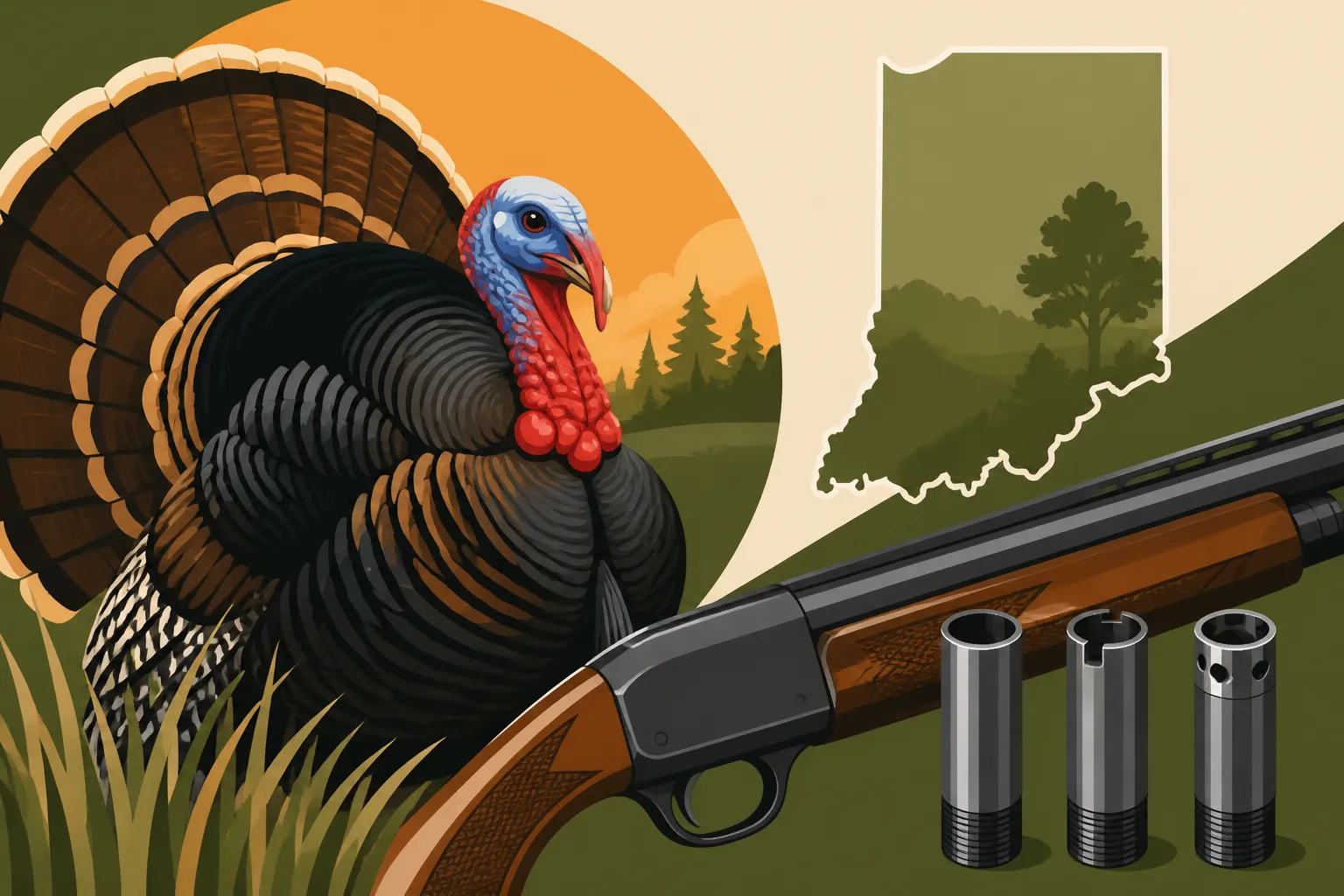
Turkey Shotguns and Chokes
There are few things more frustrating than calling in a magnificent Indiana gobbler, getting him strutting right into your setup, and then missing the shot because your shotgun isn't patterned correctly or you're using the wrong choke. It's a gut punch, and it's something many of us have experienced. This guide is all about equipping you with the knowledge to pick, set up, and pattern the perfect turkey shotgun and choke combination, so you can confidently fill your tag next spring or fall in the Hoosier State.
Understanding the Modern Turkey Shotgun
Hunting turkeys in Indiana, whether you're working a river bottom in the south or a woodlot near a cornfield in the north, requires a shotgun setup that's precise and dependable. Gone are the days when any old scattergun with a full choke would do. Today's wild turkeys are sharp, and their vitals are small, demanding a tight, consistent pattern that puts maximum energy on target.
Gauge and Action Types for Indiana Gobblers
When it comes to the heart of your turkey rig, the gauge and action type are fundamental decisions. Most Indiana turkey hunters will lean towards a 12-gauge or 20-gauge, and for good reason. The 12-gauge has long been the king, offering a heavy payload of shot, which generally translates to denser patterns and more forgiving spreads at typical turkey ranges. However, advancements in ammunition, particularly Tungsten Super Shot (TSS) loads, have elevated the 20-gauge to serious contention. It's lighter to carry through the rolling hills of the Hoosier National Forest and often results in less recoil, which can be a huge benefit for younger hunters or those sensitive to heavy kick.
As for action, you'll primarily see pump-action and semi-automatic shotguns in the turkey woods. Pump-actions are incredibly reliable, simple to operate, and usually more affordable. They require you to manually cycle each round, which can be a slower follow-up shot but teaches discipline. Semi-automatics, on the other hand, use gas or inertia to cycle automatically, providing quicker follow-up shots if needed – though with turkeys, the first shot is usually the only shot. Both are perfectly viable; it really comes down to personal preference, budget, and how much you value a potentially faster second shot versus rock-solid mechanical simplicity.
Barrel Length and Design Considerations
The length of your shotgun barrel might not seem like a huge deal, but for turkey hunting, it plays a significant role in handling and maneuverability. While longer barrels used to be common for smooth swings on flying birds, turkey guns often favor shorter barrels, typically ranging from 20 to 24 inches. A shorter barrel is a huge advantage when you're trying to pivot quickly in a ground blind, sneak through thick brush, or adjust your aim in a cramped treestand setup. It's simply more nimble and less likely to snag on branches or get noticed by a wary tom.
Beyond length, consider the overall design. Many dedicated turkey shotguns come with a matte finish to reduce glare, synthetic stocks that stand up to the elements better than wood, and often pre-drilled and tapped receivers for easy optics mounting. Some even feature adjustable stocks to perfectly fit your length of pull, which can significantly improve comfort and accuracy during those long, patient waits. The goal is a package that feels natural to shoulder, points quickly, and can take a beating from Indiana's unpredictable spring weather.
The Critical Role of Turkey Chokes
If the shotgun is the engine, the choke tube is the steering wheel, directing your payload precisely where it needs to go. For turkey hunting, the choke is arguably the most critical component in achieving a consistent, dense pattern that maximizes your chances of a clean kill. It's not just about how many pellets your shell holds; it's about how those pellets group together at the range you expect to shoot.
Types of Turkey Chokes and Their Constriction Levels
Understanding choke constriction is paramount for turkey hunting. Unlike general hunting where you might use an Improved Cylinder or Modified choke, turkey hunting demands maximum constriction to keep the pattern tight. The most common turkey chokes go beyond "Full" to "Extra Full," "Super Full," or proprietary "Turkey Specific" constrictions. These specialized chokes are designed with very tight internal diameters to squeeze the shot column into a dense, compact cloud. This maximizes the number of pellets hitting a turkey's head and neck area, which is your target zone.
It's not a one-size-fits-all situation, though. Different manufacturers design their chokes with unique internal geometries, and what works wonderfully in one barrel with a specific load might be mediocre in another. Some chokes are even optimized for particular shot sizes or materials, like TSS. The key is finding the combination that produces the most consistent and dense pattern for your gun and your chosen ammunition at your expected shooting range. Don't assume an "Extra Full" from one brand is the same as an "Extra Full" from another; they vary significantly.
Materials and Porting: What Matters for Performance
Turkey chokes are made from a variety of materials, with stainless steel being common, but you'll also find specialized alloys and even titanium. The material choice primarily impacts durability and cost. More expensive, harder materials can withstand the pressures of modern, dense turkey loads (like TSS) better and resist wear over time. This is important because a worn choke can quickly degrade your pattern.
Many turkey chokes also feature porting – small holes or slots machined into the side of the choke near the muzzle. The idea behind porting is to vent gases as the shot column exits, which can help reduce recoil and muzzle rise. For turkey hunting, where the shot is usually single and critical, reduced recoil can make a significant difference in comfort during patterning sessions and can help you stay on target for that decisive shot. While porting is a nice bonus, it's generally secondary to the choke's internal geometry and how well it patterns with your chosen ammunition. Focus on pattern density first, then consider features like porting.
Patterning Your Turkey Shotgun for Indiana's Woods
This is where the rubber meets the road. You can have the fanciest turkey shotgun and the most expensive choke, but if you haven't taken the time to pattern it, you're essentially guessing when that gobbler steps out. Patterning is not just a suggestion; it's an absolute requirement for ethical and effective turkey hunting in Indiana. It’s how you truly discover what your specific shotgun, choke, and ammunition combination can do.
The Importance of Patterning and How to Do It
Patterning your shotgun reveals exactly how your chosen load spreads at various distances. You're not looking for a "good" pattern; you're looking for a deadly pattern that consistently places enough pellets into a 10-inch circle (representing a turkey's head and neck) out to your maximum ethical shooting range. This isn't just about putting a few pellets in; it's about dense coverage that ensures a quick, humane kill. Many hunters make the mistake of patterning once and calling it good, but a truly dedicated turkey hunter will test multiple choke/load combinations.
To do it right, grab several different brands and types of turkey ammunition – varying pellet sizes, shot materials, and manufacturers. Head to the range with large sheets of paper (at least 3×3 feet, or even larger poster board) with a bullseye or turkey head target drawn in the center. Start at 20 yards, then move to 30, 40, and even 50 yards. Shoot at least three shots with each choke/load combination, aiming carefully from a rest to eliminate shooter error. After each shot, count the pellet hits within a 10-inch circle around your point of aim. Document everything. Look for consistency, even distribution, and most importantly, sufficient pellet count for a quick kill. Many Indiana hunters find that their preferred setup might only be good to 35-40 yards, and knowing that limit before you're in the field is invaluable. Websites like GoHunt offer digital tools and resources that can help you log your patterning data and compare different setups, which can be a real time-saver.
Ammunition Selection for Optimal Patterns
Choosing your turkey ammunition is just as crucial as selecting the right choke. The market is full of options, but they boil down to a few key types that behave very differently downrange. Traditional lead shot is still widely available and effective, especially in larger sizes like #4, #5, or #6. However, its effectiveness drops off faster at longer ranges compared to modern alternatives.
The real game-changer in turkey ammunition has been Tungsten Super Shot (TSS). TSS pellets are significantly denser and harder than lead, meaning you can use smaller pellet sizes (like #7, #9, or a blend) that maintain more energy and penetrate deeper. These smaller, denser pellets also allow for many more pellets per shell, creating incredibly dense patterns even at extended ranges. While TSS can be more expensive, the performance difference is often dramatic. Many hunters find that a 20-gauge loaded with TSS can outperform a 12-gauge with lead shot, giving the smaller gun a serious edge. Beyond TSS, you might encounter blended loads of lead and heavier-than-lead shot, or bismuth, which offers a good compromise between cost and performance for hunters who don't want to spring for full TSS. Experimentation is key; your gun will "like" certain loads more than others, and patterning is the only way to find out.
Choosing the Right Setup for Indiana's Diverse Terrain
Indiana offers a fantastic variety of turkey hunting environments, from wide-open agricultural fields to dense, rolling timber. Your turkey shotgun and choke setup should ideally reflect the type of terrain you'll be hunting most frequently. What works perfectly for a long-range shot across a soybean field might be overkill in a tight creek bottom.
Open Fields and Farmland Edges
If you're primarily hunting the vast farmlands of Northern Indiana or along the edges of agricultural fields throughout the state, you might be anticipating longer shots. Turkeys in these areas often move across open ground, and while you'll try to call them in close, sometimes a 40 to 50-yard shot is the only one you'll get. For these scenarios, a setup designed for maximum range and pattern density is paramount.
A 12-gauge shotgun, especially with a 3.5-inch chamber, will give you the most payload capacity, allowing for a heavier charge of shot. Pair this with a very tight turkey choke, like a .660 or .655 constriction, and high-density TSS loads (e.g., #7 or #9 shot). This combination will deliver the tightest, most pellet-dense patterns at extended ranges. A powerful optic, like a red dot sight or a low-magnification scope, can also be a huge asset here, allowing for precise aiming at a small target at distance. You'll want to practice extensively at these longer ranges to understand your shotgun's limits and ensure you can consistently make an ethical shot. Think about how you’ll approach a setup in Hunting Northern Indiana Farmland Deer and apply similar scouting logic to turkey movement patterns.
Thick Timber and River Bottoms
Conversely, if your adventures take you into the thick timber of the Hoosier National Forest, the dense woods of Morgan-Monroe State Forest, or the winding river bottoms of the Wabash, you're likely to encounter closer-range opportunities. Here, maneuverability and quick target acquisition might be more important than extreme long-range capability. Turkeys in these areas tend to pop up closer, sometimes within spitting distance, as they navigate dense undergrowth or follow terrain features.
For these environments, a shorter-barreled shotgun, perhaps a 20-gauge or even a compact 12-gauge, could be ideal. Its lighter weight and smaller profile make it easier to carry all day and quicker to shoulder in tight quarters. You might still use a tight turkey choke, but perhaps one that offers a slightly more forgiving pattern at 20-30 yards, knowing that ultra-long shots are less likely. Ammunition with #5 or #6 lead shot can still be very effective at these closer ranges, though TSS will always offer superior performance. Red dot sights remain excellent choices for quick aiming, particularly valuable when a gobbler suddenly appears in a small opening in the timber. Knowing the terrain and having a clear shooting lane is crucial when Calling an Indiana Gobbler Off the Roost in these tight areas.
Accessories and Best Practices for Indiana Turkey Hunters
Beyond the core shotgun and choke, several accessories and best practices can significantly enhance your Indiana turkey hunting experience. These additions aren't just about comfort; they're about improving your accuracy, safety, and overall success rate in the field.
Sights, Slings, and Comfort Features
Standard bead sights are perfectly adequate for many shotgun applications, but for the precise shot demanded by turkey hunting, an upgrade is often worthwhile. Red dot sights are incredibly popular for turkey guns, and for good reason. They offer a single, illuminated aiming point that's easy to see in any light condition, allows for quick target acquisition, and helps you maintain focus on the turkey's head and neck without the distraction of aligning multiple sights. Low-magnification scopes (1-4x or fixed power) are another excellent option, offering a clearer picture of the target at slightly longer ranges and aiding in precise shot placement.
A good sling is another non-negotiable accessory for hunting Indiana's varied landscapes. Whether you're hiking into a remote corner of Glendale Fish and Wildlife Area or still-hunting through a section of Yellowwood State Forest, a comfortable sling keeps your hands free for calling, carrying decoys, or simply navigating rough terrain. Look for a wide, padded strap that distributes weight well. Finally, consider comfort features like recoil pads, which can significantly reduce felt recoil, making practice sessions more enjoyable and preventing flinches during the actual hunt. An adjustable stock or cheek riser can also ensure a perfect fit, which directly translates to consistent cheek weld and repeatable accuracy.
Maintenance and Storage for Longevity
Taking care of your turkey shotgun isn't just about keeping it looking nice; it's about ensuring its reliability and longevity. Indiana's spring turkey season can bring anything from warm, sunny days to cold, driving rain, and your shotgun will be exposed to it all. After every hunt, especially if it's been wet or dirty, take the time to properly clean your firearm. This involves breaking it down, cleaning the bore with a solvent, wiping down all metal surfaces, and applying a light coat of oil to prevent rust. Pay particular attention to the choke tube area, as powder fouling can build up quickly there and affect performance. Cleaning a Rifle After a Wet Sit offers similar principles that apply to shotguns.
When storing your shotgun, ensure it's in a dry, temperature-controlled environment. A good gun safe is ideal, offering both security and protection from humidity. If storing for extended periods, consider using a dehumidifier in your safe or rust-preventative gun socks. Regular maintenance checks, like inspecting the choke tube for damage, ensuring all screws are tight, and checking for any signs of wear, will keep your turkey rig in prime condition for many seasons to come. A well-maintained shotgun is a reliable shotgun, and reliability is key when that once-in-a-lifetime gobbler struts into view.
| Feature | 12-Gauge Shotgun (Traditional Lead) | 20-Gauge Shotgun (TSS Loads) |
|---|---|---|
| Payload Capacity | High | Moderate (but highly effective with TSS) |
| Recoil | Moderate to High | Low to Moderate |
| Weight/Maneuverability | Heavier, less nimble | Lighter, more nimble |
| Barrel Length | Often 22-24 inches for balance | Often 20-22 inches for compactness |
| Choke Constriction | Extra Full to Super Full | Turkey Specific (.550-.580 typically) |
| Effective Range | 35-45 yards (with good pattern) | 40-55+ yards (with TSS & good pattern) |
| Ammunition Cost | Moderate | Higher (especially TSS) |
| Best For | General hunting, longer shots, budget | Mobility, reduced recoil, extended range |
Disclaimer
This article is for general informational purposes only and does not constitute professional advice. Laws, prices and regulations vary by location and change over time. Consult a qualified professional for guidance on your specific situation.