Minimum Draw Weight for Indiana Deer
There's often a lot of chatter around bowhunting circles about draw weight, and it can feel like a heavy weight on your shoulders – pun intended! Many new archers, or even seasoned folks getting back into the sport, get overwhelmed by questions like "How much is enough?" or "Am I strong enough?" It's easy to get caught up in the numbers game, wondering if your setup can handle an Indiana whitetail. This guide aims to cut through the noise, clarify Indiana's specific regulations, and offer practical, real-world advice to help you choose a draw weight that ensures ethical hunting and boosts your confidence in the field.
Understanding Indiana's Archery Regulations for Deer
When it comes to bowhunting, every state has its own specific rules, and Indiana is no exception. It's crucial to understand these regulations not just to stay legal, but to truly comprehend what constitutes an ethical and effective setup for deer. You might be surprised to learn that some of the most common assumptions about draw weight aren't actually codified in Indiana law.
What the Law Doesn't Say About Draw Weight
One of the biggest misconceptions many hunters have is that Indiana mandates a specific minimum draw weight in pounds for bows. You'll hear folks at the archery shop or around the campfire swearing you need "at least 50 pounds" or "you won't get through a deer with less than 60." The truth is, Indiana's hunting regulations for deer, whether for traditional bows or modern compounds, do not specify a minimum draw weight in pounds.
This often surprises people, especially those coming from states with more restrictive equipment rules. The absence of a poundage minimum is a recognition that effectiveness isn't solely about how many pounds you can pull. It's a combination of factors, and the law focuses on the projectile's capabilities rather than the bow's peak force. This means that a well-tuned, lower draw weight bow with the right arrow and broadhead can be just as, if not more, lethal than a poorly tuned, heavier bow. It frees hunters to choose equipment they can comfortably and accurately shoot, which is paramount for ethical hunting.
The Legal Requirements That Do Matter
While Indiana doesn't dictate your draw weight, it absolutely has strict rules regarding the type of arrow and broadhead you must use when hunting deer. These are the critical elements designed to ensure a quick, humane harvest, regardless of your bow's draw weight.
Firstly, your arrow needs to be at least 16 inches long. This is a hard and fast rule, so make sure your arrows meet this minimum before heading into the woods. It's not just about compliance; longer arrows generally offer more stability in flight and can carry more momentum, which aids in penetration.
Secondly, and perhaps most importantly, are the broadhead requirements. Indiana law states that you must use a broadhead with at least two cutting edges and a minimum cutting diameter of 7/8 inch. This applies to both fixed-blade and mechanical (expandable) broadheads. The intent here is clear: to ensure the broadhead creates a sufficiently large wound channel to quickly incapacitate the animal. A smaller cutting diameter significantly reduces the chances of hitting vital organs and creating enough hemorrhage for a fast, ethical kill. Many hunters agonize over Fixed Versus Mechanical Broadheads, but the key is meeting that 7/8 inch cutting diameter minimum.
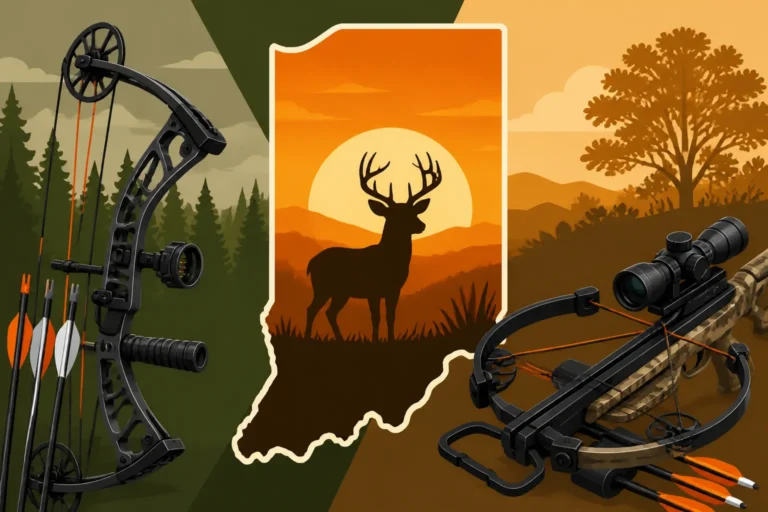
For crossbows, the rules are slightly different. Crossbows must have a minimum draw weight of 125 pounds and a mechanical safety. The arrows (or bolts) must be at least 16 inches long, and the broadheads must meet the same 7/8-inch minimum cutting diameter and two-cutting-edge rule. So, while a compound bow might not have a specified draw weight, a crossbow does. This distinction is important to remember when choosing your weapon. You can learn more about specific crossbow rules in Crossbow Rules During Indiana Archery Season.
Here's a quick look at the contrasting legal requirements:
| Equipment Type | Minimum Draw Weight (Pounds) | Minimum Arrow/Bolt Length | Minimum Broadhead Requirements |
|---|---|---|---|
| Compound Bow | None Specified | 16 inches | 2 cutting edges, 7/8" diameter |
| Recurve/Longbow | None Specified | 16 inches | 2 cutting edges, 7/8" diameter |
| Crossbow | 125 pounds | 16 inches | 2 cutting edges, 7/8" diameter |
Beyond the Law: Practical Considerations for Draw Weight
The law sets the floor, but ethical hunting often requires us to consider more than just the bare minimum. While Indiana doesn't tell you what draw weight to pull, practical experience and a commitment to humane harvesting should guide your decision. It's about ensuring your arrow has enough "oomph" to do its job reliably.
The Critical Role of Kinetic Energy and Arrow Penetration
When an arrow hits a deer, what really matters for an ethical kill is its ability to penetrate deeply enough to reach and damage vital organs. This ability is largely governed by kinetic energy (KE) and momentum. A heavier draw weight generally translates to more kinetic energy and momentum, but it's not the only factor. Arrow weight, arrow FOC (Front of Center), broadhead design, and shot placement are also huge players.
Think of it this way: a lighter arrow shot from a heavy bow might have a high initial speed and decent kinetic energy, but it can lose that energy quickly, especially if it encounters resistance like bone. A heavier arrow, even from a slightly lower draw weight, might start slower but retain its momentum better, leading to deeper penetration. This is why many experienced hunters focus on a heavier arrow setup, even if it means sacrificing some speed. They understand that ultimate penetration is the goal, not just flat trajectory. Discussions around Arrow Weight for Short Shots often dive into these nuances.
For deer, you generally want enough kinetic energy to confidently pass through both lungs and potentially the heart, even if you hit a rib on entry or exit. While specific KE numbers are debated, most consider 35-40 foot-pounds (ft-lbs) a good minimum for deer, with 45-50+ ft-lbs offering a significant advantage for larger animals or less-than-perfect shots. A bow set at 40-55 pounds, paired with a properly spined and weighted arrow (typically 350-450 grains total weight), can easily achieve these kinetic energy levels. This means you don't need to be pulling 70 pounds to get the job done.
Comfort, Accuracy, and Ethical Shot Placement
Here's where the rubber meets the road: if you can't comfortably and accurately shoot your bow, all the kinetic energy in the world won't matter. Pulling a draw weight that is too heavy for you will lead to a multitude of problems:
- Poor Form: You'll struggle to reach full draw smoothly, often resorting to bad habits like "sky-drawing" (drawing with the bow pointed upwards) or using your back muscles improperly, leading to inconsistencies.
- Fatigue: Holding at full draw for an extended period, which is sometimes necessary when a deer is quartering away or standing behind brush, will become impossible. Your muscles will burn, your pin will wobble, and your shot will suffer.
- Inaccuracy: A wobbly pin and poor form lead directly to poor accuracy. In bowhunting, accuracy is king. A well-placed arrow from a 45-pound bow is infinitely more effective than a poorly placed arrow from a 70-pound bow.
- Injury: Consistently shooting a bow that's too heavy can lead to shoulder, back, and rotator cuff injuries, putting you out of commission entirely.
Imagine sitting in your Treestands and Saddles on Public Land on a crisp October morning. A beautiful buck finally steps into your shooting lane at 25 yards. But he's slightly quartering towards you, and you need to hold your draw for a few extra seconds for him to turn broadside or present a better angle. If your draw weight is maxed out, those few seconds will feel like an eternity, and your shot will be rushed, leading to a potential wound.
An ethical shot is a confident shot. You need to be able to draw your bow smoothly, hold it steadily on target for at least 10-15 seconds without excessive strain, and execute a clean release. If you find yourself shaking, struggling to get to full draw, or developing bad habits, your draw weight is too high. Prioritizing comfort and accuracy will always lead to more ethical and successful hunts.
Choosing and Mastering Your Optimal Draw Weight
So, if the law doesn't specify a minimum, and heavy draw weight isn't always best, how do you figure out your optimal draw weight? It's a combination of starting smart, consistent practice, and prioritizing accuracy above all else.
Starting Smart: Building Strength and Perfecting Form
For new archers, or those getting back into it, start with a draw weight that feels genuinely comfortable. This might be lower than you expect, perhaps in the 30-40 pound range. The goal in the beginning isn't brute strength; it's perfecting your form. You want to be able to:
- Draw smoothly: No jerking, no sky-drawing. The draw cycle should be a controlled, continuous motion.
- Hold steadily: At full draw, your arm should be steady, and you should be able to hold your sight pin on target with minimal wobble.
- Execute a clean release: Without struggling, you should be able to trigger your release aid (or cleanly release the string if shooting fingers) without disturbing your sight picture.
Once you can consistently achieve these three things with good form, then and only then should you consider incrementally increasing your draw weight. Most compound bows have a range of adjustment, typically 10-15 pounds. Increase in small increments, say 2-5 pounds at a time, and then spend a few weeks or months practicing at that new weight before considering another increase. Strength builds over time, not overnight. Incorporating exercises that strengthen your back, shoulders, and core can significantly help. Resistance bands and light free weights focusing on rowing and pulling motions are your friends here.
Remember, deer don't care how many pounds you pull. They care about where the arrow goes. When you're Scouting Indiana Public Land Before Season and visualizing shot opportunities, remember that the most vital part of the equation is your ability to put that arrow exactly where it needs to go.
When Less is More: Prioritizing Control Over Power
It's a common trap to feel inadequate if you're not pulling the heaviest weight your bow allows. But true mastery in archery, especially for hunting, comes from control. Many highly successful, ethical bowhunters in Indiana, even those chasing big bucks during Hunting the Indiana Rut in Early November, opt for draw weights in the 45-60 pound range. Why? Because it allows them to shoot with supreme confidence and consistency.
Here are scenarios where a slightly lower draw weight can actually be an advantage:
- Cold Weather: When you're bundled up in layers for a late-season hunt and your muscles are cold, a lighter draw weight is much easier to manage.
- Awkward Angles: If you're forced to shoot from an odd position in a treestand or a ground blind, a manageable draw weight allows for smoother execution without fighting your equipment.
- Long Holds: As mentioned, if a deer isn't presenting a perfect shot, you might need to hold at full draw for a minute or more. This is where a comfortable draw weight truly shines.
If you find yourself struggling with accuracy, or if you're experiencing pain after shooting, don't be afraid to reduce your draw weight. It's not a sign of weakness; it's a sign of wisdom. It means you're prioritizing ethical hunting and your long-term enjoyment of the sport. The satisfaction of a clean, ethical harvest, and the venison that goes into your freezer for a delicious meal, like a Deer Meat Yield From an Indiana Buck, is far more rewarding than bragging about a high draw weight that leads to missed opportunities or, worse, wounded animals.
Debunking Common Draw Weight Myths
The archery world, like many outdoor pursuits, is rife with myths and old wives' tales. Draw weight is one of the most fertile grounds for these misconceptions, often leading hunters down paths that are neither productive nor ethical. Let's clear up a few of the most persistent ones.
The "70-Pound Club" Fallacy
Walk into almost any archery shop, or chat with a group of seasoned (or self-proclaimed seasoned) hunters, and you'll likely hear someone mention the "70-pound club." The implication is that if you're not pulling 70 pounds, you're not a "real" bowhunter, or you're somehow under-gunned for deer. This is, quite frankly, nonsense.
Modern bows are incredibly efficient. As discussed earlier, a 45-55 pound bow, when paired with a quality arrow and a razor-sharp broadhead, generates more than enough kinetic energy and momentum to pass through an Indiana whitetail. The idea that 70 pounds is the gold standard comes from an era when bows were less efficient, and hunters needed every bit of power they could muster. Technology has advanced significantly, making lower draw weights highly effective.
Moreover, pushing yourself to 70 pounds if you're not physically capable often leads to terrible form, inconsistency, and injury. How many times have you seen someone grunt and struggle to draw their bow, shaking like a leaf at full draw, all to say they pull 70 pounds? That's not effective hunting; it's an ego trip that sacrifices accuracy and ethics. Focus on being able to draw your chosen weight smoothly and hold it steady. That's the real mark of a skilled archer, not an arbitrary number. The Indiana Archery Season Opening Day is not the time to be testing the limits of your strength.
Draw Weight and the Illusion of "Bigger Bucks"
Another common, albeit unspoken, myth is the idea that somehow a heavier draw weight helps you kill bigger bucks. This is an absolutely ludicrous notion, yet it subtly influences many hunters. It plays into the idea that bigger deer are somehow "harder to kill" and thus require "more power."
The reality is that a mature buck's hide and bone structure are not significantly different in toughness than a doe's or a younger buck's. What makes bigger bucks harder to kill isn't their physical resilience to an arrow, but their wariness, their experience, and their ability to avoid detection. A big buck knows how to move through the woods undetected, use the wind, and respond to hunting pressure. Successfully hunting a trophy buck is about Reading a Ridge for Hoosier Forest Deer, understanding deer behavior, scouting diligently, and making a perfect shot under pressure.
Your draw weight has absolutely zero bearing on a buck's antler size, age, or intelligence. A well-placed arrow from a 50-pound bow will drop a Boone & Crockett buck just as effectively as one from a 70-pound bow. What matters is your ability to hit the vitals consistently. If you can confidently place your arrow precisely where it needs to go every single time, you're far more likely to tag a big buck than someone struggling with a heavy draw weight who sacrifices accuracy for perceived power. Tools like GoHunt can help you scout and identify prime big buck habitat, but your bow setup is all about ethical execution once you've found them.
Ultimately, your draw weight for hunting Indiana deer should be a personal decision, driven by comfort, accuracy, and ethical considerations, not by peer pressure or outdated myths. Focus on becoming proficient with a weight you can handle, and you'll be well on your way to successful and rewarding hunts.
Disclaimer
This article is for general informational purposes only and does not constitute professional advice. Laws, prices and regulations vary by location and change over time. Consult a qualified professional for guidance on your specific situation.