Crow Hunting Seasons and Tactics in Indiana
Many Indiana hunters, myself included, have felt the frustration of a quiet morning in the deer stand or a turkey hunt where the birds just wouldn't gobble. Sometimes, you just need to get out and sharpen your skills, blow off some steam, or simply experience the thrill of the hunt without the pressure of a limited tag. That's where crow hunting swoops in, offering an often-overlooked yet incredibly challenging and rewarding pursuit that can hone your field craft and provide endless entertainment. This comprehensive guide will walk you through everything you need to know about hunting crows in the Hoosier State, from understanding the regulations to mastering the tactics that bring these intelligent birds into range.
Understanding Indiana's Crow Hunting Seasons
Crow hunting in Indiana is a unique pursuit, primarily because these birds, while common, are classified under the federal Migratory Bird Treaty Act but are not considered game birds in the traditional sense. This gives states a bit more flexibility in setting seasons, but also means there are specific rules you absolutely need to know before you head afield. It's not like deer or turkey where the season is just a few weeks; crow hunting offers a much longer window of opportunity.
The Legal Framework and Open Dates
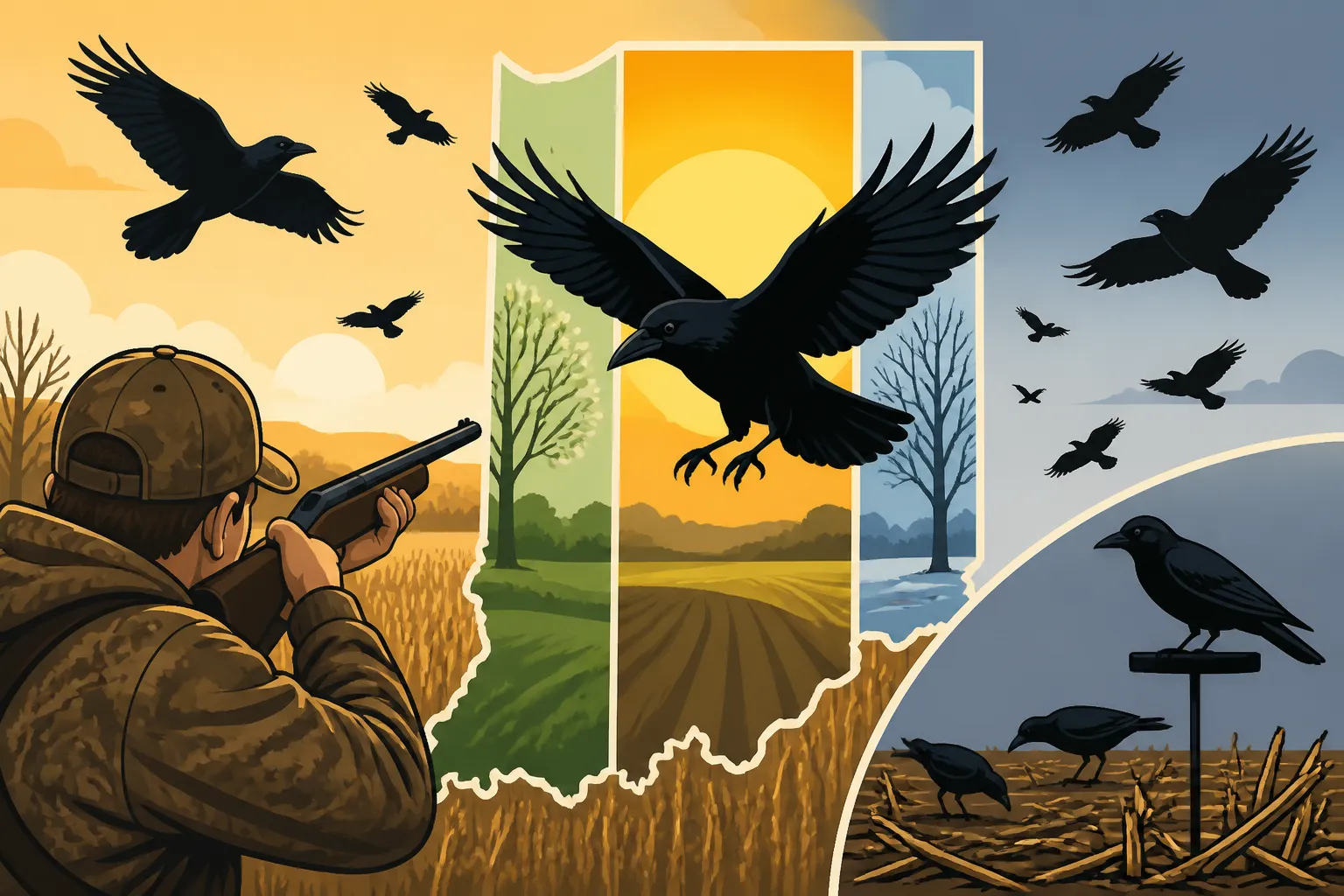
Unlike most game species that have rigid, short seasons, crow hunting in Indiana typically offers a very generous and extended period. While specific dates can shift slightly year to year based on federal guidelines and state review, Indiana generally permits crow hunting from early summer, often in June or July, all the way through to early March of the following year. This means you have a massive window – often seven to eight months – to pursue these birds. What a lot of folks don't realize is that this extended season gives you ample time to scout, experiment with different tactics, and just generally enjoy more days in the field.
The key thing to remember is that there's usually a closed period during the spring nesting season, typically from mid-March through May or June. This is a crucial time for crow populations to reproduce undisturbed, and it’s a federal requirement. So, while you can't hunt them year-round like some nuisance species, the open season is lengthy enough to satisfy even the most avid hunter. Always double-check the current Indiana DNR hunting regulations booklet or website before heading out, as these dates are subject to change. It's a small step that can save you a lot of headache and potential legal trouble.
Identifying Legal Hunting Areas
Finding a place to crow hunt can sometimes feel like a puzzle, especially if you're used to traditional public land hunting where specific game seasons are well-defined. Because crows aren't typically a primary target for most public land users, the rules can be a bit less clear-cut or overshadowed by other seasonal restrictions. Generally, you can hunt crows on any private land where you have permission from the landowner. This is often the easiest and most productive route, as crows frequently congregate in agricultural areas, woodlots adjacent to fields, and near farmsteads. Don't be shy about knocking on doors and asking farmers; they often view crows as pests that raid crops, so they might be more receptive than you'd think.
For public lands, the situation is a bit more nuanced. State Fish and Wildlife Areas (FWAs) and State Forests often allow crow hunting, but you must adhere to all general hunting regulations for those properties, including any sign-in procedures, specific hunting hours, or restrictions on vehicle access. For instance, while you can hunt crows, you still need to respect general public land rules like Indiana Public Land Hunting Hours and any specific property restrictions on firearms discharge. Areas like the Hoosier National Forest are generally open to crow hunting, provided you follow all federal and state regulations. The frustration here often comes from the sheer size and diversity of public land rules; always check the specific property's regulations before you go. Using a mapping app, perhaps even a premium one like GoHunt, can be incredibly helpful for identifying potential crow hotspots on public land, helping you pinpoint woodlots or river bottoms that might funnel crow traffic.
Licensing and Bag Limits for Crows
One of the simpler aspects of crow hunting in Indiana is the licensing and bag limit situation. If you're an Indiana resident and you're planning to hunt crows, you'll need to possess a valid Indiana hunting license. This isn't a special "crow license" but rather your general hunting license, the same one you'd use for deer, turkey, or small game. If you already have your annual Indiana Resident License Options, you're likely all set. Non-residents will need to purchase the appropriate non-resident hunting license.
The good news is that unlike ducks or geese, crows do not require a federal migratory bird stamp, nor do they typically require state-specific stamps like a waterfowl or turkey stamp. This simplifies things a great deal. Even better, Indiana generally does not impose a daily bag limit or a possession limit on crows. This means you can harvest as many as you ethically can during your hunt. While there's no legal limit, always hunt responsibly. Over-harvesting an area can quickly educate the local crow population, making future hunts much tougher. It's about enjoying the challenge and maintaining ethical hunting practices, not just piling up birds. The lack of a bag limit is one of the reasons crow hunting is such a great way to get out and practice your shooting and calling skills throughout the long season.
| Season Aspect | Details |
|---|---|
| Open Season | Typically from early summer (June/July) to early March. Always check current DNR regs. |
| Closed Season | Mid-March through May/June (nesting season). |
| License Needed | Valid Indiana hunting license (resident or non-resident). |
| Stamps Needed | None (no federal migratory bird stamp, no state stamps for crows). |
| Bag Limit | No daily bag or possession limit in Indiana. Hunt ethically and responsibly. |
| Legal Areas | Private land with permission, most State Fish & Wildlife Areas, State Forests, Hoosier National Forest. |
| Hunting Hours | Typically sunrise to sunset, check specific property rules. |
Essential Gear for Effective Crow Hunting
Crows are incredibly intelligent and wary birds, often hailed as the "black pheasants" due to their notorious ability to spot danger from a mile away. This means that a casual approach usually results in frustration. To consistently fool these sharp-eyed birds, you need the right tools in your kit, from your firearm to your concealment. Thinking of it like a miniature tactical operation against an intelligent opponent helps put you in the right mindset for success.
Shotguns and Ammunition Choices
For crow hunting, a good scattergun is your best friend. While some might try to use a small-caliber rifle, the fast, erratic flight patterns of crows make a shotgun the far more practical and effective choice. Most hunters opt for a 12-gauge, and for good reason – it offers a wide range of loads and excellent pattern density. However, a 20-gauge can also be very effective, especially for younger hunters or those who prefer a lighter firearm, as crow loads don't demand massive recoil. If you've been considering a Best Shotgun Gauge for Indiana Pheasant, many of those same principles apply here, though crows present a smaller, faster target.
When it comes to ammunition, your goal is to throw a dense pattern of small shot. Target loads or light game loads are usually perfect. I personally stick to 7 ½ or 8 shot. Some hunters even go as fine as 9 shot, especially if they're shooting over decoys at closer ranges. The key is pattern density. You're not looking for massive knockdown power like you would for geese; you're looking for enough pellets to strike the small body of a crow. Choke selection is also crucial. An Improved Cylinder or Modified choke is often a good starting point, providing a decent spread for fast-flying birds. For longer shots, or if you're really trying to stretch your range, a Full or even an Improved Modified choke can be useful, but you'll need to be more precise. It’s worth taking your shotgun to the range and patterning it with your chosen load and choke to see how it performs at typical crow shooting distances, which can range from 20 to 40 yards. Knowing your effective range is paramount. You can even check out advice on Choke Choice for Fast Flushes to get more ideas on optimizing your spread.
Decoys and Calls for Luring Crows
This is where crow hunting truly becomes an art form and where your success largely hinges. Crows are highly social and vocal, which means you can exploit their curiosity and territorial instincts with effective calling and realistic decoy spreads. The single most important piece of gear for serious crow hunting is an electronic caller. Modern electronic callers, like those from FoxPro or Primos, come pre-loaded with a variety of realistic crow vocalizations, including "crow assembly," "crow distress," and "crow fight" sounds. These are incredibly effective at drawing birds from a distance. If you're looking into Coyote Calling in Indiana Farm Country, you'll notice many of the same companies and even some of the same principles apply. Varying your calls – a sequence of excited caws, followed by a distress call, then maybe some aggressive fight sounds – can be incredibly convincing.
Supplementing an electronic caller with a few mouth calls can add a layer of realism that really sells the setup. A simple crow caw call or a distress call can be used to add nuance, especially as birds get closer. Decoys are also essential. A spread of a half-dozen or more realistic crow decoys placed on stakes in a field or hung in nearby trees can create a visual magnet. To really trigger their aggression, adding an owl or hawk decoy in the center of your crow spread often works wonders. Crows despise raptors and will mob them relentlessly. Even a few dead crows placed on the ground (if legal in your area, and they typically are for nuisance birds) can act as confidence decoys, signaling to approaching birds that it's safe to land. Your setup might even benefit from an advanced mapping system like GoHunt to pinpoint clearings or open fields suitable for decoy placement near known crow roosts.
Concealment and Scouting Aids
Crows have notoriously sharp eyesight. They will spot you, or even the glint of your barrel, from hundreds of yards away. This means meticulous concealment is not just recommended, it's absolutely vital for success. Full camouflage, including a face mask and gloves, is non-negotiable. Don't underestimate how quickly they'll flare if they see anything out of place. Wearing full head-to-toe camo that blends with your surroundings is a must.
Beyond your clothing, using a ground blind is often the best way to achieve superior concealment. A pop-up blind brushed in with natural vegetation will break up your outline effectively. Make sure your blind is well-anchored, especially on windy days, because nothing spooks a crow faster than a blind flapping in the breeze. For tips on how to secure your setup, you might find advice on Ground Blind Anchoring in Wind helpful. If you're not using a blind, situate yourself against a thick tree trunk, under a low-hanging canopy, or in a dense hedgerow. The key is to be completely still and out of sight as birds approach.
Scouting is another often-overlooked aid. Before the season, spend some time driving around likely crow areas, especially near large roosts, agricultural fields, and river bottoms. Note their flight paths and feeding locations. Binoculars are invaluable for this, allowing you to observe their patterns from a distance without disturbing them. You can use an app like GoHunt to mark potential hot spots you find, similar to how you would when Scouting Indiana Public Land Before Season for deer. Observing where crows congregate and how they react to different scenarios will greatly increase your chances of setting up in the right place at the right time.
Mastering Crow Hunting Tactics in the Hoosier State
Once you've got your gear dialed in, it's time to put it all together in the field. Crow hunting is less about brute force and more about psychological warfare. You're trying to outsmart one of the most intelligent birds in North America, and that takes patience, observation, and a willingness to adapt your strategy.
Calling Strategies for Different Scenarios
The key to successful crow hunting is dynamic calling. You can't just hit play on your e-caller and expect magic. You need to understand what different calls mean to crows and how to deploy them effectively based on their reaction. When you first set up and want to draw distant birds, an "assembly" or "gathering" call sequence, often a series of loud, excited caws, is your opener. This mimics crows getting together, and can pull birds from miles away.
As crows start to appear, observe their behavior. If they're circling high and seem wary, switch to a "distress" call. This sound, often a series of frantic caws, simulates a crow in trouble, which triggers their mobbing instinct. They'll often come in hard and fast, looking to help or investigate the commotion. If a single crow or a small group seems particularly aggressive, or if you've shot a bird and others are still in the air, a "crow fight" call can be incredibly effective. This sound replicates a skirmish, exciting the remaining birds and often bringing them into range for a shot. The trick is knowing when to stop calling. As birds commit and start to drop into your decoy spread, silence is golden. Let them focus on the decoys and the perceived threat, not on the sound from your blind. If they hesitate or begin to flare, a soft, reassuring "all clear" caw from a mouth call can sometimes bring them back, but this is a delicate balance. Much like calling Coyote Calling in Indiana Farm Country, knowing when to be aggressive and when to be subtle is the difference between success and a frustrating silence.
Setting Up Your Ambush Point
Choosing your ambush location is critical. Crows are creatures of habit, often flying predictable routes between roosting areas and feeding grounds. Look for flight corridors, often along treelines, river bottoms, or over open fields. River bottom funnels, similar to those you might target for deer, can be excellent for crows as well, especially if they provide cover and a clear flight path. You can even apply some of the principles used for Hunting a Funnel Between Two Woodlots to identify crow flyways.
When you've identified a likely area, consider your setup carefully. Ideally, you want to be downwind or crosswind from where you expect the crows to approach, allowing your calls to carry. However, also consider the sun. Having the sun at your back will illuminate the approaching crows, making them easier to spot and allowing you to remain in shadow, which can be a huge advantage against their keen eyesight. Place your decoys far enough out that the crows focus on them, but close enough to ensure they are within shotgun range once they commit. Often, this means placing your decoys 20-30 yards from your blind. If you're using an owl or hawk decoy, position it centrally within your crow decoy spread to maximize the mobbing effect. Remember to blend your ground blind in thoroughly with the surrounding vegetation; crows are notorious for spotting anything out of place. The more effort you put into your setup, the higher your chances of success.
Ethical Considerations and Responsible Hunting
While crow hunting often serves as a form of pest control, especially for farmers whose crops they raid, it's still hunting, and responsible practices are paramount. Always respect the land you're on, whether it's private property where you've obtained permission or public land. This means leaving no trace – pick up all your spent shotgun shells, any discarded food wrappers, and any other trash. Nobody wants to hunt in a littered area, and demonstrating respect goes a long way in maintaining access, especially on Hunting Small Private Tracts in Indiana.
When you harvest crows, dispatch them quickly and humanely. Ethical shots are always the goal. While there's no official reporting requirement for crows, the experience of a successful crow hunt is its own reward. For many, crow hunting is a fantastic way to sharpen their wingshooting skills and calling techniques without the intense pressure or limited opportunities of other game seasons. It keeps your eyes keen, your reflexes sharp, and your woodsmanship honed for when those deer or turkeys finally show up. Plus, crows are quite intelligent, and outsmarting them provides a unique sense of accomplishment. Some hunters even find uses for crow meat, though it's not a popular table bird. The primary benefit remains the challenge and the contribution to local pest control.
Disclaimer
Please note: The information provided in this guide is for informational purposes only and is based on general knowledge of Indiana hunting regulations. Hunting laws and regulations can change frequently. It is the responsibility of the hunter to consult the most current Indiana Department of Natural Resources (DNR) hunting regulations and local ordinances before engaging in any hunting activity. Always ensure you have the appropriate licenses and permissions, and adhere to all safety guidelines.