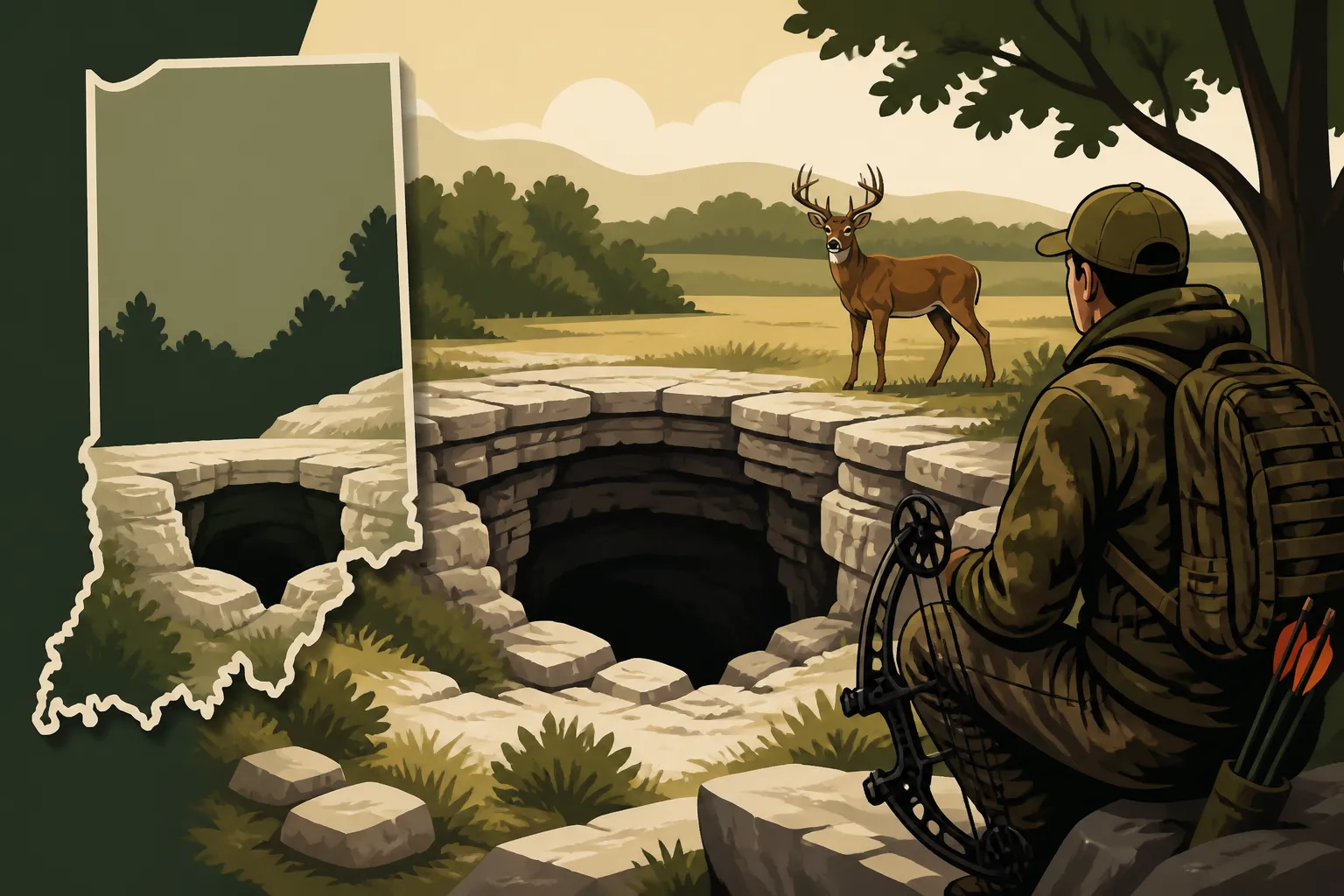
Hunting Limestone Country Sinkholes
For anyone who’s spent time trying to unravel the mysteries of deer movement in Indiana’s southern counties, you know the frustration. Those seemingly random, deep depressions in the earth, often shrouded in thick cover, can feel like a puzzle with missing pieces. These limestone country sinkholes, a defining feature of our Hoosier karst topography, offer both bewildering challenges and incredible, often overlooked, opportunities for whitetail hunters. This guide is dedicated to helping you decipher those secrets, understand why deer use these unique features, and develop effective strategies to turn complex terrain into your hunting advantage.
Understanding Indiana's Limestone Country
Indiana's southern half, particularly areas like Brown, Monroe, Lawrence, and Orange counties, is famous for its rolling hills and dense forests. But beneath that picturesque landscape lies a fascinating geological secret: vast deposits of limestone. Over eons, rainwater, slightly acidic, has slowly dissolved this soluble rock, creating an intricate network of caves, underground streams, and collapsed features on the surface. These collapses are what we commonly call sinkholes, and they profoundly influence the entire ecosystem, including how whitetail deer live and move.
The Geology of Karst Topography
Karst topography is a fancy term for a landscape formed from the dissolution of soluble rocks like limestone, dolomite, or gypsum. In Indiana, it's almost entirely about the limestone. When you're walking through a southern Indiana woodlot and suddenly find a perfectly circular or oblong depression, sometimes dozens of feet deep, you're looking at a sinkhole. These aren't just random holes; they're direct evidence of underground activity. Some are small, barely noticeable dips, while others are massive, creating their own microclimates and habitats. The prevalence of these features means the ground underneath is often honeycombed with caverns and fissures, which affects everything from water drainage to vegetation growth patterns. Understanding this underlying structure helps you grasp why certain areas hold deer and others don't, and why deer behavior might seem a little different here compared to flat farmland.
How Sinkholes Influence Deer Behavior
Deer are creatures of efficiency and survival, and they quickly learn to utilize every advantage a landscape offers. Sinkholes, by their very nature, provide several key benefits for whitetails, making them natural magnets for deer activity.
Firstly, sinkholes often concentrate food sources. Because they act as catch basins for water and sediment, the soil quality at the bottom can be richer than the surrounding uplands, leading to different and often more nutritious forage. Furthermore, the topography creates thermal cover. In winter, the deeper parts of a sinkhole can offer a slight reprieve from bitter winds, acting as a natural shelter. In warmer months, the shade and cooler air at the bottom can be a sanctuary from the midday sun and biting insects. This makes them prime bedding areas, especially during harsh weather or periods of high hunting pressure.
Secondly, sinkholes serve as crucial travel corridors and funnels. Deer inherently prefer to move with the path of least resistance or the most cover. The steep sides of a sinkhole, particularly if they are heavily vegetated, offer excellent concealment as deer traverse them. Often, a series of sinkholes will align, creating a natural pathway through otherwise open timber. Deer will often skirt the edges or utilize the bottom as a natural, protected path. Recognizing these patterns is key to predicting where a buck might travel, especially when pressured. They also play a significant role in how wind and thermals behave. Air currents will often swirl and drop into these depressions, then rise out, creating complex scent patterns that savvy hunters need to understand.
Scouting Strategies for Sinkhole Deer
You can't effectively hunt what you don't understand, and nowhere is that truer than in Indiana's sinkhole country. Effective scouting, both from afar and on the ground, is the absolute cornerstone of success here. It's not enough to just know sinkholes exist; you need to know which sinkholes are being used, how they're being used, and when deer are using them.
Aerial Map and Topo Reconnaissance
Before you ever set foot in the woods, your computer or phone can be your most powerful scouting tool. Satellite imagery and topographic maps are invaluable for identifying potential hotspots in sinkhole country. Start by zooming in on areas known for karst features. Look for those distinct, circular depressions. Pay close attention to their size, depth, and the surrounding terrain. Are they isolated, or are they part of a larger system?
Tools like GoHunt, along with the Indiana DNR app, offer incredible layers that can reveal property lines, forest types, and crucial elevation changes. On a topo map, sinkholes appear as concentric circles with hatch marks pointing inward, indicating a depression. Look for funnels created by a series of sinkholes, or saddles between them that might serve as natural crossing points. Identify potential bedding areas within the deepest, thickest sinkholes and imagine the likely travel routes from those beds to known food sources or water. Pay attention to how deer might navigate around the steepest parts. Often, subtle benches or less steep sections on the sides of a sinkhole will be natural thoroughfares. I can't stress enough how much time this initial digital scouting saves, allowing you to narrow down your boots-on-the-ground efforts to the most promising locations. For a deeper dive, consider spending time learning to read Reading Aerial Photos for Southern Indiana Deer.
Boots-on-the-Ground Exploration
Once you've identified promising areas on your maps, it's time to hit the woods. This is where you confirm your digital hunches and uncover the subtle details a satellite photo can't show. When entering sinkhole terrain, move slowly and deliberately, especially if you're scouting during the season. This kind of terrain demands stealth.
Focus on looking for hard sign: rub lines, scrape lines, and well-used trails. Deer trails often become more defined around sinkholes, as deer funnel through specific entry and exit points. Look for where these trails merge or cross, as these are natural ambush points. Pay particular attention to the wind direction as you scout; this will be crucial for later stand placement. When you find a sinkhole, don't just peek in from the edge. Carefully descend into it, looking for bedding areas (depressions in the leaves, often with broken branches nearby) and evidence of feeding. Check the perimeter of the sinkhole for sign as well, as deer often travel along the lip. Remember, this is a year-round endeavor; Shed Hunting on Indiana Public Land can provide valuable clues about buck activity and travel patterns long before the season opens.
Reading Sign in Complex Terrain
Reading deer sign in sinkhole country requires a keen eye and an understanding of how deer use these unique features. While classic sign like tracks and droppings are always important, the context here is key.
Look for concentrated rub lines leading into or out of a sinkhole, especially along its less steep "ramps" or natural funnels. These indicate a buck's regular travel path. Scrape lines, too, can often be found along the edges or within the bottom of a sinkhole, particularly if it offers good cover and intersects a travel corridor. Pay attention to browse lines – the height at which deer are feeding on vegetation – to get an idea of the intensity of use.
One important aspect to consider is how deer navigate elevation changes. Deer often create trails that traverse a hillside diagonally rather than going straight up or down the steepest part. In sinkholes, look for these "switchback" trails or natural benches that offer easier passage. The age of the sign is also critical. Fresh tracks in mud, shiny rubs, and moist droppings tell you deer are using the area now. Older, faded sign indicates past use, but it still tells you the potential for future activity. The more time you spend on the ground, the better you’ll become at distinguishing fresh, relevant sign from less important clues.
| Sinkhole Feature | Deer Behavior Indicator | Scouting Focus | Hunting Implication |
|---|---|---|---|
| Deep, Thick Cover | Primary bedding/sanctuary area | Look for beds, sparse trails, fresh droppings | Ideal for morning ambushes, post-pressure retreats |
| Shallow, Open | Travel corridor, minor feeding | Well-worn trails, crossing points | Good for intercepting deer moving between larger areas |
| Wet/Muddy Bottoms | Water source, specific browse | Tracks, feeding sign, mineral licks | Productive during dry spells or late season |
| Connecting Saddles | Primary travel funnel between ridges | Heavy main trails, rubs, scrapes | Excellent ambush points, especially during the rut |
| Steep Sides | Movement along edges, "ramps" | Trails hugging contours, less distinct rubs | Challenging to hunt; focus on entry/exit points |
Hunting Tactics in Sinkhole Terrain
Once you’ve done your homework and understand the lay of the land, it’s time to put those insights into action. Hunting sinkholes isn't always straightforward; the terrain can be challenging, but the rewards can be significant if you approach it strategically.
Stand Placement for Sinkhole Ambush
Setting up a treestand or ground blind in sinkhole country requires careful consideration of access, wind, thermals, and deer movement patterns. Since sinkholes often funnel deer, identifying those specific entry and exit points is paramount. Don’t just set up at the lip of a sinkhole; try to position yourself where you can cover the most likely travel lanes within or around it. Often, this means being slightly downwind of a primary trail that leads into or out of the depression.
Consider the depth and vegetation of the sinkhole. A deeper, brushier sinkhole might require you to set up lower to get good shooting lanes, or higher if you're trying to spot deer moving through the bottom. If using a treestand, focus on trees that offer both concealment and a clear view of where you expect deer to move. Saddle hunting can be particularly effective in this broken terrain, offering quick, quiet setups in trees that might not be suitable for traditional hang-ons. Remember to think about your entry and exit routes – you want to get in and out undetected, avoiding disturbing the sinkhole itself. The principles of effective Treestand Setups in Hoosier National Forest are highly applicable here, emphasizing stealth and understanding local movement.
Still-Hunting the Depressions
While static stand hunting can be highly effective, still-hunting offers another potent strategy in sinkhole country. This method involves moving extremely slowly, taking a few steps, then pausing for several minutes to observe your surroundings. The broken terrain and abundant cover within and around sinkholes make them ideal for this quiet, methodical approach.
When still-hunting, use the topography to your advantage. Move along the contours of the sinkhole, using the rises and depressions to conceal your movement. Always keep the wind in your face or slightly quartering. Focus on slowly scanning the shadows and thickets for any sign of a deer. Often, you'll spot a flick of an ear or a patch of hide before you see the entire animal. The goal isn't to cover ground quickly, but to thoroughly dissect small areas of high potential. This can be especially productive during the mid-day lull when deer might be bedded in the thermal cover of a deep sinkhole. This approach echoes the success found when Still-Hunting Southern Indiana Ridgelines, just adapted for the unique topography of these depressions.
Utilizing Wind and Thermals
Wind and thermals are probably the most critical factors when hunting sinkholes. Because sinkholes create unique microclimates and air currents, what might seem like a consistent wind on an open ridge can become a swirling, unpredictable mess within a depression.
Generally, thermals will pull air down into a sinkhole in the evening as the air cools, and air will rise out of a sinkhole in the morning as the air warms. This means your scent cone can be incredibly complex. Always try to set up so that your scent is blowing away from where you expect deer to approach or bed. If you're hunting an evening sit, you might want to set up on the uphill side of a sinkhole, allowing your scent to be carried down into it. Conversely, for a morning hunt, setting up on the downhill side might be better, as your scent rises and blows over the top. Always use a wind checker to understand the actual air movement at your specific location. Don't assume. Observe the leaves, test your checker, and adapt. Mastering Wind and Thermals on a Southern Indiana Ridge is paramount to success here, as the same principles apply, but with added complexity due to the inverted topography.
Overcoming Challenges and Maximizing Success
Hunting limestone country sinkholes presents unique challenges, from difficult game recovery to navigating varying deer pressure. Being prepared for these hurdles can make the difference between a successful hunt and a frustrating one.
Dealing with Difficult Recovery
Let's be honest: taking down a deer is exhilarating, but getting it out of a deep, brushy sinkhole can be a nightmare. The steep inclines, uneven ground, and often tangled vegetation make recovery a significant challenge. This is where planning ahead truly pays off.
Firstly, if possible, avoid shots that might send a deer deeper into an unrecoverable position. Take your time, wait for the best possible shot, and ensure the deer is within a reasonable distance for a clean kill. Secondly, once a deer is down, don't rush. Take a moment to mentally map out the easiest retrieval path. If you're hunting with a partner, communication and teamwork are vital. Consider bringing a deer sled or a sturdy game cart if the terrain allows for it – sometimes even dragging a deer just a short distance out of the steepest part can make the rest of the recovery much easier. For more tips on challenging recoveries, consider the advice on Dragging a Deer Out of a River Bottom, which shares similar logistical difficulties. GoHunt maps can also help you identify less steep "ramps" out of a sinkhole that might be easier for extraction.
Adapting to Pressure and Seasonal Shifts
Deer use sinkholes all season long, but their specific patterns can change drastically with hunting pressure and seasonal shifts. During the early archery season, when pressure is lighter, deer might use sinkholes more for casual bedding and feeding. However, once Indiana's Firearms Deer Season opens and the woods fill with hunters, sinkholes often become critical sanctuaries. Pressured deer will retreat to the deepest, thickest, and most inaccessible sinkholes, knowing that most hunters won't venture into such challenging terrain.
This means you need to adapt your strategy. During high-pressure times, targeting these sanctuaries can be incredibly effective. Consider a very slow, deliberate still-hunt through a series of escape-route sinkholes, or setting up on a travel corridor that connects a pressured area to one of these safe havens. Later in the season, particularly during the Hunting the Late-Season January Lull, deer will prioritize thermal cover and available food. Deep sinkholes, with their slight temperature moderation and potential for persistent browse, can be goldmines. Pay attention to changes in weather, as deer will often seek the shelter of a sinkhole during cold fronts or heavy snow.
The Benefit of Varied Food Sources
Limestone country often results in varied soil compositions and microclimates, which in turn leads to a wider diversity of forage options for deer. While the ridges might have abundant oak trees, a sinkhole’s bottom could offer different plant species, or even acorns that mature later or fall earlier than those on the surrounding uplands.
For instance, a particular sinkhole might hold an understory of honeysuckle, which remains green and palatable longer into the cold months than other native plants, or a patch of wild grapes that deer absolutely hammer. By thoroughly scouting different sinkholes, you might discover these hidden food plots that other hunters overlook. Using tools like GoHunt, you can sometimes identify subtle changes in vegetation color on satellite imagery that might hint at a different food source within a sinkhole. Understanding what deer are eating at different times of the year and how those food sources are distributed across the landscape, especially within these unique geological features, will significantly increase your odds of success.
Disclaimer
Hunting is an inherently dangerous activity. This guide is for informational purposes only and does not substitute for proper training, adherence to all local, state, and federal hunting laws, or personal responsibility. Always prioritize safety, understand your equipment, and be aware of your surroundings.