Thermal and Night Vision Rules in Indiana
You’ve hit a deer at last light, it ran into thick cover, and your buddy says, “Just borrow a thermal and go find it.” That idea raises real questions in Indiana, where the rules on infrared detectors, lights, drones and dogs are specific and still evolving. This guide covers what the confirmed Indiana texts say and how to confirm the current rule before you act.
What Indiana’s Confirmed Infrared Rule Actually Says
I’ve spent enough cold evenings sitting on a stump with a flashlight, replaying a shot in my head, to understand the appeal of thermal optics. When a deer you’ve hit is lying somewhere in a tangle of greenbrier and honeysuckle, a device that shows body heat feels like it would solve everything. Before you reach for one, you need to know what Indiana’s administrative code says. The wording is short and it matters.
The Exact Wording on Infrared Sensors and Detectors
In plain words, the Indiana administrative rule on deer, in its officially published text from late 2024, says two things:
- An individual must not use infrared sensors to locate or take deer.
- An individual must not hunt or retrieve deer with the aid of an infrared detector.
Read the second line carefully. It covers retrieving, not just hunting. Under that text, using an infrared detector to help recover a deer you’ve already shot falls inside the restriction. That is the part that surprises people standing at the edge of a dark woodlot with a deer down somewhere ahead of them.
The first line covers locating. Locating is broad. It is not limited to finding a deer to shoot. It can describe glassing a field with a thermal unit to see where deer are. Under the confirmed text, using infrared sensors to locate deer is something an individual must not do.
Why Thermal Devices Fall Under This Rule
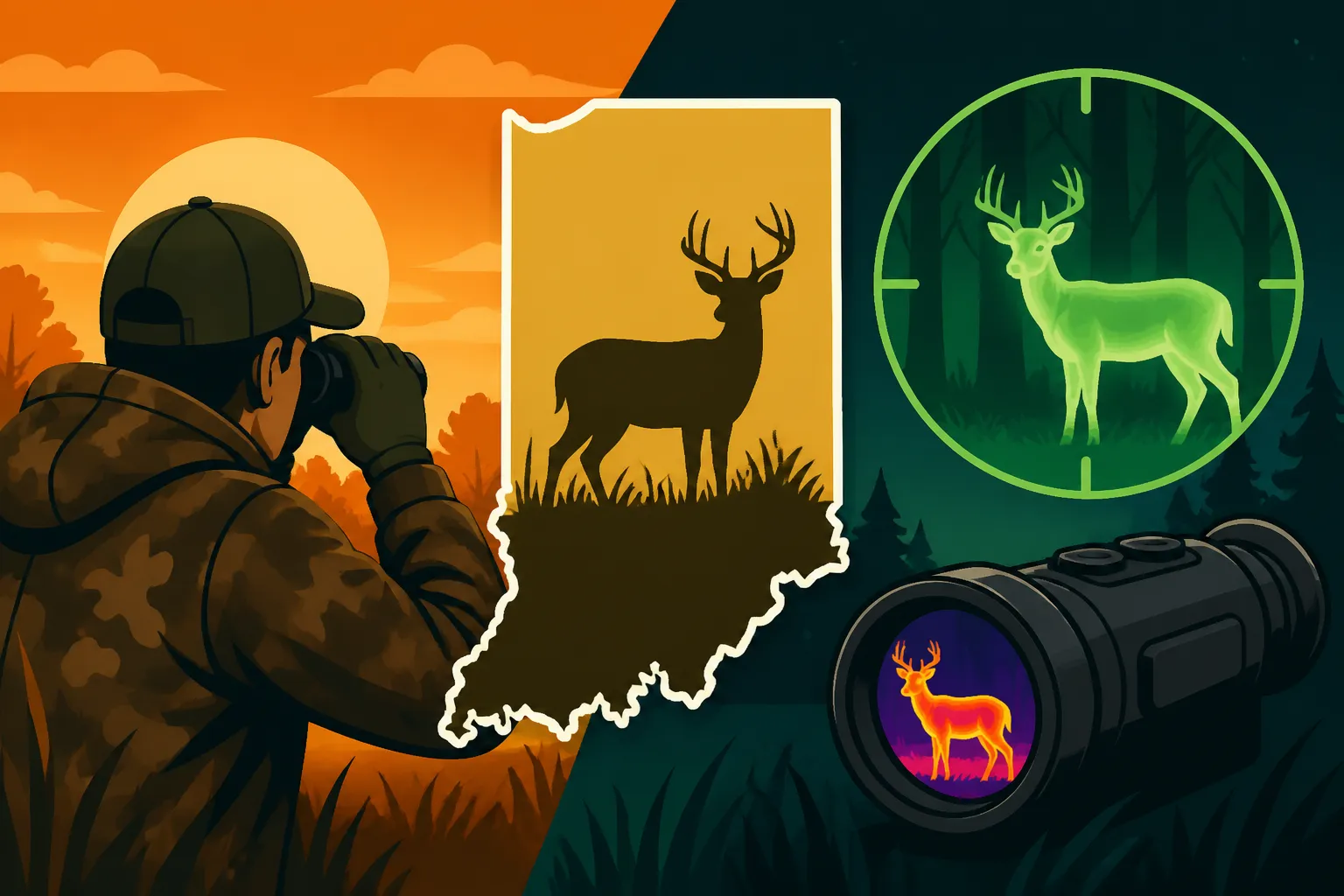
Most thermal imaging scopes, monoculars and handheld units work by detecting infrared radiation, which is heat, and turning it into an image. That is why the infrared rule is the one that matters for thermal gear. If a device works by sensing infrared energy, it falls within this language.
Night vision is a different technology, and the confirmed texts gathered here do not address it by name. No official Indiana text on night vision devices turned up, so this guide does not call them legal or illegal for any purpose. If you own a night vision unit and want to know whether you can use it in the field, ask the Indiana DNR directly before you take it out.
A Realistic Scenario From a Brown County Ridge
Picture this. You’re bowhunting a ridge in Brown County. A doe steps in at twenty yards just as the light fades, you shoot, and she crashes off downhill toward a creek bottom. You find good blood for sixty yards, then it thins out in leaf litter. Your hunting partner texts that his brother-in-law has a thermal monocular and could be there in half an hour.
Under the confirmed text, bringing that monocular in to retrieve the deer conflicts with the rule against retrieving deer with the aid of an infrared detector. The rule has been changing, though, which the next section covers. The answer in that moment is to call and ask before anyone switches the device on. Meanwhile, the slow, careful methods in Blood Trailing After Dark in Indiana are the ones to lean on.
The Retrieval Rule Has Been Changing
This is the part of the topic that leaves hunters confused. The text above has been the confirmed rule. The Indiana DNR has also put out a formal notice proposing to change it, which means you should never assume you know the current version without checking.
What the DNR’s Proposed Change Said
In a 2024 rule notice published in the Indiana Register, the Indiana DNR proposed removing the restriction on using infrared detectors to retrieve a deer. The notice tied this to legislation. It stated that SEA 189-2024 authorizes the use of unmanned aerial vehicles with infrared sensors to retrieve deer that are legally harvested.
Based on that, the department proposed changing the rule to allow thermal or infrared detectors to be used to retrieve dead deer, but not when hunting deer. In other words, the proposal separates two activities. Recovering a dead deer you legally harvested would be one thing. Hunting deer would be another, and the proposal kept infrared off-limits for that.
Whether that proposed change took final effect has not been confirmed. That’s why this guide does not say thermal recovery is now allowed. It also does not say the confirmed restriction is definitely still in force. The rule has been changing, and the only safe step is to confirm the current version with the Indiana DNR before you use any thermal or infrared device to find a deer.
How the Old Text and the Proposal Compare
Here is a side-by-side look at the confirmed text, the proposal, and what that means for you in the field.
| Situation | Confirmed text published late 2024 | 2024 DNR proposal | What to do |
|---|---|---|---|
| Using infrared to locate deer | Must not use infrared sensors to locate or take deer | Proposal kept infrared off-limits when hunting deer | Do not rely on infrared for this; ask the Indiana DNR |
| Using infrared to take deer | Must not use infrared sensors to locate or take deer | Proposal kept infrared off-limits when hunting deer | Do not rely on infrared for this; ask the Indiana DNR |
| Using an infrared detector to retrieve a deer | Must not retrieve deer with the aid of an infrared detector | Proposed allowing thermal or infrared detectors to retrieve dead deer | Rule has been changing; confirm the current rule with the Indiana DNR first |
| Drone with infrared sensor to retrieve a legally harvested deer | Not addressed in the infrared rule text | Notice stated SEA 189-2024 authorizes this | Confirm the current rule and any conditions with the Indiana DNR first |
| Night vision devices | No official Indiana text found | Not addressed | Ask the Indiana DNR before any use |
How to Confirm the Current Rule Before You Use a Device
The best time to make this call is before season, not with a deer down and your heart pounding. Here’s a practical way to handle it:
- Contact the Indiana DNR well before your hunt and ask specifically whether thermal or infrared detectors may be used to retrieve a dead deer, and under what conditions.
- Ask the same question about drones with infrared sensors, since the DNR notice tied drone recovery to SEA 189-2024.
- If you own a night vision unit, ask about it separately and by name, because the confirmed texts here do not cover it.
- Write down the date, who you spoke with, and what they told you. Keep it on your phone with your hunting notes.
- Save the number for your local Conservation Officer so you can reach someone quickly if a recovery situation comes up during season.
I keep a running hunt log for every property I hunt, with pins for blood, last sightings and recovery notes. Some folks use a mapping and research service such as GoHunt or a similar app for this. Whatever you use, put the DNR’s answer about recovery devices right in that log so it’s there when you need it.
Lights, Drones and Dogs Under Indiana Law
Thermal gets the attention, but the recovery night usually involves a flashlight, maybe a drone your nephew owns, and possibly a neighbor with a tracking dog. Each of these has its own confirmed Indiana text.
Spotlights and Artificial Light
Indiana’s statute on lights has three parts worth knowing, stated here in plain words.
First, an individual may not knowingly cast the rays of a spotlight or other artificial light that is not required by law on a motor vehicle, in search of or upon any wild bird or wild animal, from a vehicle while possessing a firearm, bow or crossbow, if a wild bird or wild animal could be killed by doing so. The law says this applies even if the animal is not killed, injured, shot at or otherwise pursued. All four conditions are in that sentence: the light, the searching, the vehicle, and having a firearm, bow or crossbow.
Second, an individual may not take any wildlife, except furbearing mammals, with the aid of illumination from any spotlight, searchlight or other artificial light. The text sets out that exception for furbearing mammals. It does not list which species count or under what other conditions, so if that exception matters to you, ask the Indiana DNR how it applies before you head out. For more on night calling questions, see Night Hunting Rules for Indiana Coyotes.
Third, an individual may not shine a spotlight, searchlight or other artificial light for the purpose of taking, attempting to take, or assisting another person to take a deer. Notice the word “assisting.” If you’re holding the light while a friend does the shooting, that is covered too.
For blood trailing, this language centers on taking, attempting to take, or assisting in taking a deer, and on casting light from a vehicle while possessing a firearm, bow or crossbow. If you’re unsure how it applies to your specific situation, such as how you carry a light and what you carry with it on a recovery, ask your Conservation Officer ahead of time. For choosing a light, see Headlamps for Walking Out After Dark.
Drones and the Fourteen-Day Window
Indiana’s drone statute, in its 2018 text, sets a defined window. Starting fourteen days before the hunting season for a particular wild animal species, and ending when legal hunting hours expire on the last day of that season, a person may not knowingly use an unmanned aerial vehicle to search for, scout, locate or detect a wild animal that season applies to as an aid to take it.
So the window runs from two weeks before the season opens until the end of legal hours on closing day. During that window, flying a drone to find animals as an aid to taking them falls within the restriction. This is about pre-season scouting as much as the hunt itself. Flying over a soybean field ten days before opener to see where deer are feeding falls inside that window.
Recovery is a separate question. The 2024 DNR notice stated that SEA 189-2024 authorizes drones with infrared sensors to retrieve legally harvested deer. Because the related rule has been changing, confirm with the Indiana DNR exactly what is permitted for drone recovery, and under what conditions, before anyone launches a drone to look for your deer.
Leashed Dogs for Wounded Deer
Here’s one of the most useful tools available to Indiana deer hunters. Indiana’s rule says an individual may use dogs only while on a leash to track or trail wounded deer.
The key words are “only while on a leash.” A trained tracking dog on a long lead, with its handler following, fits that description. A dog turned loose to run a wounded deer does not. If you’ve never watched a good blood-tracking dog work a cold line through river bottom brush, it’s remarkable. These dogs often find deer that would otherwise have been lost after hours of grid searching.
The practical step is lining up a tracker before season. Ask around at deer processors, archery shops and hunting clubs near you for people who run leashed tracking dogs, and save their numbers. For the terrain side of recoveries, see Recovering a Deer From a River Bottom.
Private Land and Building a Recovery Plan
Wounded deer don’t read property lines. Sooner or later, a deer you hit on your ground or on public land will cross onto someone else’s property. The confirmed guidance here is clear.
Tracking a Deer Onto Someone Else’s Property
The Indiana DNR’s guidance says that unless you have permission from the landowner, preferably written, you may not go onto the property to retrieve or track the deer. The DNR advises contacting your local Conservation Officer for assistance through Central Dispatch at 812-837-9536.
That’s the entire confirmed rule for this guide, and it’s worth reading twice. Permission comes first, and the DNR says written permission is preferred. Without it, you don’t cross the line to track or retrieve. If you can’t reach the landowner, the DNR points you to a Conservation Officer.
The hard truth is that this is easiest to solve months before you need to. If your stand sits within bowshot of a neighbor’s line, knock on that door in summer, introduce yourself, and ask whether they’d allow you to recover a deer if one crosses over. Getting that in writing, even a simple signed note, is what the DNR prefers. Asking an Indiana Farmer for Permission has good advice on how to open that conversation, and Retrieving Game From Private Land in Indiana goes deeper on recovery across property lines.
A Step-by-Step Recovery Plan That Stays Within the Confirmed Rules
Here’s the plan I’d want any hunter to have written down before opener. It relies only on the confirmed rules covered above.
- Before season, contact the Indiana DNR and ask about the current rule on thermal or infrared detectors for retrieving a dead deer, drone recovery, and any night vision device you own.
- Save the Central Dispatch number, 812-837-9536, and your local Conservation Officer’s contact details in your phone.
- Line up a leashed tracking dog handler you can call, since dogs may be used only while on a leash to track or trail wounded deer.
- Talk to neighboring landowners and ask for permission, preferably written, to track or retrieve a deer that crosses onto their ground.
- If you fly a drone for any reason, mark the date fourteen days before each relevant season on your calendar so you know when that restriction window starts.
- After a shot, mark your position and the last place you saw the deer. A pin in GoHunt or whatever mapping app you use works well.
- Give the deer time and follow the blood carefully on foot. Do not use an infrared device unless you have confirmed with the Indiana DNR that it is allowed for recovery.
- Keep lights within the confirmed rules, and never cast a light from a vehicle in search of wildlife while possessing a firearm, bow or crossbow.
- If the trail leads onto property you do not have permission for, stop at the line and contact the landowner or a Conservation Officer.
Weather, Terrain and Patience
Most lost deer aren’t lost because of a missing gadget. They’re lost because someone pushed too fast, bumped a wounded deer out of its first bed, and ran out of blood. Patience is still the best recovery tool.
Snow changes everything. A fresh skiff can turn a hopeless trail into a highway of tracks, and Tracking a Deer in Fresh Indiana Snow walks through reading that sign. Rain does the opposite, so if a storm is coming, getting a leashed tracking dog on the line sooner can make a real difference.
Finally, if you ever come across someone running lights from a truck or using equipment in ways that worry you, don’t confront them. Note what you can and see Reporting a Poacher in Indiana. If you want to know what’s at stake for violations, ask the Indiana DNR directly or see Indiana Wildlife Violation Penalties, and confirm details with your Conservation Officer. Whether you track deer with a leashed dog or are still building your plan, the Indiana DNR is the place to get the current answer on any device before you use it.
Disclaimer
This article is for general informational purposes only and does not constitute professional advice. Laws, prices and regulations vary by location and change over time. Consult a qualified professional for guidance on your specific situation.