Indiana’s New Statewide Rifle Rules
For years, many Indiana deer hunters felt constrained by the state's unusual rifle regulations, particularly the requirement for straight-wall cartridges. It often led to confusion, frustration, and a feeling that we were missing out on the advantages and versatility that modern centerfire rifles offer. This comprehensive guide will unravel all the intricacies of Indiana's updated rifle rules, making sure you're fully prepared and compliant for your next hunt.
The Evolution of Indiana's Rifle Regulations
Let's be honest, the old rules around deer hunting rifles in Indiana were a bit of a head-scratcher for many, especially if you came from a state with more traditional rifle seasons. It wasn't always easy to understand why we had to jump through hoops with specific cartridge designs when hunters just across the border were using whatever caliber they pleased. This wasn't some arbitrary decision, though; it stemmed from a desire to balance hunting opportunity with safety concerns in a state with a significant population density and varied landscapes.
The journey to the current, more permissive regulations has been a long one, marked by years of debate among hunters, conservationists, and legislators. For decades, many believed that allowing bottleneck cartridges—the common "rifle rounds" like .30-06 or .270—would lead to unsafe conditions, particularly in the flatter, more populated regions of northern Indiana. The concern was always about bullet travel distance and the potential for stray rounds to endanger homes or property far beyond the target. This cautious approach, while well-intentioned, often left hunters feeling limited in their gear choices and sometimes even at a disadvantage compared to neighboring states.
The Straight-Wall Era: Restrictions and Frustrations
For a very long time, if you wanted to hunt deer with a "rifle" in Indiana, you were largely limited to what were called straight-wall cartridges. This meant calibers like the .44 Magnum, .45 Long Colt, .357 Magnum, and later, more specialized rounds like the .450 Bushmaster or .350 Legend. The thinking behind this was that straight-wall cartridges, which typically have a larger diameter and carry less powder, would produce bullets that didn't travel as far as the sleek, aerodynamically efficient bullets of bottleneck cartridges. While this might have offered a perceived safety benefit in some densely populated areas, it definitely came with its own set of frustrations for hunters.
Hunters often felt restricted to cartridges that, while effective at closer ranges, sometimes lacked the extended reach or flatter trajectory desired for longer shots, especially in open fields or across wider clearings. This led to a scramble for specialized firearms and ammunition, sometimes at higher costs, just to comply with the rules. Furthermore, it created a perception that Indiana hunting was uniquely complicated, turning away hunters who preferred to use their tried-and-true deer rifles from other states. The limited options meant fewer choices for recoil sensitivity, bullet performance, and overall hunting style.
The Legislative Push for Change
The movement to modernize Indiana's rifle laws wasn't an overnight sensation; it was a steady, persistent effort driven by a growing chorus of hunters and advocacy groups. For years, organizations and individual hunters communicated their desire for change to their state representatives, sharing their experiences and highlighting how other states successfully managed hunting with a broader range of rifle calibers. They argued that advances in bullet technology and responsible hunting practices could mitigate the safety concerns, and that responsible hunters would adapt to the new rules without incident.
This legislative push gained significant momentum as more data and examples from other states demonstrated that safety could be maintained even with the use of bottleneck cartridges. The Indiana Department of Natural Resources (DNR) also played a crucial role, providing input and analysis to help inform lawmakers. Ultimately, the cumulative effect of hunter advocacy, legislative understanding, and a willingness to embrace modern hunting realities led to the introduction and eventual passage of Senate Bill 280, a landmark piece of legislation that completely reshaped the landscape of deer hunting in Indiana. It marked a significant victory for hunters who had long advocated for these changes, ushering in a new era of rifle hunting opportunity.
Understanding Senate Bill 280: What Really Changed
Senate Bill 280, signed into law, was a game-changer for Hoosier hunters. This isn't just a minor tweak; it's a fundamental shift that brings Indiana's rifle regulations much closer to what you'd find in most other deer hunting states. The bill directly addressed the main points of contention that had frustrated hunters for so long, specifically the limitations on cartridge case length and the requirement for straight-wall designs. Understanding the specifics of this bill is crucial for anyone planning to hunt deer in Indiana with a rifle moving forward.
The effective date of this new legislation marked the end of an era where specific cartridge types dictated your hunting choices. No longer do you have to consult a list of approved straight-wall cartridges or worry about the exact length of a brass casing. Instead, the focus has shifted to a more straightforward bullet diameter requirement, which makes selecting a rifle much simpler and opens up a vast array of popular and proven deer hunting calibers. This change signifies a leap forward, reflecting confidence in hunters' ability to adapt responsibly and safely.
Eliminating the Case Length and Cartridge Type Restrictions
The most impactful change brought by Senate Bill 280 is the complete removal of the previous restrictions on case length and the requirement for straight-wall cartridges. Before this law, Indiana had very specific limitations on the maximum case length (initially 1.625 inches, later adjusted to 1.8 inches) and explicitly stated that cartridges had to be "straight-walled." This meant that many of the most common and effective deer hunting calibers, like the .30-06 Springfield, .270 Winchester, .308 Winchester, or 6.5 Creedmoor, were simply illegal for deer.
Now, with the passage of Senate Bill 280, those specific limitations are gone. You can bring your favorite bolt-action, lever-action, or semi-automatic rifle chambered in a bottleneck cartridge to the Indiana deer woods, provided it meets the new bullet diameter requirement. This means a hunter who owns a .308 that they use for whitetails in Kentucky or Ohio can now use that same rifle here in Indiana, eliminating the need to purchase specialized straight-wall firearms or keep a separate "Indiana gun." This simplification is a huge win for hunter convenience and gear flexibility. If you want to dive deeper into this specific aspect, we've got a detailed breakdown on Why Straight-Wall Rifles Are No Longer Required.
The New Minimum Bullet Diameter Requirement
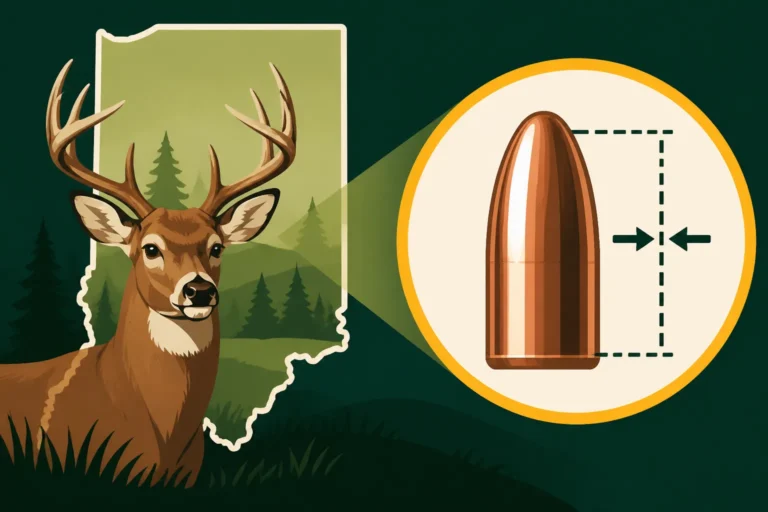
While the old restrictions on cartridge type and case length are gone, the state didn't completely throw caution to the wind. There is still a critical requirement you need to be aware of: a minimum bullet diameter. Under the new law, any rifle cartridge used for deer hunting in Indiana must have a bullet diameter of at least .243 inches (6mm). This means that cartridges like the popular .223 Remington or 5.56x45mm NATO, which are often used for varmint or predator hunting, are still illegal for deer.
This minimum diameter requirement serves several purposes. Firstly, it ensures that hunters are using cartridges generally considered adequate for humanely harvesting white-tailed deer. While smaller calibers can kill deer, the .243 minimum provides a reasonable floor for ethical hunting performance. Secondly, it helps maintain a distinction between hunting deer and hunting smaller game, preventing confusion and potential misuse of firearms. So, while you have a lot more freedom now, remember to always check that your chosen cartridge meets this crucial minimum bullet diameter. For more specifics on this, check out our piece on Minimum Bullet Diameter Under Indiana's New Law.
Here's a quick comparison of the old vs. new regulations for clarity:
| Feature | Old Regulation (Pre-SB 280) | New Regulation (Post-SB 280) |
|---|---|---|
| Cartridge Type | Must be a straight-wall cartridge | Any centerfire rifle cartridge is allowed |
| Case Length | Max 1.8 inches (initially 1.625") | No maximum case length restriction |
| Minimum Bullet Diameter | Varied, but implicitly linked to legal straight-walls | Must be at least .243 inches (6mm) in diameter |
| Popular Calibers (Example) | .450 Bushmaster, .350 Legend, .44 Mag, .357 Mag | .30-06, .270 Win, .308 Win, 6.5 Creedmoor, 7mm-08, and previous straight-walls |
| Impact on Hunters | Limited choices, required specialized firearms | Greatly expanded choices, more versatility for hunters |
Impact on Popular Calibers and Hunting Styles
The lifting of the straight-wall restriction is more than just a legal change; it's a revolution in how many Hoosiers can approach deer season. Suddenly, the entire landscape of firearm selection has broadened dramatically, bringing Indiana into alignment with the majority of the nation. This isn't just about what's legal; it's about what's practical, accessible, and potentially more effective for a wider range of hunting scenarios across our diverse Indiana landscapes.
Think about the conversations at deer camp now. Instead of debating the merits of different straight-wall loads, we can now openly discuss the advantages of a .270 for long shots or a .30-06 for timber country. This shift empowers hunters to choose a rifle that truly suits their individual hunting style, local terrain, and personal preferences for recoil and ballistic performance. It's a huge step forward for hunter satisfaction and, frankly, for modernizing our hunting heritage in the state.
Welcoming Traditional Deer Calibers to Indiana
For years, many Indiana hunters looked enviously at their counterparts in states like Michigan, Ohio, or Kentucky, who could use time-tested, traditional deer calibers like the .30-06 Springfield, .270 Winchester, .308 Winchester, or 7mm-08 Remington. These cartridges are the bread and butter of deer hunting in most places for good reason: they offer excellent ballistic performance, are widely available, and have a proven track record of ethically taking whitetails. The .30-06, for example, is renowned for its versatility and power, capable of handling everything from close-range timber shots to longer shots across fields. The .270 Winchester is a flatter-shooting option, perfect for open country, while the .308 Winchester offers similar performance in a more compact package.
With the new regulations, all of these iconic calibers, and many more, are now perfectly legal for deer hunting in Indiana, provided their bullet diameter is at least .243 inches. This means you can finally uncase that classic deer rifle you inherited, or purchase a new one chambered in a caliber that truly excites you, without worrying about archaic restrictions. This is fantastic news for hunters who might have previously felt compelled to buy a specialized straight-wall rifle just for Indiana, and it significantly broadens the market for used firearms in the state, making traditional rifle ownership more accessible. We've even put together a guide on Choosing a Rifle Now That Cartridge Limits Are Gone to help you navigate your options.
Expanded Opportunities for Longer Shots
One of the most significant practical impacts of the new rules is the ability to confidently take longer shots when the situation calls for it. Straight-wall cartridges, while effective, generally exhibit a more pronounced bullet drop at extended ranges compared to bottleneck cartridges. This often meant hunters had to pass on deer that were ethically shootable in other states, or rely heavily on precise rangefinding and holdover calculations that could be challenging under hunting conditions. In open fields, across powerline cuts, or from one ridge to another in southern Indiana, these limitations were keenly felt.
Now, with calibers like the 6.5 Creedmoor, .270 Winchester, or .308 Winchester readily available, hunters can benefit from flatter trajectories and less wind drift. This doesn't mean you should start attempting 500-yard shots without practice, but it does mean that a 200-yard shot, which might have been pushing the limits of some straight-wall cartridges, is now well within the effective and ethical range of many traditional rifle calibers. This expanded capability is particularly beneficial for hunting northern Indiana farmland deer, where open vistas are common, and in areas where shots across larger clearings are frequently encountered. It gives hunters a greater sense of confidence and expands their effective range, assuming they have put in the practice at the shooting range.
Practical Considerations for Indiana Rifle Hunters
So, the rules have changed, and your options have exploded. That's fantastic! But with new opportunities come new responsibilities and a few practical steps you'll want to consider before heading out to the woods. It's not just about what you can use, but how you use it effectively and safely in our unique Indiana environment. This includes everything from ensuring your rifle is dialed in perfectly to understanding the nuances of ammunition and even the legalities of carrying rounds.
Don't just grab an old rifle and assume it's good to go. Even if you've hunted with a .30-06 in other states for years, the specific conditions in Indiana—whether it's the dense timber of the Hoosier National Forest or the wide-open fields of the north—require thoughtful preparation. This is your chance to really optimize your setup and ensure you're making the most of these new freedoms while remaining a responsible and ethical hunter.
Sighting In Your New Rifle for Indiana Woods
With a broader range of rifle calibers now legal, accurately sighting in your firearm is more critical than ever. Many of these new-to-Indiana calibers offer flatter trajectories and extended effective ranges compared to the straight-wall cartridges we were used to. This means you can optimize your zero for the typical shot distances you expect in your hunting area. For instance, if you're hunting in dense timber with typical shot opportunities under 100 yards, a 50-yard zero might make sense for minimizing holdover/under. However, if you're hunting more open areas in northern Indiana, a 150- or 200-yard zero could be more appropriate, giving you a "point blank" range that covers most ethical shot distances without needing to compensate significantly.
Regardless of your chosen zero, consistent practice is key. Don't just shoot a few rounds to confirm your zero; spend time getting comfortable with your rifle, its recoil, and how it performs at various distances. Many ranges across Indiana offer 100-yard lanes, and some even have longer options. Take advantage of these to understand your bullet drop and windage at different yardages. Remember, a new rifle, even if it's a common caliber, is still a new tool in your hands. For a more detailed guide on this essential step, check out Sighting In a Centerfire Rifle for Indiana Woods.
Choosing the Right Ammunition for Performance
The increased choice in calibers also means a wider array of ammunition options. While virtually any factory-loaded deer hunting round in a legal caliber will be effective, taking a moment to consider bullet construction can significantly enhance your hunting success and ethical performance. For instance, in areas with thick cover or for shorter shots, a bullet designed for rapid expansion might be ideal. Conversely, if you anticipate longer shots or want maximum penetration, a bonded or heavier-for-caliber bullet might be a better choice.
Brands like Hornady, Federal, Winchester, and Remington all offer excellent hunting ammunition tailored for different situations. Don't just grab the cheapest box; research bullet types like Nosler AccuBond, Barnes TSX, Hornady SST, or Federal Fusion. These bullets are engineered to perform reliably on deer-sized game, ensuring good energy transfer and consistent expansion. Experiment with a few different brands and bullet weights with your specific rifle to see what it shoots most accurately. Accuracy trumps all, so find what performs best in your gun.
Carrying More Than Ten Rifle Cartridges Afield
This is an important point that sometimes gets overlooked in the excitement of new regulations: Indiana maintains specific rules regarding the possession of ammunition while hunting deer. While you might now be using a rifle that has a magazine capacity of 10, 20, or even 30 rounds, the state law states that a hunter may not possess more than ten (10) rifle cartridges at any time while hunting deer. This means that if your rifle has a detachable magazine, you can load it with ten rounds, but you cannot carry additional loaded magazines or loose rounds in your pocket that would exceed the ten-round limit.
This regulation applies to all deer hunting, regardless of the rifle caliber. It’s a measure designed to prevent excessive firepower and promote fair chase. So, before you head afield, make sure you count your rounds. If you're carrying a spare magazine, ensure it's empty, or that the total number of rounds you possess (loaded in the firearm plus any spares) does not exceed ten. This particular rule hasn't changed with the new rifle laws, so it's a critical piece of information to remember. For more details on this, see our article on Indiana's Ten-Cartridge Possession Limit.
Safety and Ethical Hunting in a New Rifle Landscape
The transition to statewide rifle hunting carries with it a heightened responsibility for all of us. While the regulations have evolved, the core principles of safety, ethics, and respect for the resource remain paramount. The fear of "longer range" rifles has historically been tied to public safety concerns, and as hunters, it's our duty to demonstrate that these fears are unfounded when hunters act responsibly. This means being more diligent than ever about target identification, backstop awareness, and understanding the capabilities of our firearms.
This isn't just about following the law; it's about preserving our hunting privileges for future generations. Every shot taken, every action afield, reflects on the entire hunting community. Let's make sure that reflection is one of professionalism, respect, and unwavering commitment to safety.
Public Perception and Responsible Hunting Practices
With the broader allowance of centerfire rifles, there's always an underlying concern, especially from the non-hunting public, about safety. Many people, particularly those unfamiliar with firearms, associate "high-powered rifles" with excessive danger. It's up to us, as hunters, to actively counter these perceptions through our actions. This means always being exemplary in our conduct, following all safety rules, and demonstrating a profound respect for private property and public spaces.
The bedrock of responsible hunting is the four primary rules of firearm safety: treat every firearm as if it's loaded, always point the muzzle in a safe direction, keep your finger off the trigger until ready to shoot, and be sure of your target and what is beyond it. These rules are especially critical when using a rifle with a longer effective range. By consistently adhering to these principles, hunters can reassure the public that expanded rifle opportunities do not equate to increased danger. Our collective actions will shape how future generations view hunting in Indiana.
Understanding Backstops and Effective Range
A crucial element of safe rifle hunting, particularly with bottleneck cartridges that can send a bullet much farther than a shotgun slug or straight-wall round, is intimately understanding your backstop and the effective range of your chosen caliber. A bullet from a .30-06, for example, can travel several miles if not stopped by an adequate backstop. This isn't to say you'll be shooting at deer from miles away, but it emphasizes the importance of knowing what lies beyond your target.
When hunting in southern Indiana's hill country, ridges and creek banks often provide natural backstops. In flatter northern Indiana farmland, a cut cornfield or a thick woodline might seem like an adequate backstop, but it's essential to consider the potential for ricochet or through-and-through penetration. Always choose a shot where you are absolutely certain of your target and have a substantial, unpopulated natural barrier behind it. Never take a shot towards a skyline, over a rise without knowing what's behind it, or in the direction of homes, roads, or other infrastructure. Understanding your rifle's effective range means knowing at what distance you can consistently place a shot in the vital zone, not just how far the bullet can travel. Practice at the range to determine your personal maximum ethical range, and stick to it religiously.
Hunting Different Indiana Terrains with a Centerfire Rifle
Indiana's diverse landscape, from the rolling hills and deep timber of the south to the vast agricultural fields and scattered woodlots of the north, offers a variety of hunting experiences. The new rifle rules unlock greater versatility for hunters to tailor their equipment to these specific terrains. No longer are you forced to make a compromise; you can now select a rifle and caliber that is truly optimized for the environment you're hunting.
This adaptability can be a significant advantage, whether you're still-hunting through thickets, sitting in a stand overlooking a soybean field, or tracking deer along a river bottom. Understanding how to best leverage the capabilities of your chosen centerfire rifle in these different environments is key to maximizing your success and overall hunting enjoyment.
Adapting to Northern Indiana Farmland Deer
Northern Indiana is characterized by expansive agricultural fields, interspersed with smaller woodlots, fencerows, and creek bottoms. Deer here often spend their days bedded in these smaller cover blocks or even in standing crops, moving into fields to feed at dusk and dawn. This often means longer shot opportunities across open fields or narrow windows as deer traverse field edges. Historically, a shotgun with slugs might have been pushed to its limits on these longer shots.
With traditional centerfire rifles now legal, hunting in these areas becomes much more efficient. Calibers like the .270 Winchester, 6.5 Creedmoor, or .30-06 Springfield shine here, offering flatter trajectories and better energy retention at distances up to 200-300 yards (depending on your personal comfort and practice). When planning your hunt in this type of terrain, consider setting up in a ground blind or elevated stand offering a clear view of field edges, pinch points, or travel corridors between woodlots. Remember to use a good rangefinder to accurately gauge distances across those open expanses, as a deer at 200 yards can look much closer than it is. Our article on Hunting Northern Indiana Farmland Deer provides more specific tactics for these environments.
Navigating Southern Indiana Hill Country
Southern Indiana presents a very different challenge, dominated by steep hills, thick timber, deep hollows, and dense undergrowth. Shots are often much closer, sometimes under 50 yards, but can occasionally stretch across clear-cuts or down a powerline right-of-way. The terrain itself can make shot placement tricky, with constantly changing angles and limited visibility. Before the new rules, the maneuverability of a straight-wall carbine was sometimes an advantage in this dense cover.
Now, while longer-range rifles are legal, it's essential to match your gear and tactics to the environment. A compact .308 Winchester or 7mm-08 Remington with a quality low-power variable optic might be ideal here, offering enough power for any Indiana deer while remaining nimble in tight spaces. Focus on still-hunting tactics, slowly picking your way through the woods, or setting up treestands in natural funnels, saddles, or along creek bottoms. These areas often provide natural backstops in the form of hillsides, which is a major safety advantage. Remember that shot opportunities can appear and disappear quickly in thick cover, so quick target acquisition is paramount. If you're planning a trip to this region, you might find value in our discussion on Still-Hunting Southern Indiana Ridges.
Future Outlook for Indiana Deer Hunting
The introduction of statewide rifle hunting for deer is a momentous change, and like any significant shift, it naturally brings questions about the future. Will deer populations be affected? Will hunting pressure increase? What does this mean for the long-term health of our deer herd and the hunting culture in Indiana? These are valid concerns that the Indiana DNR and hunting community will undoubtedly continue to monitor closely.
While it's impossible to predict the future with absolute certainty, we can look at data from other states that have similar regulations, and consider the underlying management principles that guide Indiana's wildlife division. The goal, as always, is a healthy deer population balanced with agricultural interests and hunter opportunity.
Potential Changes in Hunter Preference and Success Rates
One immediate potential impact is a shift in hunter preference. Many hunters who previously chose to use shotguns with slugs or muzzleloaders during the firearm season might now opt for a centerfire rifle. This could be due to a preference for a familiar firearm, perceived better accuracy, or the flatter trajectory mentioned earlier. This doesn't necessarily mean everyone will ditch their traditional slug guns overnight, but it does mean a wider variety of firearms will be present in the deer woods.
It's also possible that we could see a slight uptick in hunter success rates, particularly for those who were previously limited by the effective range of their straight-wall firearms or slug guns. A more accurate rifle with a flatter trajectory can undoubtedly lead to more confidence and potentially more successful harvests, especially on those marginal longer-range shots that might have been passed on before. However, Indiana's deer herd is robust, and the DNR manages harvest rates carefully through bag limits and season structures. The impact on the overall deer population is likely to be incremental rather than revolutionary, as the total number of hunters and available tags will remain key limiting factors. Keeping an eye on the Indiana Deer Population Estimate will be crucial for understanding these trends.
Monitoring Deer Populations and Habitat Impacts
The Indiana DNR will undoubtedly be closely monitoring deer harvest data, population estimates, and hunter feedback in the coming years to assess the impact of these new rifle rules. This includes looking at factors such as antlered buck harvest, antlerless harvest, and overall hunter numbers. Wildlife management is an ongoing process, and regulations are often adjusted based on scientific data and observed trends. It’s also important for hunters to do their part by accurately reporting their harvests and utilizing tools like the GoHunt app or the Indiana DNR's online system to ensure all data is collected efficiently.
Regarding habitat, the direct impact of rifle type on habitat is minimal. However, a potentially more efficient harvest could indirectly influence deer density in specific areas, which in turn could affect browse pressure on vegetation. Indiana's deer management strategy is comprehensive, involving careful consideration of herd health, disease prevalence (like CWD), and the balance between deer populations and ecological carrying capacity. Ultimately, the success of these new regulations will be measured not just by hunter satisfaction, but by the continued health and sustainability of Indiana's white-tailed deer population. The DNR’s comprehensive Indiana Deer Season Structure Explained guides these efforts.
Disclaimer
Please remember that hunting regulations can change, and it is always your responsibility as a hunter to consult the most current Indiana Department of Natural Resources (DNR) hunting guide before heading afield. This guide provides general information based on the latest understanding of Indiana's new rifle rules but should not be considered a substitute for official DNR publications. Stay safe, hunt ethically, and enjoy your time in the Indiana outdoors.