Indiana Predator Impact on Fawn Recruitment
It's a question many Indiana deer hunters ponder: why do some years feel like there are fawns everywhere, bouncing through the fields, while other seasons they seem few and far between? The reality is, the survival rate of young deer, known as fawn recruitment, is a complex dance influenced by many factors, and one of the biggest players in that ecosystem is predators. This guide will dig deep into how Indiana's predator populations affect the next generation of our deer herd, helping you understand the dynamics at play in the woods you hunt.
Understanding Fawn Recruitment and its Importance
When we talk about fawn recruitment, we're not just throwing around fancy biology terms. This is the heartbeat of the deer herd, the very metric that determines whether populations are growing, shrinking, or staying stable year after year. It’s a crucial concept for understanding deer management in Indiana, and it directly impacts what you see in the woods.
What is Fawn Recruitment?
At its simplest, "fawn recruitment" refers to the number of fawns that survive to reach their first hunting season, typically around six months of age. Imagine all the fawns born in the spring; not all of them make it through the summer. Some fall victim to disease, accidents, or starvation, but a significant portion will be lost to predators. The higher the recruitment rate, the more young deer are added to the population, contributing to overall herd health and future hunting opportunities. If recruitment is consistently low, even if adult deer numbers seem decent, the herd will eventually decline. It's the engine that drives population growth, and without enough fawns making it to maturity, the herd can't sustain itself. Understanding this helps us appreciate why certain management strategies or changes in predator populations can have such a profound effect.
Factors Beyond Predation Affecting Fawn Survival
While predators play a significant role, it’s important to remember they aren’t the only force at work. Fawn survival is a multi-faceted equation. Habitat quality, for instance, dictates how well a doe can hide her fawns, how much nutritious forage is available to support lactation, and how resilient the fawns themselves are. Poor habitat means less cover, making fawns easier targets. Weather also plays a massive role. A late, cold spring with heavy rains can be devastating for newborn fawns, leading to hypothermia and starvation. Disease outbreaks, like Epizootic Hemorrhagic Disease (EHD), can wipe out significant numbers of deer, including fawns, in localized areas. Human factors, such as vehicle collisions or early-season disturbances by shed hunters or hikers, can also contribute to fawn mortality, either directly or by separating fawns from their mothers. All these elements create a complex web, and predation is just one, albeit often dominant, strand within it. White-Tailed Deer Across Indiana face a gauntlet of challenges from birth.
Key Predators of Deer Fawns in Indiana
Indiana is home to a diverse array of wildlife, and many of these species, by nature, are opportunistic predators. For a vulnerable newborn fawn, nearly anything with sharp teeth or talons can pose a threat. However, some stand out as far more significant players in the fawn mortality game than others.
Coyote: Indiana's Primary Fawn Predator
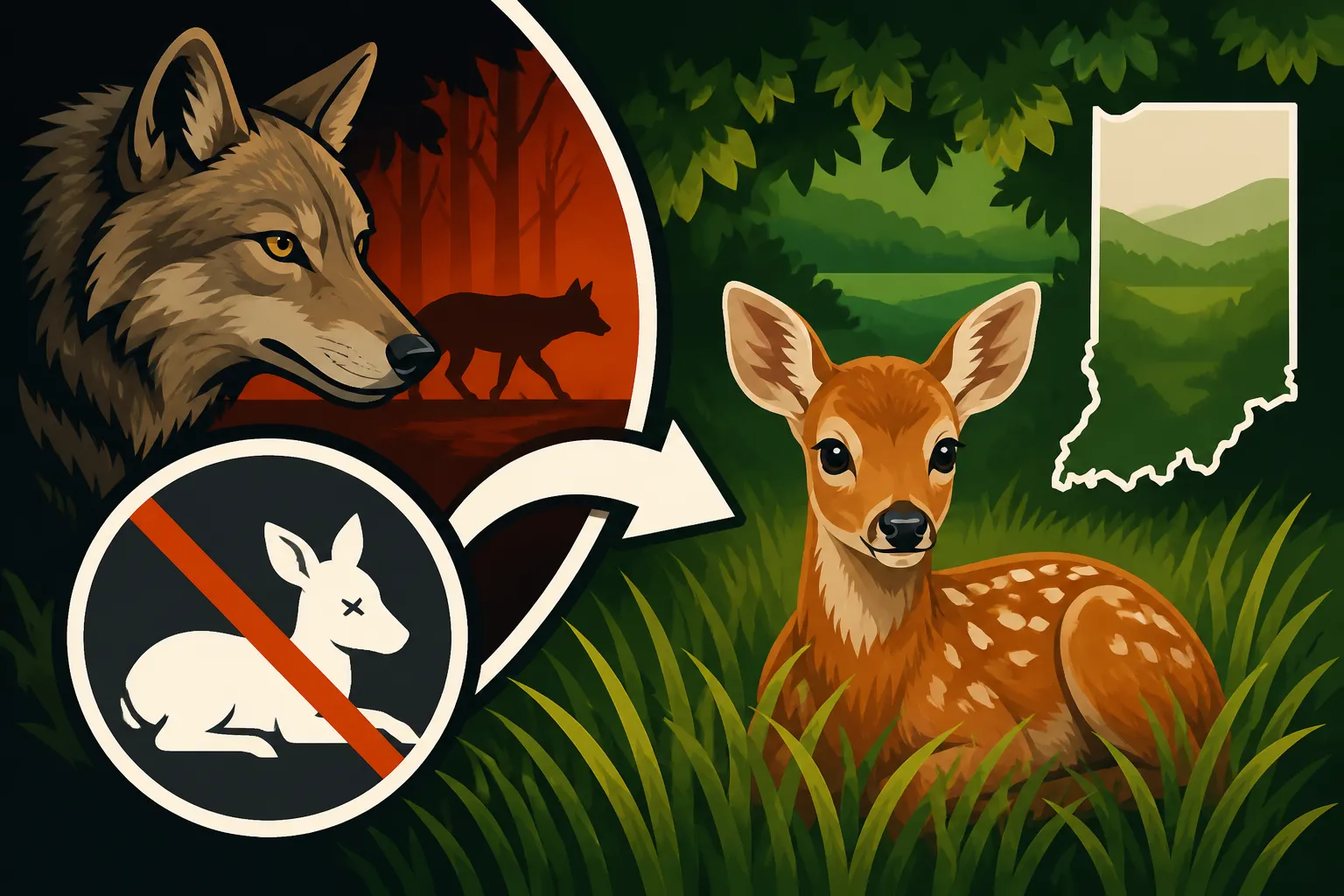
Without a doubt, the coyote stands as the number one predator of deer fawns in Indiana. These adaptable canids thrive across the entire state, from the dense timber of southern Indiana to the agricultural landscapes of the north. Coyotes are incredibly efficient hunters, and fawns represent a relatively easy meal during the spring and early summer birthing season. Research from various states, including those neighboring Indiana, consistently shows that coyotes account for a substantial percentage—often 50% or more—of all fawn mortalities. They actively seek out fawning areas, often hunting in pairs or small family units. A lone doe, even a vigilant one, struggles to defend her vulnerable offspring against determined coyotes. Their impact is so significant that fluctuations in coyote populations or their hunting pressure can directly correlate with changes in local fawn recruitment rates. Understanding their habits is key to grasping Coyotes and Predators in Indiana.
Other Predators: Bobcat, Fox, and Domestic Dogs
While coyotes are the heavy hitters, other predators certainly contribute to fawn mortality, though usually to a lesser extent. Bobcats, while less widespread and generally more reclusive than coyotes, are incredibly effective ambush predators. In areas where bobcat populations are strong, particularly in the more rugged, timbered regions of southern Indiana, they can take fawns. Their impact, however, is typically more localized. Foxes, both red and gray, are also present across Indiana. While they might occasionally take a very young or sickly fawn, their smaller size generally means they pose less of a threat to healthy, well-hidden fawns compared to coyotes or bobcats.
Perhaps surprisingly, domestic dogs, especially those allowed to roam freely, can also be a significant factor. Uncontrolled dogs, whether pets allowed to wander or truly feral packs, can harass, injure, or kill fawns. This is particularly problematic in suburban-rural interfaces where deer and human populations overlap more closely. The problem isn't always direct killing; sometimes, the stress of being chased by dogs can lead to fawns abandoning their hiding spots, making them vulnerable to other threats or causing separation from their mother, leading to starvation.
Avian Predators and Other Opportunists
You might occasionally see a bald eagle or a large hawk near a fawning area, and it's true that large raptors can potentially take a very young or weak fawn. However, their role in overall fawn mortality is generally considered minor compared to mammalian predators. Eagles are far more likely to scavenge on fawns that have already died from other causes rather than actively hunting healthy ones. Crows and other opportunistic birds might also pick at a carcass, but they aren't primary killers. Similarly, small furbearers like raccoons or opossums might occasionally find and prey on a newborn fawn, especially if it's already compromised, but these instances are rare and don't significantly impact the broader fawn recruitment numbers. The vast majority of active predation on live, healthy fawns comes from larger, terrestrial carnivores.
Measuring Predator Impact: Challenges and Findings
Understanding the exact toll predators take on Indiana's deer fawns isn't as simple as counting tracks in the mud. Biologists face significant challenges in collecting accurate data, but through dedicated research, they’ve painted a clearer picture of this complex relationship. This data is vital for wildlife managers as they work to ensure healthy deer populations for future generations of Hoosier hunters.
How Biologists Study Fawn Mortality
Studying fawn mortality is an intensive and often expensive endeavor. The primary method involves capturing newborn fawns shortly after birth (sometimes within hours) and fitting them with tiny GPS or VHF radio collars. These collars allow biologists to track the fawns' movements and, crucially, to detect mortality events. When a collar signals that a fawn has stopped moving for an extended period, researchers can quickly locate the carcass. Once found, a meticulous forensic examination begins. This often includes looking for bite marks, scat, hair, tracks, and other evidence to determine the cause of death. DNA analysis can even be used on predator saliva found on a carcass to identify the specific predator species involved. It's painstaking work, but it's the most reliable way to gather solid data on Indiana Fawn Survival Rates. Resources like GoHunt, while primarily a hunting tool, often aggregate publicly available research results and state DNR data, allowing hunters to stay informed on these important findings.
The Dynamic Nature of Predation
One of the most important takeaways from fawn mortality studies is that predator impact is rarely static. It's a highly dynamic system that changes year to year and region to region. For example, a year with excellent mast crops and lush vegetation might provide more hiding cover for fawns, potentially reducing predator success. Conversely, a drought year with sparse cover could make fawns more vulnerable. Predator populations themselves also fluctuate. A particularly harsh winter might reduce coyote numbers, leading to a temporary increase in fawn survival. Habitat fragmentation, human disturbance, and even the health of the adult doe population (a healthy doe is better equipped to protect her fawn) all factor into how effectively predators can impact recruitment. This constant flux makes long-term trend analysis crucial for wildlife agencies.
What the Data Tells Us About Indiana
While specific statewide figures on fawn mortality exclusively from predation can be hard to pin down definitively for Indiana alone without recent comprehensive, statewide DNR studies being widely published, findings from neighboring states with similar ecological profiles strongly indicate that coyotes are the dominant factor. Generally, studies show that predation, primarily by coyotes, accounts for anywhere from 40% to 70% of fawn mortalities in the first few months of life. This means that a significant portion of the fawns born each spring don't make it to fall, largely due to predation. The Indiana DNR monitors herd health and population dynamics, and while they acknowledge predation is a natural and often significant factor, they also consider habitat quality, disease (like EHD Die-Offs in Indiana Deer), and hunter harvest rates when formulating deer management strategies. Hunters using tools like GoHunt to analyze harvest data can get a localized feel for herd health, including indirect clues about recruitment, by looking at fawn-to-doe ratios in their hunting areas.
Mitigating Predator Impact: What Hunters Can (and Can't) Do
Given the significant role predators play in fawn recruitment, it's natural for hunters to wonder what, if anything, can be done to help boost deer numbers by reducing predator pressure. The answer is nuanced, involving a combination of direct action, habitat improvement, and understanding the broader ecological picture.
Predator Control Efforts and Their Effectiveness
Direct predator control, primarily through hunting and trapping coyotes, is a common response to concerns about fawn recruitment. Many hunters actively pursue coyotes, seeing it as a way to "do their part" for the deer herd. And while removing individual coyotes can certainly reduce local pressure on fawns, the effectiveness of broad-scale predator control as a long-term solution is complex and often debated. Coyotes are incredibly resilient, with high reproductive rates, and they quickly fill vacant territories. Studies have shown that for predator control to have a significant, lasting impact on deer populations, it often needs to be intensive, sustained, and cover large areas, which is difficult to achieve solely through recreational hunting. It's also important to remember that predators play a vital role in the ecosystem, helping to control other species. Trapping Indiana Furbearers and Coyote Calling in Indiana Farm Country are popular methods, but their impact on overall fawn recruitment across an entire region needs to be considered within the larger ecological context.
Habitat Management for Fawn Concealment
Perhaps the most effective way to help fawns survive, and one that hunters and landowners can directly influence, is through habitat management. Fawns are born camouflaged and rely heavily on hiding to avoid detection. Dense, thick cover provides crucial security. This means promoting areas with tall grasses, thickets, briar patches, and brushy fence rows where does can safely drop and hide their fawns. Early successional habitat, which is often rich in these types of cover, is incredibly valuable. On public lands, this might mean advocating for timber management practices that create diverse age classes of forest, including clear-cuts that eventually grow into thick, brushy areas. On private land, landowners can intentionally create and maintain these types of cover by managing timber, planting native shrubs, or letting certain areas grow wild. A fawn that is well-hidden is far less likely to become a predator's meal. Consider exploring areas with Hunting a Clear-Cut Regrowth Edge or Hunting a Brushy Fence Row at Dusk for prime fawn habitat.
The Hunter's Role in Herd Management
Ultimately, hunters play a critical role in overall deer herd management, which indirectly influences fawn recruitment. By understanding deer population dynamics and adhering to harvest guidelines, hunters help maintain a healthy, balanced herd. Overpopulation can lead to poor doe health, which can result in weaker fawns more susceptible to predation or disease. Underharvesting antlerless deer in areas with high deer densities can exacerbate these issues. Using tools like GoHunt to research local harvest data, deer densities, and habitat types can empower hunters to make informed decisions about where and how they hunt, contributing positively to local deer populations. The goal isn't necessarily to eliminate predators, which is often impossible and undesirable, but to create a robust deer herd that can withstand natural predation pressures. Being an ethical, informed hunter is one of the best ways to support healthy deer populations and, by extension, better fawn recruitment.
| Predator Species | Primary Impact on Fawns | Typical Habitat | Relative Threat Level |
|---|---|---|---|
| Coyote | High: Primary cause of direct mortality. | Statewide, adaptable to all habitats. | High |
| Bobcat | Medium: Localized impact, effective ambush. | Southern Indiana timber, dense cover. | Medium (regional) |
| Red/Gray Fox | Low: Opportunistic, targets weakest fawns. | Statewide, edges of fields and woods. | Low |
| Domestic Dog | Medium: Can harass, injure, or kill; often overlooked. | Near human habitation, rural-suburban. | Medium (localized) |
| Avian Predators | Very Low: Primarily scavengers, rarely active hunters of live fawns. | Statewide, open areas. | Very Low |
Disclaimer
This article is for general informational purposes only and does not constitute professional advice. Laws, prices and regulations vary by location and change over time. Consult a qualified professional for guidance on your specific situation.