Crossbow Scopes for Indiana Timber Ranges
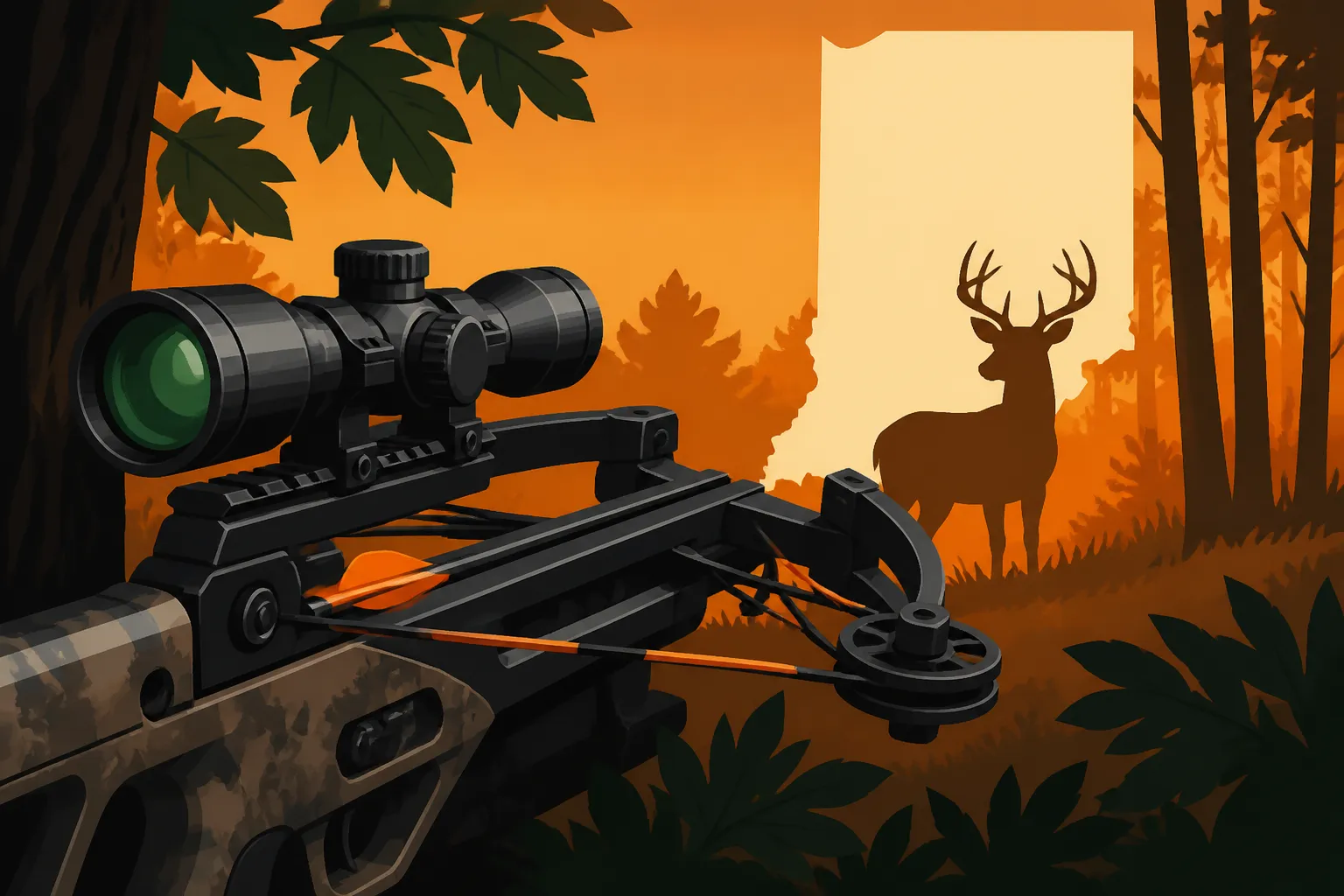
The experience of hunting whitetails in Indiana's dense timber with a crossbow is incredibly rewarding, but it comes with its own set of challenges, especially when it comes to shot placement in tight quarters. Many hunters struggle with selecting the right optics, often finding that general-purpose scopes designed for rifles or wide-open spaces simply don't cut it when a buck slips through thick cover at 25 yards. This guide aims to cut through that confusion, helping you understand what truly matters in a crossbow scope for those close-to-mid range encounters in the Hoosier woods.
The Unique Challenges of Indiana Timber Hunting with a Crossbow
Indiana's landscape offers diverse hunting opportunities, from rolling southern hills to northern farmland woodlots. However, for crossbow hunters, especially those venturing into dense timber, the environment presents specific optical hurdles that demand a specialized approach to scope selection. It’s not just about seeing the deer; it’s about making the shot count through branches and under low light.
Why Traditional Rifle Scopes Often Fall Short
Many new crossbow hunters, or those transitioning from firearms, often make the mistake of thinking a rifle scope will suffice for their crossbow. While both are optics, their fundamental design principles and intended applications differ significantly. Rifle scopes are typically designed for much higher velocities and flatter trajectories, often requiring fine adjustments for shots out to hundreds of yards. The reticles are built around rifle ballistics, which simply don't match the slower, more arcing trajectory of a crossbow bolt.
Imagine you're tucked into a treestand in Yellowwood State Forest, and a nice buck steps out at 30 yards. If your scope has too much magnification, say a 3-9x variable set on 6x or 9x, that deer can fill your field of view so much that it becomes disorienting. You might struggle to track it if it moves, or worse, you might not even be able to tell if there's a small branch just in front of its vitals because you're zoomed in too tightly. Furthermore, many rifle scopes have a parallax setting that is fixed or adjustable for much longer distances, leading to potential aiming errors at closer crossbow ranges. This mismatch in design can lead to missed shots, frustration, and ultimately, a less effective hunt. You're trying to fit a square peg in a round hole when the right tools are out there.
The Importance of a Wide Field of View in Close Quarters
In Indiana's timber, especially in areas like the Hoosier National Forest, deer can appear and disappear in a blink. They might be walking a game trail through thick underbrush, or they could emerge from a brushy creek bottom funneling into a clear-cut. In these scenarios, a wide field of view (FOV) isn't just a nice-to-have; it's absolutely critical.
A scope with a generous FOV at lower magnifications allows you to acquire targets quickly and track moving animals with ease. Think about Still-Hunting Southern Indiana Ridges – you're moving slowly, constantly scanning, and when a deer finally presents itself, it’s often a fleeting opportunity. If your scope's FOV is too narrow, you'll spend precious seconds trying to find the deer in your optic, by which time it might have vanished. This is even more vital if you're attempting a Deer Drives With Three or Four Hunters, where game can burst out quickly. Many crossbow-specific scopes are designed with this in mind, offering a broad perspective at 1x or 2x, which is ideal for shots that might be as close as 10-20 yards. A wide FOV helps maintain situational awareness, allowing you to see not just the deer, but also its immediate surroundings, which is crucial for identifying obstacles and choosing the clearest shot lane.
Dealing with Low Light and Dense Canopy
Hunting in Indiana often means being in the woods during prime deer movement hours: dawn and dusk. These are inherently low-light conditions. Add to that the dense canopy of mature hardwoods or thick pines, and you're often hunting in perpetual twilight, even midday. This is where many scopes truly falter, and a quality crossbow scope shines.
Low light performance is heavily influenced by the scope's objective lens size, lens coatings, and overall optical quality. A larger objective lens can gather more ambient light, presenting a brighter image. High-quality, multi-coated lenses reduce glare and maximize light transmission, making the image sharper and clearer when the sun is barely peeking over the horizon or has already dipped below the treetops. Imagine trying to pick out a dark brown deer against a shadowy background of tree trunks and fallen leaves just before legal shooting light ends. A cheap scope will give you a muddy, dim image, making it nearly impossible to identify your target accurately or place a shot ethically. A good crossbow scope, however, will help you discern details, define edges, and make an ethical shot even in challenging lighting. It can make the difference between packing up empty-handed and bringing home venison. This is especially true when hunting Late-Season Food Sources for Indiana Whitetails when days are short and light fades quickly.
Key Features to Look for in a Crossbow Scope
Choosing the right crossbow scope for Indiana's varied terrain means understanding the specific features that cater to the unique demands of crossbow hunting. It's not just about the price tag; it's about matching the optics to your hunting style and the conditions you'll face.
Magnification Ranges Suited for Timber
Forget about 16x or 20x magnification settings. For crossbow hunting in Indiana timber, those are almost entirely useless and often detrimental. Your typical shot ranges will be between 10 and 60 yards, with the vast majority falling under 40 yards. What you need is a low-power variable scope, usually in the 1.5-5x or 2-7x range.
A 1.5-5x scope, for instance, offers a fantastic balance. At 1.5x, you get a huge field of view for quick target acquisition on close, moving shots, allowing you to quickly acquire a deer walking through a Hunting a Funnel Between Two Woodlots. Crank it up to 5x, and you have enough magnification to precisely place a shot on a deer standing broadside at 50 yards, picking out specific hair on the shoulder. This range gives you the versatility to handle everything from an unexpected close encounter to a slightly longer, but still manageable, shot across a small clearing. The key is that the lowest power setting is truly low, providing that critical wide field of view, while the maximum power is still moderate enough to be useful without over-magnifying the target or exacerbating movement. Excessive magnification reduces light transmission and makes any slight tremor in your hold seem like an earthquake.
Reticle Design: Simplicity vs. Versatility
The reticle, or aiming point, is where much of the crossbow scope's specialization lies. Unlike simple crosshairs, crossbow reticles often feature multiple aim points designed to compensate for the bolt's trajectory at different distances.
There are generally two main types you'll encounter:
- Fixed-Power, Multi-Line Reticles: These scopes usually have a single magnification (e.g., 3x or 4x) with multiple horizontal lines or dots below the main crosshair, each corresponding to a different yardage (e.g., 20, 30, 40, 50 yards). They are simple, robust, and often very clear. The downside is that they are speed-specific, meaning they are calibrated for a certain bolt velocity. If your crossbow shoots significantly faster or slower than the scope's intended speed, your aiming points will be off. This often requires you to match your crossbow's FPS (feet per second) to the scope's calibrated speed, sometimes using a "speed ring" or adjustment.
- Variable Power, Ballistic Reticles: These scopes offer adjustable magnification, and their reticles often have multiple aiming points that automatically adjust their spacing as you change the magnification. This means you can "tune" the scope to your crossbow's velocity by adjusting the magnification until the reticle's aiming points align with known distances. This offers more flexibility, especially if you ever change arrow weights or broadheads that alter your bolt speed. Some popular models feature illuminated reticles, which can be a huge asset in low light conditions, helping your aiming point stand out against a dark background. However, too many dots or lines can clutter the sight picture, so finding a balance between versatility and clarity is key. Brands like TenPoint and Excalibur, often seen on ranges and in the woods, commonly integrate these designs into their optics.
When considering the reticle, think about the practical reality of hunting. Do you want something extremely simple and fast to use, or do you prefer the versatility of a tunable system? For most Indiana timber hunting, a clean, uncluttered reticle with clearly defined aim points for 20, 30, and 40 yards will cover 90% of your shots.
Light Transmission and Lens Quality
We touched on this earlier, but it bears repeating: light transmission is paramount in the timber. It's not just about a bright image; it's about clarity, contrast, and color fidelity. High-quality glass and advanced lens coatings work together to achieve this.
Look for scopes that boast "fully multi-coated" lenses. This means all air-to-glass surfaces have multiple layers of anti-reflective coatings, drastically reducing light loss and internal reflections. The result is a brighter, crisper image with truer colors, allowing you to distinguish antler tines from branches or differentiate a deer's vital area from its shadowy flank. A reputable manufacturer will often highlight their lens technologies. It's an investment that pays off every time you're sitting in your stand at legal shooting light, trying to discern that last-minute movement. Don't underestimate the role good glass plays when Hunting After a Poor Acorn Year and deer are moving subtly through sparse cover.
Durability and Weather Resistance for Indiana's Elements
Indiana weather is notoriously unpredictable. One day it's mild and sunny, the next it's sleeting sideways, and the next you're slogging through mud. Your crossbow scope needs to withstand all of it. Look for scopes that are advertised as "fogproof," "waterproof," and "shockproof."
- Fogproof: This means the scope's interior has been purged of air and filled with an inert gas like nitrogen or argon. This prevents internal fogging when you move from a cold outdoor environment into a warm vehicle or during rapid temperature changes afield.
- Waterproof: Critical for hunting in rain, snow, or even just high humidity. Your scope should be O-ring sealed to prevent moisture from entering the housing and affecting the optics. There's nothing worse than having your sight picture ruined by internal condensation or water droplets after an unexpected downpour while Tracking a Deer in Fresh Indiana Snow.
- Shockproof: Crossbows generate significant recoil, albeit different from a rifle. Your scope needs to be able to handle these forces without losing its zero. A well-built scope will have robust internal mechanisms designed to hold up to the repeated stress of firing, as well as the inevitable bumps and knocks that happen while traversing rough terrain, especially when you're navigating to a good Treestand Setups in Hoosier National Forest.
A one-piece aluminum tube construction is a common indicator of a durable scope. Always check the manufacturer's warranty as well; a good warranty often reflects confidence in the product's construction and longevity.
Understanding Ballistic Compensation and Rangefinding
Accuracy is everything in hunting, and with a crossbow, understanding how to compensate for bolt drop over distance is paramount. Modern scopes and accessories take a lot of the guesswork out of this, but it still requires understanding and practice.
Speed-Matched Reticles and Dialing It In
As discussed earlier, most crossbow scopes feature reticles with multiple aim points for different distances. The key to making these work effectively is "speed-matching" or "tuning" your scope to your specific crossbow and bolt combination.
Many crossbow scopes come with a "speed dial" or "speed ring" that allows you to adjust the reticle's spacing to match your crossbow's velocity. To do this, you typically set your crossbow to a known velocity (often measured with a chronograph) or you follow a specific sighting-in procedure. For example, you might sight in your top aim point at 20 yards, then shoot at 40 yards using the 40-yard aim point. If your bolt is hitting high or low at 40 yards, you adjust the speed dial on your scope until that 40-yard aim point is dead on. This adjustment effectively changes the magnification or reticle spacing so that all subsequent aim points (30, 50, 60 yards) are then calibrated for your specific setup.
This process is critical because even slight variations in bolt weight, fletching, or broadhead type can alter your crossbow's velocity and, consequently, its trajectory. Don't just assume the factory settings are perfect; dedicate time to thoroughly speed-match your scope. This attention to detail will provide immense confidence when that deer steps out at an unfamiliar distance. Consider looking up your crossbow model on a site like GoHunt for community discussions or manufacturer FAQs about optimal arrow setups and scope pairings.
Here's a simplified look at how different components impact trajectory:
| Component | Impact on Trajectory | Relevance for Scope Tuning |
|---|---|---|
| Bolt Weight | Heavier bolts drop more quickly but carry more energy. | Requires adjusting speed dial for increased drop. |
| Bolt Speed | Faster bolts have a flatter trajectory. | Direct correlation to speed dial setting on scope. |
| Broadhead | Fixed-blades can slightly alter flight vs. field points. | Always sight in with your hunting broadheads. |
| Fletching | Larger/heavier fletching can create more drag. | Minor impact, but can be a factor in speed matching. |
| String/Cables | Wear or stretch can reduce speed over time. | Regular chrono checks recommended; may need retuning seasonally. |
Integrating Rangefinders for Accuracy
Even with a perfectly speed-matched reticle, estimating distance in the woods can be incredibly difficult, especially with the undulating terrain of southern Indiana. This is where a good rangefinder becomes an indispensable tool. You might have the best reticle in the world, but if you guess a 40-yard shot is 30, you're going to miss or worse, wound a deer.
There are two main approaches to rangefinding:
- Handheld Rangefinders: These are standalone units that you carry and use to range specific targets. They are highly accurate and allow you to quickly verify distances to landmarks around your stand before a deer even appears. Many modern rangefinders also feature angle compensation, which is crucial for treestand hunting where shots are often taken at a downward angle. An angled shot at 30 yards can have the same "effective" horizontal distance as a 25-yard flat shot. Ignoring this can lead to high shots. When you're Reading a Ridge for Hoosier Forest Deer, it's vital to know the true horizontal distance.
- Rangefinding Crossbow Scopes: Some advanced crossbow scopes have integrated laser rangefinders built directly into the optic. With the press of a button, they can instantly display the range to your target directly in your sight picture and often highlight the correct aiming point for that distance. While often more expensive, these offer unparalleled speed and convenience, eliminating the need to move your head or fumble with a separate device. This can be a huge advantage when a deer suddenly steps out of heavy cover and you have only seconds to react. Many hunters, when Hunting the Rut in Early November, appreciate the speed an integrated rangefinder provides when a buck is moving quickly.
Whichever type you choose, practice with it. Range every tree, rock, and bush around your stand. When scouting with a tool like GoHunt, marking those key distances to prominent trees or game trails will help immensely when you're actually hunting. Knowing these reference points instinctively will allow you to quickly confirm a deer's distance without excessive movement.
Practical Application on Uneven Terrain
Indiana's varied topography, from the steep ravines of Brown County to the subtle swells of northern glacial till, means you'll often be taking shots on uneven ground. This is especially true when setting up a Hanging a Stand on a Southern Indiana Ridge. As mentioned, angle compensation in your rangefinder is not a luxury; it's a necessity.
When you range a deer from a treestand, the raw line-of-sight distance will be longer than the horizontal distance your bolt actually travels. A rangefinder with angle compensation (often labeled as "horizontal distance" or "true ballistic range") will give you the correct distance to use with your ballistic reticle. Failing to account for this can result in your bolt flying over the back of a deer on a steep downward shot or hitting low on an uphill shot. Practice shooting from elevated positions and different angles, even if it's just from your porch or a hill in your backyard, to truly understand how your rangefinder and scope interact. This practical experience is invaluable for building confidence in the field.
Mounting Your Scope and Field-Testing for Success
Even the best crossbow scope is only as good as its mounting and how well you know its capabilities. Proper setup and rigorous field-testing are non-negotiable for consistent accuracy.
Proper Mounting Techniques for Crossbows
Mounting a crossbow scope isn't dramatically different from mounting a rifle scope, but precision is key, especially given the recoil and vibration inherent in crossbows.
- Use Quality Rings and Base: Don't skimp here. Invest in sturdy, well-machined rings and a solid scope base that match your crossbow's rail (Picatinny or Weaver). Loose or cheap mounts are a recipe for a shifting zero and endless frustration.
- Eye Relief: This is the distance your eye needs to be from the scope's eyepiece to see a full, clear picture. With a crossbow, proper eye relief is essential for comfort and quick target acquisition. Mount the scope so that when you bring the crossbow to your shoulder, your eye naturally falls into the sweet spot for a full sight picture without having to crane your neck or lean forward. This also helps prevent scope bite – though less common with crossbows, it's still good practice.
- Leveling: Use a scope leveling kit or a bubble level to ensure your reticle is perfectly level with your crossbow's rail. An unlevel reticle will cause your point of impact to shift horizontally the further out you shoot, leading to frustrating misses. Imagine trying to shoot a deer at 40 yards with a canted reticle; your bolt will drift left or right, even if your hold is perfect.
- Torque Settings: Use a torque wrench to tighten your ring screws and base screws to the manufacturer's recommended specifications. Over-tightening can damage the scope tube or strip screws, while under-tightening can lead to the scope shifting under recoil.
- Threadlocker: A small drop of non-permanent threadlocker on base screws can prevent them from vibrating loose over time, adding an extra layer of security to your setup.
A properly mounted scope is the foundation of accuracy. If it's not mounted correctly, you'll constantly be chasing your zero, ruining your confidence and your hunt.
Sighting In and Practice at Timber-Realistic Distances
Once your scope is mounted, the real work begins: sighting in. This isn't a one-and-done deal; it's an ongoing process that requires patience and meticulousness.
Start by bore-sighting your crossbow, if possible, or get on paper at a very close range, like 10 yards. Once you're consistently hitting paper, move back to your primary zero distance, usually 20 or 30 yards. Most hunters sight in their top aim point at 20 yards. Then, using your speed-matched reticle, test each subsequent aim point (30, 40, 50, etc.).
Crucially, practice at the distances you will actually hunt. Too many hunters only shoot at 20 yards. In Indiana timber, you might have a 35-yard shot, a 45-yard shot across a clearing, or a tricky 22-yard shot through a narrow lane. Practice shooting from various positions: from a standing treestand, from your knees, sitting, and even mimicking shots from a ground blind. Use broadheads during your practice, or at least a few times, to confirm their flight characteristics are identical to your field points. Crossbow Rules During Indiana Archery Season notes the legality of crossbows, but the rules don't make you a better shot; practice does. The more you practice, the more confident you'll be when that trophy buck steps into your shooting lane.
Pre-Season Scouting and Gear Check
Your crossbow scope is an integral part of your hunting system, and it deserves a thorough check during your pre-season scouting. When you're out Scouting Indiana Public Land Before Season, don't just look for deer sign; look at your gear.
Before you ever step into the stand on opening day, take your crossbow and scope out for a final check. A few things to consider:
- Zero Confirmation: Fire a few practice bolts at varying ranges to confirm your zero hasn't shifted during storage or transport. It's not uncommon for a scope to get bumped or for screws to loosen slightly. This quick check can prevent a heartbreaking miss.
- Lens Cleanliness: Ensure your lenses are spotless. Dust, dirt, and smudges significantly reduce light transmission and clarity. Carry a lens cleaning cloth and solution specifically designed for optics.
- Battery Check: If your scope has an illuminated reticle or an integrated rangefinder, check the battery. Replace it if there's any doubt. No one wants a dead battery when legal shooting light is fading.
- Mount Security: Double-check all mounting screws for tightness.
- Rangefinder Practice: Use your rangefinder on trees and landmarks in your actual hunting area to build a mental map of distances, especially important when Finding Ground Others Walk Past where game movement might be unpredictable.
By taking the time to properly mount, sight in, and maintain your crossbow scope, you're not just investing in equipment; you're investing in successful, ethical hunting experiences in the Indiana timber. After all, when you're perched high in a tree, aiming at an elusive Hoosier whitetail, confidence in your optics is half the battle.
Disclaimer
This article is for general informational purposes only and does not constitute professional advice. Laws, prices and regulations vary by location and change over time. Consult a qualified professional for guidance on your specific situation.