Bobwhite Quail in Indiana
If you've spent any time hunting in Indiana, you've likely heard the nostalgic tales of days gone by when Bobwhite Quail coveys seemingly exploded from every field edge and fencerow. The truth is, chasing bobwhites in the Hoosier State today is a vastly different experience, often fraught with frustration as you walk miles of promising cover only to find silence. This guide aims to bring you up to speed on the reality of quail hunting in Indiana, from understanding their historical decline and current status to the best strategies for finding these elusive birds, all while navigating the current regulations and conservation efforts working to bring them back.
The Echoes of the Past: Historical Context and Decline of Indiana Quail
For many Hoosier hunters, the thought of quail evokes a wistful sigh, a longing for a time when the distinct "bob-Wight" whistle was a common sound across the landscape. The story of the Bobwhite Quail in Indiana is, unfortunately, one of significant decline, mirroring trends across much of the Midwest. To truly understand where we are today, we have to look back at the conditions that once allowed these birds to thrive and what changed.
Quail Abundance in Early Indiana
Imagine Indiana a century ago: a patchwork of small, diversified family farms. These weren't the vast monocultures we see today. Instead, fields were smaller, rotated with various crops, and often bordered by brushy fencerows, small woodlots, and overgrown pastures. This kind of landscape was an absolute paradise for Bobwhite Quail. They found everything they needed in close proximity: grain for food, dense cover for nesting and protection from predators, and open ground for dusting and foraging.
The farming practices themselves were beneficial. Less intense tillage meant more waste grain left in the fields after harvest. Hayfields provided nesting cover in spring and summer, and the natural "weeds" that grew in fallow ground or along edges were vital food sources. These conditions created a perfect mosaic of habitat – what ecologists call "edge habitat" – where different cover types met, offering a smorgasbord of resources within a small area. Coveys could move easily from feeding areas to secure roosting cover, rarely needing to expose themselves in wide-open spaces. It was a golden era for these hardy little game birds, and many older hunters still recount stories of flushing multiple coveys in a single afternoon hunt.
The Post-War Decline and Its Causes
The mid-20th century, particularly the post-World War II era, marked a dramatic turning point for Indiana's quail. Agriculture underwent a massive transformation, shifting from diversified family farms to large-scale, industrialized operations. This change was a death knell for quail. Small fields were consolidated into enormous tracts, fencerows were ripped out to accommodate larger equipment, and crop rotations often narrowed to just corn and soybeans. The critical "edge habitat" disappeared, replaced by expansive, unbroken fields that offered little food or cover for quail.
Beyond the loss of fencerows, the increased use of pesticides and herbicides stripped the land of the native grasses, wildflowers, and insects that formed the base of the quail's diet and provided vital brood-rearing cover. When quail chicks hatch, they rely heavily on insects for protein, and clean farming eliminated much of that food source. Compounding these habitat losses was an increase in predation pressure. With less suitable cover for escape and nesting, quail became more vulnerable to predators like coyotes, raccoons, and raptors. Severe winter weather, especially prolonged periods of deep snow and ice, further decimated populations that were already struggling with reduced cover and food. The cumulative effect was a precipitous decline, transforming the once-common Bobwhite Quail into a species that now requires dedicated effort and specialized habitat management to find.
A Glimmer of Hope: Current Status and Population Trends
While the stories of past abundance might make current quail hunting seem impossible, it's not entirely a lost cause. The Bobwhite Quail is still here, albeit in much lower numbers and concentrated in specific areas where habitat management is a priority. Understanding their current status is key to successful and ethical hunting.
Where Do We Stand Today?
Estimating precise statewide quail populations can be tricky, as these birds are notoriously difficult to survey accurately due to their elusive nature and often localized populations. However, the Indiana Department of Natural Resources (DNR) monitors trends through various methods, including roadside call counts and hunter harvest data. The general consensus is that Bobwhite Quail populations in Indiana remain low compared to historical levels but have shown some stability or even slight increases in localized areas with intensive habitat management. They are certainly not as widespread as they once were, and successful hunting often means traveling to specific locations known for their quail management efforts.
Most of Indiana's remaining quail strongholds are found in the southern part of the state, particularly on public lands like Fish and Wildlife Areas (FWAs) and some state forests where dedicated habitat work is ongoing. You'll also find pockets on private lands where landowners have enrolled in conservation programs. The birds are simply not able to sustain themselves in the vast agricultural landscapes that dominate much of central and northern Indiana without significant habitat intervention. When using scouting tools like GoHunt, look for these specific habitat types on the maps to increase your chances.
Factors Influencing Modern Quail Numbers
Several factors continue to influence modern quail numbers in Indiana, some echoing past challenges and others introducing new complexities. Habitat remains the undisputed king. Without sufficient acres of high-quality, interconnected habitat — a mosaic of native grasses, legumes, brushy cover, and food sources — quail simply cannot survive and reproduce effectively. The relentless pressure of modern agriculture, even with conservation efforts, means that suitable habitat often exists in isolated patches, making coveys vulnerable and hindering population expansion.
Climate change is also playing an increasingly important role. Severe winter weather events, characterized by prolonged periods of snow and ice, can be devastating to quail, making it impossible for them to find food. Conversely, extended droughts during nesting season can impact insect populations critical for chick survival. Predation, from a wider array of species now, also remains a constant threat. While always a factor, the loss of dense, secure cover makes quail more susceptible to opportunistic predators like coyotes, foxes, raccoons, opossums, and even domestic cats. The interconnectedness of these factors means that quail populations are fragile and highly dependent on active, ongoing human intervention through habitat creation and management.
Finding the Sweet Spots: Key Habitats for Bobwhite Quail in Indiana
If you're serious about finding Bobwhite Quail in Indiana, you need to become an expert at identifying their habitat. These aren't birds you stumble upon by accident in just any woodlot or field. They demand a very specific kind of landscape, and knowing what to look for is your most important scouting tool.
The Ideal Habitat Mosaic
The quintessential Bobwhite Quail habitat is a vibrant mosaic, a diverse blend of different cover types all within a short distance of each other. Think of it as a neighborhood that has everything you need within a block or two. This includes open areas dominated by native warm-season grasses like big bluestem, switchgrass, and indiangrass, which provide crucial nesting and brood-rearing cover. These grasses grow tall and clump-forming, offering excellent concealment for nests and overhead protection for chicks, while still allowing them to move easily at ground level to forage for insects.
Adjacent to these grasslands, you need areas of dense, brushy escape cover. This could be thickets of multiflora rose (though invasive, it provides excellent cover), blackberry brambles, sumac patches, or young saplings. This thorny, impenetrable cover is vital for quail to escape from aerial predators like hawks and owls, and ground predators like foxes and coyotes. It's also where coveys will huddle together to roost at night, protected from the elements and predators. Finally, the mosaic needs readily available food sources. This means areas with legumes, seeds from native weeds like ragweed or smartweed, and waste grain from agricultural fields (though less common now). The critical element is "edge habitat"—where these different types of cover meet. Quail rarely venture far into vast, uniform expanses. They thrive where food, nesting cover, and escape cover are all intertwined along a varied edge.
Recognizing Quail Habitat on Public and Private Land
While prime quail habitat is a rarity in many parts of Indiana, it's not impossible to find. Your best bet, especially for those without private land access, will be on public lands managed by the Indiana DNR. State Fish and Wildlife Areas (FWAs) are often prime candidates because many have dedicated habitat management plans that include prescribed burns, native grassland plantings, and brush management specifically designed to benefit upland game birds like quail and pheasants. Areas like Willow Slough FWA or Glendale FWA might have areas managed with quail in mind. When scouting, look for units within these properties that show a good mix of tall grasses, shrubby thickets, and open ground. Using a mapping tool like GoHunt can be incredibly helpful here. You can layer aerial photos with public land boundaries to identify promising habitat features before you even step foot in the field. Look for the distinct patterns of managed grasslands, timber edges, and brush lines. You can also leverage these mapping tools to help with your pre-season scouting on Indiana public land before the hunting season begins.
On private land, the story is similar. Quail will be found on properties where landowners are actively managing for wildlife. This often involves participation in federal programs like the Conservation Reserve Program (CRP), which pays landowners to convert cropland to native grasses and other beneficial cover, or the Environmental Quality Incentives Program (EQIP), which supports various conservation practices. These programs are vital for creating and maintaining quail habitat on private holdings. If you're seeking permission on private land, focus your efforts on landowners who seem to prioritize conservation or have visible signs of habitat management, such as fields of tall native grasses or recently planted shrubby cover. The key is to look for that diverse, interconnected habitat mosaic, whether it's on public land or a smaller, private tract. For more on finding suitable rabbit habitat, which often overlaps with quail needs, check out our guide on Rabbit Hunting Indiana Fencerows. Similarly, understanding pheasant habitat, as covered in Pheasant Hunting Indiana Grassland, can also provide insights into where quail might be found.
More Than Just a Whistle: Identifying Bobwhite Quail and Their Calls
Part of the charm, and challenge, of hunting Bobwhite Quail is their elusive nature. Knowing what to look for and, more importantly, what to listen for, is absolutely essential. These small birds can be masters of camouflage, but their distinctive calls often give them away long before you see them.
Visual Identification and Behavior
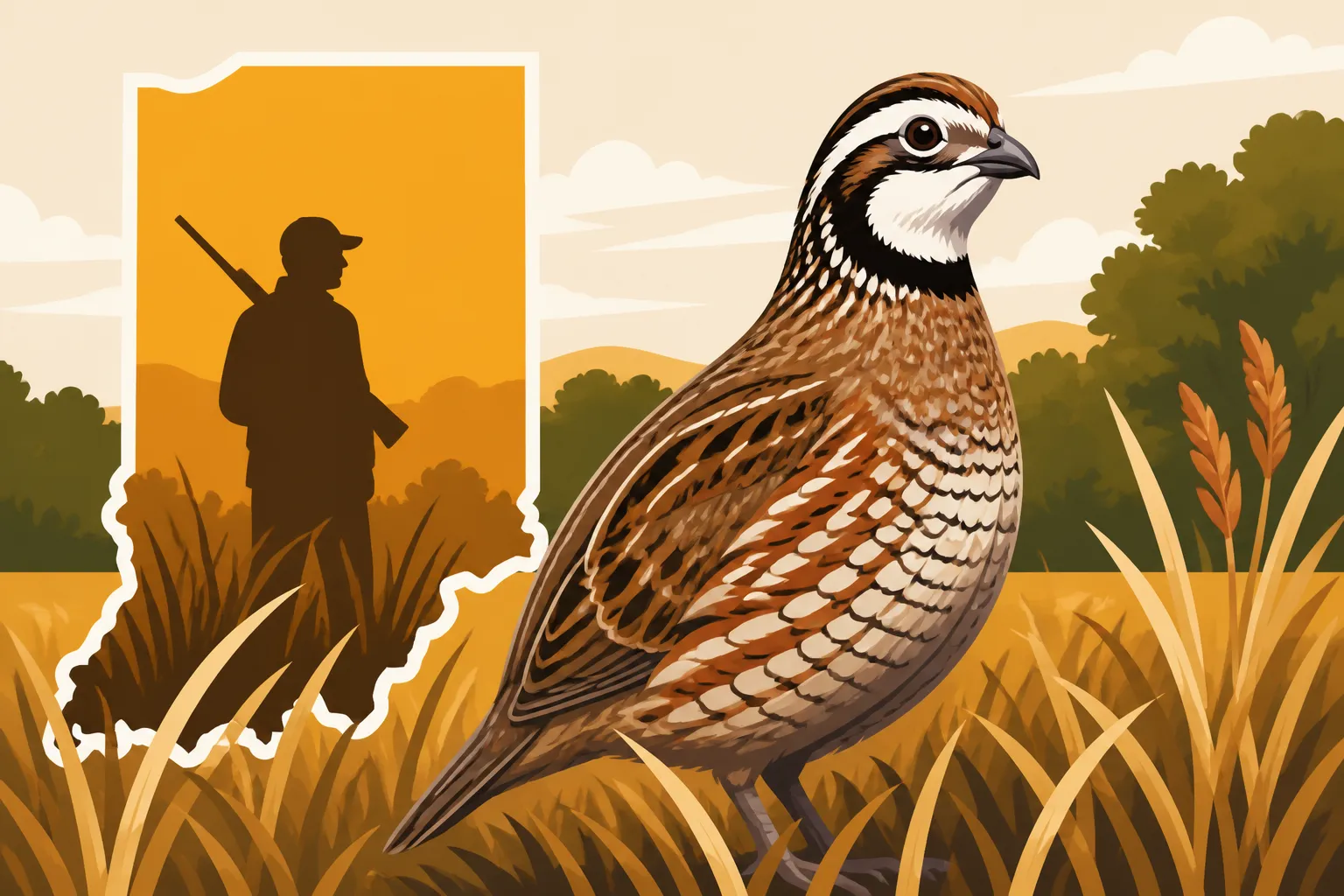
The Bobwhite Quail is a small, chunky game bird, typically weighing around 6-7 ounces and measuring about 9-11 inches in length. Their plumage is a beautiful blend of mottled browns, grays, and whites, allowing them to blend seamlessly into their grassy and brushy surroundings. The most distinctive feature is on the head: males (cocks) have a prominent white stripe above the eye and a white throat patch bordered by black, while females (hens) have a buff or yellowish-brown stripe and throat patch. Their short, rounded wings are designed for explosive, short bursts of flight, perfect for escaping danger.
Quail are primarily ground-dwelling birds. They forage for seeds and insects by scratching through leaf litter and dense vegetation. During the fall and winter, they typically live in coveys, groups of usually 8-20 birds, for warmth and protection. When flushed, a covey will explode into the air with a sudden, whirring rush of wings, scattering in all directions, often surprising even the most seasoned hunter. After the initial flush, they'll typically fly relatively short distances before plummeting back into dense cover. This scattering behavior is a key part of hunting them, as single birds are often easier to target after the covey has broken up.
Decoding the Bobwhite's Language
While spotting a quail on the ground can be tough, hearing them is often much easier. The Bobwhite Quail is named for its most famous call, a clear, two- or three-note whistle that sounds precisely like "bob-Wight" or "bob-bob-Wight." This is typically a male's territorial or advertising call, often heard in spring and early summer, but can occasionally be heard even into the hunting season. This iconic sound is a fantastic locator call, letting you know quail are in the vicinity, even if you can't see them.
Beyond the classic "bob-Wight," quail have a range of other vocalizations that hunters can learn to recognize. The "scatter call" or "covey call" is a mournful, drawn-out whistle that scattered birds use to re-group after being dispersed. It's often described as a soft, plaintive "ko-LEE-ko" or "whistle-WEE." Hearing this call after you've flushed a covey and scattered them is a good sign that they're trying to reassemble, indicating where you might find them again as singles. They also have various alarm calls, typically sharp, high-pitched peeps or chirps, given when a predator is spotted. Learning these different calls can give you a significant advantage in locating birds and understanding their behavior in the field.
The Thrill of the Flush: Hunting Strategies for Indiana Quail
Hunting Bobwhite Quail in Indiana, given their reduced numbers, is less about filling a limit and more about the experience – the hunt itself, the thrill of a covey flush, and the skill required to connect with these fast-flying birds. It's an active, engaging form of hunting that often involves plenty of walking.
Working With Bird Dogs
The most traditional and effective method for hunting Bobwhite Quail, hands down, is with a well-trained bird dog. A good pointing dog is not just a companion; it's an indispensable tool. Breeds like English Pointers, Brittanys, German Shorthaired Pointers, and English Setters are bred for this exact purpose: to range out, locate birds by scent, and then "lock up" on point, indicating the covey's location. This allows the hunter to walk in, prepare for the flush, and then hopefully get a shot.
Working with a dog adds an incredible layer of excitement and efficiency to the hunt. The dog does the hard work of covering ground and finding the birds, saving the hunter countless steps and increasing the chances of success dramatically. Once a covey is flushed and scattered, a good retrieving dog is invaluable for finding downed birds in thick cover, preventing lost game. Effective dog work also involves understanding your dog's signals, moving carefully into the point, and ensuring safety in the field, especially when hunting with others. This classic approach provides an immensely rewarding hunting experience, combining canine prowess with human skill.
Walk-Up Hunting and Small Coveys
While bird dogs are ideal, not every hunter has one. It's still possible to hunt quail effectively without a dog, though it generally requires more effort and a keen eye for habitat. This "walk-up" or "still-hunting" approach means you, the hunter, are essentially acting as the pointer, carefully covering ground and trying to jump birds. This strategy is particularly relevant in areas where coveys are smaller or more scattered, or on public lands where a dog might not be feasible for everyone.
The key to successful walk-up hunting is to move slowly and methodically through prime habitat – those edges of native grass, brushy fencerows, and thickets. Don't rush. Pause frequently, listen for calls, and scan the ground ahead for any subtle movement. Quail are masters of holding tight, often flushing at your feet, so be prepared for a sudden explosion of wings. When hunting with a partner, walking a field in a line, maintaining good spacing, can help push birds forward and increase your chances of a flush. This approach demands patience, stealth, and a deep understanding of where quail are likely to be found. For similar tactics in comparable cover, our guide on Rabbit Hunting Indiana Fencerows offers some transferable insights.
Guns, Loads, and Chokes for Quail
Choosing the right firearm and ammunition is crucial for success and enjoyment when hunting quail, especially given their small size and rapid flight. The most common choice among upland bird hunters for quail is a lightweight, fast-swinging shotgun in 20 gauge, 28 gauge, or even a .410. While a 12 gauge will certainly work, its heavier recoil and larger shot payload are often overkill for quail and can make for a less enjoyable experience over a long day of walking. The lighter gauges are quicker to shoulder and maneuver, which is essential for getting on fast-flushing birds.
For shot size, numbers 7.5, 8, or even 9 are generally preferred. These smaller shot sizes create a denser pattern, increasing your chances of hitting a small, fast-moving bird, without carrying excessive energy that would damage the meat. Non-toxic shot is not required for quail unless you're hunting specifically on certain federal lands that mandate it, so lead shot is generally permissible. As for chokes, given that most quail shots are close-range (often within 20-30 yards), open chokes are your friend. Skeet, Improved Cylinder, or even Light Modified are excellent choices, allowing for a broader pattern that is more forgiving on those quick, close flushes. Many hunters opt for an over/under or side-by-side with one barrel choked improved cylinder and the other modified, offering versatility. To compare options and understand more about shotgun choices for upland birds, you might find our guides on Best Shotgun Gauge for Indiana Pheasant and Shot Size for Pheasant and Rabbit helpful.
Staying Legal: Regulations and Season Information for Indiana Quail Hunting
Before you even think about stepping into the field for Bobwhite Quail, it's absolutely paramount to be familiar with Indiana's hunting regulations. These rules are in place not only for safety but also to manage and protect game populations, ensuring future opportunities for all hunters.
Current Season Dates and Bag Limits
The Bobwhite Quail season in Indiana typically runs from early November through mid-January. For the 2024-2025 season, based on current DNR regulations, the season opens on November 1st and closes on January 10th. However, it is critical to always check the most current Indiana Hunting & Trapping Guide published by the Indiana Department of Natural Resources (DNR) each year, as dates can shift slightly due to various management decisions.
The daily bag limit for Bobwhite Quail in Indiana is usually 4 birds per day, with a possession limit of 12 birds. This means you can harvest up to four quail in a single hunting day, and you cannot have more than twelve quail in your possession (at home, in your cooler, etc.) at any given time. These limits are set to allow for recreational hunting while preventing overharvest and contributing to the species' long-term sustainability. Hunting hours generally run from one-half hour before sunrise until sunset. Always be precise with these times, as violations can lead to serious penalties.
To help you keep track, here's a quick summary of key regulations for the upcoming season, but again, always consult the official DNR guide for the most accurate and up-to-date information:
| Category | Detail |
|---|---|
| Season Dates | November 1 – January 10 (Verify annually with DNR) |
| Daily Bag Limit | 4 Quail |
| Possession Limit | 12 Quail |
| Hunting Hours | 1/2 hour before sunrise to sunset |
| Required License | Hunting License, Game Bird Habitat Stamp, HIP Number |
| Blaze Orange | Required during firearms seasons |
| Hunter Ed | Required for most hunters born after Dec 31, 1986 |
License Requirements and Hunter Education
To legally hunt Bobwhite Quail in Indiana, you'll need several pieces of documentation. First and foremost, every hunter (unless exempt, such as very young apprentice hunters) needs a valid Indiana hunting license. For residents, this typically means a Resident Hunting License, but there are also options like the Indiana Resident Deer Bundle which includes small game privileges. Non-residents will need a Non-Resident Hunting License. Beyond the general hunting license, you must also purchase an Indiana Game Bird Habitat Stamp. This stamp directly funds habitat restoration and management efforts for upland game birds like quail, so it's a vital contribution to conservation. Finally, if you're hunting migratory game birds (which includes doves, but not specifically quail), you must also register for the Harvest Information Program (HIP) number annually. While quail are not migratory game birds, it's a good practice for anyone who hunts a variety of birds to ensure they're HIP compliant for all species.
Hunter education is another critical component. Most individuals born after December 31, 1986, are required to complete an approved hunter education course before purchasing a hunting license in Indiana. There are exceptions for apprentice hunters, but generally, this certification is mandatory. These courses cover firearm safety, wildlife identification, hunting ethics, and conservation principles, ensuring new hunters are knowledgeable and responsible afield. For more detailed information on obtaining your license or understanding the requirements, check out our guides on Indiana Resident License Options and Indiana Hunter Education Requirements.
Rules for Public and Private Land Access
Accessing hunting grounds is always a primary concern for hunters, and quail hunting is no exception. If you plan to hunt on private land in Indiana, you must obtain permission from the landowner before entering the property. Verbal permission is legally sufficient, but it's always a good idea to get it in writing if possible, especially if you plan to hunt the land multiple times. Trespassing is a serious offense, and simply seeing "no trespassing" signs isn't the only indicator; all land is considered private unless marked otherwise or officially designated public. For more on this, our guide on Indiana Property Access Permit Requirement can be very insightful.
On public lands, particularly State Fish and Wildlife Areas (FWAs) and State Forests, specific rules often apply. Many FWAs require hunters to sign in and out at designated check stations or use an online check-in system. These systems help the DNR monitor hunter pressure and harvest, and in some cases, might be tied to specific regulations for certain areas or seasons. It's crucial to always check the specific rules for the public property you intend to hunt, as they can vary. During any firearms hunting season (which overlaps with the quail season), Indiana law also mandates wearing blaze orange. You must wear at least 500 square inches of solid orange on your outer garments, worn above the waist and visible from all directions. This is a crucial safety measure that protects all hunters in the field. For a full breakdown of these requirements, see our article on Blaze Orange Requirements. Using digital mapping tools like GoHunt can help you identify public land boundaries and specific FWA regulations before you leave home.
The Path Forward: Conservation Efforts and Habitat Restoration
The good news for Bobwhite Quail enthusiasts is that their plight has not gone unnoticed. Dedicated conservation efforts are underway across Indiana, spearheaded by state agencies, federal programs, and passionate non-profit organizations. These efforts are the cornerstone of any hope for a resurgence in quail numbers.
Indiana DNR Initiatives
The Indiana Department of Natural Resources (DNR) plays a pivotal role in Bobwhite Quail conservation. Through its Division of Fish & Wildlife, the DNR implements various programs aimed at researching, managing, and restoring quail populations and their habitats. On many State Fish and Wildlife Areas (FWAs) and State Forests, you'll find active habitat management projects specifically designed to benefit upland game birds. These initiatives include large-scale plantings of native warm-season grasses and wildflowers, which provide essential nesting and brood-rearing cover, as well as crucial food sources.
Another vital tool in the DNR's arsenal is prescribed fire. Controlled burns are used to manage vegetation, remove invasive species, stimulate the growth of desirable native plants, and create the open, diverse understory that quail require. Without fire, many grassland and savanna habitats become choked with woody growth, rendering them unsuitable for quail. The DNR also conducts research and monitoring, such as call counts and population surveys, to track quail numbers and understand the effectiveness of their management strategies. These efforts are directly tied to the overall goal of reversing the decline of Indiana's Bobwhite Quail, as discussed in detail in Indiana Bobwhite Quail Decline.
Private Landowner Programs
While public lands are crucial, the vast majority of Indiana is privately owned, making private landowner involvement absolutely essential for broad-scale quail recovery. Fortunately, several federal and state programs exist to assist private landowners in creating and maintaining quail habitat. The Conservation Reserve Program (CRP), administered by the USDA Farm Service Agency, is one of the most impactful. CRP incentivizes farmers to take environmentally sensitive land out of agricultural production and plant it with long-term, resource-conserving cover like native grasses and legumes. These CRP fields often become prime habitat for quail, providing critical nesting and winter cover.
Another key program is the Environmental Quality Incentives Program (EQIP), managed by the USDA Natural Resources Conservation Service (NRCS). EQIP offers financial and technical assistance to landowners for implementing various conservation practices, which can include developing wildlife habitat, planting native species, managing brush, and improving forest health – all of which can directly benefit quail. Local DNR private land biologists and Quail Forever staff also work directly with landowners, offering expert advice and guidance on habitat improvement projects tailored to their specific property. These partnerships with private landowners are indispensable for expanding quail habitat beyond public land boundaries. For more insights into how these programs impact wildlife, our piece on Habitat Work on Indiana Wildlife Areas provides a broader context. GoHunt can also be a valuable resource for private landowners looking to understand their property's potential for habitat management and connect with relevant conservation programs.
Organizations Making a Difference
Beyond government agencies, several dedicated non-profit organizations are working tirelessly to conserve Bobwhite Quail in Indiana. Quail Forever (QF) is arguably the most prominent. QF is a national organization with local chapters composed of passionate volunteers who raise funds for habitat projects specifically within their communities. These chapters work directly with landowners, provide technical assistance, organize habitat workday events, and educate the public on the importance of quail conservation. Their model focuses on putting funds directly into local habitat projects, ensuring that dollars raised in Indiana stay in Indiana to benefit Hoosier quail.
These organizations also play a vital role in advocacy, educating policymakers and the public about the needs of quail and other upland game birds. They emphasize the ecological benefits of healthy quail populations, such as insect control and overall ecosystem health, not just their value as a game species. By supporting these groups through membership, donations, or volunteer work, hunters and conservationists alike can directly contribute to the future of Bobwhite Quail in Indiana, helping to ensure that the distinctive "bob-Wight" whistle isn't just an echo from the past, but a call heard by future generations.
What Lies Ahead: Future Outlook for Indiana's Bobwhite Quail
The future of Bobwhite Quail in Indiana is a complex picture, marked by both persistent challenges and the glimmer of hope offered by ongoing conservation efforts. It's a journey that requires continued dedication from all stakeholders.
Challenges on the Horizon
Despite the valiant efforts of conservationists, significant challenges continue to loom over Indiana's Bobwhite Quail populations. The most formidable of these remains the relentless pace of modern agricultural development. As farming practices continue to emphasize large-scale monoculture and efficiency, the remaining fragmented pieces of suitable habitat are constantly under threat. The economic pressures on landowners often make it difficult to justify setting aside valuable acreage for wildlife habitat, even with incentive programs. This ongoing habitat loss and fragmentation continue to be the primary limiting factor for quail recovery.
Climate variability also presents a growing concern. Increasingly unpredictable weather patterns, including more frequent severe winters with prolonged snow and ice, or extended summer droughts, can have devastating impacts on quail survival and reproductive success. These environmental stressors hit already fragile populations particularly hard. Furthermore, funding for conservation efforts, while crucial, can be inconsistent. State and federal budgets fluctuate, and relying solely on grants and programs can create an unstable foundation for long-term recovery plans. The continued need for public awareness and hunter participation is also a challenge; without a broad base of support, conservation initiatives can lose momentum.
The Role of the Hunter in Quail Conservation
For many, hunting is far more than just a recreational pursuit; it's a deep connection to the land and a powerful motivator for conservation. When it comes to Bobwhite Quail in Indiana, the hunter's role in their future is absolutely critical. First and foremost, hunters are often the first to notice changes in wildlife populations and habitat. Reporting your observations of quail (or the lack thereof) to the DNR can provide valuable data for population monitoring and management decisions. Ethical hunting practices, including adhering strictly to bag limits and season dates, are paramount to ensure that current harvest levels remain sustainable and do not impede recovery efforts.
Perhaps most importantly, hunters are a primary funding source for wildlife conservation. When you purchase your Indiana hunting license and Game Bird Habitat Stamp, those funds are directly channeled back into habitat projects, research, and law enforcement that benefit quail and other wildlife. It's a user-pays, user-benefits model that has been incredibly successful for wildlife management across the country. Beyond license fees, actively supporting organizations like Quail Forever through membership, donations, or volunteering your time for habitat workdays directly translates into on-the-ground improvements. By staying engaged, advocating for conservation-friendly land use, and sharing the passion for these incredible birds, hunters become indispensable stewards of Indiana's Bobwhite Quail, helping to secure their place in the Hoosier landscape for generations to come.
Disclaimer
Please remember that hunting regulations, season dates, and bag limits are subject to change. Always consult the most current Indiana Hunting & Trapping Guide published by the Indiana Department of Natural Resources (DNR) before planning any hunting trip. This guide is for informational purposes only and should not be considered a substitute for official legal documents or expert advice.