Chronic Wasting Disease in Indiana Deer
There’s nothing quite like the feeling of watching a magnificent Indiana whitetail through your scope or across your bow sight, is there? We spend countless hours scouting, practicing, and pouring over maps, all for those precious moments afield and the venison that fills our freezers. But lately, there’s been a shadow creeping into conversations around deer camp and online forums: Chronic Wasting Disease. It’s a frightening topic, full of uncertainty and confusing regulations, and it leaves many of us feeling uneasy about the deer herd we cherish. This guide is here to cut through the noise, validate those concerns, and give you a clear, realistic understanding of CWD in Indiana, what it means for you as a hunter, and how we can all work together.
Understanding Chronic Wasting Disease
Let's be honest, hearing the words "Chronic Wasting Disease" can send a shiver down any deer hunter's spine. It's a heavy topic, and the scientific jargon often makes it feel even more daunting. But understanding what CWD is, and just as importantly, what it isn't, is the first step in navigating this challenge for Indiana's deer herd and our hunting traditions.
What Exactly is CWD?
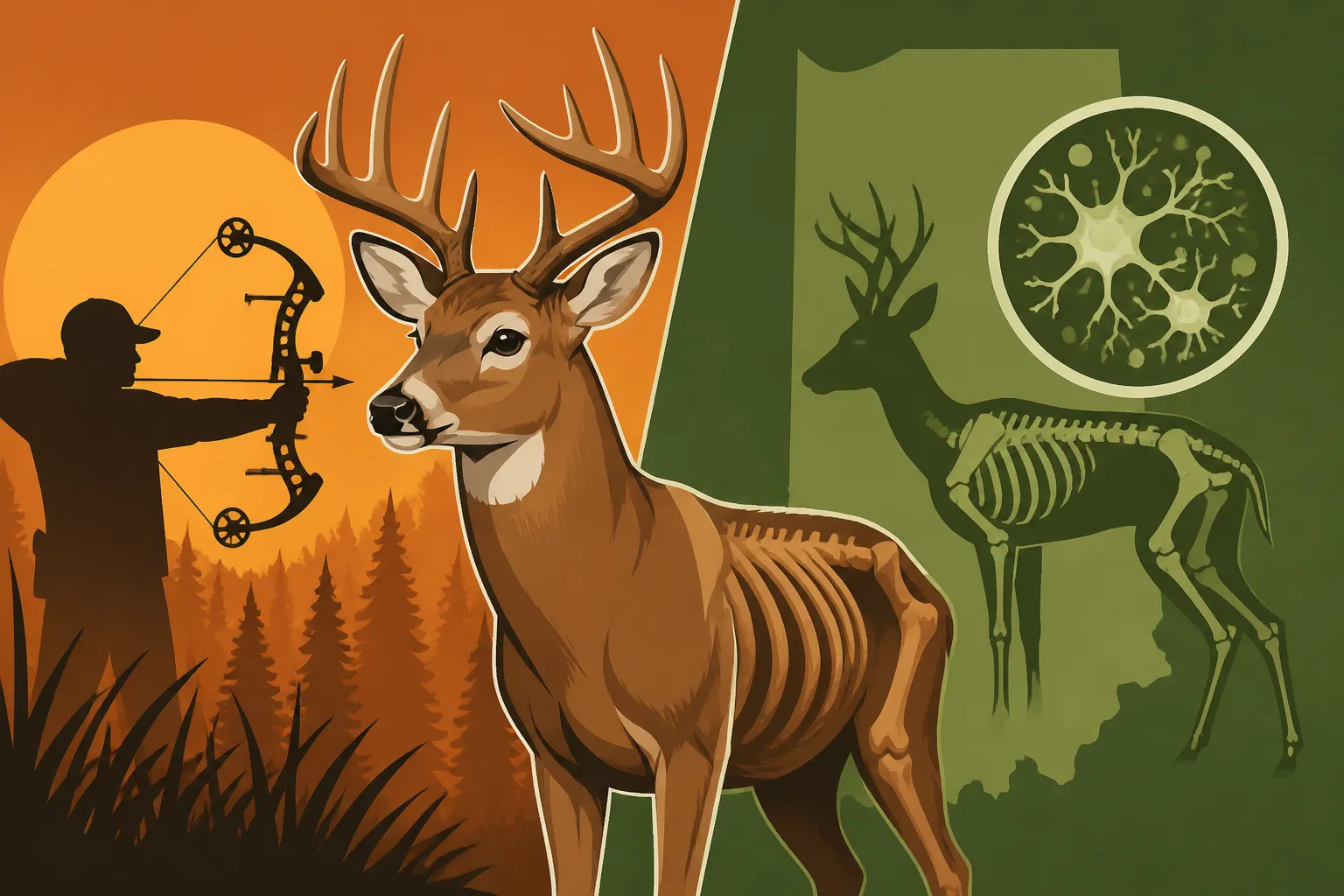
At its core, Chronic Wasting Disease is a neurological disease that affects cervids, which include deer, elk, moose, and caribou. It's caused by abnormal proteins called prions. Now, don't let "prions" throw you off too much – think of them as misfolded proteins that cause other, normal proteins in the brain to misfold too. Over time, these misfolded proteins accumulate, damaging brain tissue and essentially creating microscopic holes, like a sponge. This damage progressively impairs the animal's brain function, leading to a slow, inevitable decline.
The symptoms are heartbreaking to witness. Deer afflicted with CWD typically become emaciated, hence the "wasting" in the name, despite continuing to eat. They might exhibit abnormal behaviors such as listlessness, a loss of fear of humans, excessive drooling, and a general lack of coordination. It's a slow, agonizing process, and critically, it is always fatal. There is no vaccine, no cure, and once an animal contracts CWD, its fate is sealed. It's very different from something like EHD (Epizootic Hemorrhagic Disease), which often causes rapid death in deer and is transmitted by biting midges, not prions. While EHD can cause significant localized deer die-offs, CWD is a long-term, insidious threat to the herd's overall health and longevity. It's scary because it means every deer taken from an affected area carries a potential question mark.
How CWD Spreads Among Deer
This is where things get really tricky for us as hunters, because CWD isn't just about direct contact. The disease spreads through the bodily fluids of infected animals – saliva, urine, feces, and even blood. So, imagine a sick deer drooling on vegetation or urinating in a common deer trail. Other deer come along, graze on that vegetation, or simply interact with that contaminated environment, and the prions can be ingested. This indirect transmission is a massive concern.
Beyond direct contact, the environment itself becomes a reservoir for prions. These abnormal proteins are incredibly resilient; they can persist in the soil for years, even decades, and be taken up by plants. This means that even if all infected deer were somehow removed from an area, the ground itself could remain infectious. This environmental persistence makes CWD a fundamentally different challenge than other wildlife diseases. Add to this the natural social behaviors of deer – congregating at food plots, mineral sites, scrape lines, and especially artificial feeders – and you have a perfect storm for transmission. These areas, which we often create to attract deer for hunting or observation, can unfortunately become hotbeds for CWD spread by bringing deer into close, prolonged contact with each other and with contaminated soil. The higher the deer density, the greater the chances of transmission and faster spread.
CWD and Human Health Concerns
Now, let's talk about the big elephant in the room: can humans get CWD? This is, understandably, the most pressing concern for many hunters who rely on venison to feed their families. The official stance from public health agencies, including the Centers for Disease Control and Prevention (CDC), is that "to date, there is no strong evidence of CWD transmission to humans." That's reassuring, but it's often followed by a critical caveat: "however, animal studies suggest CWD poses a risk to humans and that it is important to prevent human exposures." This leads to what's called the "prudent avoidance" principle.
What does "prudent avoidance" mean in plain English? It means that out of an abundance of caution, public health and wildlife agencies recommend not consuming meat from CWD-positive animals. It's about minimizing any potential risk, even if it hasn't been definitively proven. For us hunters, this is a gut punch. You invest all that time, money, and effort into a hunt, and the last thing you want is a question mark hanging over the venison you worked so hard for. It puts us in a tough spot, wanting to be responsible and safe, but also deeply valuing our harvest. This is precisely why understanding and participating in testing protocols is so vital.
The Arrival and Spread of CWD in Indiana
It’s easy to think of CWD as "something that happens somewhere else," but for Hoosier hunters, that changed when the disease officially landed on our doorstep. The first confirmed cases marked a turning point, ushering in new realities for deer management and hunting in our state.
Indiana's First Documented Cases
Indiana's deer herd maintained a clean bill of health regarding CWD for many years, even as it spread in neighboring states. Unfortunately, that changed in 2021 when the first confirmed case of CWD was detected in a wild deer harvested in LaGrange County, right up in the northeast corner of the state. This discovery immediately triggered increased surveillance and concern. Just a year later, in 2022, another positive deer was found, this time in Noble County, which sits adjacent to LaGrange. These initial detections weren't isolated incidents; they confirmed that the disease had indeed established a foothold within our wild deer population.
These first cases weren't a huge surprise to wildlife biologists, who had been monitoring CWD's gradual spread in the Midwest for years. Experts believe CWD most likely entered Indiana through the natural movement of infected deer from Michigan, which has had CWD for some time, or possibly from Ohio. Deer don't recognize state lines, after all. The initial response from the Indiana Department of Natural Resources (DNR) was swift, implementing enhanced surveillance efforts in the affected and surrounding counties. This involved increasing the number of deer tested, encouraging hunters to submit samples, and educating the public about the disease, setting the stage for the regulations we see today in the CWD Positive Area.
The Expanding CWD Positive Area
Following those initial detections, the Indiana DNR quickly established a CWD Positive Area. Initially, this area encompassed LaGrange and Noble counties. However, as surveillance continued and more positive cases were found, the area has expanded. Today, the CWD Positive Area officially includes LaGrange, Noble, Steuben, DeKalb, Franklin, and Rush counties. These aren't just arbitrary lines on a map; they represent where CWD has been detected or where the risk of spread is considered highest due to proximity to known cases. You can always check the latest map on the Indiana DNR website or through their Indiana DNR App for the most up-to-date information.
The expansion, particularly into Franklin and Rush counties further south, indicates that the disease isn't static. It highlights the challenge of containing a disease that spreads through natural deer movement and environmental contamination. The expansion of the CWD Positive Area, especially when Noble County expanded the CWD Positive Area, naturally means increased scrutiny and regulations for hunters in those specific regions. While hunters across the state need to be aware of CWD, those pursuing deer in these designated counties face specific, mandatory requirements designed to slow the spread and gather critical data. This means more than just being informed; it means adapting your hunting plans to comply with these vital efforts.
How Indiana Monitors CWD
The Indiana DNR has been actively monitoring for CWD since 2002, long before the first case was found, recognizing the potential threat. Now that it's here, their efforts have intensified considerably. This monitoring is primarily conducted through a statewide surveillance program that involves testing thousands of deer samples annually. These samples are collected in a few key ways:
- Voluntary Hunter Submissions: Hunters are encouraged, and in some areas, required, to submit deer heads for testing. This is a crucial source of data, as it covers a wide geographical area.
- Targeted Surveillance: The DNR focuses additional efforts in and around known CWD positive areas, and in high-risk areas identified through modeling or proximity to other states with CWD.
- Reporting of Sick Deer: Public reports from landowners, hunters, and citizens about deer exhibiting CWD symptoms are followed up by DNR staff, who collect and test samples from these animals.
These efforts involve setting up specific Indiana CWD Testing for Hunters stations during deer seasons, collaborating with local taxidermists and processors to collect samples, and utilizing dedicated wildlife health staff. All these samples are sent to approved laboratories for testing. The goal is two-fold: to detect any new cases as early as possible and to track the prevalence and geographical spread of the disease. This comprehensive approach is vital because the more data we have, the better equipped the DNR is to make informed management decisions to protect Indiana's valuable deer resource.
Mandatory Testing and Carcass Restrictions
Hunting within a CWD Positive Area in Indiana comes with a distinct set of responsibilities that go beyond the usual licensing and tagging. These regulations are designed to minimize the risk of spreading the disease, and as hunters, it's our duty to understand and adhere to them.
Rules for Hunting in a CWD Positive Zone
If you plan on hunting in one of the designated CWD Positive Area counties – currently LaGrange, Noble, Steuben, DeKalb, Franklin, or Rush – there are specific, mandatory requirements you absolutely must follow. The most significant of these is mandatory CWD testing for any deer you harvest within these zones. You can't just harvest a deer, check it in, and head home as usual; the carcass must be sampled. This typically involves submitting the deer's head, or sometimes specific lymph node samples, to a designated CWD sampling station or a participating taxidermist or deer processor within the CWD Positive Area. The Indiana DNR maintains lists of these locations, which are regularly updated on their website and often via the Go Outdoors Indiana platform.
The process usually involves filling out a form with your contact information, where the deer was harvested, and your deer confirmation number. The DNR staff or authorized agent will then collect the necessary tissue sample. It's a bit of extra effort, yes, but it's absolutely crucial for tracking the disease. You want to know if the deer you harvested tested positive, and you want to know fast, especially if you plan to consume the venison. Turnaround times can vary, so it's always a good idea to check with the DNR or the sampling station about expected wait times for results. This mandatory testing is a cornerstone of Indiana's strategy to understand and hopefully contain the disease, and our participation as hunters is invaluable.
Understanding Carcass Movement Restrictions
Another critical component of CWD management, particularly in the CWD Positive Area, involves strict Indiana Carcass Movement Restrictions. The rationale behind these rules is simple: the brain, spinal cord, lymph nodes, and certain other tissues of an infected deer contain the highest concentrations of CWD prions. If these parts are transported outside the CWD Positive Area and improperly disposed of, they could introduce the disease to new, currently unaffected regions. This is a very real threat, as prions are notoriously resilient in the environment.
So, what does this mean for you? If you harvest a deer in one of the CWD Positive Area counties, you are generally prohibited from transporting the entire carcass, or certain high-risk parts, out of that designated zone. However, there are specific exceptions for processed meat, deboned meat, cleaned skull plates (antlers attached), cleaned antlers, capes (without skull plate or spinal column attached), and hides. Essentially, you need to ensure that the parts most likely to harbor prions remain within the CWD Positive Area or are disposed of properly there. This often means field dressing your deer on-site, or taking it to a local processor within the zone that understands and complies with these rules. It can certainly add a layer of logistical planning to your hunt, especially if you live far from these counties, but it's a necessary step to protect the broader Indiana deer herd.
Navigating Voluntary Testing Outside the Positive Area
While mandatory testing is confined to the CWD Positive Area, the Indiana DNR strongly encourages voluntary testing for deer harvested in all other counties across the state. Why? Because early detection is absolutely critical to slowing the spread of CWD. If the disease emerges in a new county, the sooner it's identified, the better the chances of containing it before it becomes widespread. Think of it as a proactive measure, a form of collective vigilance that benefits the entire hunting community and deer population.
Many taxidermists and deer processors outside the CWD Positive Area participate in the voluntary surveillance program, offering a convenient way to submit a sample when you drop off your deer. Alternatively, the DNR often sets up various drop-off locations, particularly during the peak of deer season. The best part is that you can get free CWD testing for your deer by participating in this program. This is a small investment of your time that yields huge benefits in terms of data collection and herd health monitoring. Tools like GoHunt or the official Indiana DNR website and app are excellent resources for finding specific sampling locations near you. By taking advantage of these opportunities, you're not just getting peace of mind; you're playing a direct and important role in the long-term health of Indiana's whitetails.
Practical Implications for Indiana Hunters
CWD isn't just a concern for wildlife biologists; it has very real, tangible impacts on how we approach our hunts, process our deer, and manage our properties. Adapting to these new realities is part of being a responsible Hoosier hunter.
Processing Your Deer in a CWD Area
Processing a deer harvested in a CWD Positive Area requires a bit more thought and care than usual. If you typically take your deer to a commercial processor, it's absolutely crucial to choose one that is aware of and compliant with CWD regulations. Don't be afraid to ask them about their protocols: Do they participate in the CWD surveillance program? How do they handle and dispose of high-risk tissues from deer harvested in the CWD Positive Area? Many reputable processors will have clear answers and procedures in place. Some might even be sampling agents themselves, making the testing process seamless.
For those of us who prefer to process our own deer at home, there are additional considerations. The goal is to minimize contact with and the spread of high-risk tissues, such as the brain, spinal cord, and lymph nodes. This might mean adapting your field dressing technique to be more meticulous in the woods, or even opting for a gutless method to leave the internal organs at the harvest site. If you plan to transport the boned-out meat out of the CWD Positive Area, ensure all bone and nervous system tissue is removed. Always use separate knives and cutting surfaces for CWD-positive animals if you process multiple deer. After processing, thoroughly clean and sanitize all tools, surfaces, and hands. It's an extra step, but it protects both your future harvests and the deer herd.
Safe Handling and Disposal of Carcasses
Proper disposal of deer carcasses, especially from areas with CWD, is paramount to preventing the disease's spread. Remember, CWD prions are incredibly persistent and can remain infectious in the soil for years. Simply dumping a carcass in a roadside ditch or an unapproved area is a massive no-no and could inadvertently introduce CWD to a new location. Within the CWD Positive Area, or if your deer tests positive, you have limited, but critical, options for carcass disposal.
The preferred methods usually include burying the carcass deep on private land (check local ordinances first) or disposing of it in an approved, permitted landfill. The Indiana DNR often designates specific CWD carcass drop-off points within or near the CWD Positive Area during the hunting season. These sites are equipped to handle and dispose of carcasses in a way that minimizes prion contamination. It's a good idea to check the DNR website or call ahead to verify disposal options before you head out hunting in an affected zone. Beyond the carcass, also think about cleaning your tools and any surfaces that came into contact with the deer. Simple bleach solutions can degrade prions, but thorough cleaning is key. Proper disposal is perhaps the single most impactful action a hunter can take to prevent further spread of CWD.
Impact on Hunting Practices and Deer Management
CWD isn't just changing how we handle carcasses; it's influencing broader deer management strategies and may even shift our individual hunting practices. One of the most common management responses to CWD detection is often an increase in recommended antlerless harvest in affected areas. The logic here is to reduce deer densities, which in turn can help slow the rate of disease transmission by reducing close contact between animals. So, if you're hunting in a CWD Positive Area, you might find more opportunities for Filling an Antlerless Tag in a Reduction Zone or simply a greater emphasis on doe harvest.
Another significant impact is the strong discouragement, and in some cases, outright prohibition, of baiting and feeding deer. While many hunters use feeders or mineral blocks to attract deer, these practices concentrate animals, creating ideal conditions for CWD to spread. If multiple deer are eating from the same pile of corn or licking the same mineral block, the chances of prion transmission skyrocket. As hunters, we need to be mindful of this and consider the potential risks of such practices, opting instead for natural food plots or focusing on scouting for Late-Season Food Sources for Indiana Whitetails. When Scouting Indiana Public Land Before Season, always keep an eye out for any deer exhibiting signs of illness, not just CWD symptoms, and report them to the DNR. Our individual choices, multiplied across the hunting community, have a profound effect on the health of the entire deer population.
What Hunters Can Do to Help
It's easy to feel helpless when faced with a disease like CWD, but as Indiana hunters, we are on the front lines of defense. Our actions, collectively and individually, are absolutely essential in the fight to mitigate its spread and protect our cherished deer herd.
Reporting Sick or Dead Deer
This might be the most straightforward yet critical action any hunter or outdoor enthusiast can take. If you see a deer that looks sick, trust your gut. Deer infected with CWD might exhibit a range of symptoms, including extreme weight loss (wasting), lethargy, abnormal drooling, stumbling, a lack of coordination, or a general loss of fear of humans. These symptoms aren't unique to CWD, as other diseases can cause similar signs, but any deer showing such signs warrants a report.
The importance of reporting these observations cannot be overstated. Early detection of CWD, especially in new areas, provides wildlife managers with the best chance to implement targeted strategies to slow its spread. If something looks off with a deer you encounter, do not approach or handle the animal unnecessarily. Instead, immediately contact the Indiana DNR. You can usually find a dedicated wildlife health line or a general reporting number on their website. Be prepared to provide specific details like the exact location, the date and time of your sighting, and a description of the deer's condition and behavior. This information is invaluable to DNR biologists in their ongoing surveillance efforts.
Supporting DNR Surveillance Efforts
Beyond reporting sick deer, actively participating in the Indiana DNR's surveillance program is another pillar of CWD management. This means participating in voluntary and, if applicable, mandatory CWD testing. When you harvest a deer, especially in counties where CWD is a concern or where the DNR is conducting enhanced surveillance, please consider submitting a sample. Many times, you can donate a deer head for sampling at specific drop-off locations or through participating taxidermists and processors. The DNR often provides free CWD testing for these samples, which not only gives you peace of mind about your venison but also provides crucial data points for the state's CWD map.
Understanding and diligently following all CWD-related regulations, such as Indiana Carcass Movement Restrictions and mandatory testing requirements in positive areas, directly contributes to containment efforts. While these rules might feel like an inconvenience, they are put in place for a very good reason: to prevent the physical transfer of prions to new locations. Utilize tools like the Indiana DNR App to quickly find sampling locations, report observations, and stay up-to-date on regulations. Our collective cooperation is the bedrock of any successful CWD management strategy.
Preventing the Spread on Your Own Property
If you hunt or manage private land, you have a unique opportunity to directly influence CWD prevention efforts. One of the most impactful actions you can take is to eliminate or significantly reduce practices that unnaturally concentrate deer. This means rethinking artificial attractants like feeders, mineral blocks, and bait piles. While these might seem harmless, they force deer into close, prolonged contact, increasing the likelihood of nose-to-nose contact and direct transmission of prions. Furthermore, they can contaminate the immediate environment with saliva and urine, creating long-term prion hot spots.
Instead of artificial attractants, consider implementing natural habitat improvements that provide food and cover throughout the year. Planting native food plots, improving browse opportunities, or undertaking timber stand improvements can provide ample nutrition without the heightened risk of disease transmission. If you harvest a deer on your property, ensure proper carcass disposal according to DNR guidelines, whether that's deep burial on-site or transport to an approved disposal facility. By making these thoughtful choices on your own ground, you contribute directly to the health of the deer herd and reduce the chances of CWD establishing or spreading within your local area.
Future Outlook and Long-Term Strategies
CWD is not a problem that will simply go away. It’s a long-term challenge that requires ongoing vigilance and adaptive strategies from both wildlife managers and the hunting community. Understanding the road ahead helps us prepare and remain active participants in protecting Indiana's deer.
Research and Management Strategies
The scientific community is tirelessly working on understanding CWD better, but it's a tough nut to crack. Currently, there are no vaccines or treatments available for CWD in infected deer, making prevention and containment the primary focus of management. Research continues into everything from understanding prion behavior in the environment to developing more rapid and accurate testing methods. The Indiana DNR, like wildlife agencies across the nation, relies on the latest scientific findings to inform its management strategies.
These strategies are often adaptive, meaning they can change as new information becomes available or as the disease progresses. Long-term goals for Indiana typically include containing the disease within its current footprint, reducing its prevalence in affected areas, and preventing its spread to new counties. This might involve continued mandatory testing, targeted removals of deer in high-prevalence areas, and ongoing public education campaigns. It's a complex puzzle, and the DNR's approach will continue to evolve, hopefully leading to more effective tools and techniques in the years to come.
The Importance of Hunter Participation
I cannot stress this enough: without the active and informed participation of Indiana hunters, containing CWD is an uphill battle, if not impossible. We are the largest group of individuals interacting directly with the deer herd, and our collective actions—or inactions—have a profound impact. From submitting samples for testing and adhering to carcass movement restrictions to reporting sick animals and making responsible choices about baiting, every hunter plays a crucial role.
This isn't just about compliance with regulations; it's about a shared sense of stewardship for the wildlife resource we all cherish. The social responsibility of hunters in the face of CWD is immense. By working alongside the Indiana DNR, staying informed, and adapting our practices, we become essential partners in maintaining healthy deer populations for generations to come. When you learn about the Indiana Deer Population Estimate and the health of the herd, remember that your actions contribute to those numbers.
What to Expect Going Forward
Realistically, hunters in Indiana should expect CWD to remain a persistent challenge. It's highly likely that over time, the CWD Positive Area may expand to include more counties as the disease slowly spreads through natural deer movements. This means continued vigilance and adaptability will be key. We can anticipate ongoing mandatory testing requirements in designated zones, and possibly expanded testing efforts in new areas as CWD emerges.
Regulations regarding carcass movement and disposal are also likely to remain in place and potentially become more stringent if the disease spreads widely. The goal is always to slow the spread and minimize its impact, but it's important to have realistic expectations about the difficulty of eradicating a prion disease once it's established in a wild population. Staying informed through official Indiana DNR channels, subscribing to their newsletters, and regularly checking the Indiana Deer Season Structure Explained for updates will be more important than ever. While this might sound daunting, the resilience and dedication of Indiana's hunting community give me hope that we can face this challenge head-on and continue to enjoy our hunting heritage for many years to come.
CWD and EHD: Key Differences for Hunters
It's common for hunters to confuse CWD with Epizootic Hemorrhagic Disease (EHD) because both can lead to deer deaths. However, they are fundamentally different diseases with distinct causes, symptoms, and implications. Understanding these differences is crucial for accurate reporting and understanding the health of our deer herd.
| Feature | Chronic Wasting Disease (CWD) | Epizootic Hemorrhagic Disease (EHD) |
|---|---|---|
| Cause | Misfolded proteins (prions) | Virus (transmitted by biting midges) |
| Transmission | Direct contact, bodily fluids, environmental (soil) | Insect-borne (biting midges) |
| Fatality | Always fatal, slow progression (months to years) | Often fatal, rapid progression (days to weeks) |
| Symptoms | Progressive wasting, lethargy, drooling, abnormal behavior, loss of fear, uncoordinated movement | High fever, swelling of head/neck/tongue, internal bleeding, lameness, often found near water |
| Seasonal Pattern | Year-round, no specific seasonal peak | Late summer/early fall, typically after a midge hatch and drought |
| Human Health Risk | No strong evidence, but "prudent avoidance" advised | No known risk to humans |
| Carcass Handling | Strict restrictions in positive areas due to prion persistence | Less concern for carcass, but report large die-offs |
| Environmental | Prions persist in environment for years | Virus does not persist long in environment |
| Recovery | None | Some deer can recover and develop immunity |
This table highlights why CWD demands a different management approach. While both are serious for deer, CWD's persistence and slow, insidious nature make it a unique, long-term threat to the integrity of the deer herd itself, extending beyond seasonal outbreaks.
Disclaimer
The information provided in this guide is for general informational purposes only and is based on current understanding and publicly available data. Wildlife regulations, including those pertaining to Chronic Wasting Disease, can change. Always consult the official Indiana Department of Natural Resources (DNR) website and current hunting regulations for the most accurate and up-to-date information before hunting.