Hunting Northern Indiana Farmland
Hunting in northern Indiana can feel like a completely different world compared to the big timber of the Hoosier National Forest. Instead of vast, unbroken woods, you're often staring at endless rows of corn and soybeans, dotted with small, isolated woodlots or fencerows. This unique landscape presents its own set of frustrations and challenges for deer hunters, from securing access to understanding how whitetails navigate such an open environment. This comprehensive guide is designed to equip you with the knowledge and strategies you'll need to successfully pursue deer in the agricultural heartland of northern Indiana, helping you unlock the secrets of these often-overlooked hunting grounds.
Understanding the Northern Indiana Farmland Landscape
When you think of deer hunting, vast forests and rugged terrain often come to mind. But northern Indiana's landscape is predominantly agricultural, a patchwork of fields interspersed with small woodlots, creek bottoms, and fencerows. This isn't the southern Indiana hills; it's a flat, often windswept expanse where deer behave differently, and successful hunting requires a nuanced approach that acknowledges these unique characteristics. Understanding this environment is the first step toward filling your tags.
Topography and Cover Types
Northern Indiana is generally flatter than its southern counterpart, a legacy of glacial activity that shaped the land thousands of years ago. This means fewer drastic elevation changes, but it doesn't mean a lack of cover for deer. Instead, cover comes in different forms. You'll find scattered woodlots, often only a few acres in size, acting as critical bedding areas. These small timber blocks might be surrounded on all sides by open fields, making entry and exit routes paramount. Think of them as islands of refuge in a sea of agriculture.
Beyond these woodlots, creek and river bottoms often provide linear strips of dense cover, sometimes only a few dozen yards wide, but stretching for miles. These riparian corridors are natural highways for deer, connecting larger patches of timber and providing year-round food and water. Fencerows, especially those that have grown thick with multiflora rose, honeysuckle, and small trees, also serve as vital travel lanes and quick bedding spots for deer moving between fields. Don't overlook old farmsteads with overgrown barns or tangled brush; these pockets can hold deer that feel secure in their proximity to human activity, as long as they remain undisturbed.
Agricultural Impact on Deer Behavior
The constant cycle of planting, growing, and harvesting crops fundamentally dictates deer movement and behavior in northern Indiana. Early in the season, during archery, deer might spend virtually all their time living within vast cornfields, which offer incredible security cover, food, and thermal regulation. They become almost invisible, melting into the stalks, making them incredibly difficult to hunt until harvest. As crops come out, typically starting in late September for silage and then through October and November for grain, the deer's world shrinks dramatically.
Suddenly, those secure cornfields are gone, forcing deer to rely on the remaining woodlots, fencerows, and creek bottoms for cover. This transition period, when crops are being harvested, can be a golden opportunity for hunters, as deer are displaced and more visible. Post-harvest, deer shift their focus to remaining food sources like cut soybean fields (gleaning leftover beans), standing soybeans, winter wheat, and any mast crops in the woodlots. Their travel patterns become much more predictable, often moving directly between remaining cover and the most attractive food sources. Entry Routes Through Standing Corn become much more defined as the cover disappears.
Water Sources and Travel Corridors
In this agricultural landscape, natural water sources are absolutely crucial, especially during dry periods or early archery season. Rivers, creeks, drainage ditches, and even farm ponds serve as indispensable water holes for deer. In many areas, especially the flatter till plains, these water features are often lined with thicker vegetation, creating those linear travel corridors we discussed earlier. Deer will often hug these lines of cover when moving between feeding and bedding areas, making them prime spots for stand placement.
Consider how a deer might move from a small woodlot, cross an open soybean field, and then disappear into a thick fencerow leading to a creek. That fencerow, or the edge of the woodlot where it meets the field, becomes a critical funnel. Similarly, saddles or low spots in the few rolling hills, even subtle ones, can funnel deer movement. Understanding these choke points and how they relate to food, water, and cover is paramount. Digital mapping tools, like onX Hunt, can be incredibly valuable here, allowing you to identify these features from an aerial perspective and plan your approach before ever stepping foot on the property.
Scouting Strategies for Farmland Deer
Scouting in northern Indiana farmland is less about covering vast tracts of land and more about surgical precision. With limited cover, every bit of sign, every subtle topographical change, and every potential travel corridor takes on magnified importance. Your scouting efforts will directly translate to your success, as deer have fewer places to hide, making their movements more predictable once you decipher the patterns.
Digital Scouting with Mapping Apps
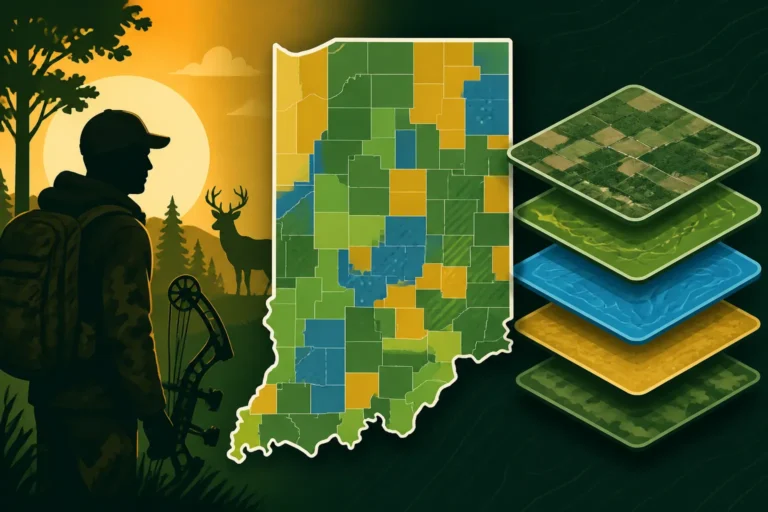
Before you ever lace up your boots, your best friend will be a robust mapping application like onX Hunt or even Indiana's own DNR app. These tools allow you to study aerial imagery, identifying those crucial woodlots, fencerows, creek bottoms, and crop fields. Look for "fingers" of timber extending into fields, small islands of cover, or pinch points where two cover types come close together. Pay attention to how different crop fields connect to cover. A standing cornfield adjacent to a mature woodlot will be a completely different hunting scenario than a cut bean field bordered by a sparse fencerow.
Use the property boundary lines feature (often available with premium versions of these apps) to identify individual landowners. This is essential for when you start Knocking on Doors in Indiana Farm Country to gain access. Mark potential bedding areas, probable food sources (even if it's just a general crop type at the time of scouting), and obvious travel corridors. Note any subtle elevation changes, even just a few feet, as these can be significant in flat country for deer movement and thermal advantages. The more you can learn from your couch, the more efficient your in-field scouting will be.
In-Season Versus Off-Season Scouting
The timing of your scouting makes a huge difference in farmland. Off-season scouting, typically in late winter or early spring after snow melt, allows you to clearly see the lay of the land without vegetation. This is when you can identify old rub lines, scrape areas, beaten-down deer trails, and preferred bedding areas within woodlots. You'll see the distinct paths deer took when fields were barren, offering clues about their post-harvest travel. This is also a great time to evaluate the health of the habitat and see what kind of mast crops are available. You can literally walk every inch of a potential property, taking your time without the fear of disturbing deer.
In-season scouting, on the other hand, is more about current conditions. How are the crops progressing? Which fields have been cut? Where are fresh tracks appearing after a rain? During the season, your scouting should be more discreet, often done from a distance with binoculars or a spotting scope. Drive roads around potential properties, observing from a vehicle without intruding. Look for deer entering and exiting fields at dawn and dusk. The Indiana DNR app, along with other mapping resources, can help you keep track of current regulations and property access points. For public parcels, keep an eye on areas that might be overlooked, as deer will often seek refuge from pressure in the most unassuming places. You might find areas where you need to adapt your scouting based on the specific crop cycle, which changes year after year.
Reading Field Edges and Pinch Points
In northern Indiana farmland, the edge is everything. Deer rarely venture far into wide-open fields during daylight unless they feel completely secure. This makes the transition zones between cover and open ground the most critical areas to scout. Walk the edges of woodlots, fencerows, and creek bottoms, looking for fresh tracks, droppings, and browse. Pay close attention to where these linear features meet, forming natural pinch points. A single mature oak dropping acorns on the edge of a cornfield, for example, will become a magnet once the corn is cut.
Look for subtle funnels: a narrow strip of tall grass or weeds acting as a hidden pathway between a woodlot and a field, or a slight rise in elevation that offers a deer just enough cover to cross an otherwise open area. Waterways, even small drainage ditches, often have taller grasses or brush along their banks, creating miniature travel corridors. Setting Up on a Northern Indiana Field Edge requires understanding exactly where along that edge deer are most likely to appear and where they feel most comfortable. Use trail cameras sparingly and strategically, focusing on these pinch points and field edges, to get a better understanding of movement patterns without over-pressuring the area.
Gaining Access: The Biggest Challenge
Let's be real, in northern Indiana, public land is scarce, and the best deer hunting often happens on private farms. This means that securing permission to hunt is arguably the most critical and often the most frustrating aspect of hunting the region. It's not about being the best hunter; it's about being the best at building relationships.
Knocking on Doors and Building Relationships
This is where the rubber meets the road. Simply driving by a farm and hoping for a "For Lease" sign is a fool's errand. You need to talk to landowners, face-to-face. Start well before hunting season, ideally in the spring or summer. Dress respectfully, be polite, and come prepared with a brief, honest explanation of why you're there. Many farmers have had bad experiences with disrespectful hunters, so your first impression is crucial. Offer to help them with chores, fix a fence, or even just check on their property from time to time. Make it clear you're not just looking for a deer, but you're looking to be a good neighbor and a responsible steward of their land.
When you're Knocking on Doors in Indiana Farm Country, emphasize that you'll respect their property, close gates, avoid driving on wet fields, and share some of the venison if you're successful. Some landowners might be more receptive to bowhunters, as it's often perceived as less disruptive than firearms hunting. Offer to help manage their deer herd if they're experiencing crop damage. Remember, it's a marathon, not a sprint. You might get ten "no's" before you get one "yes." But that one "yes" can open up incredible hunting opportunities. Once you gain permission, maintain that relationship through the off-season. Send holiday cards, offer help, and show appreciation. Your reputation is everything.
Understanding Indiana's Trespass Laws
Indiana has clear laws regarding trespassing, and it's imperative that hunters understand and respect them. Generally, land is considered private, and you need permission to be on it for hunting or other recreational purposes. Posting "No Trespassing" signs is not always required for the land to be considered private; if it's not explicitly public, assume it's private. Hunting without permission can lead to serious legal consequences, including fines and loss of hunting privileges.
Even if you have permission to hunt one parcel, ensure you know the exact boundaries. Using mapping apps like onX Hunt that show property lines is invaluable for this. Accidentally crossing onto an adjacent property without permission, even for game retrieval, can still be considered trespassing. Always err on the side of caution. If you're unsure, ask the landowner for clarification or consult Indiana's Department of Natural Resources (DNR) regulations. Being a knowledgeable and law-abiding hunter not only keeps you out of trouble but also builds goodwill with landowners, which is vital in a state where private land access is king.
Utilizing Public Access
While the vast majority of northern Indiana is private, there are still some public land hunting opportunities available, though they are often smaller and subject to significant hunting pressure. State Fish and Wildlife Areas (FWAs), State Forests, and sometimes local county parks (check specific regulations) offer public access. However, these areas are often small woodlots or reclaimed farmland that see a lot of foot traffic. Using a Ground Blind on Indiana Public Land can be an effective tactic here, as you can set up discreetly and wait out pressured deer.
Hunting public land in northern Indiana requires different strategies. You'll need to work harder to find pockets of unpressured deer, often by walking further, getting off the beaten path, or targeting specific times when pressure is lower (e.g., weekdays, during less popular seasons). Scouting With the Indiana DNR App is critical for finding these parcels and understanding their specific rules, which can vary from property to property (e.g., sign-in requirements, specific weapon restrictions). Expect competition, but don't be deterred. Often, the deer on these public parcels become nocturnal or learn to live in the thickest, nastiest cover that other hunters won't penetrate.
Hunting Tactics for Northern Farmland
Hunting northern Indiana farmland deer means adapting your tactics to a landscape that offers both challenges and unique advantages. Your setup and approach will differ significantly from hunting dense forests, requiring a keen understanding of deer behavior in open, agricultural environments.
Stand Placement on Field Edges and Woodlots
In northern Indiana, your stand placement is critical. Deer in farmland environments often use the edges of cover for security before committing to open fields. This means setting up on the edge of a woodlot, near a thick fencerow, or along a creek bottom where it meets a field. Look for natural funnels or pinch points along these edges where deer are forced to travel through a smaller area. A small point of timber extending into a large field, for instance, can be a perfect ambush spot. Remember to consider the prevailing wind and thermals, especially in relatively flat terrain. Deer will almost always try to use the wind to their advantage. Setting Up on a Northern Indiana Field Edge means being acutely aware of your scent.
When placing stands in woodlots, focus on interior travel corridors, especially those leading to known food sources or water. These woodlots are often relatively small, so minimizing your intrusion is key. Consider a two-pronged approach: an early season stand for when deer are still using standing crops and a post-harvest stand that targets residual food sources like cut soybean fields. For the small, isolated woodlots, look for the densest cover—cedar thickets, multiflora rose patches, or areas of thick saplings. Deer will often bed in the middle of these seemingly small areas, feeling secure due to the thick overhead and lateral cover.
Hunting Standing Crops
Hunting standing crops, particularly corn, can be incredibly challenging but also immensely rewarding. A mature cornfield is a deer's sanctuary, offering food, water (from dew and rain), and nearly impenetrable cover. Deer can live their entire lives within a large cornfield without ever stepping foot into the open. The trick is to find their internal travel routes and bedding areas. Look for beaten-down trails leading into the corn from woodlots or fencerows. Early season scouting might reveal where deer are entering or exiting. Once inside, look for "rooms" or wider areas where deer might be bedding, identifiable by flattened stalks.
However, hunting within standing corn can be incredibly difficult due to limited visibility and swirling winds. The best approach is often to hunt the edges or small funnels leading into the field, or to wait for the crop to be harvested. If you do attempt to hunt within the corn, proceed slowly and quietly. Still-hunting the edges of a field, especially if it's a very large one, might reveal where deer are moving. As the corn begins to be harvested, pay close attention to the remaining standing patches. Deer will often concentrate in the last few acres of corn, offering a golden opportunity. Entry Routes Through Standing Corn are crucial intel here.
Deer Drives in Small Coverts
Given the fragmented nature of northern Indiana farmland, deer drives can be a highly effective tactic, especially during the firearms season. Unlike vast timber drives, these drives are typically on a much smaller scale, often involving just a few hunters. The goal is to push deer out of small woodlots, fencerows, or thick creek bottoms into pre-positioned standers. This strategy works particularly well on parcels where you've gained permission to hunt multiple small patches of cover that are otherwise difficult to hunt from a stationary stand. Deer Drives With Three or Four Hunters can effectively cover these smaller areas.
Success with small drives hinges on good communication and understanding the deer's escape routes. The drivers should move slowly and deliberately, pushing towards the standers, who are positioned where deer are most likely to try and escape—perhaps a narrow crossing, a low spot in a fencerow, or an intersection of cover. Always emphasize safety: know where everyone is at all times, identify shooting lanes, and never take a shot unless you have a clear understanding of what's beyond your target. These drives can be physically demanding, requiring hunters to push through dense, tangled cover, but the reward can be well worth the effort. Posting a Drive Around a Woodlot requires careful planning to ensure safety and effectiveness.
Dealing with Hunting Pressure and Weather
Northern Indiana farmland often experiences significant hunting pressure, especially on public lands and easily accessible private parcels. This, coupled with the wide-open nature of the landscape, means you'll need to be extra strategic about dealing with both fellow hunters and Mother Nature.
Adapting to Local Hunting Pressure
Deer, especially mature bucks, quickly learn to avoid areas with heavy hunting pressure. On public land, this often means they become almost entirely nocturnal or seek refuge in the thickest, nastiest cover that most hunters avoid. To counter this, consider hunting during weekdays when pressure is typically lower, or focus on areas that require more effort to reach—a longer walk, crossing a ditch, or navigating dense brush. Deer will often gravitate to these overlooked pockets. Hunting Pressure on Indiana Public Land is a reality, so adapting is key.
On private land, discuss with the landowner how many other hunters they allow and when. If you're the sole hunter or one of a select few, you have a distinct advantage. If there are other hunters, try to coordinate to avoid over-pressuring the same areas. Also, understand that deer pressured on one property might seek refuge on an adjacent one. Your job is to predict where they'll go when disturbed and position yourself accordingly. Sometimes, simply waiting an extra hour after daylight, when most hunters have moved or given up, can yield results as deer return to their bedding areas.
Wind, Thermals, and Scent Control in Open Areas
In the relatively flat terrain of northern Indiana, wind and thermals behave differently than in hilly country. Without significant elevation changes, large-scale thermal drafts are less pronounced, but localized thermals—especially near water, depressions, or sun-drenched field edges—can still play a role, particularly at dawn and dusk. However, the wind is your primary concern. In open fields, the wind can swirl unpredictably, and deer have an incredible sense of smell.
Strict scent control is paramount. This means meticulous washing of hunting clothes, using scent-eliminating sprays, and storing gear properly. Always play the wind, even if it means sacrificing a perfect stand location for one that keeps your scent out of the deer's nose. In farmland, a deer might pick up your scent from hundreds of yards away in an open field. Use natural barriers, like thick hedgerows or standing crops (if applicable), to help break up and carry your scent away from where you expect deer to approach. Wind and Thermals on a Southern Indiana Ridge provides good general principles, but adjust them for the flatter plains.
Cold Weather and Late Season Opportunities
The late season in northern Indiana, particularly after most crops are out and cold weather has set in, can offer some of the best hunting opportunities. Deer are entirely focused on food and cover during this time. With standing crops gone, their movements become much more predictable, often traveling directly from bedding cover to the most attractive remaining food sources. These food sources might include standing soybeans that weren't harvested, winter wheat, food plots, or gleaning leftovers in cut cornfields. Late-Season Food Sources for Indiana Whitetails are critical intel here.
This is also a time when deer often form larger groups, and finding one can mean finding several. Thermal cover, such as dense cedar thickets or thick brush in creek bottoms, becomes extremely important for deer seeking refuge from harsh winds and cold temperatures. Hunters willing to brave the cold and sit for long hours, especially during a post-front cold snap, can be very successful. Invest in quality cold-weather gear and use ground blinds for warmth and concealment. Cold-Weather Sitting Strategy in Indiana is a must-read for anyone heading out in December or January.
| Cover Type / Food Source | Deer Value | Hunting Considerations |
|---|---|---|
| Standing Corn | Excellent security cover, abundant food, thermal and wind break. Deer live in it. | Very difficult to hunt until harvest. Focus on edges or pinch points. Hard to see/shoot in. |
| Cut Corn Fields | Moderate to high food source (gleaning leftover kernels), especially post-harvest. No security cover. | Prime feeding areas in late season. Hunt edges from cover. Good for long-range observation with optics. Deer will hit these under the cover of darkness usually. |
| Standing Soybeans | High food source (beans are preferred), good security cover until leaves drop. | Similar to corn in terms of difficulty, but deer are often easier to see once leaves yellow. Can be very active feeding areas. Hunting a Standing Soybean Field can be tricky with limited visibility. |
| Cut Soybean Fields | High food source (gleaning leftover beans). No security cover. | Excellent late-season feeding areas. Hunt from adjacent cover. Deer often visit early morning or late evening. |
| Small Woodlots | Primary bedding and staging areas, some mast crops (acorns). Limited size can lead to high pressure. | Focus on internal trails, thick bedding areas. Minimize intrusion. Crucial for movement between fields. |
| Fencerows / Hedgerows | Vital travel corridors, secondary bedding areas, limited browse. Often connect larger patches of cover. | Excellent ambush points. Look for thick, overgrown rows. Deer will typically move along these edges. Can be great for still-hunting or small drives. Working a Fencerow for Late-Season Deer is a great strategy. |
| Creek/River Bottoms | Major travel corridors, dense thermal cover, water source, varied food (soft mast, browse). | Often act as major deer highways. Hunt transition areas where deer leave the bottomland to feed. Excellent for setting up treestands or ground blinds. |
| Winter Wheat / Food Plots | High food source (especially in late season), minimal cover depending on growth. Acts as a deer magnet. | Prime feeding destination. Hunt from distant cover, especially during evening. Expect nocturnal movement if pressured. |
| Old Farmsteads / Overgrowth | Good security cover, often overlooked bedding areas, some food sources. Deer tolerate human proximity here. | Hunt quietly and cautiously. Deer may be less wary of human scent if used to it, but easily spooked by direct pressure. |
Essential Gear for Farmland Hunting
Hunting northern Indiana farmland requires specific gear choices that cater to the unique demands of open landscapes, limited cover, and potentially long-range shots. Your equipment needs to be versatile, durable, and effective in these conditions.
Optics for Long-Range Observation
In a landscape dominated by open fields, quality optics are not just a luxury; they are a necessity. Binoculars are your primary scouting tool, allowing you to glass distant field edges, look for deer entering and exiting cover, and spot subtle movements without intruding on the property. An 8x or 10x magnification is generally sufficient, but prioritize clarity and low-light performance, as deer movement is often concentrated during dawn and dusk. Binocular Choice for Indiana Whitetails should prioritize light gathering and clear edge-to-edge resolution.
A good rangefinder is also crucial. Whether you're bowhunting a field edge or rifle hunting across a wide-open expanse, knowing precise distances is vital for ethical shots. With fewer trees to block line of sight, you might encounter longer shots than you'd typically expect in dense woods. Consider a rangefinding binocular for efficiency, especially if you plan on covering a lot of ground by glassing. Being able to quickly range a distant deer or a landmark for a shooting reference will significantly increase your confidence and accuracy.
Rifles and Ammunition Choices
Indiana's recent changes to rifle regulations have opened up a world of possibilities for deer hunters, moving beyond the previous straight-wall cartridge restrictions. Now, you can use common centerfire rifle cartridges, which is a significant advantage in northern Indiana where longer shots are more common due to the open landscape. Indiana's New Statewide Rifle Rules permit a wider array of calibers, so choosing a flat-shooting, accurate rifle becomes more practical.
For this type of terrain, cartridges like the .270 Winchester, .30-06 Springfield, or 6.5 Creedmoor are excellent choices, offering the flatter trajectories and energy needed for potential shots across fields. Even the venerable .30-30 can be effective in the smaller woodlots and fencerows. Accuracy is paramount, so ensure your rifle is zeroed correctly for the typical ranges you expect to encounter. Practice shooting from various positions you might encounter in the field, such as off a bipod or shooting sticks, which can be invaluable when bracing for a shot in an open field.
Ground Blinds and Treestand Mobility
Given the limited and often fragmented cover in northern Indiana, ground blinds are incredibly versatile and effective. They offer excellent concealment, shelter from the elements (which can be brutal in open country), and flexibility in placement. You can set them up along a fencerow, at the edge of a woodlot, or even brushed into a strategic spot within a field (with landowner permission and proper concealment). Brushing In a Blind on a Field Edge ensures it blends seamlessly with the environment. They're also an excellent option for bowhunters looking to minimize movement when deer approach.
While treestands are still viable, particularly in larger woodlots or along creek bottoms, their effectiveness can be limited by the scarcity of suitable trees in many areas. If using a treestand, choose a mobile setup—a lightweight hang-on or saddle system with climbing sticks—to maximize your flexibility. This allows you to quickly adapt to changing deer patterns, crop rotations, or hunting pressure. Always prioritize safety with any elevated stand, ensuring it's properly secured and using a full-body harness. For very open areas, a sturdy ground blind offers the best combination of concealment and comfort.
Managing Your Harvest and Venison
Successfully harvesting a deer in northern Indiana farmland is a rewarding experience, but the work isn't over yet. Proper field dressing, efficient transport, and meticulous venison care are crucial steps to ensure your hard-earned meat makes it to the table in top condition. The open, often flat nature of this terrain presents unique considerations for post-harvest care.
Efficient Field Dressing in the Field
Field dressing your deer promptly is essential, especially if temperatures are mild, common during early archery season. In northern Indiana, you might be quite a distance from any vehicle access, so efficiency is key. Clear away any crop residue or debris from around the deer to ensure a clean work area. A sharp knife, gutting gloves, and a few rags are indispensable. If you're on a landowner's property, be mindful of where you leave the gut pile; ask them beforehand if they have a preference, or consider removing it from prominent view.
In this open environment, attracting scavengers or unwanted attention to the gut pile can be a concern. Dragging the deer a short distance before gutting might place the remains in a more discreet spot. Take your time, work cleanly, and ensure all internal organs are removed to allow the carcass to cool as quickly as possible. This is particularly important for venison quality. Field Dressing a Deer in Cold Weather provides an excellent guide if you're hunting during the firearms or muzzleloader seasons.
Transporting Deer in Farm Country
Transporting a harvested deer in northern Indiana farmland can be surprisingly challenging. While the terrain is generally flat, the distances across fields can be long, and driving vehicles on private crop fields is often strictly forbidden. This means you might be dragging a deer for a considerable distance. Investing in a quality deer cart or sled can save your back and make the process much easier, especially if you're hunting alone.
If you're hunting with a group, coordinating vehicle access with the landowner beforehand is critical. Can you drive a side-by-side or truck to a specific field edge? Or will you need to meet at a designated pickup point? Plan your extraction route before you even begin hunting. Remember that legally, you need to tag your deer immediately after harvest and register it within the specified timeframe. Having your Registering an Indiana Deer Online method ready (e.g., the DNR app) will make this process smooth.
Venison Care in Variable Temperatures
Indiana weather can be incredibly unpredictable, with warm spells in early fall and bitterly cold temperatures in late winter. This variability directly impacts how you care for your venison. During warm early seasons, rapid cooling is paramount. After field dressing, get the deer cooled down as quickly as possible. This might mean quartering it in the field and placing the meat in coolers packed with ice, especially if you have a long drive home. Don't let the meat sit in a warm vehicle for extended periods.
During colder seasons, you have a bit more leeway. Hanging the deer in a cool, shaded area (like an unheated garage or barn, with landowner permission) for a few days can help age the meat, improving tenderness and flavor. Ensure it's protected from scavengers and insects. Always aim for a clean, quick, and efficient process from harvest to cooling to ensure the highest quality venison for your family. Understanding the unique challenges of the northern Indiana landscape will allow you to enjoy the fruits of your labor for months to come.
Disclaimer
This article is for general informational purposes only and does not constitute professional advice. Laws, prices and regulations vary by location and change over time. Consult a qualified professional for guidance on your specific situation.