Hunting the Fall Archery Turkey Window
The golden leaves of an Indiana autumn can be breathtaking, but for those of us who spend our seasons chasing wild turkeys, they often signal a completely different kind of challenge than the boisterous spring. Fall turkeys are a different beast entirely – often quieter, more dispersed, and demanding a shift in tactics from the aggressive gobbler-chasing of April and May. If you're looking to fill a tag with archery gear during Indiana's fall turkey window, understanding these differences and adapting your approach is key to success, and this guide is here to walk you through exactly that.
Understanding Indiana's Fall Archery Turkey Season
Indiana's fall archery turkey season offers a fantastic opportunity to extend your time in the woods and experience turkey hunting from a completely new perspective. Unlike the spring, where territorial gobblers are vocal and predictable, fall birds are primarily focused on food and flock cohesion. This fundamental difference dictates everything from your scouting methods to your calling strategy.
Key Dates and Regulations
First things first, you've got to know when you can even be out there. Indiana's fall turkey season typically runs concurrently with the deer archery season, stretching from early October all the way through early January. This long season offers a generous window to pursue birds, often overlapping with prime deer hunting, which means you might even see a bonus deer while you're out there for turkeys. However, it's absolutely crucial to double-check the current year's exact dates and regulations with the Indiana Department of Natural Resources (DNR) every single season. Things can change, and you don't want to find yourself on the wrong side of the law.
When it comes to bag limits, Indiana typically allows one turkey of either sex during the fall archery season. This "either sex" rule is a significant departure from spring, where hunters are generally limited to gobblers. This flexibility opens up more opportunities, as you're not solely focused on mature Toms. However, remember that you need a valid hunting license and a fall turkey tag. You can usually find comprehensive details on all the rules, including bag limits and county restrictions, by checking out the article on Indiana Fall Turkey Season Structure. Always ensure you have your HIP registration if you're hunting migratory birds, though turkeys aren't usually included in that specific requirement.
Why Fall is Different Than Spring
If you've spent any time at all chasing spring gobblers, you know the drill: locate a roosted bird, set up, call aggressively, and try to seal the deal when he struts in. Fall turkey hunting, especially with archery gear, throws much of that out the window. In the spring, hormones are raging, and gobblers are eager to breed, making them more susceptible to calling. In the fall, their priorities shift dramatically. After the breeding season, hens and their poults have formed large, sometimes multi-generational, flocks. Gobblers will also gather in bachelor groups. Their primary focus now is survival: finding consistent food sources to fatten up for winter and maintaining flock security.
This means that instead of responding aggressively to your yelps and cutts, fall turkeys are often much more wary and less vocal. They might still gobble occasionally, especially at roost, but it's not the reliable indicator of location or interest that it is in spring. You're less likely to call a mature tom across two ridges, and more likely to call scattered birds back together after you've broken up a flock. The dynamic is less about seduction and more about reunion. This shift demands patience, observation, and a willingness to adapt your entire hunting approach, making it an incredibly rewarding, albeit challenging, endeavor.
Archery-Specific Considerations
Hunting fall turkeys with a bow or crossbow adds another layer of complexity that spring shotgun hunters rarely contend with. The effective range of an archery setup is significantly shorter than a shotgun, typically limiting shots to 40 yards or less, and often much closer in the thick Indiana timber. This means you need to get really close to these already wary birds.
Unlike deer, turkeys have incredible eyesight, a 270-degree field of view, and detect the slightest movement. Drawing your bow without being detected is a monumental challenge. This is where meticulous concealment, patient setup, and understanding turkey behavior are paramount. You'll be spending more time breaking up flocks, setting up ambushes, and trying to get a shot at a bird that often appears quickly and erratically. The margin for error is razor-thin, and a missed opportunity is often due to an unseen twitch or an arrow hitting a stray twig. It’s a game of inches, and that’s part of the thrill. For more specific advice on gear, you might find some useful crossover tips in Bowhunting Indiana's Long Archery Season.
Scouting Strategies for Fall Turkeys
Successful fall archery turkey hunting hinges almost entirely on thorough scouting. You can't just stumble into birds like you might in spring when they're gobbling their heads off. You need to know where they are, what they're eating, and where they're bedding down. This requires legwork, keen observation, and sometimes, a little help from modern technology.
Locating Food and Roost Trees
In the fall, turkeys are absolutely driven by food. Their entire existence revolves around finding enough calories to sustain them through the lean winter months. Your scouting efforts should heavily focus on identifying these crucial food sources. In Indiana, this often means hard mast crops like acorns, beech nuts, and hickory nuts. Spend time in oak ridges, looking for freshly scratched leaves, droppings, and even empty acorn caps. Turkeys will spend hours scratching through the leaf litter in a productive oak flat, creating obvious "turkey sign." If it's been a poor mast year, they might shift to agricultural fields, gleaning corn or soybeans, or focusing on softer mast like wild grapes or dogwood berries in creek bottoms.
Equally important are roost trees. Turkeys typically roost in large, sturdy trees, often pines, sycamores, or large oaks, usually near water or in protected areas on ridge points. Look for whitewash on branches or the ground, and shed feathers. Once you locate a consistent roost, you can plan an early morning or late evening ambush. Knowing where they spend the night and where they intend to feed the next morning gives you a huge advantage. Often, scouting a new area starts with understanding the habitat – for a deeper dive, check out Scouting Indiana Public Land Before Season.
Reading Sign and Habitat
Beyond food and roosts, you need to become an expert at reading the subtle clues turkeys leave behind. Droppings are a dead giveaway; distinct J-shaped droppings indicate a gobbler, while more globular or curled droppings belong to hens and poults. Dusting bowls – depressions in dry, sandy soil where turkeys "bathe" to rid themselves of parasites – are another strong indicator of frequent use. Track size and shape can also tell you about the birds present.
Pay attention to topography and vegetation. Turkeys, especially in larger flocks, tend to travel along benches, ridge lines, and open creek bottoms. They'll avoid extremely dense thickets but seek out areas with good visibility to spot predators. In southern Indiana, this might mean the gentle slopes of the Hoosier National Forest or Morgan-Monroe State Forest, while in northern Indiana, it could be the woodlots bordering cornfields. Look for fresh tracks in soft soil after a rain, or scratch marks in the leaves. When you find these signs, you've found an area birds are actively using.
Pre-Season Scouting with Technology
Modern technology has revolutionized how we scout, making it possible to pinpoint promising areas even before stepping foot in the woods. Satellite imagery and topographic maps, available through apps like GoHunt, are invaluable tools. You can identify oak flats, potential roosting areas along ridge lines or near water, and potential travel corridors from the comfort of your home.
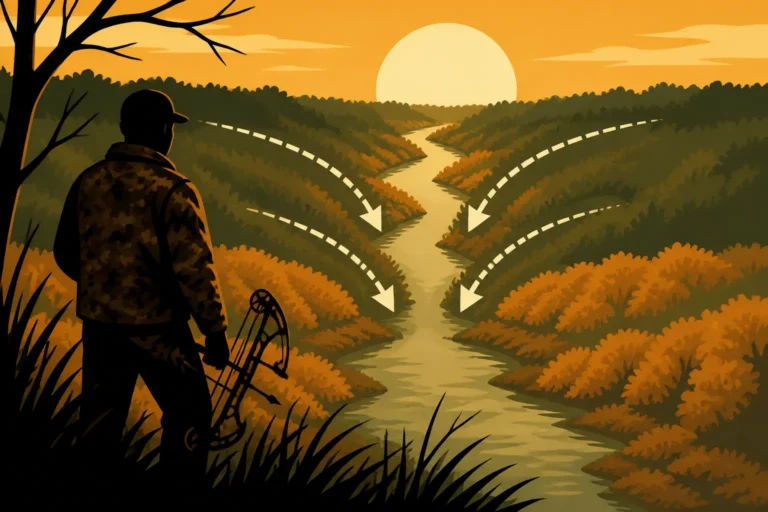
Look for areas of mature timber adjacent to open fields or thick cover, which provide both feeding and security. Identify pinch points, creek crossings, or saddles where turkeys might be funneled. You can use these apps to mark potential roost sites, feeding areas, and travel routes, creating a "game plan" before you ever hit the dirt. These platforms often include public/private land boundaries, helping you identify accessible hunting grounds. Leveraging GoHunt to analyze terrain, timber types, and water sources can save you countless hours of unproductive walking, allowing you to focus your physical scouting efforts on the most promising spots.
Effective Archery Tactics in the Fall Woods
Once you've done your homework and found where the birds are, it's time to put a plan into action. Fall archery turkey hunting is a game of patience, stealth, and knowing when to make a move. The tactics are often completely different from the spring, requiring a more nuanced approach.
The Art of Flock Busting
Flock busting is arguably the most effective and exciting fall turkey hunting tactic. The idea is simple: find a large flock of turkeys, rush them hard to scatter them in every direction, and then set up and call them back together. The key is to run directly into the middle of the flock, yelling and waving your arms, causing them to scatter like buckshot. Don't be timid; you want them to fly off in panic, losing track of each other. The more thoroughly they scatter, the more eager they will be to regroup.
After busting the flock, immediately set up. Find a spot with good concealment against a wide tree or in a ground blind, ideally facing the direction you expect birds to return from, with a clear shooting lane at archery distances. Give it 20-30 minutes for the woods to settle down. Then, begin calling. The younger birds, especially poults and jakes, will be the first to start yelping and peeping, trying to locate their flock mates. This is when your soft, plaintive assembly calls come into play. This technique is so crucial for fall success, you could dedicate an entire outing to Breaking Up a Fall Turkey Flock.
Calling Techniques for Scattered Birds
Calling fall turkeys isn't about mimicking a lovesick hen to draw in a strutting gobbler. It's about sounding like a lost bird trying to reunite with its family. Your calls should be soft, sincere, and infrequent at first. Start with a few soft "lost" yelps, perhaps some soft clucks and purrs. Listen intently. If you hear an answer, pinpoint its direction and try to call it in. The goal is to make them believe you are one of their scattered flock mates, not a predator or a hunter.
Poults make distinct, high-pitched "kee-kee" runs, especially when scattered. Mastering this call can be incredibly effective at drawing in other young birds, and often the hens will follow. As the day progresses, and especially if you've busted a flock, increasing the intensity of your calling slightly might be necessary as birds get more desperate to regroup. If you hear multiple birds calling, try to mimic the rhythm and tone of the dominant hen to draw them in. Sometimes, placing a decoy a short distance in front of your setup can provide a visual aid, especially for cautious birds coming in. You can also review Grunt Calls in Mature Indiana Timber for tips on adapting calling volume to dense cover, even if it's for deer, the principle applies to sound travel.
Ambush and Still-Hunting Approaches
Sometimes, flock busting isn't feasible, or you're hunting an area where turkeys are more dispersed. In these scenarios, ambush hunting or still-hunting become your go-to tactics. Ambush hunting involves setting up quietly in a high-traffic area – a proven food source, a travel corridor between roosts and feeding areas, or a water source – and simply waiting for birds to come to you. This requires immense patience and meticulous setup. A ground blind or a well-placed treestand, camouflaged naturally, can be incredibly effective. Consider using a compact, lightweight blind that you can set up quickly if you stumble upon birds. For tips on elevated setups, look at Treestand Setups in Hoosier National Forest.
Still-hunting for turkeys is a slow, methodical approach where you move through the woods like a predator, taking a few steps, then pausing to observe and listen for several minutes. Use your binoculars constantly, scanning for movement, often just the subtle flicker of a turkey's head or the distinct dark blob of their body against the undergrowth. This is particularly effective on quiet days in open timber or along ridge lines where visibility is better. Focus on areas you've identified as likely travel routes or feeding areas. The key is to move extremely slowly and deliberately, constantly aware of the wind direction and any noise you might make. When you spot birds, assess the situation and try to get ahead of them or position yourself for an ambush.
Gear Essentials for the Fall Archery Turkey Hunter
Having the right gear is non-negotiable for fall archery turkey hunting. You're trying to outwit a creature with unparalleled eyesight and hearing in its natural element, all while using a short-range weapon. Your equipment choices can make or break your hunt.
Bow and Arrow Setup Optimization
Your archery setup needs to be dialed in for accuracy at close ranges. A bow with a smooth draw cycle and a forgiving brace height can be advantageous, helping you make a quiet, controlled draw when a turkey is in close. For arrows, prioritize accuracy and kinetic energy for clean pass-throughs. A heavier arrow with good FOC (Front of Center) can help stabilize flight and provide excellent penetration.
Broadheads are a critical choice. While mechanical broadheads are popular for deer, many turkey hunters prefer fixed-blade broadheads for their reliability and penetration on bone, especially if you hit a wing butt or keel bone. Look for a strong, sharp, two or three-blade fixed head, perhaps one with a larger cutting diameter, to ensure maximum damage and a quick, ethical kill. Practice shooting your exact hunting setup at realistic ranges (20-40 yards) from various positions you might encounter in the field, like kneeling or sitting, to build confidence. Even though it covers spring, Turkey Gear for an Indiana Spring will have useful advice on bows and broadheads.
Camouflage and Concealment
Turkeys can spot the slightest color aberration or movement. Full concealment is absolutely paramount. Your camouflage pattern should match the fall woods of Indiana – think browns, grays, and muted greens, mimicking tree bark and dried leaves. Avoid anything too dark or too green if the leaves are mostly down. Layering is key, as fall mornings can be cold, but mid-day can warm up quickly, especially when you're on the move. Don't forget a full face mask and gloves. Even a reflection off your watch or glasses can spook a bird.
Beyond your clothes, how you use the terrain for concealment is equally important. Always set up against a wide tree or in dense brush that breaks up your outline. Avoid silhouetting yourself against the sky. A good quality ground blind, ideally one brushed in with natural vegetation, can provide a significant advantage, allowing for more movement and easier draws. When waiting, remain absolutely motionless, even if you think you’ve been spotted. Many times, a turkey will slowly walk off if they can’t confirm what they’re seeing.
Calling Devices and Decoys
A versatile set of calling devices is essential for fall turkey hunting. A good mouth call (diaphragm call) allows for hands-free calling, which is invaluable when you're holding a bow. Practice a variety of yelps, clucks, purrs, and the "kee-kee" run. A slate call (pot call) offers a wider range of tones and can be great for louder assembly calls after a bust. A box call is also a solid option for versatility and volume. Having a few different types lets you adapt to the birds' mood and the specific situation.
Decoys can be a game-changer, especially after a flock bust or when calling birds to an ambush site. A jake or hen decoy, or a combination, can draw birds into bow range. In the fall, a single hen or a small group of jake and hen decoys often works best, mimicking a small, lost group. Place your decoy about 15-20 yards from your setup, slightly off to the side, so that when the real birds come in to check it out, they present a broadside or quartering-away shot at a comfortable archery distance. Make sure your decoys are lightweight and easy to deploy quickly, as opportunities can arise rapidly.
Public vs. Private Land: Navigating Access
Indiana offers a fantastic array of hunting opportunities, but understanding the nuances of public versus private land access is crucial, especially when you're looking for fall turkeys. Both present unique challenges and rewards.
Hunting Indiana State Forests and FWAs
Indiana is fortunate to have extensive public hunting opportunities, with numerous State Forests and Fish and Wildlife Areas (FWAs) scattered across the state. Places like the Hoosier National Forest in southern Indiana offer vast tracts of public land, often characterized by steep hills, thick timber, and winding creek bottoms. These areas can hold good numbers of turkeys, but they often require more physical exertion and a willingness to get away from roads and trails to find undisturbed birds. Scouting here is paramount, looking for those hidden oak flats or secluded roosting areas. For hunters who want to explore this vast resource, understanding Hoosier National Forest Hunting is a great start.
State Forests, such as Morgan-Monroe, Yellowwood, or Jackson-Washington, provide excellent public access, often with slightly different terrain and timber types. Many FWAs, like Atterbury or Glendale, are managed specifically for wildlife and habitat, offering diverse landscapes from wetlands to upland timber, which can be fantastic for turkeys. Remember that many FWAs have specific sign-in procedures or special regulations, so always check with the local property office before you hunt. These public lands can certainly hold quality birds, but be prepared for company, especially on weekends during overlapping deer season.
Gaining Private Land Permission
While public lands are a great resource, gaining permission to hunt private land can often provide access to less pressured birds and more consistent hunting. Indiana is largely agricultural, and many landowners are open to hunters, especially if turkeys are causing crop damage or are simply abundant. The key is respect, politeness, and being a good ambassador for hunters.
Start by knocking on doors well in advance of the season, neatly dressed, and clearly stating your intentions. Offer to share game or help with chores. Emphasize that you're an archery hunter, which can sometimes ease concerns about firearms discharge. Building a good relationship with a landowner can secure you hunting access for years to come. Always carry written permission if possible, and leave the property exactly as you found it, if not better. A well-placed game camera (with permission, of course) can reveal if turkeys are regularly using a property, which can be a strong selling point when asking for access. Sometimes, it's just about Knocking on Doors in Indiana Farm Country.
Dealing with Hunting Pressure
Whether on public or private land, hunting pressure is a reality in Indiana. On public lands, especially during the combined archery deer and turkey season, you'll likely encounter other hunters. The best way to deal with this is to go where others won't. Hike deeper, explore harder-to-reach areas, or focus on smaller, overlooked pockets of habitat. This is where tools like GoHunt can help identify remote sections of public land that might see less traffic. Turkeys, like deer, will quickly learn to avoid areas with heavy human activity.
On private land, even if you have exclusive access, birds can still be pressured if adjacent properties are heavily hunted. Pay attention to how turkeys react. If they're extremely wary and vocalizing less, they've likely been pressured. In these situations, extreme stealth, minimal calling, and focusing on ambush tactics become even more critical. Sometimes, the best strategy is to embrace the challenge and use your scouting and woodsmanship to find Finding Ground That Sees Fewer Hunters.
Fall Versus Spring Turkey Hunting Approaches
Here's a quick overview of how the fall and spring turkey hunting dynamics often compare, helping you adjust your mindset and tactics.
| Feature | Spring Turkey Hunting (Typical) | Fall Archery Turkey Hunting (Typical) |
|---|---|---|
| Primary Motivation | Breeding (gobblers seeking hens) | Food & Flock Cohesion (survival) |
| Vocal Behavior | Highly vocal, gobbling is key locator/attractor | Less vocal, subtle yelps/clucks/purrs, kee-kee runs are more common |
| Target Birds | Mature Gobblers | Either Sex (hens, jakes, gobblers) |
| Calling Strategy | Aggressive hen calls, shock gobbling, mimicking breeding behavior | Soft, sincere assembly calls, lost yelps, kee-kee runs, mimicking lost birds |
| Flock Structure | Gobbler groups, individual gobblers, small hen groups | Large family flocks (hens & poults), bachelor gobbler groups, mixed flocks |
| Key Tactics | Calling a gobbler to your position, run-and-gun | Flock busting, ambush hunting food sources, still-hunting |
| Time of Day | Early morning fly-down, mid-day lull, late afternoon roost | All day, as birds feed and regroup, often best mid-morning after a bust |
| Concealment Needs | Important, but movement less critical with shotgun | Absolutely paramount, minimal movement for bow draw is critical |
| Decoy Use | Strutting gobblers, breeding hen | Single hen, jake, or small group of hens/jakes |
This table highlights the stark differences you'll encounter. Fall archery turkey hunting is a unique challenge that tests a hunter's patience and woodsmanship in a very different way than the boisterous spring.
Disclaimer
Hunting is an inherently dangerous activity. Always prioritize safety, follow all local, state, and federal regulations, and practice ethical hunting principles. The information provided in this guide is for informational purposes only and should not be considered legal advice. Consult the official Indiana Department of Natural Resources (DNR) regulations for the most current and accurate rules and laws before engaging in any hunting activities.