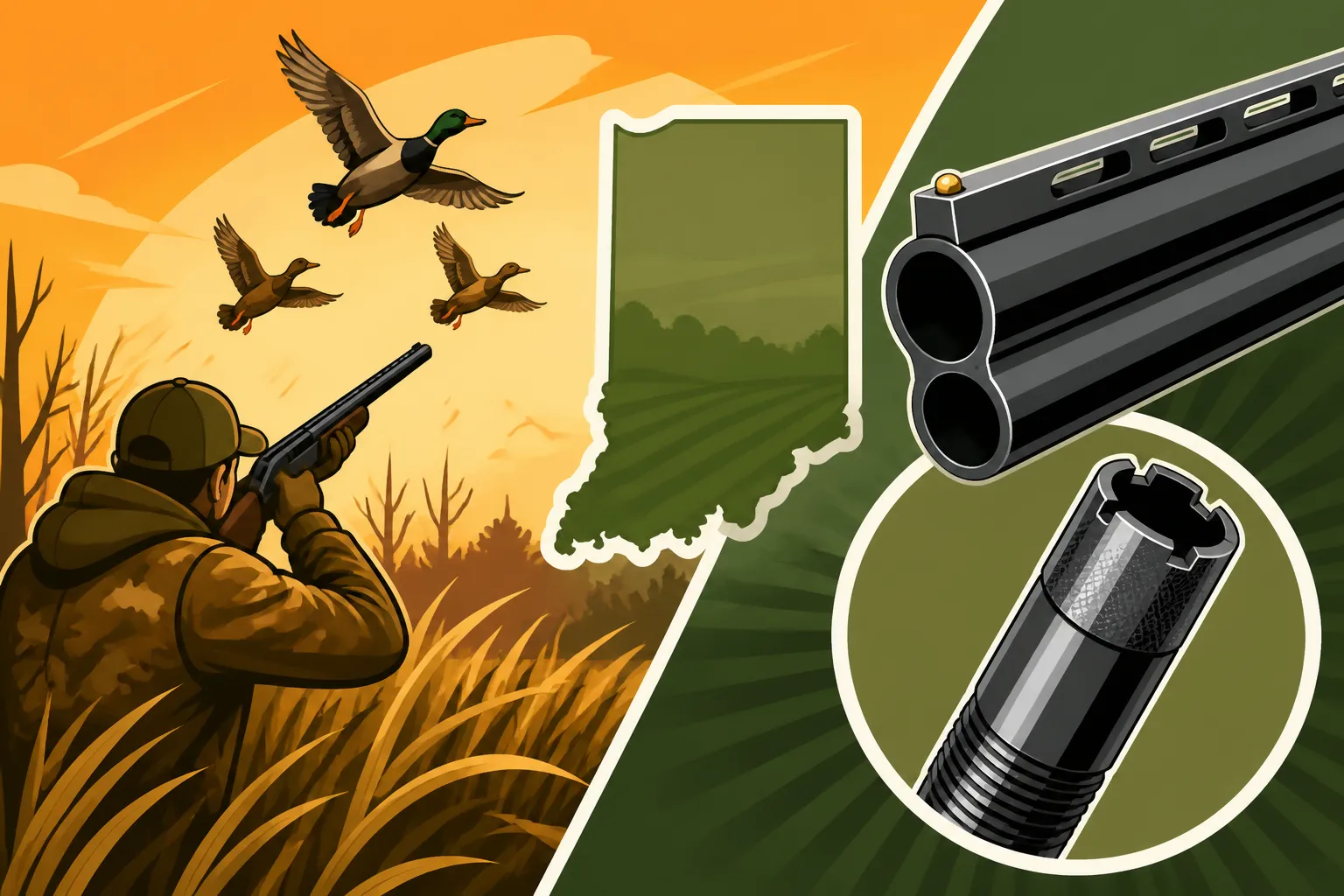
Choke Choice for Fast Flushes
There’s almost nothing more frustrating for a wing shooter than a fast-flushing bird that blows out of cover like a rocket, leaving you feeling like you just stood there watching it disappear. You shoulder your shotgun, swing, and… miss. Or worse, you rush the shot, and you know you just sent a pattern that was either too tight or too wide to be effective. It’s a common scenario, especially when hunting Indiana’s pheasant fields or thick quail cover. This guide is all about helping you understand choke choice, so you can optimize your shotgun for those lightning-fast flushes and turn those frustrating misses into satisfying retrieves.
Understanding Shotgun Chokes: The Basics for Indiana Hunters
Before we dive into specific game birds, let's get a handle on what a choke actually is and how it impacts your shooting. It’s not just a random piece of metal you screw into your barrel; it's a carefully engineered device designed to control your shot pattern.
What is a Choke and How Does it Work?
Imagine your shotgun barrel as a garden hose. When you turn on the water, it comes out in a wide spray. If you put your thumb over part of the opening, you constrict the flow, and the water sprays further and more narrowly. A shotgun choke works on a similar principle. It’s a constricted device located at the muzzle end of your shotgun barrel. This constriction literally squeezes the shot column as it exits the barrel, controlling how tightly or loosely the shot pellets spread out.
The goal is to create a pattern that's dense enough to put multiple pellets on a small target like a pheasant or quail, ensuring a clean kill, but also wide enough that you don't have to be laser-precise, especially on a bird that's zipping past at 40 miles an hour. Too tight a choke, and you're essentially shooting a rifle with tiny pellets, making a hit incredibly difficult on a moving target at close range. Too open, and your pattern spreads too quickly, becoming too sparse at longer distances to guarantee enough pellets hit the target for a humane kill. It's a delicate balance, and understanding it is key to successful wing shooting in the diverse cover found across Indiana.
Common Choke Constrictions and Their Ranges
Chokes are typically measured in terms of their constriction, and these constrictions are given names that correspond to their tightness. From most open to most constricted, you'll generally encounter Cylinder, Improved Cylinder, Modified, Full, and sometimes even more specialized options like Skeet or Extra Full. Each choke is designed for a different effective range and shot pattern density.
- Cylinder (Cyl): This is the most open choke, offering little to no constriction. It produces the widest pattern at close range. Think dense brush, very close flushing birds, or perhaps even slugs. Effective range is typically 15-20 yards.
- Improved Cylinder (IC): A slight step up in constriction from Cylinder, offering a bit more pattern density but still a good spread. This is a very popular choice for many upland hunters, especially when birds might flush within 20-30 yards. It’s excellent for quail, grouse, and early-season pheasants in tight cover.
- Modified (Mod): This is often considered the most versatile choke, providing a good balance between pattern spread and density. It's a solid all-around choice for pheasants, ducks, and longer-range small game shots. Its effective range stretches to about 30-40 yards. Many hunters start with a Modified choke when they're unsure what to expect.
- Full (F): As the name suggests, this choke offers significant constriction, producing a tight, dense pattern for maximum range. It’s excellent for waterfowl at longer distances, late-season pheasants that flush wild, or turkeys. However, at close range, a Full choke can literally blow a bird to smithereens, and it makes hitting a fast-flushing target incredibly challenging due to the small pattern size. Its effective range is typically 40-50+ yards.
Many shotgun barrels, particularly older ones, came with fixed chokes, meaning the choke was permanently machined into the barrel. This meant you were stuck with one choke unless you modified the barrel. However, most modern shotguns feature interchangeable chokes, also known as screw-in chokes. These allow you to easily change the choke constriction to match your hunting conditions or target species. This versatility is a game-changer for Indiana hunters who might pursue diverse game in varied habitats, allowing you to adapt on the fly whether you're chasing Rabbit Hunting Indiana Fencerows or tackling Pheasant Hunting Indiana Grassland. Having a set of these interchangeable chokes is like having a toolbox for your shotgun, letting you fine-tune your setup without needing multiple firearms.
Fixed vs. Interchangeable Chokes
The choice between fixed and interchangeable chokes largely depends on your shotgun and hunting style. Older shotguns, especially many classic side-by-sides and pumps, often have fixed chokes. This isn't necessarily a bad thing, particularly if the choke is a versatile one like Improved Cylinder or Modified. For a hunter who primarily focuses on one type of game in a consistent environment, a fixed choke can be perfectly adequate. For example, a dedicated quail hunter might be perfectly happy with an Improved Cylinder choke fixed in their barrel, as it perfectly suits the typical close-range flushes of bobwhites.
However, the vast majority of modern shotguns, from pumps to semi-autos, come equipped with interchangeable choke tubes. This system offers unparalleled flexibility. Heading out for early season pheasants in heavy cover? Screw in an Improved Cylinder. Later in the season, when birds are wary and flushing further out across open fields? Swap to a Modified or even a Light Full. This adaptability is invaluable, allowing you to optimize your pattern for different distances, game, and even specific hunting spots. If you're using a planning tool like GoHunt to scout different public lands across Indiana, like various Fish and Wildlife Areas, you might find yourself needing to switch chokes based on the specific cover types you anticipate encountering that day. The ability to quickly change your choke means you're always ready, whether the birds are holding tight or rocketing away.
Matching Chokes to Indiana's Fast-Flushing Game Birds
Now, let’s get down to the nitty-gritty: which chokes work best for the birds that burst from cover, demanding a quick and accurate shot here in Indiana.
Pheasants: The King of the Fast Flush
Ah, the pheasant. There's almost nothing quite like the explosive cackle and vibrant flash of a rooster pheasant taking flight. They are, without a doubt, one of Indiana’s most prized upland game birds, and they are masters of the fast flush. Their behavior can vary wildly, though, depending on the habitat and time of year.
- Early Season & Heavy Cover: In early fall, especially in dense cattails, CRP fields, or heavy brush rows, pheasants often hold tight. A good dog might pin them down, and when they finally flush, it's usually at close range—15 to 25 yards. For these situations, an Improved Cylinder (IC) choke is often ideal. It provides a broad enough pattern to catch a rapidly accelerating bird without obliterating it at close quarters. It’s forgiving enough for a quick swing and shot, yet still delivers sufficient pellet density. If you're pushing thick creek bottoms or fencerows, especially in areas where pheasants are known to hold tight, the IC will serve you well.
- Late Season & Open Fields: As the season progresses and birds become warier, or if you're hunting more open agricultural fields and sparse cover, pheasants tend to flush much further out. These birds have been pressured, and they've learned to take flight at the first sign of danger, often 30 to 45 yards away. For these longer shots, a Modified (Mod) or even a Light Full (LF) choke becomes more appropriate. The denser pattern ensures you have enough pellets for a clean kill at increased distances. When planning your hunt on public access areas using tools like GoHunt, pay attention to the cover types. If you’re targeting expansive grassland or winter wheat fields, lean towards a tighter choke. You might even consider a two-barrel setup if you carry a double gun, with an IC in the first barrel for a close bird and a Mod in the second for a follow-up shot on a runner or a bird that flushes further out. For a detailed look at appropriate firearms, check out Shotguns for Indiana Pheasant and Small Game.
Quail and Rabbits: Quick Jumps in Tight Cover
While rabbits don't technically "flush" like birds, they often burst from heavy brush with incredible speed, demanding a very similar quick-reaction shot. Quail, on the other hand, are famous for their explosive covey rise, where multiple birds erupt simultaneously from underfoot. Both scenarios demand a rapid response and a pattern that spreads quickly.
- Bobwhite Quail: When a covey of quail explodes around you, it's exhilarating and disorienting. The birds scatter in all directions, often at very close range—10 to 20 yards, sometimes even closer. Trying to pick out a single bird and make a precise shot with a tight choke is a recipe for frustration (and missed birds). For quail, an Improved Cylinder (IC) or even a Skeet (SK) choke is generally the best choice. Skeet chokes are specifically designed for extremely close, fast-moving targets and offer the widest, most forgiving pattern. The goal here is to get enough pellets on one or two birds quickly, allowing the pattern to spread adequately for the close distances. The sheer speed and proximity of a quail flush make an open choke indispensable.
- Rabbits: Hunting cottontails in Indiana often means pushing through briar patches, thickets, and dense fencerows. When a rabbit bolts, it’s usually at close range and moving erratically. Again, an open pattern is your friend. An Improved Cylinder (IC) or Cylinder (Cyl) choke works wonderfully for rabbits. It allows for a quick, reactive shot without worrying about hitting a tiny target with a pencil-thin pattern. You're trying to stop a fast-moving target in thick cover, and a spreading pattern increases your chances dramatically. Remember, these aren't long-distance targets; they're quick, close-range bursts. For more on hunting these little speedsters, refer to Rabbit Hunting Indiana Fencerows.
Woodcock and Snipe: Erratic Flight in the Alders
Though perhaps not as widely hunted as pheasant or quail, woodcock and snipe offer some of the most challenging and rewarding fast-flush shooting. These migratory birds are known for their incredibly erratic, twisting flight paths.
- Woodcock: Often found in moist, young timber, thick alders, or willow bottoms, woodcock have a unique, spiraling flush. They burst from cover and fly in an unpredictable, zig-zagging pattern for a short distance before leveling out. Most shots are taken within 15 to 25 yards. For these close, unpredictable, and often brush-obscured shots, an Improved Cylinder (IC) or even a Skeet (SK) choke is paramount. You need the widest possible pattern to account for their erratic flight and the limited clear shot window. A tighter choke would almost guarantee a miss.
- Snipe: Snipe are typically found in wet, marshy areas, often alongside open water. Their flush is equally challenging—a high, fast, and incredibly erratic flight that makes them a favorite among wing-shooting enthusiasts looking for a true test. Like woodcock, most shots are taken at relatively close distances, and the unpredictable flight demands a forgiving pattern. An Improved Cylinder (IC) or Skeet (SK) choke is again the go-to for these birds, giving you the best chance to connect with their dizzying aerial acrobatics.
Factors Beyond Choke: Improving Your Success on Quick Shots
While choke choice is critical, it’s only one piece of the puzzle when it comes to consistently hitting fast-flushing game. Several other factors play a significant role in your success.
Cover Density and Anticipated Shot Distance
The type of cover you're hunting in directly influences not only your choke choice but also your overall strategy. Think about the specific habitat.
- Thick, Dense Cover: If you're slogging through impenetrable multiflora rose, cattails, or dense dogwood thickets, chances are any bird that flushes will do so at very close range. Your visibility will be limited, and the window for a shot will be brief. This is where an Improved Cylinder or Skeet choke truly shines. The wide pattern helps compensate for the short reaction time and the potential for brush interference. You might anticipate shots ranging from 10 to 20 yards. When you’re using GoHunt to study satellite imagery of potential hunting spots, look for these dense, "chunky" cover areas and plan your choke accordingly.
- Open Fields and Sparse Cover: Conversely, if you're hunting fields of standing corn, cut stubble, or thin broom sedge, birds are likely to flush at a greater distance. They have more room to run or fly before being forced into the air, and they've likely learned to be wary. Here, a Modified or Light Full choke gives you the necessary reach and pattern density. Shots here could be anywhere from 30 to 45 yards. Understanding this relationship between cover and expected flush distance is vital. You wouldn't use the same choke for hunting a small brushy woodlot as you would for an expansive CRP field. Consider also the terrain; Hunting Northern Indiana Farmland Deer often involves field edges which can provide different flushing scenarios compared to Hunting Southern Indiana Hill Country.
Ammunition Choice: Shot Size and Payload
The choke directs the shot, but the ammunition itself is what delivers the punch. The type of shot you use, its size, and the amount of payload (the weight of shot) all interact with your choke to create the final pattern.
- Shot Size: Generally, larger shot (e.g., #4, #5) carries more energy and is better for larger birds like pheasants, especially at longer ranges. Smaller shot (e.g., #7.5, #8, #9) creates a denser pattern with more pellets per ounce, which is excellent for smaller birds like quail or woodcock, where many pellets are needed to ensure a hit on a small target. For a good breakdown, see Shot Size for Pheasant and Rabbit. A common mistake is to try and compensate for a too-open choke by using larger shot, or vice versa. The best approach is to match shot size to the game and then select the appropriate choke.
- Payload and Velocity: The amount of shot (e.g., 1 oz, 1 1/8 oz) and its velocity can also affect pattern density and spread, though to a lesser extent than choke. Higher velocity loads might spread slightly quicker out of a given choke, while heavier payloads simply mean more pellets in the pattern. For fast flushes, consistent, reliable loads are key. Don’t skimp on ammunition, as quality shells deliver more consistent patterns. Experimenting with different brands and loads through your chosen choke on a pattern board is the only way to truly understand what your specific shotgun-choke-ammo combination does.
Hunter Position and Dog Work
Your position relative to the cover and how you work with your hunting partners or dog can dramatically influence the type of shot you get. A well-placed hunter can turn a wild flush into a manageable shot, regardless of choke.
- Working with a Dog: If you're hunting with a pointing dog, you often have a bit more control over the flush. You can position yourself for an optimal shot when the dog goes on point, anticipating the direction of flight. However, even with a pointing dog, birds can be unpredictable, especially if they're runners. For Running Pointing Dogs on Indiana Pheasants, you'll often have a closer shot. If you're hunting with a flushing dog, the flushes will be more spontaneous, demanding quick reactions. Understanding your dog's style and how it interacts with the cover is critical for setting up your shots.
- Hunter Placement: When hunting with a group, proper spacing and communication are vital. Spacing out too far means birds might flush between hunters, leading to difficult or unsafe shots. Too close, and you risk swinging into another hunter's line of fire. Walking the edges of cover, pushing through draws, or standing ready at the end of a field are all tactics that can put you in a better position for a cleaner shot. Anticipating where a bird might flush is almost as important as having the right choke. Scouting beforehand, possibly using a mapping tool like GoHunt, helps you understand terrain and where birds might hold, allowing you to plan your approach and position effectively.
Field Testing and Fine-Tuning Your Choke Setup
Choosing a choke from a chart is one thing; seeing how it performs with your gun and your chosen ammunition is another. Field testing is essential to truly understanding your setup.
Patterning Your Shotgun: Why It Matters
Patterning your shotgun is the single most important step you can take to understand how your chokes and ammunition perform. It means shooting your specific shotgun, with your chosen choke, and your preferred ammunition at large paper targets (usually 30×30 or 40×40 inches) at known distances.
- Understanding Your Unique Performance: Every shotgun is a unique beast. Two identical shotguns with the same choke and ammo might throw slightly different patterns. Patterning reveals this individual performance. You'll see how evenly distributed the pellets are, if there are any "holes" in the pattern that a bird could fly through, and what the actual effective diameter of your pattern is at a given distance.
- Optimal Density: For a clean, humane kill, you typically want 3-5 pellets of pheasant-sized shot (e.g., #5 or #6) to hit the vital areas of the bird. For quail, you might need more pellets of smaller shot. Patterning helps you determine at what distance your chosen choke/ammo combination provides this optimal density. If your pattern is too sparse at your intended maximum range, you might need a tighter choke or different ammunition. If it's too tight and causes too much damage at close range, you might need a more open choke. While Patterning a Turkey Gun at 40 Yards focuses on turkey, the principle of patterning is exactly the same for upland birds – understanding how your shotgun and choke perform is critical.
Practice, Practice, Practice: Training for Fast Flushes
Having the right choke is useless if you can't put the gun on the bird. Practicing your shooting, especially for fast-flushing targets, is just as important as choke selection.
- Skeet and Trap Shooting: These clay target games are invaluable for improving your shotgunning skills. Skeet, with its close-range, crossing targets, is particularly good for simulating the types of quick, unexpected shots you get on upland birds. Trap shooting focuses more on outgoing targets, which can simulate birds flushing at longer distances. Regular practice on the range builds muscle memory, improves your swing, and helps you learn to react quickly and fluidly.
- Simulating Hunting Scenarios: Beyond the formal games, try practicing in ways that mimic actual hunting. Walk a field with an unloaded gun and imagine birds flushing, practicing your mount and swing. If safely possible, use a thrower to simulate erratic flushes in a field setting. The more comfortable you are with the quick mount and swing, the more likely you are to connect when a real bird bursts from cover. This mental and physical preparation can make all the difference when that pheasant suddenly erupts from the cattails, regardless of what choke you have screwed in. Consider using a compact shotgun for ease of handling in thick cover, as discussed in Barrel Length for Walking Thick Cover.
Adjusting for Conditions: When to Change Your Choke
The beauty of interchangeable chokes is their adaptability. Don't be afraid to change your choke based on the conditions you encounter throughout the season or even during a single hunting day.
- Changing Habitat: If you start your morning hunting a dense, brushy creek bottom with an Improved Cylinder, and then move to a wide-open CRP field in the afternoon, consider swapping to a Modified choke. The change in habitat almost guarantees a change in flush distance. Tools like GoHunt can help you visualize these habitat changes before you even step foot in the field, allowing you to pre-plan your choke selection.
- Weather and Visibility: Heavy fog, rain, or falling snow can reduce visibility and shorten effective shooting ranges. In these conditions, you might opt for a slightly more open choke, as the chances of a long shot are reduced, and a wider pattern is more forgiving. Conversely, on a bright, clear day with excellent visibility, you might feel confident pushing the range with a tighter choke.
- Game Behavior: Early in the season, young birds might hold tighter, favoring an open choke. As birds get pressured and older, they often flush much wilder, necessitating a tighter choke. Observe the birds' behavior in your area; if they're consistently flushing at the edge of your effective range, it might be time to tighten things up. Adapting your choke to these dynamic conditions is a hallmark of an experienced and successful Indiana hunter.
| Choke Constriction | Typical Game & Scenario | Effective Range (Yards) | Pattern Density |
|---|---|---|---|
| Cylinder | Very close-range rabbits, slugs | 10-20 | Very Wide, Sparse |
| Skeet | Quail covey rise, woodcock, very close flush pheasant | 15-25 | Very Wide, Good at Close Range |
| Improved Cylinder | Close-range pheasant, quail, rabbits, early-season upland | 20-30 | Wide, Good for Fast Flushes |
| Modified | All-around pheasant, medium-range ducks, diverse upland | 30-40 | Balanced, Versatile |
| Light Full | Wary pheasants, longer-range upland | 35-45 | Denser, Good for Longer Shots |
| Full | Late-season wild pheasants, distant waterfowl, turkey | 40-50+ | Tight, Dense, Difficult for Fast, Close Flushes |
Disclaimer
This article is for general informational purposes only and does not constitute professional advice. Laws, prices and regulations vary by location and change over time. Consult a qualified professional for guidance on your specific situation.