Night Hunting Hogs With Lights on Private Land
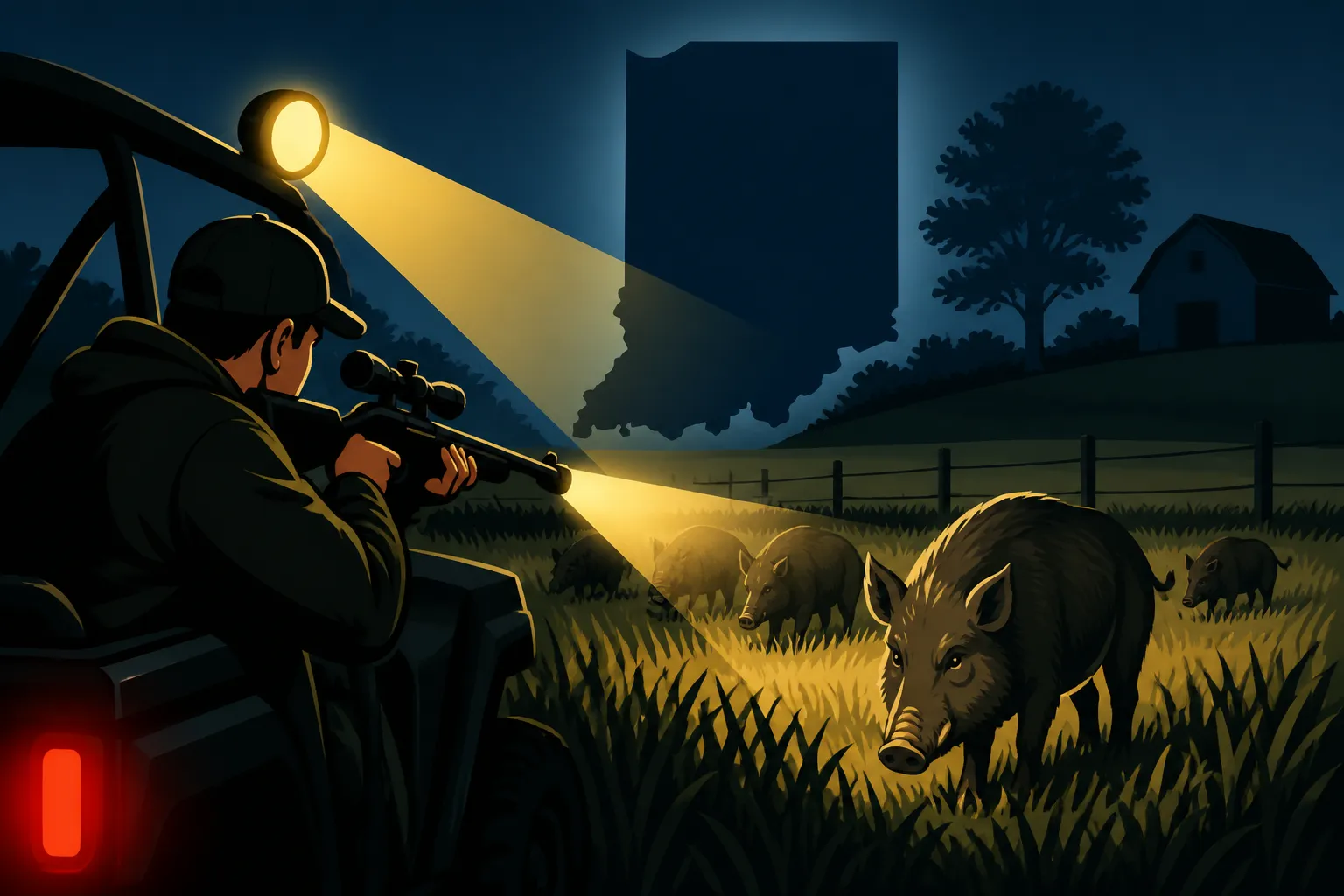
Feral hogs are a menace in Indiana, tearing up farmland, destroying natural habitats, and wreaking havoc on wildlife populations. Their destructive nature and rapid breeding make them a year-round challenge for landowners and wildlife managers alike. If you've got them on your private land, you know the frustration firsthand. This guide is all about how to effectively tackle these destructive invaders after the sun goes down, using lights to your advantage on private land, all within the bounds of Indiana law.
Understanding Indiana's Feral Hog Regulations for Night Hunting
Dealing with feral hogs isn't like hunting deer or turkey; the rules are completely different, and for good reason. These aren't native animals, and they cause immense damage, which is why the Indiana Department of Natural Resources (DNR) treats them as an unprotected nuisance species. This classification is key to understanding why night hunting with lights on private land is not just permitted, but often encouraged.
The Legal Framework for Hunting Hogs at Night
In Indiana, feral hogs are classified as an unprotected, exotic species. This means there are no closed seasons, no bag limits, and no time-of-day restrictions when you're on private land with permission. You can hunt them year-round, at any time of day or night. This is a crucial distinction that many hunters, used to strict sunrise-to-sunset rules for game animals, often overlook. The intent behind these liberal regulations is to provide landowners and hunters with every possible tool to control and, ideally, eradicate these destructive animals.
When it comes to using artificial lights for hunting, the rules are very specific and critical to follow. For feral hogs on private land, it is perfectly legal to use artificial lights to spot, target, and shoot animals. This contrasts sharply with most other game species in Indiana, where shining a light on wildlife with the intent to take them is usually prohibited. Always double-check the latest regulations on the Indiana DNR website or through resources like the Indiana Feral Hog Regulations page. It’s also important to remember that these rules only apply to true feral hogs; misidentifying a domestic pig or even a bear, which can occasionally wander into the state, could lead to serious legal trouble. The state's stance is clear: when it comes to hogs, they are a problem that needs solving, and you have flexibility in how you go about it, especially when you consider Indiana's Year-Round Hog Rule on Private Land.
Why Private Land is Key for Night Hunting with Lights
While the state is quite liberal with how you can pursue feral hogs, the specific allowance for night hunting with artificial lights is almost exclusively limited to private land. Public hunting lands, like Fish and Wildlife Areas or State Forests, generally have much stricter regulations, often prohibiting any hunting after dark or the use of artificial lights. This is due to safety concerns for other users, the presence of protected species, and the overall management goals of those specific properties.
Private land offers a controlled environment where you can minimize risks to others and focus solely on the task of hog eradication. It also allows you the flexibility to set up permanent blinds, feeders, or scouting cameras without fear of interference. Gaining explicit permission from a landowner is the first and most critical step. This isn't just a courtesy; it's a legal requirement that protects both you and the property owner. You'll want to make sure you have a clear understanding of the property boundaries, any specific areas to avoid, and the landowner's expectations regarding your activities. If you’re unsure how to approach this, our guide on Getting Private Land Permission in Indiana offers some great tips. This also means you can invest in more specialized gear, knowing your setups won't be disturbed, enhancing your chances of success.
Essential Gear for Night Hunting Feral Hogs
Night hunting brings a whole new set of challenges and demands specialized gear. You’re not just trying to see in the dark; you're trying to identify, track, and ethically harvest an animal that’s often highly nocturnal and incredibly wary. Having the right tools makes all the difference between a frustrating night and a successful one.
Lighting Systems and Optics
When hunting hogs at night, your primary goal is to illuminate the target without spooking it entirely. There are several types of lights, each with its own advantages and disadvantages. Red lights are often favored because many animals, including hogs, are believed to have difficulty seeing red light, making them less likely to be alarmed. This allows for closer observation and more precise shot placement. Green lights are another popular option, offering better illumination than red for human vision while still being less alarming to hogs than white light. They're particularly good for scanning wider areas. White lights, while providing the clearest vision for you, can often spook hogs instantly, sending them scattering before you even get a shot off. They are best used sparingly, perhaps for tracking after a shot or for confirming identification once a hog is already engaged.
Beyond the color, consider the mounting. Weapon-mounted lights attach directly to your rifle or shotgun, illuminating precisely where you’re aiming. Helmet-mounted lights, or headlamps with red/green filters, allow you to scan the environment independently of your weapon, which can be useful for initial spotting or navigating to your stand. Battery life is paramount; always carry spares, and consider durable, waterproof lights built for harsh conditions. If your budget allows, thermal imaging and night vision optics are game-changers. Thermal scopes or handheld units detect heat signatures, allowing you to spot hogs in complete darkness, thick cover, or at extreme distances where a traditional light would never reach. Night vision, on the other hand, amplifies ambient light (like moonlight or starlight), offering a greenish, real-time view of your surroundings. Both are incredibly effective but come with a higher price tag. Before investing, it's wise to review the specific Thermal and Night Vision Rules in Indiana to ensure you're compliant with any state regulations regarding their use.
Firearms and Ammunition Choices
Selecting the right firearm and ammunition is critical for humane and effective hog hunting, especially at night when shot placement can be more challenging. While hogs aren't bulletproof, they are tough, dense animals with a thick hide and a forward-set vitals area, protected by a "shield" of gristle and mud. This means you need a caliber with enough kinetic energy and a bullet designed for penetration and expansion. For rifles, popular choices include the .223/5.56 NATO (with heavier, bonded bullets), the versatile .308 Winchester, and the increasingly popular 6.5 Creedmoor. The recent changes in Indiana's rifle laws have really opened up options, allowing for a much wider array of effective calibers that were previously restricted. If you're looking to upgrade, our guide on Choosing a Rifle Now That Cartridge Limits Are Gone can help you navigate the new possibilities.
For ammunition, always choose high-quality hunting rounds. Expanding bullets like soft points or controlled-expansion hollow points are generally preferred as they create a larger wound channel and deliver more energy to the target. Avoid cheap, thin-jacketed varmint rounds, as they may not reliably penetrate a hog’s tough hide and vitals. If you're hunting in thick cover and shots will be close, a shotgun loaded with slugs or heavy buckshot (like 00 or 000) can also be highly effective. The key is to practice extensively with your chosen setup, both in daylight and under low-light conditions, so you're confident in your ability to make an ethical shot when the opportunity arises in the dark. Consider adding a suppressor to your rifle if legal and practical; it reduces muzzle flash, preserves your night vision, and protects your hearing, making for a much more pleasant experience, especially when hunting multiple hogs in a sounder.
Strategies and Tactics for Successful Night Hunts
Hunting hogs at night isn't just about showing up with a light and a rifle. It requires thoughtful planning, extensive scouting, and an understanding of hog behavior to maximize your chances of success. These animals are incredibly intelligent and adapt quickly to pressure, so a well-executed strategy is paramount.
Scouting and Patterning Hogs
Effective night hunting begins long before the sun sets. Pre-hunt scouting during the day is absolutely crucial. You need to identify areas of significant hog activity, which often includes freshly rooted-up ground where they've been digging for tubers and invertebrates, active wallows where they cool off and coat themselves in mud, and well-worn trails connecting these areas to bedding sites and water sources. Look for distinct tracks, droppings, and rubs on trees where they’ve scratched themselves. Pay close attention to food sources; during certain times of year, hogs will concentrate heavily on fields of standing corn, soybeans, or areas with abundant acorn crops.
Trail cameras are your best friend for patterning hog movement, especially when trying to understand their nocturnal habits. Opt for cameras with "no-glow" infrared emitters so the flash won't spook the hogs at night. Place cameras on trails, near feeders (if legal and you're using them), or in areas with fresh rooting. Pay close attention to the timestamps on photos to establish precise feeding and travel times. Hogs often move in "sounders," which are groups of sows and their offspring, or individual boars. Understanding the size and composition of these groups, as well as their preferred travel routes and predictable feeding times, will allow you to position yourself for the best ambush opportunity. For more general advice on finding and interpreting animal sign, much of the information in our Scouting Indiana Public Land Before Season guide can be adapted for private land hog hunting. Remember, hogs reproduce at an alarming rate, and understanding their numbers, as discussed in How Many Feral Hogs Indiana Has, will further emphasize the importance of your efforts.
Stand Placement and Setup
Once you've identified active areas and established hog patterns through scouting, the next critical step is intelligent stand placement. Your goal is to be in a position that offers a clear shot, good visibility with your chosen lighting system, and, most importantly, provides an advantage over the hog's keen senses. Elevated stands, such as traditional treestands or enclosed box blinds, offer several benefits. Being elevated significantly helps with scent control, as your scent cone will dissipate higher above the ground before reaching a hog's sensitive nose. It also provides a better vantage point for scanning with lights and offers a safer shooting angle, sending your bullet into the ground more quickly after exiting the target.
If elevated stands aren't practical, well-constructed ground blinds can also be effective. The key with a ground blind is maximum concealment and meticulous scent management. Brush it in thoroughly with natural vegetation, mimicking our advice in Brushing In a Blind on a Field Edge. Position your blind downwind of anticipated travel routes or feeding areas, always considering the prevailing wind direction. Hogs have an incredible sense of smell, far superior to their eyesight, so playing the wind correctly is non-negotiable. Think about your entry and exit routes to your stand, too. You want to be able to approach and leave quietly and without leaving a significant scent trail that could alert hogs before or during your hunt. The further you are from bedding areas, the less likely you are to spook them while moving into position.
Execution of the Night Hunt
With your scouting done and your stand set, the moment of truth arrives. Night hunting requires patience, stealth, and a precise execution plan. Every step, from your approach to the shot itself, needs to be considered in the context of darkness and the hogs' acute senses.
Approaching Your Stand and Managing Scent
The biggest challenge with night hunting often isn't the shot itself, but getting into position undetected. Hogs are creatures of habit but incredibly wary, and any unnatural noise or smell can send them packing before you even settle in. Plan your approach route carefully, ideally using natural features to muffle your sound and block your scent. Walk slowly, deliberately, and avoid breaking twigs or rustling leaves unnecessarily. If you're crossing an open field, try to do so under the cover of darkness or moonlight, long before you expect hogs to be active.
Scent control is paramount. Just as you would for deer, take a scent-eliminating shower, wear clean, scent-free clothing that has been stored properly, and use scent-eliminating sprays on your boots and outer layers. The slightest whiff of human odor can alert hogs from hundreds of yards away. Consider carrying your hunting clothes in a sealed bag until you reach your stand, putting them on just before you climb up. Throughout the process, minimize the use of any lights until absolutely necessary. Rely on your natural night vision as much as possible, or use the lowest possible red light setting on your headlamp for navigation. Your goal is to become an invisible, scentless part of the landscape.
Engaging Hogs with Lights
Once you're settled in your stand, the real work begins. Begin by scanning slowly and methodically with your chosen light system. If using a handheld or helmet-mounted light, sweep the area in front of you, looking for eyeshine or the subtle movements of hogs. If you're using a weapon-mounted light, keep it pointed downrange, only illuminating the specific area where you anticipate a shot. When you spot what you believe to be a hog, confirm its identity. It's easy to mistake other nocturnal animals like raccoons or even deer in the dark, so take your time.
Once you’ve identified a hog and it’s in a shootable position, slowly bring your weapon-mounted light or turn up your handheld light to fully illuminate the target. Observe the hog's reaction. Some may freeze, others may look towards the light, and some might spook and run. With practice, you'll learn to anticipate their reactions. Aim for a clean, ethical shot. The vitals are slightly lower and more forward than on a deer, generally behind the ear for a head shot (if comfortable with that small target) or directly behind the front leg for a heart/lung shot. After the shot, immediately reload and be ready for a follow-up, as hogs can be incredibly tough. Even with a good hit, they might run a short distance. Take note of the last place you saw the hog, the direction it ran, and any sounds you heard. Tracking in the dark can be extremely difficult, but vital blood trailing skills, much like those discussed in Tracking a Deer in Fresh Indiana Snow, are transferable, even without the snow. A good light source for tracking is crucial here, even a bright white light if necessary.
Post-Harvest Considerations for Feral Hogs
Harvesting a feral hog is only part of the job. What you do with the animal afterward is just as important, both for disease prevention and for maximizing the utility of your efforts. Unlike deer, there are some unique considerations when handling a hog carcass.
Carcass Handling and Meat Care
Feral hogs are often carriers of various diseases, some of which can be transmitted to humans. Brucellosis and leptospirosis are two of the more common concerns. Therefore, when field dressing, it’s critical to wear sturdy rubber or latex gloves. Avoid direct contact with blood and internal organs, and be careful not to cut yourself. If you notice any unusual lesions or abnormalities on the organs or meat, it’s best to err on the side of caution and dispose of the carcass properly. After field dressing, thoroughly wash your hands and tools with soap and water, and sanitize them with a bleach solution.
Just like with deer, rapid cooling of the carcass is essential for meat quality, especially during warmer months. If you’re hunting in the late summer or early fall, get the hog field dressed and on ice or into a cooler as quickly as possible. The meat from feral hogs can be excellent, though its flavor and tenderness can vary widely depending on the hog’s diet, age, and sex (boars, especially older ones, can have a strong "gamey" or "rank" flavor). Many hunters enjoy the meat, treating it like lean pork. For detailed guidance on processing, our guide on Butchering a Deer at Camp can provide many transferable techniques, though hog anatomy has its differences. Always cook feral hog meat thoroughly to an internal temperature of at least 160°F (71°C) to kill any potential parasites or bacteria.
Reporting and Disposal
While individual reporting of every feral hog harvested on private land isn't typically mandatory in Indiana, the DNR does encourage reporting sightings and removals. This data helps them monitor populations, track movement, and understand the effectiveness of control efforts. You can usually find information on how to report hog sightings or harvests on the Indiana DNR website. Your efforts directly contribute to the larger goal of managing these invasive species.
Proper carcass disposal is another critical step. Do not simply leave carcasses where they can attract other wildlife or spread disease. If you have multiple hogs, burying them deeply or taking them to an approved disposal site (like a landfill or rendering facility) are the best options. If burying on your property, ensure it's deep enough to prevent scavengers from digging them up. For landowners dealing with persistent hog issues, combining night hunting with other control methods, such as trapping, can be highly effective. If you're interested in a more comprehensive approach, our article on Trapping Indiana Feral Hogs provides additional strategies for managing these troublesome animals. The aim is not just to harvest, but to reduce their impact on Indiana's natural and agricultural landscapes.
| Light Color | Pros | Cons | Ideal Use Case |
|---|---|---|---|
| Red Light | Least alarming to hogs; preserves human night vision; good for subtle scanning. | Less overall illumination; can be harder to see fine details at longer ranges. | Initial spotting, close-range engagement, maintaining stealth. |
| Green Light | Better illumination than red; still less alarming than white; good for scanning larger areas. | Can still spook some wary hogs; slightly reduces human night vision compared to red. | General purpose, medium-range scanning and identification. |
| White Light | Brightest, clearest vision for the hunter; excellent for positive ID and tracking. | Most alarming to hogs, almost guaranteed to spook them if turned on suddenly. | Confirmation of identity (briefly), post-shot tracking, emergency navigation. |
| Thermal Imager | Detects heat signatures; excellent for spotting in any condition (darkness, fog, brush). | High cost; no positive ID without additional visible light; no depth perception. | Long-range spotting, identifying animals in thick cover, supplementing visible light. |
| Night Vision | Amplifies ambient light; provides a "real" view of the environment. | Can be affected by very low light or bright sources; typically lower resolution than daylight optics. | Navigation, general observation, can be used for targeting with IR illuminators. |
Disclaimer
Hunting is a challenging and rewarding activity that comes with inherent risks. Always prioritize safety for yourself and others. Familiarize yourself with and strictly adhere to all local, state, and federal hunting regulations. This guide provides general information and recommendations; it is not a substitute for official legal advice or comprehensive hunter education. The information on laws and regulations can change, so it is your responsibility to verify all current rules with the Indiana Department of Natural Resources (DNR) before engaging in any hunting activities.