Rabbit Hunting Thick Indiana Brush
There's nothing quite like the thrill of chasing cottontail rabbits through the thick, tangled brush of an Indiana winter, but let's be honest, it can also be a brutal, frustrating endeavor if you're not prepared. The dense briars and unforgiving undergrowth that offer rabbits their sanctuary often seem custom-built to snag your clothes, scratch your skin, and hide those speedy little targets right when you think you've got them. This guide is all about equipping you with the knowledge and tactics to not just survive, but truly thrive, when you venture into Indiana's toughest rabbit cover.
Understanding Indiana's Cottontail Country
Rabbit hunting in Indiana, especially when you're targeting those prime thickets, is a whole different ballgame than walking open fields. To consistently find and flush cottontails, you first need to understand why they choose these gnarly places and what those places look like across our Hoosier landscape.
Why Thick Brush is a Rabbit Haven
Imagine you're a cottontail rabbit. You're small, you're relatively slow, and just about everything in the woods wants to eat you – coyotes, foxes, hawks, owls, even the occasional housecat if you're too close to town. So, what's your best defense? Impenetrable cover. Thick brush provides an unparalleled combination of safety, sustenance, and shelter from the elements.
These dense patches, whether they're briar thickets, multiflora rose, or tangled honeysuckle, offer a physical barrier that most predators simply can't navigate with the same agility as a rabbit. It's their fortress, a place where they can dive in and disappear, often just feet from a pursuing predator. Beyond safety, these areas are often abundant with young, tender shoots, fallen seeds, and bark – all crucial food sources, especially when snow blankets the ground. And let's not forget the protection from harsh weather; a dense briar patch acts like a natural windbreak and insulation, keeping rabbits warmer in freezing temperatures and cooler on hot days. When you understand these reasons, you start to see these seemingly impenetrable tangles not as obstacles, but as the most promising locations to find game.
Prime Brush Types in Indiana
Indiana is blessed with a diverse landscape, which means rabbit-holding cover can vary widely from region to region. However, a few types of thick brush are consistent cottontail magnets you should always be on the lookout for. Briar patches, particularly those nasty greenbrier and blackberry brambles, are probably the first thing that comes to mind. These patches, often found along old field edges, logging roads, or in clear-cuts, are virtually impenetrable to anything but a rabbit or a well-equipped hunter.
Multiflora rose, an invasive but undeniably effective cover plant, forms dense, thorny thickets that rabbits absolutely adore. You'll find it creeping into old pastures, abandoned homesteads, and forest edges. Honeysuckle, another invasive species, also provides incredible cover, especially the Japanese variety that forms dense mats close to the ground. Then there are the classic Indiana fencerows – often overgrown with a mix of small trees, vines, and brush, creating linear strips of ideal rabbit habitat. Finally, don't overlook young timber clear-cuts or areas where timber has been thinned. The resulting regrowth of saplings, briars, and weeds quickly becomes prime rabbit country, offering both food and escape routes. Learning to identify these specific cover types is a huge step in knowing Where to Hang a Camera on a Logging Road to scout for rabbits or where to start your hunt.
Seasonal Considerations for Brush Hunting
Rabbit behavior and the nature of their brushy homes change dramatically with the seasons, impacting your hunting strategy. Early in the fall, when Indiana's Indiana Rabbit Season Dates often open, rabbits are still scattered. The leafy green cover is abundant, meaning they might be found in lighter brush or even taller grass. The challenge then is locating them in what seems like endless cover. This is when dogs truly shine, as they can scent out rabbits where you might never see them.
As winter deepens and the leaves fall, the dynamics shift significantly. The thinner cover in open areas becomes less appealing to rabbits, forcing them into the thickest, densest patches available – precisely the kind of brush we're talking about. This concentration makes them easier to locate, but harder to dislodge. Snow cover can be a double-edged sword: it helps you spot tracks, but also pushes rabbits even deeper into their fortified hideouts. The late season, particularly in January, can be incredibly productive, as rabbits are primarily focused on those dense areas for warmth and security. Understanding these seasonal nuances is key to planning your hunts, from the earliest mild days to the coldest, snowiest stretches of winter.
Essential Gear for Navigating and Hunting Brush
Venturing into thick Indiana brush without the right gear is a recipe for a miserable, torn-up day. This isn't a walk in the park; it's a battle against thorns, snags, and concealment. Being properly outfitted not only makes the hunt more comfortable but also significantly increases your chances of success and, more importantly, keeps you safe.
Protective Clothing is Non-Negotiable
Seriously, if you take one piece of advice from this entire guide, let it be this: invest in quality protective clothing. Trying to push through briars and thickets in regular hunting clothes is like walking barefoot on Legos – painful, frustrating, and ultimately counterproductive. The absolute must-have is a good pair of briar-proof pants or chaps. Look for materials like heavy-duty canvas, Cordura, or reinforced nylon that can stand up to repeated assaults from thorns and sharp branches. These will prevent countless scratches, tears, and painful punctures. You can read more about Brush Pants for Indiana Fencerows for specific recommendations.
Equally important is a durable, thorn-resistant jacket or vest. While you might not need full briar-proof protection on your upper body, something sturdy enough to resist snags and light punctures is crucial. Don't forget a good pair of leather or heavy-duty gloves to protect your hands when pushing through tangles or handling thorny game. Lastly, eye protection is paramount. Branches constantly spring back, and a simple pair of shooting glasses can save you from a serious eye injury. Think about blaze orange, too, especially if you're hunting with a group or dogs. Safety first, always.
Shotguns and Ammunition for Close Quarters
When you're busting thick brush for rabbits, long-range precision isn't your primary concern. Instead, you need a firearm that can put a dense pattern of shot on a fast-moving target at extremely close range. This is where the trusty shotgun shines. A 20-gauge or 12-gauge shotgun is ideal, offering a good balance of power and shot volume. Don't go lighter than a 20-gauge if you can help it; you want enough pellets to ensure a clean kill.
Choke selection is critical for rabbit hunting in dense cover. Forget your full or modified chokes; you want something much more open to spread your pattern quickly. Improved Cylinder or even Skeet chokes are often preferred. A wide pattern gives you a larger margin for error on those split-second shots as a rabbit bursts from cover and zips through a small window in the brush. For ammunition, consider high-brass loads with shot sizes between 6 and 7.5. These sizes offer a good balance of pellet count and individual pellet energy to cleanly dispatch a rabbit. You can dive deeper into Shot Size for Pheasant and Rabbit and Choke Choice for Fast Flushes for more detailed insights specific to Indiana small game. Remember, rapid follow-up shots are common, so choose a shotgun you can swing and shoulder quickly.
Tools for Navigation and Rabbit Retrieval
Beyond your firearm and protective clothing, a few other tools can make your brush-busting adventure much more productive and enjoyable. First off, navigation. Even if you think you know an area like the back of your hand, getting disoriented in thick brush is incredibly easy. A reliable GPS unit or a mapping app on your smartphone, like GoHunt, is invaluable. Mark your starting point, track your path, and use it to find your way back out or to locate specific features you noticed during scouting. GoHunt can be especially useful for layering property boundaries over aerial imagery, helping you stay on public land or within permissioned private tracts.
A game vest with a large, accessible pouch is another essential. You'll want to quickly stow your rabbits after the shot, keeping them clean and out of the way as you continue to hunt. Many vests also have pockets for extra shells, water, and snacks. If you're hunting with dogs, dog bells are a must. They allow you to keep track of your canine companions even when they're out of sight in the dense cover, preventing them from getting too far ahead or lost. Lastly, consider a sturdy walking stick or a small, collapsible game carrier. After a successful hunt in heavy cover, dragging multiple rabbits can be tiring, and these tools can make the trek back to the truck much easier. Don't forget a small first-aid kit for those inevitable briar scratches!
Tactics for Flushing and Bagging Rabbits
Once you've got the right gear, it's time to talk strategy. Rabbit hunting in thick brush requires a proactive approach. Rabbits aren't going to politely walk out into the open for you; you have to go in after them, or at least convince them to come out.
Solo Hunter Strategies for Thick Cover
Hunting rabbits solo in thick cover is a rewarding challenge, demanding patience, keen observation, and a methodical approach. The key is to be slow and deliberate, working the cover systematically rather than just crashing through it. Start by identifying the densest parts of the brush – these are often the rabbit strongholds. Begin on the edges, working your way in with a zigzag pattern. Don't just walk; stop frequently, sometimes for several minutes, and listen. Rabbits often hold tight, relying on their camouflage, but will eventually bolt if they feel the pressure is too close or if they think you've passed. These pauses are often when rabbits decide to make their break.
When you're moving, kick at brush piles, fallen logs, and low-hanging branches. Use your walking stick to poke into tight spots. Rabbits will often use small burrows, hollows under roots, or tight nests within the brush. Be prepared for a lightning-fast flush at any moment. Your shotgun should be ready, with the safety off, especially when you're in prime looking areas. Focus on small openings, knowing that a flushed rabbit will often take the path of least resistance. Learning to anticipate these escape routes is a huge advantage. Remember, in heavy cover, your shots will be quick and often at very close range. Sometimes, the only shot you get is a fleeting glimpse.
Hunting with Dogs: The Ultimate Brush Buster
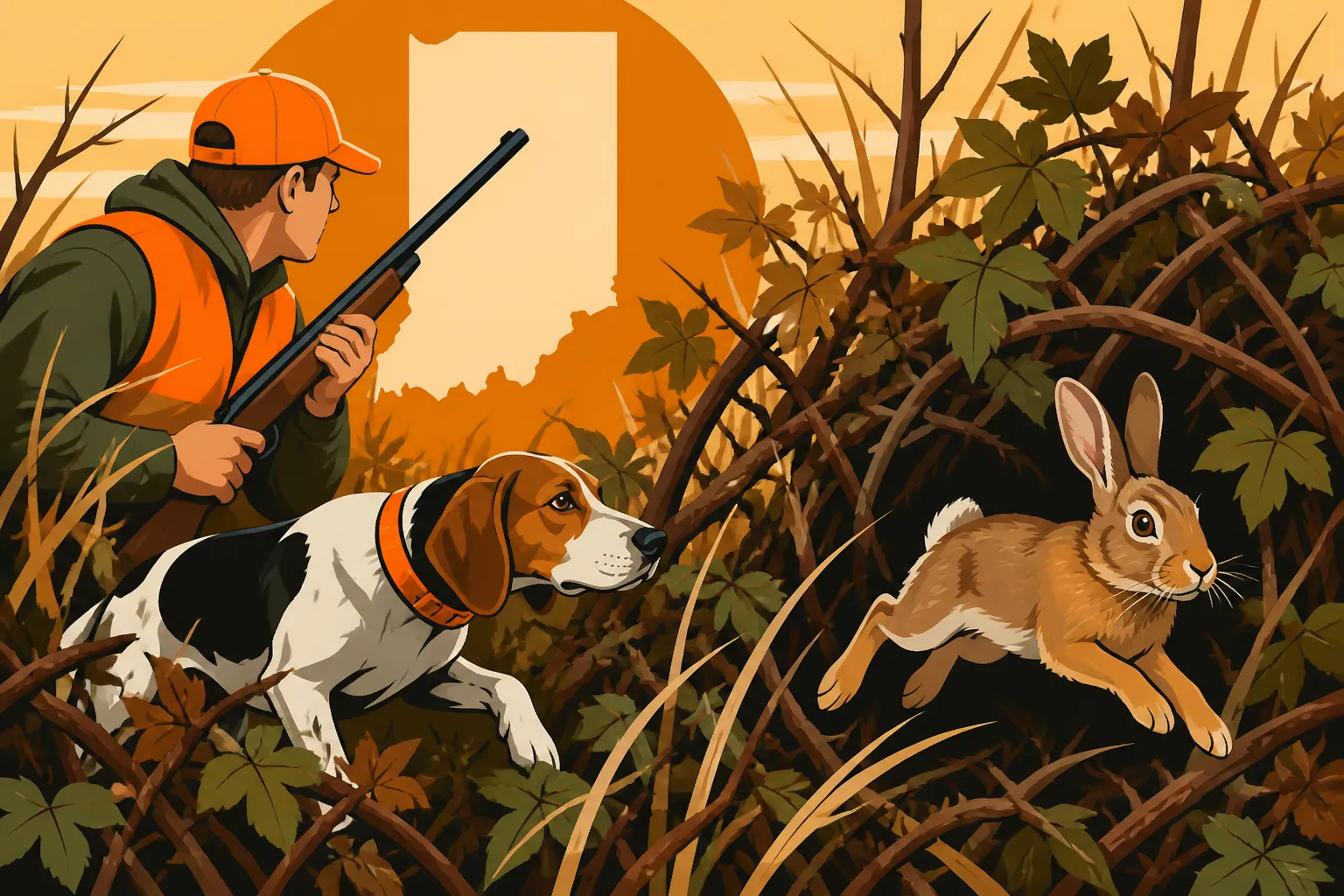
If you want to experience rabbit hunting at its finest, especially in thick Indiana brush, bringing along a good rabbit dog, particularly beagles, is a game-changer. Dogs, with their superior sense of smell and boundless energy, can penetrate cover that's nearly impossible for a human, effectively scenting and pushing out rabbits you'd otherwise walk right past. When Running Beagles on Indiana Cottontails, the music of the chase is half the fun.
The strategy with dogs is different. Instead of you pushing the cover, you become the listener and the shooter. Turn your dogs loose near a promising briar patch. They'll dive in, noses to the ground, working the scent. When they jump a rabbit, the barking will intensify into a "chop" or "bawl" as they follow the trail. This is your cue to position yourself. Rabbits, when chased, often run in a circle, returning close to where they were flushed. Find an opening on the downwind side of the thicket, or an escape route you've identified, and wait. The dogs will push the rabbit towards you. It requires patience and a good ear, but when a rabbit bursts out of the brush with the dogs hot on its trail, it's an exhilarating moment. Make sure your dogs are equipped with bells or a GPS collar (like those compatible with GoHunt) so you can keep track of them in the densest cover, especially if you're using E-Collar Use on Public Ground.
Group Hunting Tactics for Pushing Brush
Hunting rabbits in thick brush with a group can be incredibly effective, allowing you to cover more ground and increase the chances of flushing game. The key to successful group hunting is coordination and clear communication, especially concerning safety. Before you start, assign roles: "drivers" and "blockers" (or "posters").
Drivers are the ones who walk through the thickest cover, making noise, kicking brush, and actively trying to flush rabbits. Blockers position themselves strategically around the edges of the cover, or at anticipated escape routes like fencerows, small clearings, or along field edges. Their job is to intercept rabbits that are pushed out by the drivers. It's crucial for everyone to know where everyone else is at all times. Use hand signals or pre-arranged calls if voice communication is difficult due to thick brush or distance. Always maintain safe shooting lanes, never shooting towards another hunter. The line of drivers should move at a steady, even pace, ensuring they sweep the entire patch. If dogs are part of the group hunt, they typically work ahead of the drivers, keeping the rabbits moving and making it easier for the drivers to push them towards the blockers. This cooperative effort makes tackling large, intimidating brush patches far more efficient and productive, helping everyone fill their bag limits under Indiana's Indiana Small Game Season Rules.
Post-Hunt Care and Safety in the Field
The hunt doesn't end when the rabbit drops. Proper care of your harvest and remaining vigilant about safety are critical for a successful and enjoyable experience.
Field Dressing and Meat Care in Warm vs. Cold Weather
Caring for your rabbit immediately after the shot is essential for preserving the meat quality. Field dressing a rabbit is straightforward: simply make a small incision in the abdomen, pull out the entrails, and clean the cavity. You can learn this technique quickly, and it's best to do it as soon as possible after the kill.
The primary concern is cooling the meat, and this varies significantly with the ambient temperature. In warmer early-season conditions, or on unseasonably warm winter days, quick cooling is paramount to prevent spoilage. After field dressing, you can place the rabbit in a game bag (like those from reputable brands such as Allen Company or Wild Game Innovations) to allow air circulation, then get it into a cooler with ice as soon as possible. Some hunters even carry a small, soft-sided cooler into the field for this purpose. In contrast, during colder late-season hunts, especially when temperatures are well below freezing, natural air circulation is often sufficient. The cold air will quickly chill the carcass, slowing bacterial growth. Hang rabbits by their hind legs if you have a place to do so, or simply place them in your game vest, ensuring they're not piled up, which can trap heat. Always be mindful of preventing dirt or debris from contaminating the meat, especially when working in thick, messy cover.
Staying Safe in Dense Habitat
Hunting in thick brush presents unique safety challenges that demand constant attention. The number one rule is always, always be aware of your muzzle direction. When pushing through dense cover, it's easy for your gun barrel to get snagged or pointed in an unsafe direction. Keep your safety on until you're ready to shoot, and only disengage it when you identify your target and have a clear shot.
Communication is vital, especially when hunting with others. As mentioned earlier, establishing clear roles and maintaining communication, whether through voice, calls, or a radio system, ensures everyone knows where fellow hunters and dogs are at all times. When a rabbit flushes, it's instinctive to swing your gun, but take that split second to confirm what's beyond your target. Never shoot into thick cover without absolute certainty of your target and what's behind it. Hydration is often overlooked in cold weather, but pushing through heavy brush is physically demanding. Carry water and take regular breaks. Lastly, be vigilant about ticks, even in colder months, and other insects like chiggers, especially in early fall. Always do a thorough tick check after your hunt, and consider using insect repellent containing permethrin on your clothing before heading out. Safety in the brush isn't just about gun handling; it's about being prepared for the environment itself, ensuring that your hunting experience is not only successful but also safe for everyone involved. For general advice on Squirrel and Small Game Hunting in Indiana, these safety principles remain paramount.
| Season | Rabbit Behavior | Cover Density | Recommended Tactics | Key Gear Considerations |
|---|---|---|---|---|
| Early Fall | More scattered, less pressured, abundant food. | Very high, leafy | Solo zigzagging, dog work for scenting, working edges | Briar pants, light jacket, open choke, insect repellent |
| Late Fall | Starting to concentrate, seeking thicker cover. | Medium-high, leaves dropping | Slower pushes, more deliberate dog work, pause-and-go | Briar pants, medium layers, 6-7.5 shot, GPS/App |
| Early Winter | Concentrated in densest brush for warmth/safety. | Medium-low, bare branches | Group drives, strategic blockers, active dog work | Heavy briar gear, warm layers, 6 shot, dog bells/GPS |
| Late Winter | Highly concentrated, relying on deep cover. | Low, bare | Targeted pushes into known rabbit havens, patience | Warmest briar gear, insulated boots, game carrier |
Disclaimer
Hunting is an inherently dangerous activity. Always prioritize safety, adhere to all local, state, and federal hunting regulations, and ensure you have proper training and licensing. The information provided in this guide is for informational purposes only and should not replace professional guidance or personal judgment.