Reading a Slough for Deer Movement After Rain
Hunting deer after a heavy rain in Indiana can feel like starting from scratch. The woods often go quiet, old scent is washed away, and what once looked like a clear travel corridor might now be a muddy bog. It’s a frustrating scenario for any hunter, leaving you wondering where the deer have gone and how to pick up their new movements. This guide is designed to help you decode deer behavior around sloughs after a rainfall, giving you the insights needed to locate and pattern whitetails when the landscape has changed.
Understanding Slough Dynamics and Deer Behavior Post-Rain
Sloughs are often overlooked by hunters, but they can be absolute hotspots, especially after a good rain. These low-lying, often wet areas change dramatically with precipitation, and understanding these shifts is key to successful hunting.
What is a Slough in Indiana?
In the context of Indiana hunting, a "slough" generally refers to a low-lying, often marshy or boggy depression, typically found in floodplains, river bottoms, or even natural depressions in timbered areas. These are often old oxbows or channels left behind by rivers like the Wabash, Kankakee, or White River, or just areas with poor drainage that collect water. After heavy rainfall, these areas can fill up, creating temporary ponds or extended wet zones that fundamentally alter the landscape. They might feature standing water, thick cattails, brushy edges, and sometimes even remnants of timber that can tolerate wet feet.
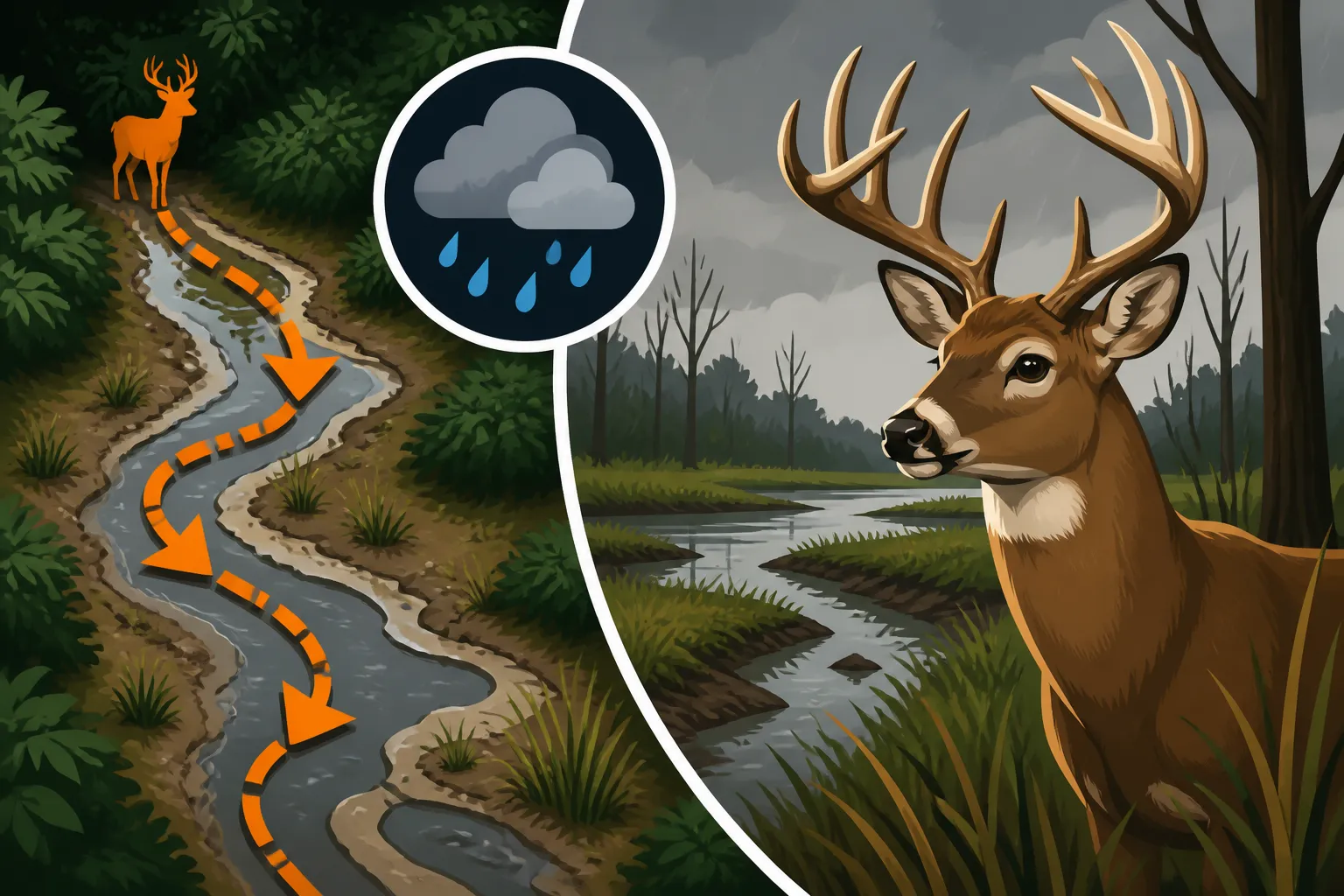
Deer are drawn to sloughs for a number of reasons. They offer dense cover, particularly the thicker vegetation along their edges, providing excellent bedding areas. These wet zones also serve as vital water sources, and the transition areas between wet and dry ground can act as natural funnels for deer movement. When rain hits, the dynamics of these sloughs shift dramatically. Water levels rise, expanding the wet footprint, potentially submerging existing trails, but also opening up new ones along higher, drier edges. This inundation can either push deer out to higher ground or concentrate them in the remaining dry pockets, creating a puzzle for hunters to solve.
Immediate Deer Response to Rainfall
During a heavy rain, deer, like most wildlife, tend to hunker down. They'll seek the thickest cover available, often bedding down in dense brush, cedars, or deep timber pockets where they are somewhat sheltered from the deluge. Movement during the actual rainfall is minimal, mostly just shifting to find more comfortable bedding or to avoid rising water.
However, the period immediately after a rain is often characterized by increased deer activity. Think about it: they've been cooped up, likely a bit restless, and when the skies clear, they're ready to move. This burst of activity is driven by several factors. First, they need to resume feeding, especially if the rain was prolonged. Second, some traditional bedding or travel routes might now be impassable or uncomfortable due to standing water, forcing them to find new paths. This can lead to deer exploring new areas or concentrating their travel along established high-ground routes that become even more defined. The woods also become incredibly quiet and scent-rich after a rain. Old, stale odors are washed away, making fresh tracks and deer scent much more potent. The moist ground also muffles sound, allowing deer (and careful hunters) to move more silently. This is a prime window for encountering deer on the move.
How Rain Affects Food and Cover in Sloughs
Rainfall can significantly alter the availability and appeal of food and cover around sloughs. For food sources, a good rain can be a mixed bag. On one hand, newly exposed ground, especially along the edges of a receding water line, might reveal fresh, tender browse or small plants that deer find palatable. On the other hand, heavy rains can wash away mast crops like acorns from higher ground into the slough, or simply cover them with water, making them inaccessible. The moisture itself can make existing browse more succulent and appealing to deer.
When it comes to cover, sloughs inherently offer superb protection. The thick brush, tall grasses, and often dense tree growth around these wet areas provide excellent concealment from both predators and the elements. After a rain, this cover becomes even more critical. If the slough fills up substantially, deer might be pushed to the slightly higher ground that borders the wettest parts. These elevated edges, often lined with dense timber or brush, become prime bedding locations. They offer a vantage point over the slough while still providing thick concealment. It’s like a natural fortress. Understanding these shifts in preferred bedding and feeding areas is paramount. By looking at aerial maps, you can often identify these subtle elevation changes that become deer magnets post-rain.
Reading the Sign: Fresh Tracks, Trails, and Rubs
After a rain, the woods offer a fresh canvas for deer sign. Knowing what to look for, and how to interpret it, is the difference between blindly wandering and targeting high-probability areas.
Interpreting Fresh Tracks in Mud
Mud is a hunter's best friend after a rain. It records every step, telling a clear story if you know how to read it. When you're near a slough, the soft, damp earth along its edges, particularly where deer might be crossing or entering/exiting thick cover, becomes a natural register of recent activity. Look for tracks with sharp, well-defined edges. If there’s no water pooled in the bottom of the track, or if the edges haven’t started to crumble or weather, you're likely looking at sign from the last few hours. You might even see a bit of mud splatter around the track, indicating very recent movement.
Compare these fresh tracks to older ones. Older tracks will appear rounded, perhaps filled with a little water, or the mud around them will be dry and crusty. The clarity of the hoof print – showing dew claws, for example – also helps indicate freshness. Pay close attention to the direction of travel. Are deer moving from bedding cover towards a known food source? Are they crossing the slough at a particular pinch point? The size and shape of the track can also give you clues about the deer. Larger, blunter tracks might indicate a buck, while smaller, daintier ones are likely does or fawns. Tools like the GoHunt app can be incredibly useful here, allowing you to mark every fresh track you find, building a real-time picture of deer movement patterns. This information helps you build a detailed picture of deer activity, much like Reading a Ridge for Hoosier Forest Deer helps you understand terrain.
Identifying Active Travel Corridors
After a rain, deer are often forced to adjust their travel routes, making some corridors more active than others. Sloughs inherently create natural funnels. Any high ground that juts into or runs alongside a slough creates a pinch point where deer are naturally channeled. Look for narrow strips of timber or brush between the wettest parts of the slough and a higher, drier area. These become superhighways for deer moving through the landscape.
Water crossings are another critical area. Deer, while generally adept at navigating wet terrain, will often seek the path of least resistance across a slough. This might be a shallower section, a log spanning a narrow part, or a subtle rise in the slough bottom. After a rain, these crossing points will show concentrated tracks, indicating consistent use. Sometimes, heavy rain can even wash away enough debris to expose new, temporary travel routes that weren’t obvious before. Keep an eye out for these fresh disruptions. These concentrated travel routes are very similar to Hunting Indiana River Bottom Funnels, and apply the same principles. If the slough is adjacent to agricultural fields, you might even see deer using the edges where the standing water meets a Standing Soybean Field or Entry Routes Through Standing Corn.
Here’s a quick comparison of fresh versus old deer sign after rain:
| Sign Type | Fresh Sign (Post-Rain) | Older Sign (Pre-Rain) |
|---|---|---|
| Tracks | Sharp, crisp edges; mud often still moist/dark; possibly mud splatter; no water pooling inside. | Rounded, eroded edges; mud dry/crusty; water may be pooled inside; less defined. |
| Rubs | Bark visibly scraped and moist; wood underneath bright; fresh sap evident; often on small, supple saplings. | Bark dry, discolored; wood dull; sap dried; edges weathered. |
| Scrapes | Ground freshly pawed, moist earth exposed; strong urine/musk odor; fresh droppings nearby; overhanging branch often recently broken or licked. | Ground dry, crusted over; odor faded; leaves or debris may have fallen back into scrape; branch withered. |
| Droppings | Soft, shiny, dark; often in clusters; strong odor. | Dry, dull, faded; scattered; little to no odor. |
Rubs and Scrapes Along Slough Edges
Buck activity around sloughs, especially after a good rain, can be quite telling. Bucks, particularly during the rut or pre-rut, are constantly communicating their presence through rubs and scrapes. Rain washes away old scent, essentially clearing the slate, which often prompts bucks to re-establish their territory and dominance displays. This means you might find very fresh rubs on trees along the slough edges. Look for smaller, supple saplings that have had their bark recently scraped away, revealing bright, moist wood underneath. These rubs often appear on trees bordering the transition from the slough's thick cover to more open feeding areas, acting as signposts for other deer.
Similarly, scrapes can be particularly active post-rain. A fresh scrape, where a buck has pawed away leaves and debris to expose the bare earth, will often have a strong musky odor from urine and glandular secretions. The overhanging branch (the "licking branch") might also show signs of recent fraying or chewing. Since the rain would have washed away older scent, a fresh scrape indicates that a buck was actively working that area very recently. These signs are often concentrated where deer funnel, such as where the slough transitions into a logging road or a powerline cut. Observing these fresh rubs and scrapes is a direct window into current buck movement and presence.
Strategic Scouting and Hunting Sloughs After Rain
Successfully hunting sloughs after a rain isn't just about reading sign; it's about smart planning and execution.
Utilizing Topographical Maps and Satellite Imagery
The real work starts long before you ever step foot in the woods. Before the rain even hits, or certainly before you head out after it, spend time with topographical maps and satellite imagery. Tools like GoHunt or the Indiana DNR app are invaluable for this. Your goal is to identify the sloughs, but more importantly, to understand the surrounding terrain. Look for areas of higher ground within or immediately adjacent to the slough. These subtle elevation changes become critical islands or travel routes when the lower areas are flooded. Identify natural pinch points, funnels, and potential water crossings that deer would instinctively use. These might be narrow strips of timber, saddles between small ridges, or areas where the slough narrows significantly.
Pay attention to how water might flow through the area. Where would heavy rain likely channel? Understanding this can help predict where deer will be pushed to dryer ground. Mark these potential hotspots on your map. This pre-scouting, even if it's just digital, helps you build a mental picture of the landscape, allowing you to approach the area with a plan rather than just reacting to what you find on the ground. Think of it as a crucial step in Scouting Indiana Public Land Before Season.
On-the-Ground Reconnaissance and Scent Control
Once you're in the field, your approach to a slough after rain needs to be methodical. Resist the urge to plunge straight into the thickest cover. Instead, circle around the slough, staying upwind and on higher ground if possible. This allows you to observe entry and exit points, spot fresh tracks, and listen for movement without immediately contaminating the core area with your scent.
Scent control is absolutely paramount, especially in moist, post-rain conditions where odors hang heavy. Wear clean clothes, use scent-eliminating sprays, and play the wind religiously. Around low-lying, wet areas, wind and thermals can be tricky. Warm, moist air might rise, carrying your scent upward, but cool air settling into the depression can create unpredictable currents, much like Wind and Thermals on a Southern Indiana Ridge. Always assume your scent is traveling further and in more directions than you think. Move slowly and quietly. The wet ground might muffle your footsteps, but splashing through puddles or crunching through damp leaves can still alert deer. Take your time, stop often, and scan your surroundings. Listen for subtle sounds – a deer splashing through a shallow section, the rustle of leaves as it beds down, or even the distant sound of a gobbler getting off the roost if you're out during fall turkey season.
Stand Placement and Hunting Tactics
Your stand placement, whether a treestand or ground blind, is critical around a post-rain slough. With deer likely to be concentrated or funneled, you want to be positioned to intercept them. Look for locations on higher ground that overlook key crossing points, natural funnels created by the slough, or areas where you’ve identified fresh sign. Consider placing your stand along the edge of thick bedding cover within the slough, or where a well-used trail exits the slough towards a feeding area. Your entry and exit routes to and from your stand must be silent and minimize disturbance, ideally approaching with the wind in your face and away from known deer travel patterns. For those Using a Ground Blind on Indiana Public Land, make sure it's well-brushed in and allows for silent drawing of a bow or shouldering of a rifle.
Hunting tactics might vary based on how active the deer are. If you've observed significant fresh movement, a well-placed stand for a morning or evening sit is often the most effective. Deer are often most active in the early morning or late evening after a rain has passed, making these prime hunting windows. For those who prefer to be on the move, still-hunting the edges of a slough can be incredibly productive. The quiet, moist woods allow for silent movement, letting you creep along, stopping frequently to glass and listen. Focus on the transition zones between the slough and dryer ground, paying extra attention to areas where a Hunting a Funnel Between Two Woodlots might occur, or where the slough opens into a hard-wood ridge. Whether you're hunting during How Indiana's Archery Season Runs Into January or simply looking for late-season movement near Late-Season Food Sources for Indiana Whitetails, reading the slough after a rain provides crucial clues to success. The deer are there; it's up to you to understand their watery world.
Disclaimer
Hunting is an activity with inherent risks. Always prioritize safety, understand and follow all Indiana hunting regulations, and obtain appropriate licenses and permits before heading afield. This guide provides general information and recommendations, and individual results may vary. Conditions in the field can change rapidly, and responsible hunting requires continuous awareness and adaptation.